Apple Pollination Chart
Compatibility depends on four things: overlapping bloom windows, viable pollen, S-allele and pedigree compatibility, and enough insect activity to move the pollen. A triploid can receive compatible pollen and set fruit, but it should not be relied upon as a pollen source and needs two compatible diploid partners nearby.
Use the chart below directionally: choose the apple you want to pollinate on the left, then read across to a pollen source at the top. Dark green is the strongest choice, light green is a partial match, and an off-white or hatched cell should not be relied upon.
Choose the layout that is easiest for you to reference. The A-Z chart makes a variety quick to find, while the bloom-window chart keeps apples with similar flowering times together. Click either image or its link to open the full-resolution version. On a phone, tap either chart to open the full-size image, then pinch to zoom and drag around it. Use the A-Z chart to find a variety quickly, or the bloom-window chart to compare apples that flower at similar times.Pollen Source VE E M L VL Selected Variety VE Anna Dorsett Golden Ein-Shemer Zestar! E Cortland Dolgo Empire Golden Russet Hidden Rose Liberty McIntosh Williams Pride Yellow Transparent M Ambrosia Antonovka Arkansas Black Blue Pearmain Chehalis Chenango Strawberry Cinnamon Spice Crimson Crisp Fireside Freedom Frostbite Fuji Gala Golden Delicious Granny Smith Grimes Golden Haralson Honeygold Jonaprince Jonathan Mutsu Newtown Pippin Opal Pink Lady Redfree Shizuka Smokehouse SnowSweet Sweet Sixteen Wolf River L Ashmead's Kernel Cosmic Crisp Enterprise GoldRush Haralred Honeycrisp Mollies Delicious Pixie Crunch Pristine Red Delicious Red June Sundance SweeTango Winesap VL Braeburn Northern Spy Red Rome Printable apple pollination charts
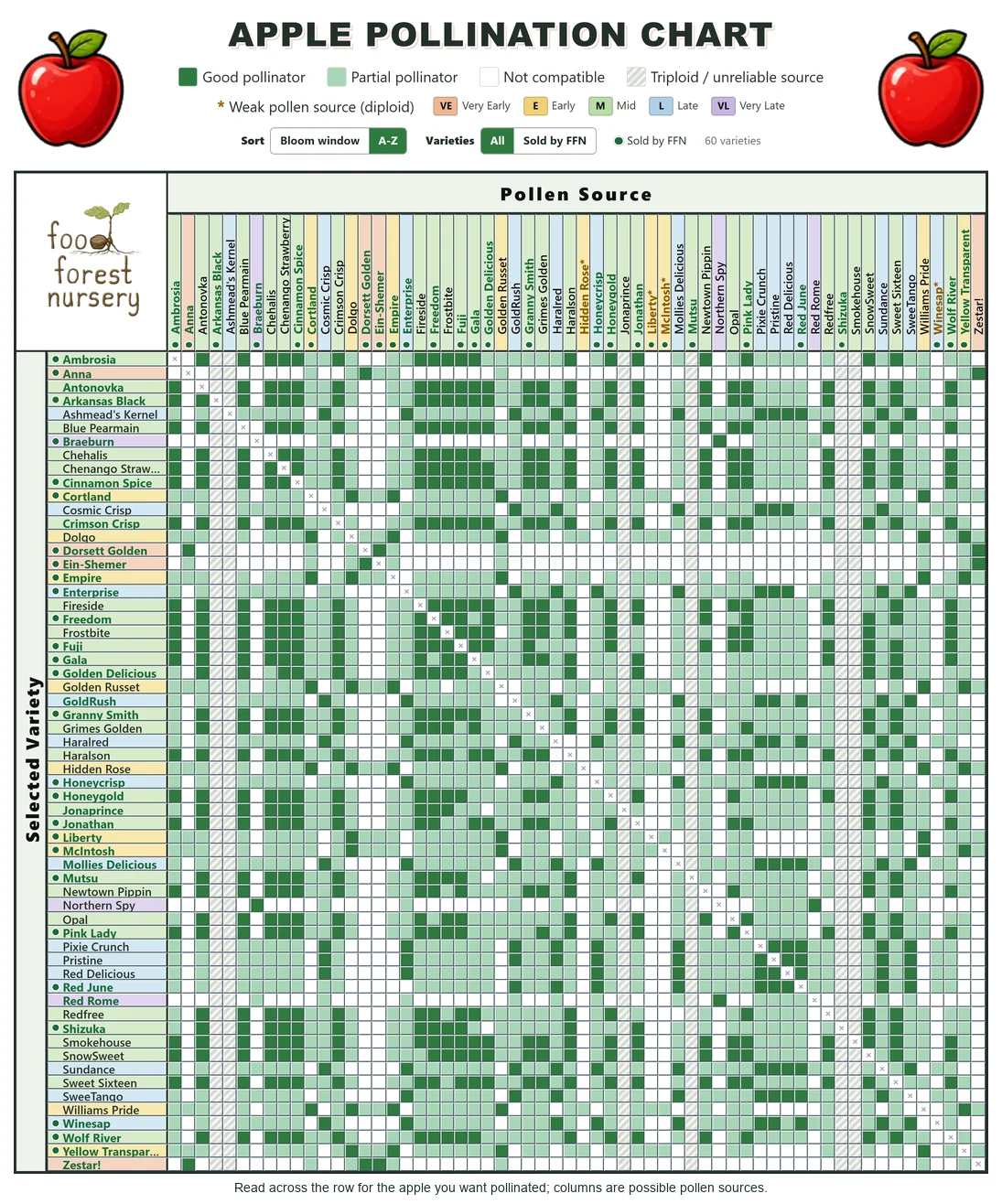
Open full-size A-Z chart
Open full-size bloom-window chart
The short answer: Most apple trees need pollen from a different compatible apple or flowering crabapple that blooms at the same time. Keep the trees within about 50 feet, start with the dark-green matches in the interactive chart, and give every hatched triploid or unreliable pollen source two dependable diploid partners nearby.
Introduction
Use the interactive apple pollination chart above to compare apple varieties. It opens in A-Z order, can be regrouped by bloom window, and can show either all 60 varieties or only those sold by Food Forest Nursery. The ratings combine bloom overlap with pollen fertility and documented genetic compatibility, so they are more specific than flowering time alone. The sections below explain how to choose a partner, plan tree spacing, and support the pollinators that move pollen between trees.
Table of Contents
Factors Affecting Pollination Compatibility
- Bloom Overlap: This is crucial. Apple varieties are often categorized into flowering groups based on their bloom times. For effective pollination, the bloom times of the different varieties should overlap. Varieties in the same flowering group will have a full overlap, while those in adjacent groups may only partially overlap. This timing ensures that pollen is available when the flowers are receptive.
- Pollen Viability: Triploid apples can receive compatible pollen and produce fruit, but their own pollen is generally sparse or unreliable. Plant two compatible diploid varieties nearby so those two trees pollinate each other as well as the triploid.
- Genetic Compatibility: Apple flowers use S-alleles to reject genetically matching pollen. Sharing both documented alleles can block a pollen source, while sharing one allele can reduce it to a partial match. Parent-offspring relationships deserve review, but pedigree alone does not make every related pair incompatible.
- Pollinator Activity: Effective pollination relies heavily on pollinators like bees. Their activity is influenced by factors such as weather conditions, flower attractiveness, and the use of bee-friendly pesticides. Ensuring a healthy pollinator population and favorable conditions for their activity is crucial for successful apple tree pollination.
Self Pollinating Apple Trees
- Some apples, including Golden Delicious, are reported as partially self-fertile and may set a limited crop alone.
- Partial self-fertility is useful in a small garden, but it is not as dependable as planting a different compatible variety.
- For the most reliable fruit set and fruit quality, provide a compatible cross-pollinator whenever space allows.
Cross Pollinating Varieties
- Cross-pollination is the process where pollen from one apple tree variety is transferred to another variety.
- This is essential for most apple trees as they are typically self-unfruitful.
- Effective cross-pollination requires compatible varieties that bloom around the same time.
- Check the exact directional cell rather than assuming that every same-window pair is equal. For example, the current chart gives Gala good matches with Fuji and Granny Smith, while shared S-alleles downgrade some other same-window choices.
Triploid Apple Varieties
- Confirmed triploids in this chart include Mutsu, Shizuka, Jonaprince, Smokehouse, and Ashmead’s Kernel. Their pollen-source columns are hatched because they should not be relied upon to pollinate another tree.
- A triploid needs compatible pollen to set fruit, plus two diploid partners that can also pollinate one another.
- Despite their pollination challenges, triploid varieties are often valued for their unique fruit qualities. One key caution: two triploids cannot pollinate each other, so never plant a pair of triploids alone — each triploid needs two non-triploid varieties that also bloom together and can pollinate one another.
- They need careful planning in orchard design, ensuring that two other compatible varieties are planted nearby.
When Do Apple Trees Bloom?
The bloom timeline uses five relative windows: Very Early, Early, Mid, Late, and Very Late. Same-window bloom gives the strongest timing overlap, while an adjacent window may provide only a partial match. Weather can move the calendar dates, so use the relative order and the compatibility matrix together.
Bloom Periods of Apple Trees
The interactive timeline below shows all 60 varieties across the same five bloom windows used by the compatibility chart. The calendar is a Zone 7 planning estimate; a warm or cool spring may shift the whole season, but varieties usually retain a similar relative order.
Use this Zone 7 timeline to compare when each variety normally flowers. Spring weather, elevation, and the planting site can shift the actual dates, so nearby or overlapping bloom windows are more dependable than a calendar date alone.
Importance of Bloom Time Synchronization
- Successful pollination requires bloom time synchronization between different apple tree varieties.
- Choosing varieties that bloom around the same time ensures that pollen is available when the flowers are receptive.
Influence of Climate and Rootstock on Bloom Times
- Climate plays a significant role in determining bloom times. Varieties suited to a region’s climate will bloom more effectively.
- Rootstock choice can also influence bloom periods. Some rootstocks induce earlier or later blooming in the grafted variety.
- Gardeners should select varieties and rootstocks that are compatible with their local climate and bloom period requirements.
Matching apple tree varieties according to their bloom periods is key to ensuring successful cross-pollination. This not only maximizes fruit production but also contributes to the overall health and vigor of the apple trees.
How Close Do Apple Trees Need to Be to Pollinate?
Keep compatible varieties within about 50 feet of each other so bees can move pollen easily; in tight spaces, dwarf/semi-dwarf plantings, a multi-graft combo tree, or hanging blossom branches from a compatible variety can substitute for a second full-size tree.
Apple trees should ideally be planted within 50 feet of each other for effective cross-pollination. This distance ensures that bees and other pollinators can easily transfer pollen between trees. If space is limited, growing compatible dwarf or semi-dwarf varieties closer together, or even grafting different varieties onto a single tree, can be effective alternatives.
Impact of Orchard Design on Pollination
The design and layout of an orchard significantly influence pollination efficiency.
- Row Planning: In commercial orchards, it’s common to plant a row of pollinizer trees for every four rows of the main variety to ensure adequate cross-pollination.
- Solitary Trees: For a single apple tree, branches with blossoms from another variety can be hung in the tree to assist in pollination.
- Smaller Gardens: In limited spaces, combo apple trees with multiple varieties grafted onto one rootstock can provide internal cross-pollination.
Key Considerations for Planting Distance
- Accessibility for Pollinators: Ensure trees are close enough for bees and other pollinators to move between them effectively.
- Environmental Factors: Consider local wind patterns, sun exposure, and topography to optimize tree placement for pollination.
- Variety Selection: Choose apple tree varieties that not only are compatible for cross-pollination but also fit well within the available space.
Understanding and implementing the right spacing and design for apple trees can greatly enhance the chances of successful pollination and, consequently, a fruitful harvest.

Pollination Challenges Specific to Apple Trees
Most pollination failures trace back to three things: too few flowers (poor pruning or care), bad weather during bloom, or too few pollinators — and sterile-pollen triploid varieties add a planning wrinkle since they need two compatible neighbors, not one.
Factors Affecting Fruit Set and Pollination Success
The process of apple tree pollination can be influenced by various factors, each playing a significant role in the ultimate fruit set.
- Absence of Flowers: A lack of flowering can impede pollination. This may result from inadequate tree care, incorrect pruning, or unfavorable weather conditions.
- Poor Pollination Conditions: Weather conditions during bloom, such as rain or extreme temperatures, can negatively impact pollination.
- Inadequate Pollinator Presence: A lack of bees and other pollinators can lead to insufficient pollination. This might be due to environmental factors or the use of pesticides.
Dealing with Sterile Pollen Varieties
Some apple tree varieties produce sterile pollen and require careful planning in orchard design.
- Understanding Triploids: Confirmed triploids such as Mutsu and Shizuka can receive compatible pollen but should not be used as pollenizers. Give them two compatible diploid partners.
- Strategic Planting: Plant at least two other varieties that bloom at the same time as the triploid to ensure effective pollination. A compatible flowering crabapple, such as Dolgo or Snowdrift, is an excellent pollen source here because it blooms heavily over a long window.
- Check Genetic Exceptions: A shared S-allele can reduce a same-window pairing, and sharing both documented alleles can block it. Use the matrix and its exception table instead of excluding every related variety automatically.
Why some same-window apples are not good pollinators
Bloom overlap is necessary, but it is not the whole compatibility test. Triploidy, weak pollen, uncertain cultivar identity, and shared S-alleles can downgrade or exclude an otherwise well-timed pollen source. These are the cultivar-specific exceptions used in the matrix.
| Variety or pair | Why it is an exception | How the chart treats it |
|---|---|---|
| Ashmead's Kernel | Confirmed triploid; its pollen is not dependable even when bloom overlaps. | Shown as a pollination target, but its entire pollen-source column is hatched. |
| Jonaprince | A triploid sport of Jonagold, with unreliable pollen. | Can receive compatible pollen but is excluded as a pollen source. |
| Mutsu | Confirmed triploid with S2/S3/S20. | Can receive compatible pollen but is excluded as a pollen source. |
| Shizuka | Confirmed triploid with S2/S3/S20. | Can receive compatible pollen but is excluded as a pollen source. |
| Smokehouse | DNA pedigree research identifies it as triploid. | Can receive compatible pollen but is excluded as a pollen source. |
| Arkansas Black | Published identity and ploidy evidence conflicts among accessions sold under this name. | Its pollen-source column remains under review; do not use it as the only pollenizer. |
| Hidden Rose | Reported as a poor pollen source, although primary pollen-viability data remain limited. | Same-window matches are partial; adjacent-window matches are not dependable. |
| Liberty | Diploid, but published work reports many nonviable pollen grains, irregular pollen tubes, and conflicting S3/S5/S10 results. | Same-window donor matches are partial; adjacent donor matches are not dependable. Reported shared alleles can downgrade incoming pollen to partial, but cannot prove complete incompatibility. |
| McIntosh | Controlled studies report reduced pollen germination compared with stronger pollen sources. | Same-window donor matches are partial; adjacent-window donor matches are not dependable. |
| Winesap | It is diploid, but older controlled work reports poor or nonviable pollen. | Same-window donor matches are partial; adjacent-window donor matches are not dependable. |
| Freedom | S5 is documented, but its second S-allele remains unresolved. | A documented S5 match is partial; the incomplete genotype is never used to claim complete incompatibility. |
| Chehalis / Golden Delicious | DNA parentage identifies Golden Delicious as a Chehalis parent, so they necessarily share an S-allele. | The pair is partial rather than good despite same-window bloom. |
| Fireside / SnowSweet | Documented parent-offspring relationship indicates a shared S-allele. | The pair is partial rather than good despite same-window bloom. |
| Frostbite / Sweet Sixteen | Frostbite is a documented parent of Sweet Sixteen. | The pair is partial rather than good where bloom overlaps. |
| Northern Spy / Sweet Sixteen | Northern Spy is a documented parent of Sweet Sixteen. | The pair is partial rather than good where bloom overlaps. |
| Golden Delicious / Sundance | Golden Delicious is a documented parent of Sundance. | The pair is partial rather than good where bloom overlaps. |
Same-window S-allele exceptions by selected variety
These are normal-pollen sources whose documented S-alleles override the usual same-window "good" rating. "Not compatible" means all documented donor alleles are rejected; "partial" means one documented or reported allele is shared.
Confirmed as normal matches: Yellow Transparent remains a fertile diploid pollen source. Crimson Crisp and Golden Delicious are not a documented parent-offspring pair, so their same-window match remains good. Controlled pollination supports Anna and Dorsett Golden as a usable same-window pair.
Evidence was cross-checked against peer-reviewed triploid pedigree research, the apple S-genotype review, controlled S-allele pollination trials, and the CFIA apple biology reference.
Best apple pollinators from the varieties we sell
For each apple variety available this season, this table lists good same-window pollinators only. More disease-resistant partners appear first. The DR value is the relative composite disease-resistance score used to rank the choices; higher is better.
Important chart notes
- The five bloom windows are approximate for Zone 7: Very Early, Early, Mid, Late, and Very Late. Local spring weather can move every variety earlier or later.
- A good match has strong bloom overlap and no known pollen-fertility or genetic conflict. A partial match may have less bloom overlap, weak pollen, or a shared S-allele. Not compatible means the pollen source should not be relied upon for that selected variety.
- Every diagonal X joins a variety to itself. Most apples set a better crop with pollen from a different compatible cultivar.
- An amber asterisk marks a diploid with weak pollen. Same-window matches are partial, and adjacent-window matches are not dependable.
- Hatched columns mark triploids or cultivars whose pollen should not be relied upon. These trees can still receive compatible pollen and produce fruit.
- Arkansas Black has conflicting identity and ploidy evidence, so plant another dependable pollen source rather than relying on Arkansas Black alone.
- A flowering crabapple can also provide pollen when its bloom overlaps, even though crabapples are not included in this matrix.
- Common Apple is not charted because a cultivar name and bloom window are needed to select a dependable partner.
Key Strategies for Overcoming Challenges
- Regular Monitoring: Keep a close eye on flowering patterns and pollinator activity to identify and address issues early.
- Creating a Pollinator-Friendly Environment: Plant native flowering plants and provide nesting habitats to attract and support pollinators.
- Careful Variety Selection: Choose apple tree varieties that are well-suited to the local climate and have overlapping bloom periods for effective cross-pollination.
Addressing these challenges is crucial for ensuring a healthy and productive apple orchard. Understanding the nuances of apple tree pollination can lead to more effective management practices and a successful harvest.

Apple Tree Pollinators – Bees and other Insects
Bees (honeybees, bumblebees, mason bees, solitary bees) do the bulk of apple pollination, with flies, beetles, butterflies, moths, and wasps assisting; protecting them means holding off on pesticides during bloom and keeping nesting habitat and native forage nearby.
Diversity of Pollinators: Bees, Flies, Beetles, Butterflies, Moths, Wasps
Pollinators play a pivotal role in the successful pollination of apple trees. Each type of pollinator contributes uniquely to the process.
- Bees: The most significant pollinators for apple trees. This group includes honeybees, bumblebees, mason bees, and solitary bees.
- Other Insects: Flies, beetles, butterflies, moths, and wasps also assist in pollination, although they are less efficient than bees.
Managing Orchards for Pollinator Health
Creating a pollinator-friendly environment is essential for a thriving orchard.
- Providing Food Sources: Planting native flowering plants can offer additional food sources for pollinators.
- Creating Nesting Habitats: Providing suitable habitats, such as well-drained soil or rotting logs, encourages native bee populations.
- Orchard Design: Incorporate features that attract and protect pollinators, like windbreaks and natural hedgerows.
Best Practices for Pesticide Use and Alternative Pest Management Strategies
The use of pesticides can significantly impact pollinators. Implementing alternative pest management strategies can mitigate this risk.
- Timing of Pesticide Application: Avoid using pesticides during bloom when pollinators are most active.
- Selection of Pesticides: Choose pesticides that are less harmful to bees and apply them in a way that minimizes exposure.
- Integrated Pest Management (IPM): Employ IPM strategies to reduce the need for chemical pesticides, such as using natural predators or mechanical controls.
Understanding and supporting the diverse range of pollinators is key to successful apple tree pollination. By adopting pollinator-friendly practices and mindful pesticide use, orchard health and productivity can be significantly enhanced.

How to Pollinate Apple Trees with Artificial Techniques
When natural pollinators are scarce, hand-pollinate with a small paintbrush or cotton swab on a dry, sunny mid-morning, or hang fresh-cut blossom branches from a compatible variety (kept in water, changed regularly) in a solitary tree.
Hand Pollination Methods
In situations where natural pollinators are scarce or environmental conditions are not favorable, hand pollination can be a viable alternative.
- Using a Paintbrush or Cotton Swab: Gently transfer pollen from the anthers of one flower to the stigma of another. This mimics the natural process done by bees.
- Best Timing: The optimal time for hand pollination is when the flowers are fully open, typically mid-morning on a dry, sunny day.
Use of Blossom Branches in Solitary Trees
For solitary apple trees lacking nearby pollinators, utilizing branches from other apple varieties can encourage cross-pollination.
- Branch Placement: Hang branches with fresh blossoms from a compatible variety in the solitary tree. The branches should be placed in water to keep them fresh.
- Regular Replacement: Change these branches regularly to ensure a continuous supply of fresh pollen during the blooming period.
Hand pollination and the strategic use of blossom branches are effective techniques to enhance pollination in apple orchards, especially in areas with limited natural pollinator activity. These methods require careful and timely execution but can significantly improve fruit set and quality.

Apple Pollination Checklist
- Identify the exact cultivar rather than relying on fruit color or a broad apple type.
- Choose a dark-green partner in the matrix; it should be a different cultivar with supported bloom overlap and usable pollen.
- If either tree is triploid or marked as an unreliable pollen source, include two dependable diploid partners that also pollinate each other.
- Keep partners within 50–100 feet when practical, and closer where buildings, fences, or sparse bee activity interrupt movement.
- Protect open flowers from insecticide sprays and provide season-long forage and nesting habitat for wild pollinators.
- If fruit set is poor, record actual bloom for two springs and check flower abundance, frost, rain, wind, bee activity, and tree health before changing varieties.
Conclusion
Bottom line: pick two or more apple varieties with overlapping bloom windows, keep them within pollinating distance, watch for triploids that need extra partners, and support the pollinators that carry the pollen between them.
In conclusion, understanding the intricacies of apple tree pollination is crucial for anyone aspiring to cultivate these fruit trees successfully. From selecting the right varieties for cross-pollination to managing the orchard environment for optimal pollinator health, each aspect plays a vital role in ensuring a healthy and productive harvest.
Embracing the diversity of apple varieties and their specific pollination needs, while being mindful of environmental factors and pollinator health, can lead to a more sustainable and fruitful orchard. This knowledge is not just beneficial for achieving a successful harvest but also for contributing to the broader ecosystem, supporting biodiversity and natural balance.
In short, a little understanding of pollination goes a long way toward a productive apple planting.
FAQ
Are Apple Trees Self Pollinating?
Most apple trees are not reliably self-pollinating. Some varieties are partially self-fertile and may set a small crop alone, but a different compatible variety with overlapping bloom usually improves fruit set, fruit size, and consistency.
Can a Pear Tree Pollinate an Apple Tree?
No. Apples and pears are different genera and do not cross-pollinate. Use another compatible apple variety or a flowering crabapple whose bloom overlaps the apple tree.
What is the Best Pollinator for Honeycrisp Apple Tree?
Choose a dark-green Honeycrisp pairing in the interactive chart. Among the varieties currently offered by Food Forest Nursery, Enterprise and Red June are good matches. Do not rely on a hatched triploid or unreliable pollen-source column.
What Apple Trees are Self Pollinating?
Anna, Cortland, Gala, Golden Delicious, and Granny Smith are often described as partially self-fertile, but none should be treated as a dependable one-tree orchard. Plant a compatible second variety for the best crop.
Resources
https://www.canr.msu.edu/apples/horticulture/pollination
Pretty! This was a really wonderful post. Thank you for
supplying this info.
Great collection of apple tree, pollination, etc. information. The top pollination chart is excellent.