Freedom Apple
$49.95
Freedom Apple (Malus domestica ‘Freedom’) is a disease-resistant apple bred at the New York State Agricultural Experiment Station carrying near-immunity to scab from two independent resistance sources, with bright-red, crisp, sweet-spicy fruit excellent for fresh eating, cider, and baking. It grows in USDA hardiness zones 4-8 and AHS heat zones 1-7, needs 800-1000 chill hours, and requires cross-pollination with a compatible variety such as Fuji Apple or Granny Smith Apple to set fruit.
4-5′ Bare Root Grafted Tree
Rootstock: G969 – Semi Dwarf
Sizes like M.7. Fire blight and crown rot resistant, precocious and heavy bearing.
• Support: Freestanding; staking optional the first 2-3 years.
Can’t be shipped to: AK, HI, MT
In stock
Freedom was developed at the New York State Agricultural Experiment Station in Geneva, New York, from a 1958 cross of NY 18491 (itself a Macoun × Antonovka selection) as the seed parent, pollinated by NY 49821-46 (a Golden Delicious × Ill 26829-2-2 complex selection). It was formally selected in 1965 and released in 1983, carrying the plant patent designation NY 58533-1. The breeding strategy deliberately combined two independent sources of scab resistance: the Macoun lineage contributed the Malus floribunda-derived Vf gene, while the Antonovka side added a second resistance factor from a different genetic pathway. This dual-source approach was intended to buffer against future pathogen adaptation. Freedom became a cornerstone cultivar in Cornell’s program to develop multi-disease-resistant apples suited to the humid summer conditions of the northeastern and mid-Atlantic United States.
Freedom's 800 to 1,000 chill hour requirement keeps it in solid mid-belt territory—it performs reliably across zones 4 through 8 where continental winters are the norm, but it's marginal in the warm-winter South and not suited to low-desert climates. Consistent soil moisture during fruit cell division in late spring directly affects final fruit size and skin finish; drought stress at that stage tends to produce undersized fruit with poor color development. The variety is notably vigorous on standard rootstocks, so semi-dwarf or dwarfing rootstocks (M.26, G.41) are standard practice for manageable tree size and earlier bearing. Plant in full sun—six or more hours of direct light is necessary for adequate color development on the red skin. Soil pH in the 6.0 to 7.0 range suits the typical loamy well-drained soils where this cultivar performs best. Avoid low-lying frost pockets, as mid-spring bloom timing puts it at some frost risk in the northern part of its range.
USDA Hardiness Zone: 4-8
AHS Heat Zone: 1-7
Chill Hours: 800-1000
Sun Requirements: Full Sun
Soil pH: 6.0-7.0
Soil Type: Loam, well-drained
Soil Drainage: Well-drained
Water Requirements: Medium; consistent moisture especially during establishment and fruit development
Plant Spacing: 12-15 ft apart
Container Suitability: Possible on dwarfing rootstock (M-26, G.41)
Freedom develops a vigorous, upright-spreading framework typical of spur-type diploid apples, reaching 12 to 20 feet tall and 12 to 15 feet wide at maturity on standard rootstocks—considerably less on dwarfing understock. The growth rate is moderate to fast during establishment, slowing once the tree shifts into spur development and regular fruiting. Root architecture is moderately deep with spreading laterals; root spread and depth are strongly influenced by rootstock choice, with dwarfing rootstocks producing shallower, denser root systems that benefit from permanent staking or trellis support. The spur-type growth habit makes Freedom well-suited to central-leader training, where annual dormant pruning focuses on maintaining light penetration into the fruiting zone, removing crossing branches, and renewing older spur systems. Leaf color is medium to dark green in season; fall color transitions to yellow and orange before leaf drop. No thorns are present on mature wood.
Mature Height: 12-20 ft tall
Mature Spread: 12-15 ft wide
Growth Habit: Vigorous, upright-spreading, spur-type
Growth Rate: Moderate to Fast
Foliage Type: Deciduous
Food Forest Layer: Canopy
Leaf Color: Medium to dark green
Fall Foliage Color: Yellow to orange
Thorns?: No
Attracts Wildlife: Bees, pollinators, birds (fruit), deer
Life Span: 50-100+ years
Freedom is a diploid cultivar and produces viable pollen, but it is not self-fertile—cross-pollination from a second diploid apple blooming concurrently is required for consistent fruit set. Bloom opens mid-April to early May in temperate climates, placing it in the mid-season bloom group. Liberty Apple is the most commonly paired companion, sharing mid-season bloom timing, zone overlap, and similar disease-resistance breeding—it is also the variety most frequently planted alongside Freedom in low-spray systems. Honeycrisp Apple and Gala Apple are also compatible mid-season pollinators where bloom windows overlap. Honeybees are the primary pollination vector; maintaining bee-attractive ground covers beneath the canopy (white clover, phacelia) improves pollination rates, especially in cool springs when bee flight activity is reduced.
Bloom Season: Mid
Bloom Window: Mid Apr - Late Apr
Pollination Requirements: Requires cross-pollinator
Pollination Mechanism: Insect (bee) pollinated
Flower Color: White to pale pink
Ploidy: Diploid (2n)
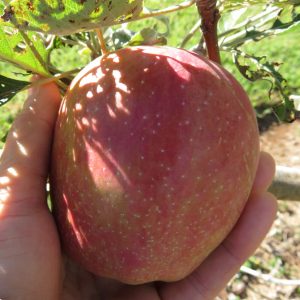
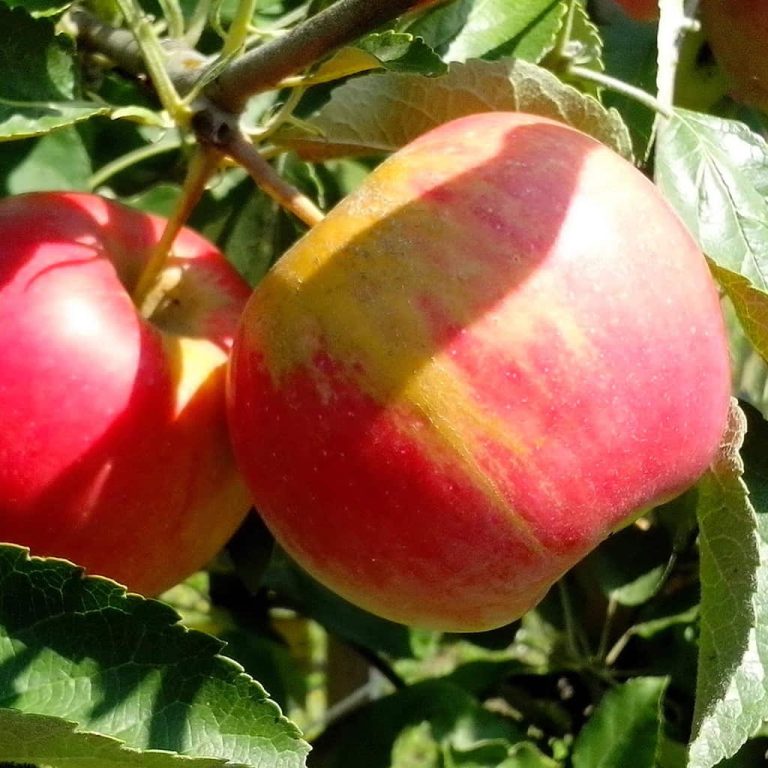
Freedom produces medium-large fruit averaging 3.0 to 3.5 inches in diameter and roughly 132 grams (approximately 4 to 6 oz). The skin is bright red with a yellow-green background and prominent lenticels; the peel is thin and smooth. Flavor is sweet and spicy with a subacid, sprightly quality—a balance that works across both fresh eating and culinary applications. Flesh is crisp and juicy with medium-coarse texture, holding up well in baking and cooking without turning to mush. The taste profile is distinct from the mild sweetness of scab-resistant sister Liberty; Freedom carries more spice character. Ripening falls late September to early October in temperate climates. Storage life runs 4 to 8 weeks under cool humid conditions, with flavor typically best through November. Culinary applications include fresh eating, cider, juicing, baking, applesauce, and cooking. Annual bearing habit and high productivity (30 to 50 lbs per dwarf or semi-dwarf tree) make it a dependable supply variety.
Ripening Season: Late
Harvest Window: Late Sep - Early Oct
Fruit Size: 3-3.5 inch
Fruit Weight: 4-6 oz (132 g average)
Flavor: Sweet, spicy, subacid with a sprightly taste; juicy and tender
Fruit Color: Bright red with yellow-green background; prominent lenticels
Fruit Texture: Crisp, juicy, tender; medium-coarse
Bearing Habit: Annual bearer; precocious and productive
Years to Bear: 2-5 years
Storage Life: 4-8 weeks (until approximately New Year's under good storage)
Culinary Uses: Fresh eating, cider, juicing, baking, cooking, applesauce
Freedom's primary value in disease management is near-immunity to apple scab (Venturia inaequalis)—the single most damaging apple disease in humid Eastern conditions. This resistance, conferred by the Vf gene from Malus floribunda, eliminates the need for the repeated fungicide applications that scab-susceptible cultivars require during the critical pre-bloom to petal-fall window. It also carries solid resistance to powdery mildew (Podosphaera leucotricha) and cedar apple rust (Gymnosporangium juniperi-virginianae), reducing pressure from two additional fungal diseases common where eastern red cedars grow nearby. Fire blight (Erwinia amylovora) resistance is moderate—growers in humid climates should still prune out blighted wood promptly with sterilized tools, cutting 8 to 12 inches below visible discoloration, and avoid excess nitrogen fertilization. Black rot (Botryosphaeria obtusa) susceptibility is moderate, so mummified fruit removal and sanitation pruning of cankers are important maintenance steps; good airflow through the canopy via annual pruning also reduces the humidity levels that favor fungal spread. All four major pest categories—codling moth (Cydia pomonella), plum curculio (Conotrachelus nenuphar), apple maggot (Rhagoletis pomonella), and brown marmorated stink bug (Halyomorpha halys)—are moderately susceptible. Kaolin clay applied at petal fall deters multiple pests organically; pheromone traps help time codling moth applications; fine mesh fruit bags offer direct exclusion for apple maggot and stink bug.
Apple Scab: Very Resistant
Fire Blight: Moderately Resistant
Powdery Mildew: Resistant
Cedar Apple Rust: Resistant
Black Rot: Moderately Susceptible
Codling Moth: Moderately Susceptible
Plum Curculio: Moderately Susceptible
Apple Maggot: Moderately Susceptible
Brown Marmorated Stink Bug: Moderately Susceptible
- Leverage the Scab Immunity: Freedom's near-immunity to apple scab eliminates the fungicide spray schedule required from silver-tip through petal fall — a significant labor reduction, especially in organic systems.
- Match Your Pollinator's Bloom Window: Plant Liberty or Honeycrisp within 50 feet; both share Freedom's mid-April to early May bloom window.
- Manage Black Rot Proactively: Remove all unharvested fruit at season's end — overwintering mummies are the primary inoculum source for black rot the following spring.
- Control Fire Blight with Pruning Hygiene: During warm, humid springs, sterilize pruning tools with 70% isopropyl alcohol between cuts when removing infected wood.
- Pest Exclusion for Clean Fruit: Codling moth, plum curculio, and apple maggot all require management; individual fruit bagging at petal fall produces pest-free fruit without any spray program for small plantings.
We ship in late winter or early spring based on your USDA hardiness zone.
We strive to ship orders on the scheduled dates listed in the table below. However, please note that the actual shipping date may be subject to change due to factors like weather conditions and order volume.
The specific date for shipping your order will be determined according to your zipcode at the time of checkout.
Our plants are shipped bare root, packed in moist sawdust, and securely wrapped in plastic to prevent the roots from drying out. We use USPS Ground Advantage for shipping, ensuring that your plants typically arrive within 2-5 days after packaging.
In case you're unable to plant the trees immediately upon arrival, we recommend soaking them in water for a few hours and temporarily heeling them in. Ideally, they should be planted within three days of receipt for optimal health.
See our full shipping policy and map here
| Zone | Ship Date |
|---|---|
| 11 - 8b | March 1st, 2027 |
| 8a - 7b | March 8th, 2027 |
| 7a | March 15th, 2027 |
| 6b | March 22nd, 2027 |
| 6a | March 29th, 2027 |
| 5b - 5a | April 12th, 2027 |
| 4b - 4a | April 26th, 2027 |
| 3b - 1a | May 3rd, 2027 |
Our 365-Day Plant Guarantee: We ensure that our plants are delivered to you alive and healthy. If your plant does not survive its first year, you're eligible for store credit under these conditions:
- Your location falls within the appropriate USDA hardiness zone for the plant variety (refer to our hardiness zone map).
- You maintain the roots' moisture and plant within three days of delivery, following the instructions in our Planting Guide.
If you're concerned about your plant's health, please consult our guide, How to Tell if Your Tree is Dead or Dormant. Remember, our plants are shipped in a dormant state and may leaf out at different times based on their species. To check for plant vital
3 reviews for Freedom Apple
Related products

Anna Apple
Checking fit- SOLD OUT
Sansa Apple
Checking fit 
Granny Smith Apple
$49.95 Select Rootstock This product has multiple variants. The options may be chosen on the product pageChecking fit
Ein-Shemer Apple
Checking fitRated 5.00 out of 5


Jacqueline I. (verified owner) –
Tree arrived healthy and in great condition. Thanks too for offering a less common variety. I wanted a Freedom to give a pollination boost to the young Liberty nearby.
RUSSELL PAIGE (verified owner) –
Beautiful Bareroot Apple trees arrived packaged well and healthy. Immediately staked, tree tubed, watered in, and weed matted, and mulched the trees. Fingers cross they leaf out and do well. Thank you! Russell and Robin Paige
Brenda S. (verified owner) –
Looks healthy. Still dormant.