Honeygold Apple
$49.95
Honeygold Apple (Malus domestica ‘Honeygold’) is a University of Minnesota cold-hardy apple bred from Golden Delicious and Haralson, bearing golden-yellow fruit with sweet, honey-noted flavor that is crisper and sweeter than its Golden Delicious parent. It grows in USDA hardiness zones 3-7 and AHS heat zones 1-6, needs 900-1100 chill hours, and requires cross-pollination with a compatible variety such as Freedom Apple or Fuji Apple to set fruit.
4-5′ Bare Root Grafted Tree
Rootstock: M106 – Semi Dwarf
About 65% of standard, widely adaptable with good anchorage. Avoid poorly drained sites — it is prone to collar rot in wet ground.
• Support: Freestanding; staking optional while young.
Can’t be shipped to: AK, HI, MT
In stock
Honeygold was released by the University of Minnesota in 1969 as a product of the institution’s northern-hardy apple breeding program. It was developed from a cross of Golden Delicious and Haralson — combining Golden Delicious’s sweetness and mild character with Haralson’s proven tolerance for sub-zero Minnesota winters. The objective was to place a Golden Delicious-type eating experience within reach of growers in USDA Zone 3 and Zone 4, where the original variety consistently suffers winter injury. The resulting cultivar ripens in late September and carries a notably sweeter flavor than Golden Delicious when freshly harvested, with a crisper texture. It was adopted quickly by Minnesota and upper Midwest orchardists as a reliable late-season yellow apple for northern climates. Honeygold was also later identified as a parent in the Honeycrisp lineage, establishing its indirect influence on the most commercially successful apple the University’s program has produced.
Cold hardiness is Honeygold's most operationally significant trait: planting it on slightly elevated ground or a north-facing slope helps avoid late spring frost pockets that kill open blossoms, which is a real concern at Zone 3-4 boundaries where the variety is most valuable. It requires 800 to 1,000 chilling hours — easily met across most of its hardiness range — and full sun of at least six to eight hours daily drives sugar accumulation that defines this cultivar's flavor. Well-drained loamy soil with a pH of 6.0 to 7.0 suits it best; standing water in the root zone weakens the tree and intensifies susceptibility to fire blight during wet springs. Moderate water of one to two inches per week during establishment is adequate, and established trees show reasonable drought tolerance once roots extend past the original planting zone. Irrigation during fruit development, particularly in dry summers, reduces fruit size loss and skin cracking near harvest.
USDA Hardiness Zone: 3-7
AHS Heat Zone: 1-6
Chill Hours: 900-1100
Sun Requirements: Full Sun (6-8 hours minimum)
Soil pH: 6.0-7.0
Soil Type: Loam, well-drained; adaptable to most soil types with adequate drainage
Soil Drainage: Well-drained; does not tolerate standing water
Water Requirements: Medium; 1-2 inches per week during establishment, drought tolerant once established
Drought Tolerance: Moderate; drought tolerant once established
Plant Spacing: 12-25 ft depending on rootstock (dwarf: 12-15 ft; semi-dwarf: 15-20 ft; standard: 25 ft)
Rootstock choice governs almost every structural aspect of a Honeygold planting. On dwarfing rootstock, trees stay in the 12- to 16-foot range with a spread to match, fitting tight spaces and making hand-harvest feasible from the ground. Standards reach 25 feet or more and demand a long-term pruning commitment to maintain accessible fruiting wood. The growth habit runs upright to spreading and fairly open, which benefits air circulation — critical given Honeygold's disease sensitivities. Annual bearing occurs on both spurs and one-year-old wood, so training systems that preserve spur clusters (central leader or modified central leader) maximize yield without excessive pruning. Trees are long-lived — 50 or more years on standard rootstock — meaning the initial site selection and training investments compound over decades. Deciduous foliage drops fully in autumn, allowing dormant pruning without canopy obstruction.
Mature Height: 25+ ft tall (standard); 12-16 ft tall (semi-dwarf)
Mature Spread: 12-25 ft wide (rootstock-dependent; spread roughly equals height)
Growth Habit: Upright to spreading; open habit
Foliage Type: Deciduous
Food Forest Layer: Canopy, Sub-canopy
Attracts Wildlife: Bees, birds, deer
Life Span: 50+ years
Honeygold is diploid and fully cross-pollination-dependent; it carries no meaningful self-fertility and will set little to no fruit without a compatible pollinator in bloom simultaneously. Flowers open mid-season, from mid-April to early May in a temperate climate, placing it in Flowering Group 3. Any diploid mid-season apple blooming in Groups 2 through 4 within 50 to 100 feet serves as an effective pollinator — Gala Apple, Honeycrisp Apple, and McIntosh Apple all overlap reliably. A single pollinator tree within range generally suffices because insect vectors — primarily honeybees and mason bees — transport pollen efficiently at those distances. Planting two different diploid pollinators provides insurance against a year when one blooms slightly off-schedule due to temperature anomalies.
Bloom Season: Mid
Bloom Window: Mid Apr - Late Apr
Pollination Requirements: Requires cross-pollination; not self-fertile
Pollination Mechanism: Insect (bee) pollinated
Flower Color: Pinkish-white
Ploidy: Diploid
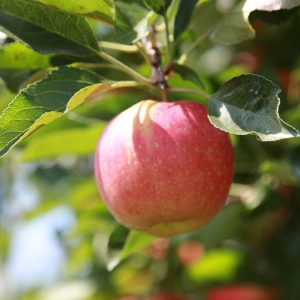
Golden-yellow to greenish-yellow skin, sometimes carrying a reddish-bronze blush on the sun-exposed cheek, covers fruit reaching 2.5 to 3.5 inches in diameter. Russet lenticels are common, and the skin is thin and prone to bruising, so harvest handling matters more than with tougher-skinned varieties. Flesh is creamy white to yellowish, crisp and juicy, with flavor described as sweeter and crisper than Golden Delicious — pronounced honey notes, mild tartness, and good juice content. Brix readings typically fall in the mid-to-upper teens. Ripening spans late September to early October. Cold storage at 32 to 34°F extends keeping quality to two to three months. The mild acid-to-sugar balance suits fresh eating and salads where oxidation resistance matters — the flesh browns slowly after cutting. Baking, pies, applesauce, and fresh-pressed cider are all practical uses; the sweetness reduces the need for added sugar in baked applications.
Ripening Season: Mid
Harvest Window: Early Sep - Late Sep
Fruit Size: 2.5-3.5 inch
Flavor: Sweet with honey notes; similar to Golden Delicious but sweeter and crisper; mildly tart, juicy
Fruit Color: Golden yellow to greenish-yellow skin, sometimes with reddish-bronze blush; creamy-white to yellowish flesh
Fruit Texture: Crisp and tender; juicy
Fruit Skin: Smooth, thin; golden-yellow to greenish with russet lenticels and occasional bronze blush; bruises easily
Bearing Habit: Annual bearer; bears fruit on spurs and 1-year-old wood
Years to Bear: 2-5 years
Yield: 30-50 per tree annually
Storage Life: 2-3 months in cold storage
Culinary Uses: Fresh eating, baking, pies, applesauce, cider, salads
Honeygold has one of the more demanding disease profiles among late-season apples: highly susceptible to apple scab (Venturia inaequalis) and moderately susceptible to fire blight (Erwinia amylovora), cedar apple rust (Gymnosporangium juniperi-virginianae), and black rot (Botryosphaeria obtusa). For apple scab, a preventive sulfur or copper spray from green-tip through petal fall is the core organic strategy; raking fallen leaf litter in autumn breaks the overwintering cycle and lowers the following season's inoculum load. Fire blight management requires pruning infected shoots at least twelve inches below the visible margin and sterilizing tools between every cut; avoiding high-nitrogen fertilization reduces the succulent shoot growth fire blight targets. Cedar apple rust pressure drops when nearby Eastern red cedar (Juniperus virginiana) or ornamental junipers within several hundred feet are removed; copper at petal fall adds an organic backup layer. Black rot spreads through mummified fruit — removing all mummies from tree and ground before bud break is the most practical control. All four tracked pests — codling moth (Cydia pomonella), plum curculio (Conotrachelus nenuphar), apple maggot (Rhagoletis pomonella), and brown marmorated stink bug (Halyomorpha halys) — show moderate susceptibility; kaolin clay and pheromone traps reduce codling moth and apple maggot populations without synthetic inputs.
Apple Scab: Very Susceptible
Fire Blight: Susceptible
Powdery Mildew: Moderately Resistant
Cedar Apple Rust: Susceptible
Codling Moth: Moderately Susceptible
Plum Curculio: Moderately Susceptible
Apple Maggot: Moderately Susceptible
Brown Marmorated Stink Bug: Moderately Susceptible
- Scab prevention is the foundation: Begin sulfur or copper at green-tip and continue through petal fall on a 7–10 day schedule; once scab infects fruit early, no later intervention restores it.
- Fire blight pruning protocol: Cut infected shoots 12 inches below visible symptoms and sterilize tools between every cut with 70% isopropyl alcohol; pruning without sterilization spreads the bacterium.
- Two pollinators provide bloom insurance: Plant Gala and Honeycrisp within 100 feet; staggered bloom between two varieties covers Honeygold's full window in variable springs.
- Harvest before full color: Pick when background color shifts from green to yellow and fruit separates with a slight upward twist — waiting for full golden color often means overripe, mealy fruit.
- Leaf litter cleanup reduces scab pressure: Rake and remove fallen leaves after leaf drop; the scab fungus overwinters on debris, lowering inoculum load the following spring.
We ship in late winter or early spring based on your USDA hardiness zone.
We strive to ship orders on the scheduled dates listed in the table below. However, please note that the actual shipping date may be subject to change due to factors like weather conditions and order volume.
The specific date for shipping your order will be determined according to your zipcode at the time of checkout.
Our plants are shipped bare root, packed in moist sawdust, and securely wrapped in plastic to prevent the roots from drying out. We use USPS Ground Advantage for shipping, ensuring that your plants typically arrive within 2-5 days after packaging.
In case you're unable to plant the trees immediately upon arrival, we recommend soaking them in water for a few hours and temporarily heeling them in. Ideally, they should be planted within three days of receipt for optimal health.
See our full shipping policy and map here
| Zone | Ship Date |
|---|---|
| 11 - 8b | March 1st, 2027 |
| 8a - 7b | March 8th, 2027 |
| 7a | March 15th, 2027 |
| 6b | March 22nd, 2027 |
| 6a | March 29th, 2027 |
| 5b - 5a | April 12th, 2027 |
| 4b - 4a | April 26th, 2027 |
| 3b - 1a | May 3rd, 2027 |
Our 365-Day Plant Guarantee: We ensure that our plants are delivered to you alive and healthy. If your plant does not survive its first year, you're eligible for store credit under these conditions:
- Your location falls within the appropriate USDA hardiness zone for the plant variety (refer to our hardiness zone map).
- You maintain the roots' moisture and plant within three days of delivery, following the instructions in our Planting Guide.
If you're concerned about your plant's health, please consult our guide, How to Tell if Your Tree is Dead or Dormant. Remember, our plants are shipped in a dormant state and may leaf out at different times based on their species. To check for plant vital
1 review for Honeygold Apple
Related products

Winesap Apple
Rated 5.00 out of 5$49.95 Select Rootstock This product has multiple variants. The options may be chosen on the product pageChecking fit
Enterprise Apple
Checking fitRated 5.00 out of 5
Siberian Crabapple
Checking fitRated 4.60 out of 5
Granny Smith Apple
$49.95 Select Rootstock This product has multiple variants. The options may be chosen on the product pageChecking fit


Paul Y. (verified owner) –
Honeygold apple was hard to find, but Food Forest Nursery had it. The bare root plant was a good size, well-formed, and had a robust root system. Thank you Forest Farm Nursery.