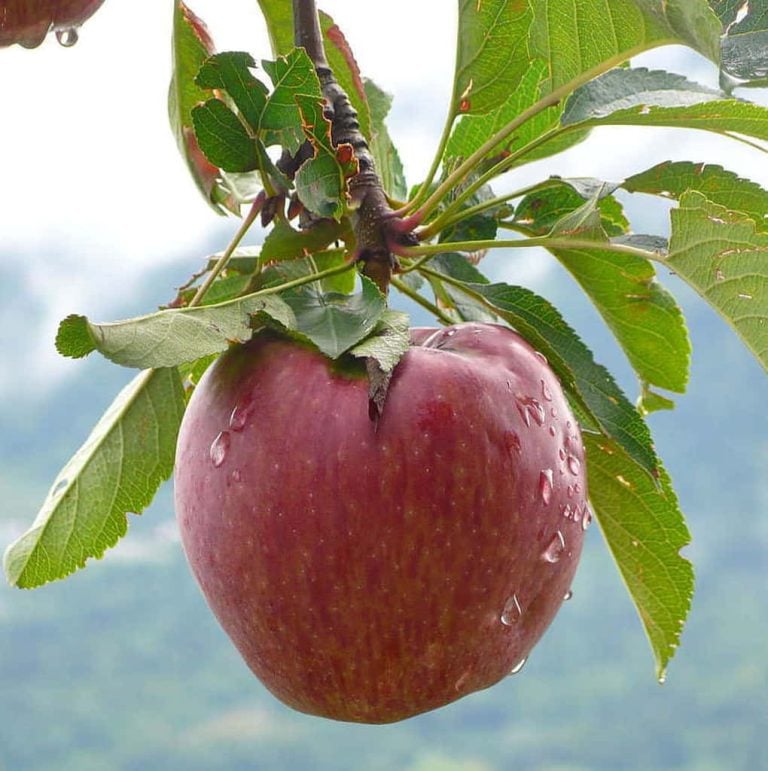
Honeycrisp Apple
$49.95
Honeycrisp Apple (Malus domestica ‘Honeycrisp’) is a University of Minnesota apple bearing large, bright red-orange fruit with exceptionally crisp, juice-bursting flesh and a honey-sweet, mildly tart flavor that made it one of the most sought-after fresh-eating varieties ever released. It grows in USDA hardiness zones 3-8 and AHS heat zones 1-7, needs 800-1000 chill hours, and requires cross-pollination with a compatible variety such as Enterprise Apple or Carolina Red June Apple to set fruit.
4-5′ Bare Root Grafted Tree
Rootstock: M111 – Semi Dwarf, G935 – Dwarf, G890 – Semi Dwarf
Can’t be shipped to: AK, HI, MT
Out of stock — back next season
Spring 2027 inventory drops in June. Drop your email and we'll notify you the day this variety is back in stock.
You're on the list. Check your inbox for a confirmation link — click it to lock in your spot. We'll email you the day this variety is back in stock.
Honeycrisp was developed at the University of Minnesota under the breeding designation MN1711 and released in 1991. The University’s plant patent was filed under the parentage listed in breeding records as a Macoun × Honeygold cross from 1960; however, DNA analysis conducted after release revised the documented parentage. Genetic testing identified the true seed parent as Keepsake — itself a cross of (MN447 × Northern Spy) — while the pollen parent could not be determined with certainty. The original records appear to have assigned the wrong label to the maternal seedling. Regardless of the parentage question, the program’s selection deliberately targeted unusually large cell size in the flesh, which produces the characteristic burst of juice at each bite. The University held a plant patent that expired in 2008, making the variety freely propagatable. Honeycrisp grew from a regional cold-climate specialty into the top-grossing fresh apple variety in North American retail within roughly two decades of its release.
Honeycrisp needs 800 to 1,000 chill hours — sufficient across zones 3 through 6 in temperate continental climates, but problematic in warm coastal areas where winter chill accumulation falls short. The upper zone limit of 7 reflects another constraint: prolonged summer heat above 90°F degrades the crisp cell structure and mutes flavor, so growers in warm-summer humid regions should prioritize north-facing slopes or sites with afternoon shade to moderate heat stress. Consistent moisture is especially important during cell expansion (30–60 days after petal fall); drought stress at this stage produces small, starchy fruit and triggers early drop. Well-drained loam is the target soil type — heavy clay that holds water around the root zone increases Phytophthora collar rot risk and amplifies biennial bearing. Soil pH between 6.0 and 7.0 keeps calcium and trace minerals available. Calcium is particularly critical for Honeycrisp: the variety is prone to bitter pit, so supplemental calcium foliar sprays at petal fall and repeated through fruit development are standard practice in commercial orchards and advisable for home growers as well.
USDA Hardiness Zone: 3-8
AHS Heat Zone: 1-7
Chill Hours: 800-1000
Sun Requirements: Full Sun (6+ hours direct sunlight)
Soil pH: 6.0-7.0
Soil Type: Loam, well-drained; avoids heavy clay or compacted soils
Soil Drainage: Well-drained; does not tolerate waterlogged conditions
Water Requirements: Medium; consistent moisture needed especially during fruit development
Drought Tolerance: Low to Moderate; inconsistent watering causes smaller fruit and premature drop
Heat Tolerance: Low; not well adapted to prolonged summer heat above 90°F; fruit quality declines in hot climates
Plant Spacing: Select a rootstock above for exact spacing information.
Container Suitability: Suitable on dwarfing rootstock only (e.g., M.27 or M.9); requires large container (15+ gallons)
Tree size is entirely rootstock-driven. On dwarfing M.26 or M.9 stock, Honeycrisp stays in the 8- to 12-foot range — manageable for most home orchards and small-scale plantings, and well-suited to espalier training against a south-facing wall. Semi-dwarf rootstocks such as MM.111 or M.7 push the canopy to 12–15 feet with a spread to match, providing a longer productive life and greater drought resilience from deeper root anchorage. Standard-size trees can exceed 20 feet and are best suited to open sites where mowing under the canopy is practical. The natural growth habit is upright-spreading, which responds well to either a central-leader or open-vase training system. Lateral root spread typically extends to roughly twice the canopy diameter, so spacing decisions should account for root competition, not just canopy overlap. Foliage turns yellow to orange in autumn, and the white-to-pink spring bloom provides meaningful pollinator value in the orchard ecosystem.
Mature Height: Select a rootstock above for exact size information.
Mature Spread: Select a rootstock above for exact spread information.
Growth Habit: Upright-spreading; open vase or central leader depending on training
Growth Rate: Moderate; 12-18 inches per year
Foliage Type: Deciduous
Food Forest Layer: Canopy, Sub-canopy
Leaf Color: Medium green
Fall Foliage Color: Yellow to orange
Thorns?: No
Attracts Wildlife: Bees, butterflies, hummingbirds (flowers); birds and small mammals (fruit)
Life Span: 50-100+ years (standard); 25-40 years (semi-dwarf/dwarf)
Honeycrisp is a diploid variety that produces viable pollen but cannot fertilize itself — it needs a separate compatible apple variety within 30–50 feet for reliable fruit set. Bloom timing falls in the mid- to late-season window: early May to mid-May in zone 5, mid-April to early May in zones 6–7. Any other diploid apple flowering concurrently will serve as a cross-pollinator; for growers buying both trees, Gala Apple, Fuji Apple, and Golden Delicious Apple all bloom in an overlapping window and are widely available. Zestar! Apple, also bred at the University of Minnesota, overlaps in bloom and is another natural pairing for cold-climate growers. Bees are the primary transfer agents; maintaining hedgerow plantings or flowering cover crops beneath the canopy supports native bee populations where managed hive density is low.
Bloom Season: Late
Bloom Window: Late Apr - Early May
Pollination Requirements: Requires cross-pollination; self-infertile; needs another apple variety blooming concurrently within 30-50 ft
Pollination Mechanism: Insect-pollinated (primarily honeybees and native bees)
Flower Color: White to pale pink
Ploidy: Diploid (2n = 2x = 34)
The defining trait is textural rather than purely flavor-based: Honeycrisp flesh has enlarged parenchyma cells that hold more juice than standard apple tissue, producing the characteristic crisp fracture and juicy release that drove its commercial adoption. Brix values typically run in the 12–14 range — moderately sweet with a sub-acid finish and mild aromatic quality. Fruit size is large, 3 to 4 inches in diameter and commonly reaching 10 to 16 oz per fruit, with bright red-orange blush over a yellow-green background. Fresh eating is the primary use, and the texture holds better in salads and slaws than softer varieties because the flesh resists browning after cutting. For baking, the firm structure survives pie and crisp applications without turning to mush. Cold storage life is unusually long — 4 to 7 months at 37–38°F, and up to 12 months under controlled atmosphere — though storage below 36°F causes chilling injury that softens the flesh and defeats the variety's chief selling point.
Ripening Season: Mid
Harvest Window: Early Sep - Late Sep
Fruit Size: Large; 3-4 inch
Fruit Weight: 10-16 oz (0.6-1 lb) per fruit
Flavor: Sweet-tart balance; aromatic; honey-sweet with mild tartness and refreshing acidity; sub-acid
Fruit Color: Bright red-orange blush over yellow-green background; mottled red with some striping
Fruit Texture: Exceptionally crisp and juicy; coarse-grained flesh with large cells that burst with juice when bitten
Fruit Skin: Thin to medium; smooth with visible lenticels
Bearing Habit: Biennial (strong tendency); crop management and calcium applications required to reduce alternate bearing
Years to Bear: Select a rootstock above for exact bearing information.
Yield: 8.03 kg/tree in 3rd leaf (1998), 12.99 kg/tree in 4th leaf (1999), and 9.79 kg/tree in 5th leaf (2000); cumulative yield efficiency 3.24 kg/cm² (UVM NE-183 trial; Honeycrisp on M.9, 5 reps)
Storage Life: 4-7 months refrigerated at 37-38°F; up to 12 months in controlled atmosphere storage; chilling injury below 36°F
Culinary Uses: Fresh eating, salads, slaws, baking (pies, crisps, cakes, muffins), applesauce, apple butter, juicing, cider, drying
Honeycrisp carries a moderately susceptible rating to apple scab (Venturia inaequalis), which is among its better disease scores; most other pressure points are more acute. Fire blight (Erwinia amylovora) is a significant liability — susceptibility means pruning of blighted shoots must be done with sterilized tools, cutting at least 8–12 inches below visible infection into healthy wood, and the orchard should avoid excess nitrogen fertilization, which promotes the succulent shoot growth that blight exploits most aggressively. Powdery mildew (Podosphaera leucotricha) is another susceptibility; pruning for good canopy airflow and removing infected shoot tips in early spring are the primary cultural controls. Cedar apple rust (Gymnosporangium juniperi-virginianae) is especially relevant in humid climates where Eastern red cedar serves as an alternate host — removing nearby junipers within a quarter mile is the most effective tactic where practical. Sooty blotch and flyspeck complex (Peltaster fructicola and related fungi) cosmetically blemishes fruit in humid summers; maintaining canopy openness through summer pruning speeds drying after rain. Pest-wise, plum curculio (Conotrachelus nenuphar), apple maggot (Rhagoletis pomonella), and Japanese beetle (Popillia japonica) all pressure Honeycrisp without varietal resistance; row covers, kaolin clay applications, and yellow sticky traps are standard organic approaches. Codling moth (Cydia pomonella) shows moderate resistance.
Fire Blight: Susceptible
Apple Scab: Moderately Resistant
Powdery Mildew: Susceptible
Cedar Apple Rust: Susceptible
Sooty Blotch and Flyspeck Complex: Susceptible
Plum Curculio: Susceptible
Apple Maggot: Susceptible
Codling Moth: Moderately Resistant
Japanese Beetle: Susceptible
- Calcium spray program: Begin foliar calcium at petal fall and repeat every 10–14 days through mid-summer to prevent bitter pit — the most common quality defect in home-grown Honeycrisp.
- Crop thinning for biennial bearing: Thin to one apple per spur within 3–4 weeks of petal fall; overcropping triggers the biennial cycle that leaves alternate years nearly fruitless.
- Fire blight sanitation: Keep pruning tools in a 10% bleach solution between cuts when removing blighted shoots, cutting 8–12 inches below the last visible infection.
- Cedar apple rust management: Inventory eastern red cedars within a quarter mile; removing or replacing nearby junipers with non-host species is the most durable organic strategy against rust cycles.
- Storage temperature precision: Hold fruit between 37°F and 38°F — not colder. Chilling injury below 36°F causes internal browning and softening that ruins Honeycrisp's signature texture.
We ship in late winter or early spring based on your USDA hardiness zone.
We strive to ship orders on the scheduled dates listed in the table below. However, please note that the actual shipping date may be subject to change due to factors like weather conditions and order volume.
The specific date for shipping your order will be determined according to your zipcode at the time of checkout.
Our plants are shipped bare root, packed in moist sawdust, and securely wrapped in plastic to prevent the roots from drying out. We use USPS Ground Advantage for shipping, ensuring that your plants typically arrive within 2-5 days after packaging.
In case you're unable to plant the trees immediately upon arrival, we recommend soaking them in water for a few hours and temporarily heeling them in. Ideally, they should be planted within three days of receipt for optimal health.
See our full shipping policy and map here
| Zone | Ship Date |
|---|---|
| 11 - 8b | March 1st, 2027 |
| 8a - 7b | March 8th, 2027 |
| 7a | March 15th, 2027 |
| 6b | March 22nd, 2027 |
| 6a | March 29th, 2027 |
| 5b - 5a | April 12th, 2027 |
| 4b - 4a | April 26th, 2027 |
| 3b - 1a | May 3rd, 2027 |
Our 365-Day Plant Guarantee: We ensure that our plants are delivered to you alive and healthy. If your plant does not survive its first year, you're eligible for store credit under these conditions:
- Your location falls within the appropriate USDA hardiness zone for the plant variety (refer to our hardiness zone map).
- You maintain the roots' moisture and plant within three days of delivery, following the instructions in our Planting Guide.
If you're concerned about your plant's health, please consult our guide, How to Tell if Your Tree is Dead or Dormant. Remember, our plants are shipped in a dormant state and may leaf out at different times based on their species. To check for plant vital
5 reviews for Honeycrisp Apple
Related products

Dorsett Golden Apple
Checking fitRated 5.00 out of 5
Common Apple
Checking fit
Gladiator Crabapple
Checking fit
Granny Smith Apple
$49.95 Select Rootstock This product has multiple variants. The options may be chosen on the product pageChecking fit


Jennifer G. (verified owner) –
Extremely happy with the size and width of the honeycrisp tree that arrived. It was the first thing I planted.
Tracy J. (verified owner) –
Planted great customer service. Can’t wait for our harvest
Jennifer H. (verified owner) –
Ashley Wesenberg (verified owner) –
My favorite apple of all
Kyle Johnson (verified owner) –
Awake!