
Nectarine Tree Growing Guide
The short answer: Nectarine trees grow the same way peach trees do — they are the same species with a smooth-skinned mutation — and thrive in USDA Zones 5–9 given full sun, well-drained soil, and chill hours matched to your winter (200–900 depending on cultivar). The one catch: their fuzz-free skin makes them more prone to brown rot, so fall sanitation and good airflow matter more than they do for peach.
1. Introduction
Nectarines and peaches are the same species (Prunus persica), differing by one recessive gene for smooth skin — so nectarine culture is peach culture, with extra care against brown rot and slightly less cold-hardiness in most cultivars.
Nectarines are not a separate species — botanically they are Prunus persica var. nucipersica, the same plant as peach with a recessive gene for smooth skin instead of fuzz. Plant a peach seed and you have a 25% chance of growing a nectarine; the trees are otherwise indistinguishable. Culturally, almost everything written about peach culture applies to nectarine: same chill hours, same pruning form, same diseases, same regional adaptation.
Two important differences shape this guide: nectarines are more susceptible to brown rot (the fuzz on a peach is part of its disease defense), and many cultivars are slightly less cold-hardy than the most cold-hardy peaches. Growing nectarines successfully means slightly more attention to sanitation, slightly more cautious siting in cold zones, and an honest acceptance that nectarine is the slightly higher-maintenance sibling.
The reward is worth it. A tree-ripe nectarine — picked fully soft, eaten within minutes of harvest — is among the most intensely flavored stone fruits a home grower can produce. This guide covers nectarine across USDA Zones 5–9, with the same chill-hour and bloom-timing logic that applies to peaches.
Quick Facts Table
Aspect | Details |
|---|---|
| USDA Hardiness Zones | 5–9 (most cultivars); Zone 4 with hardiest selections in protected sites |
| Mature Height | Standard: 15–25 ft; Semi-dwarf: 10–18 ft; Dwarf (genetic): 6–8 ft |
| Mature Spread | Standard: 15–20 ft; Semi-dwarf: 12–15 ft |
| Time to First Harvest | 2–3 years (most cultivars); 3–4 years to full bearing |
| Chill Hours Needed | 200–400 (low-chill) to 700–900 (high-chill standard cultivars) |
| Soil pH | 6.0–7.5 (slightly acidic to slightly alkaline) |
| Lifespan | 12–20 years (commercial); 20–25 years with care |
| Pollination | Self-fertile; one tree fruits reliably |
Key Takeaway: Treat nectarines like peaches with extra attention to brown-rot sanitation. Match chill hours to your local winter, prune to an open vase each spring, thin fruit aggressively, and pick at full soft ripeness.

2. Choosing the Right Variety
Match chill hours to your winter first (200–400 for mild-winter Zones 8–9 up to 700–900 for cold-winter Zones 5–7), then choose yellow or white flesh and freestone or clingstone by taste preference.
Nectarine cultivars range from the white-fleshed aromatic types preferred in the West to firmer yellow-fleshed varieties bred for the Eastern US and shipping. Choose based on your climate (chill hours), intended use (fresh vs canning), and flesh type (white vs yellow, freestone vs clingstone).
Flesh Type and Stone Adhesion
- Freestone: Pit separates cleanly from flesh — easier processing. Most modern cultivars are freestone.
- Clingstone: Pit clings to flesh — common in older heirloom varieties and some canning types.
- Yellow Flesh: The standard. Firmer texture, classic balanced sweet-tart flavor.
- White Flesh: Sweeter, more aromatic, lower acid. Highly prized in California and Asia.
Chill Hour Requirements
- High-Chill (700–900 hours): Zones 5–7 cold winters. Cultivars: Mericrest, Independence, Sunglo, Red Gold, Hardired.
- Mid-Chill (500–700 hours): Zones 6–8 moderate winters. Cultivars: Fantasia.
- Low-Chill (200–500 hours): Zones 8–9 mild winters. Cultivars: Snow Queen, Arctic Star, Goldmine, Panamint.
Variety Comparison Table
Cultivar | Flesh / Stone | Zones | Chill Hours | Best Use / Notes | Self-Fertile? |
|---|---|---|---|---|---|
| Fantasia | Yellow / freestone | 5–9 | 500–600 | California release; large red-blushed fruit; the most widely planted nectarine in North America. | Yes |
| Sunglo | Yellow / freestone | 5–9 | 650 | Reliable Eastern US cultivar; firm fruit; ships and stores well. Late-summer harvest. | Yes |
| Red Gold | Yellow / freestone | 5–8 | 750 | Large fruit with intense red color; classic mid-late season Eastern cultivar. | Yes |
| Durbin | Yellow / freestone | 5–9 | 650 | Southern-bred; vigorous tree; reliable producer for South-Central US. | Yes |
| Mericrest | Yellow / freestone | 5–8 | 850 | One of the most cold-hardy nectarines available; reliable in Zone 5. | Yes |
| Independence | Yellow / freestone | 5–8 | 750 | Cold-hardy; firm fruit; good shipper; reliable producer. | Yes |
| Hardired | Yellow / freestone | 5–8 | 750 | Disease-tolerant (bacterial spot, brown rot); red-skinned large fruit. | Yes |
| Snow Queen | White / freestone | 7–9 | 300 | Low-chill white-flesh sweet fruit. Excellent for the South and CA. | Yes |
| Arctic Star | White / freestone | 7–9 | 300 | Low-chill; sweet white flesh; California favorite for fresh eating. | Yes |
| Goldmine | White / freestone | 7–9 | 400 | Heirloom white nectarine; fragrant aromatic fruit. | Yes |
Harvest Windows
Nectarine harvest runs from early summer to early fall depending on the cultivar. Like peaches, the spread comes from cultivar choice rather than from any difference between the two fruits — match early, mid, and late types to stretch the season.
- Early Season (late June–early July): Snow Queen, Arctic Star, low-chill yellows.
- Mid Season (mid-July–early August): Fantasia, Durbin, Hardired.
- Late Season (mid-August–early September): Sunglo, Red Gold, Mericrest, Independence.
3. Site Selection & Preparation
Give nectarines full sun, pH 6.0–7.5, fast drainage, and a site above the cold-air pool — the same requirements as peach, with airflow weighted even more heavily because of nectarine’s brown-rot susceptibility.
Nectarines need the same site as peaches: full sun, excellent drainage, well above frost-pool elevations, and adequate airflow for disease management. The brown-rot vulnerability of smooth-skinned fruit makes air circulation slightly more important than for peaches.
Sunlight Requirements
Full sun — 8+ hours of direct daily light from spring through fall. Nectarines in shade ripen unevenly, produce less, and are more disease-prone than peaches in the same conditions.
Soil and pH
Nectarines tolerate pH 6.0–7.5 and a wide range of soils. Deep, well-drained loam is ideal. Sandy soil works with adequate water; clay works if drainage is verified.
Drainage
Critical. Nectarines are highly susceptible to Phytophthora root rot and crown rot. An 18-inch test hole should drain within 8 hours. Build planting mounds (8–12 inches tall, 4–5 feet wide) on heavier soil.
Frost Pockets — Site Above the Cold-Air Pool
Like peach and apricot, nectarines bloom early enough to lose flowers to late freezes in Zones 5–7. Site on slope or raised elevation; avoid low spots and valley bottoms.
Spacing Guidelines
Tree Type | In-Row × Between-Row |
|---|---|
| Standard nectarine | 15–20 ft × 20 ft |
| Semi-dwarf nectarine | 12–15 ft × 18 ft |
| Genetic dwarf nectarine (Nectar Babe, etc.) | 6–8 ft × 10 ft (also great in containers) |
| Espalier on a wall | 8–10 ft between trees |
| Permaculture row | 20 ft minimum between trunks |
4. Planting Instructions
Plant bare-root while dormant (late winter to early spring, timed by zone), set the graft union 2–4 inches above grade, and strip all flowers the first year so the tree builds roots instead of fruit.
Same as peach. Plant during dormancy (late winter to early spring), with the graft union 2–4 inches above grade, into well-drained soil with no in-hole amendments. On heavier soils, plant on a mounded site.
When to Plant
- Bare-root: Late winter through early spring while dormant. Zones 5 target April; Zones 6–7 March; Zones 8–9 January–February.
- Container-grown: Spring through early summer in cold zones.
Planting Depth
Set the graft union 2–4 inches above the surrounding grade. Don’t bury the graft.
Initial Watering and Mulch
Water deeply at planting (5–10 gallons). Apply 3–4 inches of wood-chip mulch in a 3-foot ring, kept 3 inches back from the trunk to prevent crown rot.
Year-One Establishment
Water deeply twice weekly through the first growing season. Remove all flowers in year one to redirect energy to root and structural growth.
5. Pollination and Fruit Set
A single nectarine tree is self-fertile and will set fruit on its own; a second cultivar with overlapping bloom is optional and mainly helps in cold, wet springs when pollinator activity is limited.
All commercial nectarine cultivars are self-fertile. One tree fruits reliably. No partner cultivar is required, though planting two cultivars with overlapping bloom can slightly improve yield and extend the harvest window. This makes nectarine an excellent choice for small yards where space limits the number of trees.
Honeybees and native bumblebees pollinate nectarine flowers efficiently. The early-spring bloom (March–April in most zones) means cold rainy weather can disrupt pollinator activity — the same vulnerability that affects apricot and peach. Pollinator habitat (undisturbed margins, hedgerow plantings) supports nectarine pollination but cannot fully compensate for prolonged cold-weather bloom periods.
6. Pruning and Training
Train to an open-vase form and remove 40–50% of the prior year’s growth every winter on mature trees — nectarines fruit only on 1-year-old wood, so this heavy renewal pruning is what keeps them productive.
Nectarines are pruned to an open-vase form, exactly like peaches. The goal is maximum sunlight penetration to the interior of the canopy — both to ripen fruit and to dry leaves and fruit surfaces fast enough to reduce brown rot pressure. Aggressive annual pruning is non-negotiable for nectarines because they fruit on 1-year-old wood and become unproductive within 5 years if pruned lightly.
Training a Young Tree (Years 1–4)
Open-vase form:
- Year 1: Head the unbranched whip to 24–30 inches. Select 3–4 future scaffolds at 18–24 inches off the ground, spiraling around the trunk and angled outward at 45–60 degrees.
- Year 2: Remove the central leader entirely. Select the 3–4 strongest scaffolds; remove competitors. Head scaffolds back by 1/3.
- Years 3–4: Develop secondary scaffolds. Keep the canopy center fully open.
Maintenance Pruning (Years 5+)
Once a year in late winter, remove approximately 40–50% of the prior year’s growth on a mature nectarine. Yes, that’s a lot — nectarines fruit on 1-year-old wood, so heavy renewal pruning maintains a steady supply of productive wood.
- Dead, damaged, broken, and crossing branches first.
- Any wood with bacterial canker, brown rot mummies, or other disease.
- Inward-growing branches crowding the canopy center.
- About half of last year’s growth on the remaining scaffolds (this is the renewal pruning that keeps the tree productive).
Fruit Thinning — Critical
Nectarines, like peaches, set 5–10× more fruit than the tree can size up. Thin to one fruit per 6 inches of fruiting wood by early June when fruit is marble-sized. Unthinned nectarines produce small fruit, break branches, and exhaust the tree.
Pruning Calendar
Month | Task |
|---|---|
| January–February | Dormant structural pruning — Zones 7–9. |
| Late February–March | Dormant structural pruning — Zones 5–6. |
| March–April | Bloom — hands-off. Frost watch. |
| Late May–early June | Fruit thinning to one per 6 inches of fruiting wood. |
| June–July | Light removal of broken or diseased wood. |
| Late July–August | Harvest. No major pruning. |
| September | Inspect canopy structure; plan next dormant pruning. |
7. Ongoing Care & Maintenance
Keep moisture consistent through fruit fill, fertilize modestly, and treat fall sanitation — stripping every mummified fruit — as the single highest-leverage task against brown rot.
Nectarines respond to consistent moisture, moderate fertility, and meticulous sanitation. Brown rot is the dominant disease pressure, and sanitation — removing all mummies and infected fruit — is more effective than any spray schedule.
Water Management
Stage | Approach |
|---|---|
| Year 1 establishment | 5–10 gallons twice weekly unless rainfall is reliable. |
| Years 2–3 | Deep weekly watering during dry spells. 15 gallons per watering. |
| Years 4+ established | Biweekly during summer dry weather. Drought-tolerant once established. |
| Fruit fill (June–August) | Consistent moisture is critical for fruit size. Drought now causes premature drop and split-pit defects. |
| Post-harvest (August–September) | Reduce water to slow new growth and encourage winter hardening. |
Fertilization
Modest. Most established nectarines need 1 lb 10-10-10 per inch of trunk diameter, broadcast under the dripline in early spring. Over-fertilizing pushes soft growth highly susceptible to bacterial canker and brown rot.
- Organic equivalent: 2–3 inches of compost top-dressed each spring.
- Stop fertilizing after July in Zones 5–7. Soft growth won’t harden off for winter.
- Pale leaves: light nitrogen supplement (kelp meal, fish meal).
Mulch Renewal
Annual wood-chip top-up to maintain 3–4 inches of depth. Keep mulch 3 inches back from the trunk.
Sanitation — Brown Rot’s Best Defense
This is the single most important nectarine maintenance task. Every fall, walk the tree and remove every mummy (shriveled rotted fruit hanging from twigs). Rake and dispose of all fallen fruit. Bag or burn — do not compost — mummified fruit. Mummies are next year’s brown rot inoculum. A clean orchard floor going into winter is a low-pressure orchard the following spring.
8. Pest and Disease Management (Organic)
Brown rot is nectarine’s dominant threat because smooth skin lacks the fuzz that helps protect peach; sanitation, thinning for airflow, and timely harvest control it better than any spray program.
Nectarines share peach’s full disease and pest roster, plus elevated brown rot susceptibility (smooth skin lacks the protective fuzz). The big four are brown rot, peach leaf curl, bacterial spot, and plum curculio. All respond to integrated management.
Major Diseases
Disease | Identification & Management |
|---|---|
| Brown Rot (Monilinia fructicola) | The dominant nectarine disease. Tan to brown rotted spots on ripening fruit; rapid spread; fruit shrivels into overwintering mummies. Manage: remove ALL mummies and fallen fruit; thin fruit for airflow; harvest at first ripeness; sulfur or Bacillus subtilis spray at petal fall and 3 weeks pre-harvest; choose resistant cultivars where available (Hardired). |
| Peach Leaf Curl (Taphrina deformans) | Crinkled red-purple distorted spring leaves; can cause early defoliation. Manage: single copper or lime-sulfur spray during dormancy (after leaf drop OR just before bud swell). Spring sprays are too late. |
| Bacterial Spot (Xanthomonas arboricola pv. pruni) | Small dark spots on leaves and fruit; severe infections defoliate trees. More problematic in humid East. Manage: resistant cultivars (Hardired, Sunglo); copper spray at leaf drop and bud swell; reduce stress. |
| Bacterial Canker (Pseudomonas syringae) | Sunken cankers on trunk and branches; weeping gum. Common killer of young nectarines. Manage: avoid pruning in wet weather; copper at leaf drop; remove infected wood 6 inches below canker. |
| Phytophthora Root and Crown Rot | Wilt despite wet soil. Manage: drainage; mounded planting on heavy soil. |
Major Pests
Pest | Identification & Management |
|---|---|
| Peach Tree Borer | Larvae bore into trunk at soil line; gum and frass at base. Manage: paint trunks white; pheromone traps; nematode soil drench. |
| Plum Curculio | Weevil that lays eggs in young fruit. Manage: tarp-shake at first fruit set; kaolin clay (Surround) at petal fall through June; spinosad as last resort. |
| Oriental Fruit Moth | Larvae bore into new shoots in spring and fruit in summer. Manage: pheromone traps + mating disruption; spinosad sprays at peak flights. |
| Spotted Wing Drosophila | Larvae in ripening fruit. Manage: harvest at first color; cool harvest; netting where economical. |
| Aphids | Cluster on new growth. Manage: water blast; lacewing/ladybeetle habitat; insecticidal soap. |
| Birds, Squirrels | Take ripening fruit. Manage: netting on smaller trees; harvest aggressively. |
9. Harvest and Storage
Pick only when the fruit yields to gentle thumb pressure and releases with a slight twist — nectarines don’t ship or ripen off the tree the way peaches sometimes do, so full tree-ripeness is what separates home-grown fruit from store-bought.
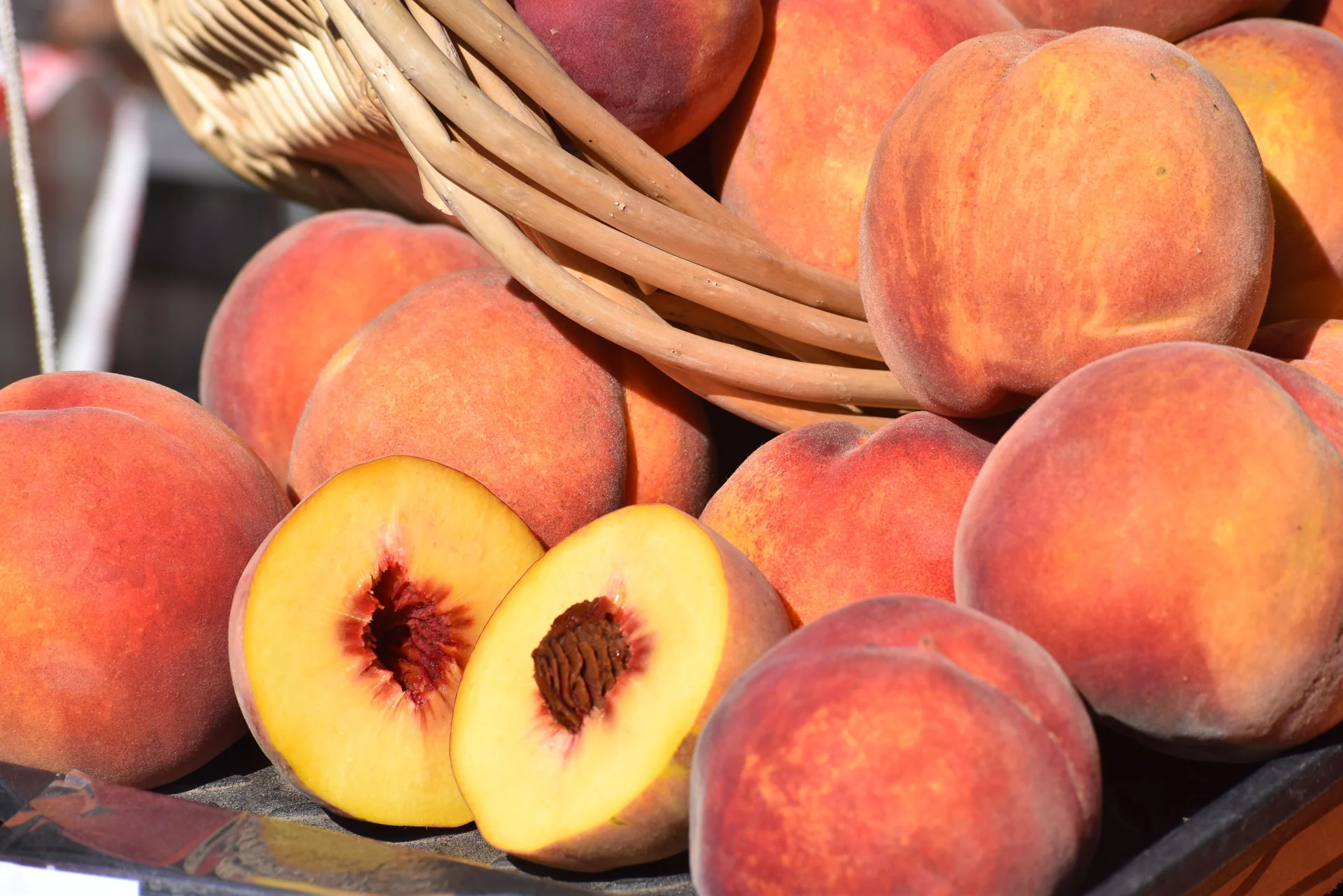
Tree-ripe nectarine is one of the year’s great agricultural payoffs. The fruit is delicate, doesn’t ship well, and reaches peak quality only when picked at full softness — exactly why home-grown nectarines are dramatically better than store-bought.
Ripeness Cues
A ripe nectarine has full background color (yellow-orange under the red blush; the red blush alone is not enough), yields slightly to gentle thumb pressure, smells fragrant at the stem end, and detaches from the spur with a slight twist. If you have to pull hard, it is not ready.
Harvest Frequency
Walk the tree every 1–2 days during peak ripening — typically a 10–14 day window. Pick only the ripest fruit each visit. Unpicked overripe fruit drops, attracts wasps, and becomes brown-rot inoculum.
Picking Technique
- Twist gently; ripe fruit releases.
- Pick into shallow padded containers (4 inches max depth). Nectarines bruise easily.
- Morning harvest gives longer shelf life.
- Avoid washing until just before use.
Storage Methods
Method | Approach & Shelf Life |
|---|---|
| Refrigeration (firm-ripe) | 32–34°F. 1–2 weeks for firm-ripe; fully soft fruit: 3–5 days only. |
| Freezing | Halve, pit, treat with ascorbic acid (prevents browning). Single-layer freeze then bag. 12+ months at 0°F. |
| Canning (halves in syrup) | Use yellow-fleshed nectarines and follow the full NCHFP canning procedure, including jar size, headspace, pack style and elevation-adjusted processing. Do not apply it to white-fleshed nectarines; use a tested freezing method instead. |
| Drying | Halve, pit, dehydrate at 135°F for 18–24 hours. Stores 12+ months airtight. |
| Jam and Preserves | Moderate pectin; pair with lemon juice or commercial pectin for reliable set. |
| Nectarine Wine, Brandy | 3–5 lb fruit per gallon. Traditional in California and the Mediterranean. |
Yield Expectations by Tree Age
- Year 2: A handful — 1–5 lb.
- Year 3–4: 25–50 lb.
- Mature (5–10 years): 75–150 lb per standard tree.
- Productive lifespan: 12–20 years commercial; some home trees reach 25 years with good care.
10. Companion Planting (The “Nectarine Guild”)
Nectarines share the same stone-fruit guild as peach, plum, and apricot: nitrogen-fixing clover and pest-deterring alliums below, pollinator-supporting herbs and natives around, and other Prunus kept at a distance to avoid shared disease pressure.
Nectarines integrate into the same stone-fruit guild as peach, plum, and apricot. Same companions, same exclusions, same general approach.
Companions and Their Roles
Companion | Role in the Guild |
|---|---|
| Comfrey | Dynamic accumulator, chop-and-drop mulch, pollinator forage. |
| White or Crimson Clover | Nitrogen fixation; living mulch; pollinator forage. |
| Garlic, Chives, Daffodils | Pest deterrent (peach tree borer); rodent deterrence. |
| Lavender, Rosemary, Sage | Pollinator attractors; pest-confusing aromatics. |
| Native Asters, Yarrow, Bee Balm | Pollinator and beneficial-insect support. |
| Strawberry / Wild Strawberry | Ground-cover layer; weed suppression. |
| Currants or Gooseberries | Understory berry layer; tolerates light shade once nectarine matures. |
Plants to Avoid
- Other Prunus at close range — shared disease pressure.
- Tomatoes and Solanaceae — verticillium wilt risk.
- Walnut and hickory — assess the planting site and competing roots. Nectarines appear on Penn State’s observed tolerance list, so blanket toxicity is not an established outcome for every pairing.
11. Regional Growth Profiles
California and the Pacific Northwest favor Fantasia and the low-chill white types, while cold-hardy Mericrest and Independence carry the Great Plains, Great Lakes, and Northeast — the same regional split that governs peach cultivar choice.
Region | Recommended Cultivars |
|---|---|
| Pacific Northwest | Fantasia, Sunglo, Mericrest. Hardired for disease pressure. Same regional logic as peach. |
| California | California is the nectarine commercial heart. Fantasia, Arctic Star, Snow Queen, Goldmine — all widely planted. |
| Desert Southwest | Low-chill white nectarines (Arctic Star, Snow Queen) for low desert. |
| Intermountain West & Rockies | Mericrest, Independence in protected sites. Alkaline-soil iron chlorosis is the main challenge. |
| Great Plains | Hardired, Mericrest, Independence. Cold-hardy choices required. |
| Ozarks & Interior Highlands | Sunglo, Red Gold, Durbin. Same regional fit as peach. |
| Upper South / Mid-South | Durbin (Southern bred), Sunglo, Red Gold. Reliable producers. |
| Southeast & Gulf Coast | Hardired (bacterial spot tolerance), Durbin, Sunglo. Low-chill Snow Queen south of Zone 8. |
| Mid-Atlantic | Sunglo, Red Gold, Hardired. Reliable producers in PA/MD/VA. |
| Northeast & New England | Mericrest is the cold-hardy standard. Sunglo, Red Gold in protected sites. |
| Great Lakes & Upper Midwest | Mericrest, Independence. Hardiest selections. Site for cold-air drainage. |
Frequently Asked Questions
Do I need two nectarine trees to get fruit?
No — all commercial nectarine cultivars are self-fertile, so a single tree will set fruit reliably with no pollinator partner. That makes nectarines a great pick for small yards. Planting a second cultivar with overlapping bloom can nudge yields up and stretch the harvest, but it’s a bonus, not a requirement.
How long until a nectarine tree bears fruit?
Most cultivars start producing in 2–3 years from planting and reach full bearing around 3–4 years. Pinch off any flowers the first year so the young tree puts its energy into roots and structure rather than fruit.
What zones and climate do nectarines need?
Nectarines grow across USDA Zones 5–9, with the hardiest selections (like Mericrest) reliable into Zone 5 and low-chill types suited to mild Zones 8–9. The key is matching chill hours to your winter — 700–900 hours for cold-winter areas down to 200–400 hours for mild ones — and siting on a slope or rise above frost pockets, since the early spring bloom is vulnerable to late freezes.
What’s the difference between a nectarine and a peach?
They’re the same species — a nectarine is just a peach with a recessive gene for smooth skin instead of fuzz, and the two share the same chill needs, pruning, and care. The one practical catch is that a nectarine’s fuzz-free skin makes it more prone to brown rot, so fall sanitation (removing every mummy and fallen fruit) and good airflow matter even more.
12. Resources & Further Reading
Because nectarines and peaches are botanically the same species, most peach-extension resources apply directly. The Peach Tree Growing Guide is also a useful reference.
University Cooperative Extension Services
- Penn State Extension — comprehensive peach and nectarine production guidance.
- NC State Extension — Southeast peach/nectarine commercial standards.
- UC ANR — California nectarine standards; the regional flagship.
- Cornell Cooperative Extension — Northeast home-garden peach/nectarine culture.
- University of Georgia Extension — Southeast variety trials and disease management.
- Rutgers NJAES — Eastern US breeding releases.
- Michigan State Extension — Great Lakes peach/nectarine research.
USDA-ARS Research
USDA-ARS National Clonal Germplasm Repository at Davis, CA maintains comprehensive Prunus persica collections covering both peach and nectarine cultivars.
See Also
Most cultural practices for nectarine apply equally to peach. See the Peach Tree Growing Guide for additional detail.
NCHFP: Nectarines, Halved or Sliced
UC Master Food Preservers: White-Fleshed Peaches and Nectarines