Fuji Apple
$49.95
Fuji Apple (Malus domestica ‘Fuji’) is a Japanese-bred apple from a Ralls Janet × Red Delicious cross, bearing large, exceptionally dense and crisp fruit with rich, low-acid sweetness and outstanding long-term storage life. It grows in USDA hardiness zones 5-8 and AHS heat zones 3-8, needs 400-600 chill hours, and requires cross-pollination with a compatible variety such as Gala Apple or Freedom Apple to set fruit.
4-5′ Bare Root Grafted Tree
Rootstock: M111 – Semi Dwarf, Malus domestica, G935 – Dwarf
Can’t be shipped to: AK, HI, MT
Only 0 left in stock!
Out of stock — back next season
Spring 2027 inventory drops in June. Drop your email and we'll notify you the day this variety is back in stock.
You're on the list. Check your inbox for a confirmation link — click it to lock in your spot. We'll email you the day this variety is back in stock.
Fuji originated at the Tohoku Research Station in Fujisaki, Aomori Prefecture, northern Japan. The cross of Ralls Janet — an early American heirloom known in Japan as Kokkou — and Red Delicious (Stark Delicious) was made in 1939, with selection work carried out over the following two decades. The cultivar was released in Japan in 1962 and named after Fujisaki, the town adjacent to the research station — not, as is sometimes stated, after Mount Fuji. Japanese breeders selected for high sugar content, dense flesh, and extended shelf life rather than surface color intensity, which explains why Fuji’s blush varies considerably between strains and by sunlight exposure. More than 120 color mutations have been recorded. Commercial strains including Beni Fuji, Kiku, and Nagafu share the same underlying genetics but differ in blush percentage and spur-bearing habit. Fuji became one of the most widely planted apple cultivars in the world in the decades following its release.
Fuji's 400- to 600-hour chilling requirement places it lower than most standard apples, making it workable across a wider band of mild-winter climates while still performing reliably through zone 5 cold. The catch is its late ripening window — Late September through Late October — which means growers at the northern edge need to verify their frost-free days allow adequate hang time. Soil drainage is the single most consequential site factor: Fuji on poorly drained ground develops chronic root stress that magnifies scab and fire blight severity. A well-drained loam or sandy clay loam with pH between 6.0 and 6.5 gives the rootstock the best access to calcium and trace minerals that directly influence fruit firmness and skin integrity. Consistent irrigation during cell division (late May through July) prevents the fruit cracking and russeting that Fuji is prone to in alternating wet-dry cycles. Fruit thinning to one fruit per spur by late June is nearly mandatory — Fuji carries a notable biennial bearing tendency, and heavy crops in year one exhaust carbohydrate reserves, producing little to nothing in year two.
USDA Hardiness Zone: 5-8
AHS Heat Zone: 3-8
Chill Hours: 400-600
Sun Requirements: Full Sun (6-8+ hours direct sun)
Soil pH: 6.0-6.5
Soil Type: Deep well-drained sandy clay loam or loam; adaptable to most soils with good drainage
Soil Drainage: Well-drained; does not tolerate standing water
Water Requirements: Medium; consistent uniform soil moisture; deep watering every 2-3 weeks once established; 3-5 gallons per week for young trees
Drought Tolerance: Low; consistent soil moisture required for quality fruit production; drought stress causes reduced fruit size and quality
Heat Tolerance: Moderate; performs best where summers are not excessively hot; tolerates up to 100°F but quality declines in extreme heat
Plant Spacing: Select a rootstock above for exact spacing information.
How to Prune: Train to central leader or open-center form; prune annually during dormancy to remove crossing branches, water sprouts, and dead wood; thin heavily in spring to reduce biennial bearing tendency
Fuji grows with moderate to high vigor in an upright-spreading form, reaching 20 to 25 feet on a standard rootstock, 12 to 15 feet on semi-dwarf, and 8 to 10 feet on dwarfing stock such as M.9 or G.41. Rootstock selection is the primary determinant of how the tree fits a given space and how quickly it comes into bearing — dwarf trees begin producing in 2 to 3 years versus 5 to 7 for standards, but require staking and typically trellis support throughout their productive life. The spreading scaffold branches develop strong attachment angles when trained early to a central leader, reducing the limb breakage risk that heavily loaded late-season apple trees can experience in late-summer windstorms. Lateral root spread tends to mirror the canopy spread, so keep heavy mulch from piling against the trunk and maintain a weed-free root zone for the first several years. Foliage turns yellow to orange in fall before leaf drop, adding seasonal interest in edible landscape settings. The tree produces no thorns and is manageable to prune for home orchard contexts.
Mature Height: Select a rootstock above for exact size information.
Mature Spread: Select a rootstock above for exact spread information.
Growth Habit: Upright-spreading; moderate to high vigor
Growth Rate: Moderate
Foliage Type: Deciduous
Food Forest Layer: Canopy, Sub-canopy
Leaf Color: Dark green
Fall Foliage Color: Yellow to orange
Thorns?: No
Attracts Wildlife: Bees (primary pollination); birds and mammals consume fallen fruit
Life Span: productive life 25-50 years depending on rootstock
Fuji is a diploid apple that blooms in the mid-season window — Mid April to Late April — and is fully self-unfruitful, meaning a compatible cross-pollinator within roughly 100 feet is required for fruit set. Any diploid apple with overlapping mid-season bloom serves as a functional pollinator; Gala Apple and Honeycrisp Apple are well-matched in bloom timing and are widely available. Golden Delicious Apple is a reliable choice and a particularly effective Fuji pollinator in commercial plantings. Avoid triploid apples (Mutsu, Jonagold) as pollinators, since their pollen is sterile. Bees are the primary pollination vector; a planting with diverse spring-blooming companions around the trees will sustain the ground-nesting and mason bee populations that do the most effective work at apple-bloom temperatures.
Bloom Season: Mid
Bloom Window: Mid Apr - Late Apr
Pollination Requirements: Requires cross-pollination; self-unfruitful; plant with another diploid apple that blooms at the same time
Pollination Mechanism: Insect-pollinated (primarily bees); wind plays minor role
Flower Color: White to pink
Ploidy: Diploid (2x)
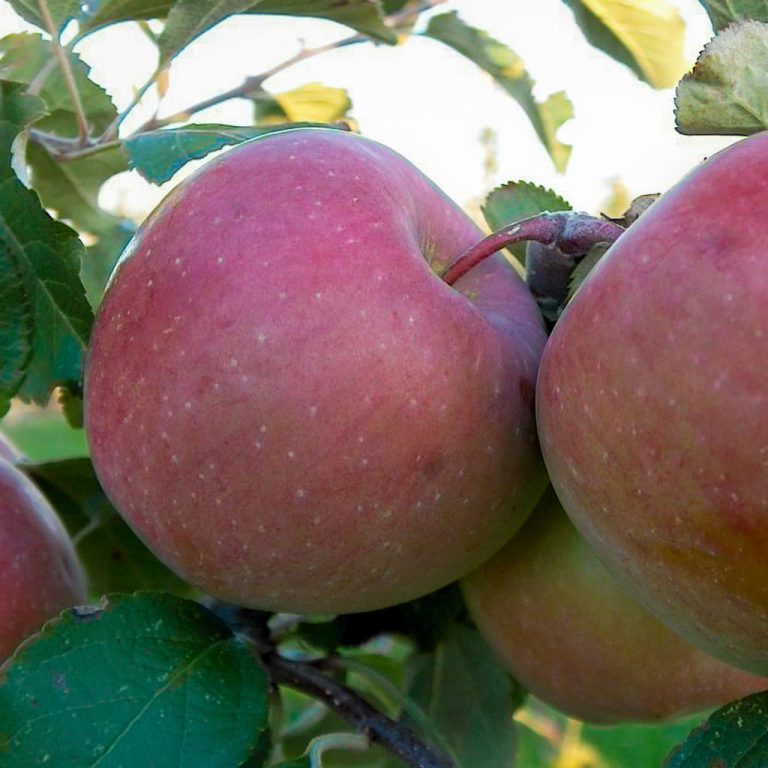
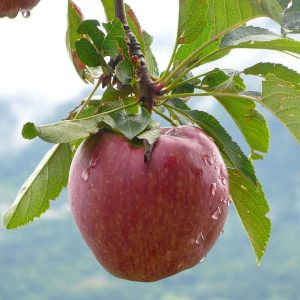
Fuji produces large fruit averaging 2.7 to 3.4 inches in diameter and 170 to 283 grams (6 to 10 oz), with a yellow-green base and a light pink to crimson-red blush that varies substantially by strain and sun exposure — trees in humid-summer climates often color less than those with full-day direct light. The flesh is fine-grained and dense, snapping cleanly when bitten, with very low acidity and rich sweetness that intensifies during cold storage. Fuji ranks among the highest-Brix commercial apple varieties, with values commonly in the 15 to 18 range at full ripeness. The thin skin tends to crack near harvest when rain follows a dry period, so maintaining consistent soil moisture through September matters. Storage life of 4 to 7 months under standard refrigeration — and up to 12 months in controlled-atmosphere storage — makes Fuji the benchmark fresh-keeping apple for home orchards. Culinary applications include fresh eating, salads, baking, applesauce, juice, cider, and dehydrating; the low-acid profile caramelizes cleanly but lacks the tartness some baking recipes rely on.
Ripening Season: Very Late
Harvest Window: Early Oct - Late Oct
Fruit Size: 2.7-3.4 inch
Fruit Weight: 170-283 g (6-10 oz)
Flavor: Sweet; low acidity; rich, dense sweetness with mild subacid notes; excellent flavor
Fruit Color: Yellow-green base with light pink to crimson-red blush; color varies widely by strain and sun exposure
Fruit Texture: Crisp, firm, very dense and juicy; flesh snaps cleanly; exceptionally fine-grained
Fruit Skin: Smooth, thin skin; tends to crack in wet conditions near harvest
Bearing Habit: Biennial bearing tendency; annual cropping requires consistent fruit thinning
Years to Bear: Select a rootstock above for exact bearing information.
Storage Life: 4-7 months refrigerated; 12 months with controlled atmosphere (CA) storage
Culinary Uses: Fresh eating; salads; baking; applesauce; cider; juice; drying; excellent long-term keeper
Fuji is susceptible to all four primary apple diseases and moderately susceptible to two, making disease management central to growing this variety successfully. Apple scab (Venturia inaequalis) is the most damaging: infections establish in spring when ascospores release during wet weather from green tip through petal fall. Rake and destroy leaf litter in fall to reduce the overwintering ascospore load; kaolin clay applied from green tip creates a physical barrier that disrupts spore adhesion. Fire blight (Erwinia amylovora) enters through blossoms and shoot tips — prune infected wood at least 12 inches below the visible margin during dry weather, sterilizing tools between cuts. Avoid high-nitrogen fertilization, which drives the succulent shoot growth fire blight colonizes most aggressively. Cedar apple rust (Gymnosporangium juniperi-virginianae) originates from nearby Eastern red cedars; removing juniper hosts within a quarter mile substantially reduces inoculum pressure. Powdery mildew (Podosphaera leucotricha) and black rot (Botryosphaeria obtusa) are moderately susceptible — canopy airflow pruning and mummified-fruit removal reduce both. All four tracked pests — codling moth (Cydia pomonella), plum curculio (Conotrachelus nenuphar), apple maggot (Rhagoletis pomonella), and brown marmorated stink bug (Halyomorpha halys) — lack variety-level resistance. Kaolin clay, red-sphere traps for apple maggot, exclusion netting, and codling moth pheromone traps are the primary OMRI-compatible tools.
Apple Scab: Susceptible
Fire Blight: Susceptible
Powdery Mildew: Resistant
Cedar Apple Rust: Susceptible
Black Rot: Moderately Susceptible
Codling Moth: Susceptible
Plum Curculio: Susceptible
Apple Maggot: Susceptible
Brown Marmorated Stink Bug: Susceptible
- Thin aggressively in June: Fuji's biennial bearing tendency is strong — thinning to one fruit per spur by late June sustains annual crops and maximizes fruit size.
- Scab spray starts at green tip: Fuji is fully susceptible to apple scab; apply copper or sulfur-based OMRI-listed materials before wetting events at bud break to interrupt the infection cycle.
- Time harvest by starch-iodine test: A starch-iodine test on a cut cross-section gives a more reliable maturity indicator than skin color, which varies by strain and exposure.
- Match site drainage to disease pressure: Fuji on waterlogged soil sees amplified fire blight and root rot; a dwarfing rootstock on a raised berm elevates the root zone on problematic sites.
- Remove eastern red cedar hosts: Cedar apple rust pressure is proportional to juniper density — removal or replacement with non-alternate-host shrubs is the most durable rust-management strategy.
We ship in late winter or early spring based on your USDA hardiness zone.
We strive to ship orders on the scheduled dates listed in the table below. However, please note that the actual shipping date may be subject to change due to factors like weather conditions and order volume.
The specific date for shipping your order will be determined according to your zipcode at the time of checkout.
Our plants are shipped bare root, packed in moist sawdust, and securely wrapped in plastic to prevent the roots from drying out. We use USPS Ground Advantage for shipping, ensuring that your plants typically arrive within 2-5 days after packaging.
In case you're unable to plant the trees immediately upon arrival, we recommend soaking them in water for a few hours and temporarily heeling them in. Ideally, they should be planted within three days of receipt for optimal health.
See our full shipping policy and map here
| Zone | Ship Date |
|---|---|
| 11 - 8b | March 1st, 2027 |
| 8a - 7b | March 8th, 2027 |
| 7a | March 15th, 2027 |
| 6b | March 22nd, 2027 |
| 6a | March 29th, 2027 |
| 5b - 5a | April 12th, 2027 |
| 4b - 4a | April 26th, 2027 |
| 3b - 1a | May 3rd, 2027 |
Our 365-Day Plant Guarantee: We ensure that our plants are delivered to you alive and healthy. If your plant does not survive its first year, you're eligible for store credit under these conditions:
- Your location falls within the appropriate USDA hardiness zone for the plant variety (refer to our hardiness zone map).
- You maintain the roots' moisture and plant within three days of delivery, following the instructions in our Planting Guide.
If you're concerned about your plant's health, please consult our guide, How to Tell if Your Tree is Dead or Dormant. Remember, our plants are shipped in a dormant state and may leaf out at different times based on their species. To check for plant vital
Related products

Granny Smith Apple
$49.95 Select Rootstock This product has multiple variants. The options may be chosen on the product pageChecking fit
Cortland Apple
Checking fit
Prairie Fire Crabapple
Checking fit
Honeycrisp Apple
Rated 5.00 out of 5$49.95 Select Rootstock This product has multiple variants. The options may be chosen on the product pageChecking fit


Reviews
There are no reviews yet.