Crimson Crisp Apple
$49.95
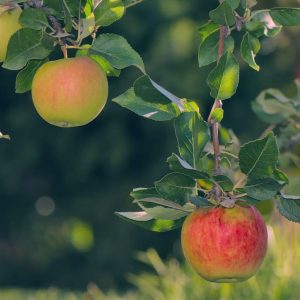
Crimson Crisp Apple (Malus domestica ‘Co-op 39’) is a PRI cooperative apple carrying the Vf gene for scab immunity, producing firm, very crisp 2.75–3 inch deep crimson fruit with a spicy sweet-tart finish and excellent fresh-eating and cider character. It grows in USDA hardiness zones 4-8 and AHS heat zones 1-7, needs 850-1000 chill hours, and requires cross-pollination with a compatible variety such as Gala Apple or Freedom Apple to set fruit.
4-5′ Bare Root Grafted Tree
Rootstock: M111 – Semi Dwarf
The most “bulletproof” option; thrives in heavy clay or dry, sandy soils.
Excellent drought resistance once established.
• Support: Freestanding; no staking required.
Can’t be shipped to: AK, HI, MT
Out of stock
Out of stock — back next season
Spring 2027 inventory drops in June. Drop your email and we'll notify you the day this variety is back in stock.
You're on the list. Check your inbox for a confirmation link — click it to lock in your spot. We'll email you the day this variety is back in stock.
Crimson Crisp, released commercially as CrimsonCrisp under plant patent PP16622, was developed through the PRI cooperative apple breeding program — a long-running collaboration among Purdue University, Rutgers University, and the University of Illinois founded in 1945 with the stated goal of introducing scab resistance into commercially viable apple cultivars. The original cross was made in 1971 at the Rutgers Fruit Research and Extension Center in Cream Ridge, New Jersey, with seed parent PCFW2-134 and pollen parent PR1 669-205. E. B. Williams at Purdue University selected the resulting seedling in 1979 at the Purdue Horticultural Research Farm in West Lafayette, Indiana, where it was initially tested as CLR20T14. Named breeders on the patent are Jules Janick, Edwin B. Williams, Joseph C. Goffreda, and Schuyler S. Korban.
The PRI program had by 2000 released eighteen scab-resistant cultivars through the same pipeline; Crimson Crisp, released in 2004 under the Co-op 39 experimental designation, was among the later and more commercially successful of that group. Its Vf scab immunity, derived from Malus floribunda 821 germplasm that the PRI program had been threading through breeding lines since the 1940s, combined with a standout crunch and vivid red color that competing disease-resistant releases like Enterprise and Liberty did not fully match.
Crimson Crisp performs best on well-drained loamy soils at pH 6.0–7.0; standing water during the growing season promotes Phytophthora collar rot, which bypasses the variety's otherwise strong pathogen resistance package. It demands a full-sun position — at least eight hours of direct light — because shading suppresses the anthocyanin development responsible for its signature deep crimson skin. Chill hours fall in the 800–1,000 range, placing the variety comfortably in Zones 5–7 and into the cooler pockets of Zone 8 in elevated terrain. Consistent moisture from fruit set through pit hardening supports size development; water stress during this window limits fruit weight below the 189-gram target. On semi-dwarf rootstock, a modified central-leader training system with annual dormant pruning opens canopy airflow and is especially important given the variety's moderate susceptibility to fire blight — a well-thinned canopy slows bacterial spread during bloom.
USDA Hardiness Zone: 4-8
AHS Heat Zone: 1-7
Chill Hours: 850-1000
Sun Requirements: Full Sun
Soil pH: 6.0-7.0
Soil Type: Loam; well-drained
Soil Drainage: Well-drained
Tree size depends heavily on rootstock selection: semi-dwarf stock holds height to 12–15 feet with a matching spread, while standard stock allows 15–20 feet in both dimensions. The growth habit is upright-spreading, with strong primary scaffold branches that angle upward before arching outward as the tree matures and sets fruit. Fruiting wood concentrates on two- and three-year-old spurs, so annual pruning should remove spent spur clusters and crossing branches rather than aggressively head back the leader. The rounded canopy at maturity occupies about the same footprint as a mature Honeycrisp — plan spacing at 12–15 feet for semi-dwarf rows. Deciduous foliage is dark green through the season, transitioning to yellow in autumn. Deep purple flower buds emerge in late April to early May across USDA zones 5 through 8, opening to white blooms with a shell-pink cast that make the tree briefly ornamental before the focus shifts to fruit.
Mature Height: 15-20 ft tall (standard); 12-15 ft tall (semi-dwarf)
Mature Spread: 12-20 ft wide (rootstock-dependent)
Growth Habit: Upright-spreading; rounded canopy with upright primary branches; spreading fruiting on 2- and 3-year-old wood
Growth Rate: Moderate
Foliage Type: Deciduous
Food Forest Layer: Canopy, Sub-canopy
Leaf Color: Dark green
Fall Foliage Color: Yellow
Life Span: 50+ years
Crimson Crisp is self-sterile and will not set commercially useful crops without a cross-pollinator in bloom simultaneously. It is a diploid, so standard pollinator logic applies — any mid-season diploid apple blooming in overlap is a candidate. The bloom window falls in late April to early May in a temperate climate. Strong pollinators from the nursery's inventory include Gala Apple, Honeycrisp Apple, Liberty Apple, and Fuji Apple, all of which overlap the bloom window reliably across most temperate sites. Keep pollinators within 50–100 feet for reliable bee transfer, and site them upwind of the prevailing spring airflow to help insects move pollen directionally toward the Crimson Crisp canopy.
Bloom Season: Mid
Bloom Window: Mid Apr - Late Apr
Pollination Requirements: Self-sterile; requires cross-pollination from a compatible apple variety
Pollination Mechanism: Insect (bee)
Flower Color: White with shell pink overtones; buds deep purple transitioning to bright white at bloom
Ploidy: Diploid
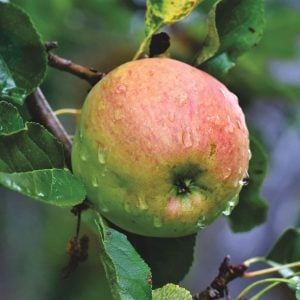
Fruit reaches roughly 2.75–3 inches in diameter and averages approximately 189 grams (6.7 oz) — medium-large by dessert-apple standards. The flavor profile is sweet-tart with mild acidity and a spicy, complex finish that distinguishes it from the lower-acid sweetness typical of Gala or Fuji; it is classified subacid, meaning tartness is noticeable but not sharp. The 95–100% deep crimson to red-purple skin over cream-yellow flesh produces a visually striking cross-section. Texture is very firm and coarse-fleshed with standout crunch — comparable to Honeycrisp in snap — which holds up well in fresh salads and on cheese boards where soft apples turn mushy. Cold storage life is 4–6 months at 1°C (34°F), extending to seven or more months under controlled-atmosphere conditions. Culinary range includes fresh eating, cider blending (the acidity adds complexity to blends dominated by sweet varieties), and baked applications where the firm flesh holds shape rather than collapsing.
Ripening Season: Late
Harvest Window: Mid Sep - Early Oct
Fruit Size: 2.75-3 inch
Fruit Weight: 189 g (6.7 oz)
Flavor: Sweet-tart; mildly acidic with a spicy, complex finish; subacid
Fruit Color: Deep crimson red; 95-100% red-purple skin over yellowish-cream flesh
Fruit Texture: Very crisp, firm; juicy; coarse flesh
Fruit Skin: Medium-thick; glossy
Years to Bear: 2-5 years
Storage Life: 4-6 months in cold storage (1°C / 34°F); controlled atmosphere extends quality
Culinary Uses: Fresh eating (dessert); salads; cider blending; pairs well with cheese; holds shape well in cooking
The Vf-gene scab resistance from Malus floribunda 821 gives Crimson Crisp essentially complete immunity to Apple Scab (Venturia inaequalis) under field conditions across humid-summer climates — growers can eliminate the entire fungicide schedule targeting scab that conventional apple programs require from bud break through petal fall. Cedar Apple Rust (Gymnosporangium juniperi-virginianae) and Powdery Mildew (Podosphaera leucotricha) resistance is moderate, allowing a light organic sulfur application at pink stage to cover rust in juniper-dense landscapes, but without the repeated sprays susceptible varieties need. The notable vulnerability is Fire Blight (Erwinia amylovora), where susceptibility is confirmed — prune out infected shoots immediately at least 8–12 inches below the visible infection margin, sterilizing tools between cuts with 10% bleach or 70% isopropyl alcohol, and avoid high-nitrogen fertilization that drives succulent growth attractive to the bacterium. Black Rot (Botryosphaeria obtusa) shows moderate susceptibility; remove and destroy all mummified fruit and cankered wood each dormant season to reduce overwintering inoculum. The four primary pests — Codling Moth (Cydia pomonella), Plum Curculio (Conotrachelus nenuphar), Apple Maggot (Rhagoletis pomonella), and Brown Marmorated Stink Bug (Halyomorpha halys) — all show moderate susceptibility, so kaolin clay barrier applications from petal fall through mid-summer form the core organic monitoring and suppression strategy.
Apple Scab: Very Resistant
Fire Blight: Susceptible
Powdery Mildew: Moderately Resistant
Cedar Apple Rust: Moderately Resistant
Black Rot: Moderately Susceptible
Codling Moth: Moderately Susceptible
Plum Curculio: Moderately Susceptible
Apple Maggot: Moderately Susceptible
Brown Marmorated Stink Bug: Moderately Susceptible
- Fire blight vigilance: Prune infected wood 8–12 inches below visible disease margin during dry weather; sterilize tools between every cut and keep nitrogen inputs moderate to discourage succulent shoot growth.
- Dormant pruning for airflow: Annual thinning of crossing branches and spent spur clusters opens the canopy, reduces humidity, and limits conditions that favor blight strikes during bloom.
- Maximize color development: Position trees where afternoon sun reaches fruit directly — shading even 20% of the canopy measurably reduces the deep crimson color that defines Crimson Crisp.
- Codling moth and curculio timing: Apply kaolin clay at petal fall and reapply every 7–14 days or after rain; set pheromone traps before bloom to track first adult flight and calibrate spray timing.
- Cold-storage potential: At 34°F with high humidity, fruit holds marketable quality for 4–6 months — viable for extended retail seasons or late-winter fresh eating.
We ship in late winter or early spring based on your USDA hardiness zone.
We strive to ship orders on the scheduled dates listed in the table below. However, please note that the actual shipping date may be subject to change due to factors like weather conditions and order volume.
The specific date for shipping your order will be determined according to your zipcode at the time of checkout.
Our plants are shipped bare root, packed in moist sawdust, and securely wrapped in plastic to prevent the roots from drying out. We use USPS Ground Advantage for shipping, ensuring that your plants typically arrive within 2-5 days after packaging.
In case you're unable to plant the trees immediately upon arrival, we recommend soaking them in water for a few hours and temporarily heeling them in. Ideally, they should be planted within three days of receipt for optimal health.
See our full shipping policy and map here
| Zone | Ship Date |
|---|---|
| 11 - 8b | March 1st, 2027 |
| 8a - 7b | March 8th, 2027 |
| 7a | March 15th, 2027 |
| 6b | March 22nd, 2027 |
| 6a | March 29th, 2027 |
| 5b - 5a | April 12th, 2027 |
| 4b - 4a | April 26th, 2027 |
| 3b - 1a | May 3rd, 2027 |
Our 365-Day Plant Guarantee: We ensure that our plants are delivered to you alive and healthy. If your plant does not survive its first year, you're eligible for store credit under these conditions:
- Your location falls within the appropriate USDA hardiness zone for the plant variety (refer to our hardiness zone map).
- You maintain the roots' moisture and plant within three days of delivery, following the instructions in our Planting Guide.
If you're concerned about your plant's health, please consult our guide, How to Tell if Your Tree is Dead or Dormant. Remember, our plants are shipped in a dormant state and may leaf out at different times based on their species. To check for plant vital
Related products

Cortland Apple
Checking fit
Dorsett Golden Apple
Checking fitRated 5.00 out of 5
Profusion Crabapple
Checking fit
Wolf River Apple
Checking fit

Reviews
There are no reviews yet.