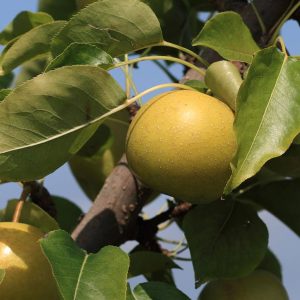
Wolf River Apple
$49.95
Wolf River Apple (Malus domestica ‘Wolf River’) is a vigorous heirloom apple traced to a Wisconsin chance seedling of Alexander descent, producing exceptionally large 3–5 inch fruit with mild subacid flavor—one apple fills a pie—that holds its shape beautifully when baked. It grows in USDA hardiness zones 4-8 and AHS heat zones 1-6, needs 900-1100 chill hours, and requires cross-pollination with a compatible variety such as Freedom Apple or Fuji Apple to set fruit.
4-5′ Bare Root Grafted Tree
Rootstock: G890 – Semi Dwarf
About 60-65% of a standard tree, the largest Geneva we use. Highly tolerant of fire blight and collar rot, and resistant to woolly apple aphid.
• Support: Freestanding; no staking required.
Can’t be shipped to: AK, HI, MT
In stock
Wolf River traces to a chance seedling that grew along the banks of the Wolf River in Fremont, Wisconsin, around the 1860s. According to the earliest accounts, William Springer carried a bushel of Alexander apples (also known as Aport, a large Russian cultivar brought to North America from Quebec) westward during migration, and seeds from that shipment gave rise to the tree. The variety was first mentioned in print by the Wisconsin State Horticultural Society in its 1875 annual Transactions, establishing a firm historical record. Parentage is presumed to be an open-pollinated seedling of Alexander, accounting for the shared trait of notably large fruit size; no formal cross is documented. Wolf River entered regional nursery trade by the late 1880s and gained rapid popularity among Wisconsin settlers who valued a single fruit capable of filling a pie. It remained primarily a home-orchard and heritage variety, seldom appearing in commercial production due to its soft texture and brief storage window. The variety is fully in the public domain with no patent or royalty restrictions.
Wolf River's cold hardiness through Zone 3 makes it one of the more reliable choices for growers in the northern tier, where many popular cultivars fail. The roughly 1,000-hour chilling requirement fits naturally into temperate climates with genuine winters, and the variety struggles at the warmer edge of Zone 8 where accumulated chill is inconsistent. Plant in full sun — at least six direct hours daily — since shaded canopies compound disease pressure and reduce fruit coloring. Soil drainage matters more than texture; Wolf River tolerates a range from loamy sand to clay loam but will underperform in waterlogged ground, especially during bloom and early fruit set when root oxygen demand peaks. Aim for pH between 6.0 and 7.0 for optimal nutrient availability. Consistent moisture during the first two to three growing seasons speeds establishment; once anchored, the tree handles moderate dry spells without significant yield loss. Standard trees require 18 to 25 feet of spacing; semi-dwarf forms on size-controlling rootstocks can be planted 12 to 16 feet apart and come into bearing somewhat earlier.
USDA Hardiness Zone: 4-8
AHS Heat Zone: 1-6
Chill Hours: 900-1100
Sun Requirements: Full Sun (6+ hours direct sun daily)
Soil pH: 6.0-7.0
Soil Type: Loam, well-drained; tolerates clay to sandy loam
Soil Drainage: Well-drained
Water Requirements: Medium; consistent moisture during establishment; drought tolerant once established
Drought Tolerance: Moderate; drought tolerant once established
Plant Spacing: 18-25 ft (standard); 12-16 ft (semi-dwarf)
Container Suitability: Not suitable (very vigorous standard tree; dwarf rootstock required for container)
Wolf River develops into a large, vigorous tree with an upright-spreading habit that growers often describe as somewhat open and straggly compared to more formally shaped commercial varieties. On standard rootstock the tree reaches 18 to 25 feet tall with a canopy spread of 18 to 20 feet; semi-dwarf grafts produce a more manageable silhouette of 12 to 16 feet in both dimensions. The open framework benefits airflow through the canopy — a practical advantage given Wolf River's susceptibility to fire blight. Annual pruning to thin crossing branches and maintain central leader structure keeps fruit accessible and reduces disease inoculum. Growth rate is medium; expect several years of establishment before significant fruiting begins. The tree is long-lived, with productive lifespans commonly exceeding 50 to 100 years under reasonable care. White to pale pink flowers open in early to mid-April (Zones 5 to 6) and mid-April to early May in Zone 4, producing a brief but notable floral display that attracts bees, butterflies, and other pollinators. Deciduous foliage is medium green through the growing season.
Mature Height: 18-25 ft tall (standard); 12-16 ft tall (semi-dwarf)
Mature Spread: 18-20 ft wide (standard); 12-16 ft wide (semi-dwarf)
Growth Habit: Upright-spreading; somewhat straggly; very vigorous
Growth Rate: Moderate
Foliage Type: Deciduous
Food Forest Layer: Canopy
Leaf Color: Medium green
Thorns?: No
Attracts Wildlife: Yes; attracts deer, birds, small mammals, bees, butterflies
Life Span: 50-100+ years
Wolf River is self-unfruitful and requires a cross-pollinator blooming in the same or an adjacent bloom group (group 3 to 5 diploid) to set a full crop. The variety is diploid, so its pollen is viable and it can serve as a pollinator for other compatible varieties — no second dedicated pollinator is needed. Bloom occurs in early to mid-April in Zones 5 to 6 and mid-April to early May in Zone 4, timing that overlaps reliably with mid-season flowering varieties. Honeycrisp Apple and McIntosh Apple are practical choices that bloom in the same window and are widely available. Golden Delicious Apple provides reliable bloom overlap across a wide zone range. Insect pollination — primarily honeybees and native bees — is required for effective pollen transfer; a 100-foot planting radius between varieties is adequate for bee foraging under most conditions.
Bloom Season: Mid
Bloom Window: Mid Apr - Late Apr
Pollination Requirements: Self-unfruitful; requires cross-pollination with another apple variety in bloom group 4 (same or adjacent group)
Pollination Mechanism: Insect (bee) pollinated
Flower Color: White to pale pink
Ploidy: Diploid
The defining trait of Wolf River is scale: fruits typically span 3 to 5 inches in diameter and commonly exceed one pound each, putting a single apple within range of filling a standard 9-inch pie without slicing more than one fruit. Flavor is mildly subacid with slight aromatic notes — pleasant when eaten fresh but not the complex sweet-tart profile that drives fresh-market demand. The flesh is white, soft, and somewhat coarse or granular at full ripeness, which limits fresh-eating appeal but makes it ideal for baking, since the texture holds shape during cooking rather than collapsing into mush. Fruit color is a red to pink-red blush, sometimes with stripes, over a yellow-green background. Harvest runs late September to mid-October. Storage life is short — around one month — so plan to process promptly after picking. Wolf River excels as a cooking apple across all methods: pies, apple butter, applesauce, canning, and drying all suit its size and texture. Dropped or overripe fruit is heavily utilized by deer, birds, and small mammals, adding incidental wildlife value to the planting.
Ripening Season: Late
Harvest Window: Late Sep - Mid Oct
Fruit Size: 3-5 inch
Fruit Weight: 1 lb or more per fruit
Flavor: Mildly subacid; slightly aromatic; mild and pleasant when eaten fresh; tart when cooked
Fruit Color: Red to pink-red blush (sometimes striped) over yellow-green background; white flesh
Fruit Texture: Soft, tender, coarse/granular; holds shape well when cooked; can be mealy at full ripeness
Bearing Habit: Annual bearer; reliable and productive once established; slow to come into bearing
Years to Bear: 2-5 years
Storage Life: 1 month or less; poor keeper
Culinary Uses: Baking, pies, apple butter, canning, drying, applesauce; can be eaten fresh; ideal for cooking due to large size (one apple per pie)
Wolf River's disease profile is genuinely mixed, with two strong suits and two meaningful vulnerabilities. It is highly resistant to Apple Scab (Venturia inaequalis) and Powdery Mildew (Podosphaera leucotricha), and resistant to Cedar Apple Rust (Gymnosporangium juniperi-virginianae) — a combination that substantially reduces fungicide pressure in humid climates where these three diseases typically dominate the spray calendar. Fire Blight (Erwinia amylovora) is the most serious concern: Wolf River is susceptible, and the disease spreads rapidly during warm, wet bloom periods. Prune out infected wood at least 12 inches below visible symptoms, sterilize tools between cuts with 70% isopropyl alcohol, and avoid high-nitrogen fertilization that promotes the succulent shoot growth blight bacteria colonize most aggressively. Black Rot (Botryosphaeria obtusa) presents moderate susceptibility; promptly remove mummified fruits and dead wood where the fungus overwinters. All four tracked pests — Codling Moth (Cydia pomonella), Plum Curculio (Conotrachelus nenuphar), Apple Maggot (Rhagoletis pomonella), and Brown Marmorated Stink Bug (Halyomorpha halys) — show moderate susceptibility. Codling moth and apple maggot respond well to kaolin clay applied at petal fall and repeated through summer. Plum curculio adults can be jarred from branches onto ground cloths and destroyed. Stink bug pressure peaks in late summer; perimeter trap crops and exclusion netting over individual fruits reduce damage.
Apple Scab: Very Resistant
Fire Blight: Susceptible
Powdery Mildew: Very Resistant
Cedar Apple Rust: Resistant
Black Rot: Moderately Susceptible
Codling Moth: Moderately Susceptible
Plum Curculio: Moderately Susceptible
Apple Maggot: Moderately Susceptible
Brown Marmorated Stink Bug: Moderately Susceptible
- Fire blight defense starts at pruning: Prune to an open, well-ventilated canopy each dormant season and sterilize tools with 70% isopropyl alcohol between cuts to avoid spreading fire blight within the tree.
- Kaolin clay from petal fall: For codling moth and apple maggot control, begin kaolin clay applications at petal fall before egg-laying peaks; reapply after rain events through midsummer to maintain the protective barrier.
- Harvest promptly: Shelf life runs about one month; pick at first color break and process quickly — fruit left past peak develops mealy texture and loses cooking quality.
- Choose rootstock carefully: Standard-size trees reach 20-25 feet; semi-dwarf rootstock (MM.106, M.7) keeps the tree at 12-16 feet and brings bearing 1-2 years earlier without sacrificing hardiness.
We ship in late winter or early spring based on your USDA hardiness zone.
We strive to ship orders on the scheduled dates listed in the table below. However, please note that the actual shipping date may be subject to change due to factors like weather conditions and order volume.
The specific date for shipping your order will be determined according to your zipcode at the time of checkout.
Our plants are shipped bare root, packed in moist sawdust, and securely wrapped in plastic to prevent the roots from drying out. We use USPS Ground Advantage for shipping, ensuring that your plants typically arrive within 2-5 days after packaging.
In case you're unable to plant the trees immediately upon arrival, we recommend soaking them in water for a few hours and temporarily heeling them in. Ideally, they should be planted within three days of receipt for optimal health.
See our full shipping policy and map here
| Zone | Ship Date |
|---|---|
| 11 - 8b | March 1st, 2027 |
| 8a - 7b | March 8th, 2027 |
| 7a | March 15th, 2027 |
| 6b | March 22nd, 2027 |
| 6a | March 29th, 2027 |
| 5b - 5a | April 12th, 2027 |
| 4b - 4a | April 26th, 2027 |
| 3b - 1a | May 3rd, 2027 |
Our 365-Day Plant Guarantee: We ensure that our plants are delivered to you alive and healthy. If your plant does not survive its first year, you're eligible for store credit under these conditions:
- Your location falls within the appropriate USDA hardiness zone for the plant variety (refer to our hardiness zone map).
- You maintain the roots' moisture and plant within three days of delivery, following the instructions in our Planting Guide.
If you're concerned about your plant's health, please consult our guide, How to Tell if Your Tree is Dead or Dormant. Remember, our plants are shipped in a dormant state and may leaf out at different times based on their species. To check for plant vital
Related products

Swamp Chestnut Oak
Checking fitRated 5.00 out of 5
Loring Peach
Checking fitRated 4.50 out of 5
Shinseiki Asian Pear
Checking fit
Bur Oak
Checking fit


Reviews
There are no reviews yet.