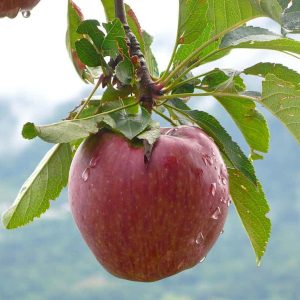
Ambrosia Apple
$59.95
Ambrosia Apple (Malus domestica ‘Ambrosia’) is a chance-seedling apple discovered in British Columbia around 1987, yielding large, honey-sweet, low-acid fruit with a hint of pear, firm crisp flesh that resists browning after cutting, and 70–90% bright red skin. It grows in USDA hardiness zones 4-8 and AHS heat zones 1-7, needs 800-1000 chill hours, and requires cross-pollination with a compatible variety such as Freedom Apple or Fuji Apple to set fruit.
4-5′ Bare Root Grafted Tree
Rootstock: G969 – Semi Dwarf
Sizes like M.7. Fire blight and crown rot resistant, precocious and heavy bearing.
• Support: Freestanding; staking optional the first 2-3 years.
Can’t be shipped to: AK, HI, MT
In stock
Ambrosia Apple originated as a chance seedling discovered by Wilfrid and Sally Mennell on their orchard in Cawston, in British Columbia’s Similkameen Valley, around 1987 to 1991 — sources differ slightly on the exact year. The seedling emerged in a row of established plantings, and its exact parentage was never confirmed through controlled crossing records. Pomologists examining the variety have pointed to Jonagold and Golden Delicious as possible parents based on flavor and appearance, while others have noted the presence of Starking Delicious in the same orchard block, leaving parentage an open and likely unresolvable question.
The Mennells propagated the tree, grafted cuttings to verify that its characteristics would hold, and in 1993 partnered with the Summerland Varieties Corporation (formerly OKANAGAN Plant Improvement Corporation) to register and commercialize the selection. They named it Ambrosia, after the food of the gods in Greek mythology. A Canadian plant breeder’s rights certificate covered the variety through 2017, after which the patent expired and unrestricted propagation became possible. The combination of low acidity, slow browning of cut flesh, and long storage life drove rapid adoption in both commercial orchards and home gardens across Canada and the temperate apple belt.
Ambrosia performs best in sites offering at least six hours of direct sun daily with good air circulation, which matters especially given its high susceptibility to apple scab and cedar apple rust in humid conditions. Soil in the loam-to-clay-loam range with a pH between 6.0 and 7.0 provides optimal nutrient availability; add sulfur to lower pH above 7.0 or lime to raise it below 6.0, testing every three to four years. Consistent moisture during fruit cell division — roughly from petal fall through early summer — supports the large fruit size Ambrosia is known for, but standing water at the roots invites Phytophthora and root rot. Space trees 12–15 feet apart to allow adequate airflow and to ease canopy management. Ambrosia's spur-bearing habit means it crops annually on short, persistent spurs rather than on long one-year shoots, so training to a central-leader form with well-spaced scaffold branches is the most efficient structure.
USDA Hardiness Zone: 4-8
AHS Heat Zone: 1-7
Chill Hours: 800-1000
Sun Requirements: Full Sun
Soil pH: 6.0-7.0
Soil Type: Loam, sandy loam, clay loam (well-drained)
Soil Drainage: Well-drained
Water Requirements: Medium; consistent moisture, avoid waterlogging
Drought Tolerance: Low to Moderate
Plant Spacing: 12-15 ft apart
At maturity, Ambrosia reaches roughly 12–15 feet in both height and spread on standard rootstock, though semi-dwarfing rootstocks (M.26, G.935) bring it to 8–12 feet and accelerate bearing age to two to three years. The growth habit is upright and compact, which simplifies pruning to maintain interior light penetration — the primary target when managing a spur-type apple. Spur systems on older wood tend to become congested over time; renewal pruning every three to four years, removing the weakest spur clusters, keeps fruit size from declining. The deciduous canopy provides moderate shade in summer and opens fully in winter, making Ambrosia a workable component in food forest canopy layers where understory light management matters. Bark is smooth to slightly furrowed on older scaffold limbs, and the tree develops a moderately dense branch architecture that responds well to open-center or modified central-leader training.
Mature Height: 12-15 ft tall
Mature Spread: 12-15 ft wide
Growth Habit: Upright, compact
Growth Rate: Moderate
Foliage Type: Deciduous
Food Forest Layer: Canopy, Sub-canopy
Attracts Wildlife: Bees, birds
Life Span: 50-100+ years
Ambrosia is a diploid that produces viable pollen but is not self-fertile; a cross-pollinating companion with overlapping bloom is required for reliable fruit set. Bloom falls in the early-to-mid April window in temperate climates, placing it solidly in the standard mid-season apple bloom group. Compatible diploid pollinators from that group include Golden Delicious Apple, Fuji Apple, Gala Apple, Honeycrisp Apple, and Cortland Apple. Honeybees are the primary transfer agent; maintaining a hive within a quarter-mile or planting a pollinator strip near the orchard directly improves set rates. Flowers are pink-tinged in bud, opening to white, and are attractive to native pollinators as well. Plant the pollinator within 50 feet for reliable bee movement between trees.
Bloom Season: Mid
Bloom Window: Mid Apr - Late Apr
Pollination Requirements: Requires cross-pollinator; not self-fertile
Pollination Mechanism: Insect (bee)
Flower Color: Pink and white
Ploidy: Diploid
Ambrosia produces large fruit averaging 3.0 inches in diameter and 210–220 grams (7–8 oz), with a smooth, glossy skin showing a 70–90% bright red blush over a cream-to-yellow background. The flavor profile is distinctly low-acid and sweet, with honey and floral notes and faint undertones reminiscent of pear — a profile that diverges sharply from the balanced sweet-tart of Honeycrisp or the sharp crispness of Granny Smith. Brix values documented in commercial trials typically fall in the 14–16 range. Flesh is firm, fine-grained, and resists enzymatic browning for longer than most varieties after cutting, making it practical for fruit trays, salads, and cheese boards where appearance matters. Storage life is excellent: up to four months in air storage and six or more months under controlled atmosphere conditions. The variety matures in mid-September to early October in temperate climates, ahead of late-season keepers like GoldRush, and crops annually from spur systems at moderate-to-heavy yields of 30–50 pounds per semi-dwarf tree.
Ripening Season: Late
Harvest Window: Mid Sep - Early Oct
Fruit Size: 3 inch
Fruit Weight: 210-220 g (7-8 oz)
Flavor: Sweet, low-acid, honey-floral notes with hints of pear; very juicy
Fruit Color: 70-90% bright red blush with broad faint stripes over cream to yellow background
Fruit Texture: Firm, crisp, juicy; flesh resists browning after cutting
Fruit Skin: Smooth, glossy, thin
Bearing Habit: Spur bearer, annual
Years to Bear: 2-5 years
Storage Life: 4 months air storage; 6+ months controlled atmosphere
Culinary Uses: Fresh eating, salads, baking, cheese pairings; slow browning makes it ideal for fresh displays
Apple scab (Venturia inaequalis) and cedar apple rust (Gymnosporangium juniperi-virginianae) present the two most pressing disease management challenges for Ambrosia — the variety is highly susceptible to both. In humid climates where primary scab infection periods begin with green-tip, a preventive spray program with copper or OMRI-listed sulfur timed to Mills Table infection periods is essential; sanitation — raking and removing fallen leaves — sharply reduces overwintering inoculum. Cedar apple rust requires removal of nearby eastern red cedars and junipers within several hundred feet, or where that's impractical, sulfur applications from pink bud through petal fall. Fire blight (Erwinia amylovora) susceptibility is moderate; prune blighted shoots at least 8–12 inches below visible discoloration during dry weather and sterilize tools between cuts. Black rot (Botryosphaeria obtusa) susceptibility is moderate; remove mummified fruit promptly and prune out dead or canker-infected wood. Ambrosia's powdery mildew (Podosphaera leucotricha) resistance is solid, reducing that particular management burden. Codling moth (Cydia pomonella), plum curculio (Conotrachelus nenuphar), apple maggot (Rhagoletis pomonella), and brown marmorated stink bug (Halyomorpha halys) all show moderate susceptibility; deploy kaolin clay applications starting at petal fall, supplemented by codling moth traps to time spray windows, and physical exclusion bags for small plantings.
Apple Scab: Very Susceptible
Fire Blight: Susceptible
Powdery Mildew: Resistant
Cedar Apple Rust: Very Susceptible
Black Rot: Moderately Susceptible
Codling Moth: Moderately Susceptible
Plum Curculio: Moderately Susceptible
Apple Maggot: Moderately Susceptible
Brown Marmorated Stink Bug: Moderately Susceptible
- Scab prevention calendar: Begin copper or sulfur applications at green-tip stage and track Mills Table wetting events. Missing even one primary-season infection window can compromise Ambrosia's fruit quality for the entire crop.
- Cedar removal radius: Map eastern red cedars within 500 feet. Cedar apple rust galls on those hosts produce spores infecting Ambrosia; eliminating the alternate host is the most effective long-term management step.
- Pollinator placement: Site your cross-pollinator within 50 feet downwind from Ambrosia. Honeybee flight patterns favor short distances; wider spacing reduces set rates noticeably.
- Spur renewal pruning: Every three to four years, remove the oldest spur clusters to the scaffold limb. Fresh spurs produce larger, better-colored fruit and support annual bearing.
- Harvest timing: Pick when background color shifts toward cream-yellow and starch index reaches 4–6. Cool immediately to 32–34°F; Ambrosia holds quality for up to four months in proper cold storage.
We ship in late winter or early spring based on your USDA hardiness zone.
We strive to ship orders on the scheduled dates listed in the table below. However, please note that the actual shipping date may be subject to change due to factors like weather conditions and order volume.
The specific date for shipping your order will be determined according to your zipcode at the time of checkout.
Our plants are shipped bare root, packed in moist sawdust, and securely wrapped in plastic to prevent the roots from drying out. We use USPS Ground Advantage for shipping, ensuring that your plants typically arrive within 2-5 days after packaging.
In case you're unable to plant the trees immediately upon arrival, we recommend soaking them in water for a few hours and temporarily heeling them in. Ideally, they should be planted within three days of receipt for optimal health.
See our full shipping policy and map here
| Zone | Ship Date |
|---|---|
| 11 - 8b | March 1st, 2027 |
| 8a - 7b | March 8th, 2027 |
| 7a | March 15th, 2027 |
| 6b | March 22nd, 2027 |
| 6a | March 29th, 2027 |
| 5b - 5a | April 12th, 2027 |
| 4b - 4a | April 26th, 2027 |
| 3b - 1a | May 3rd, 2027 |
Our 365-Day Plant Guarantee: We ensure that our plants are delivered to you alive and healthy. If your plant does not survive its first year, you're eligible for store credit under these conditions:
- Your location falls within the appropriate USDA hardiness zone for the plant variety (refer to our hardiness zone map).
- You maintain the roots' moisture and plant within three days of delivery, following the instructions in our Planting Guide.
If you're concerned about your plant's health, please consult our guide, How to Tell if Your Tree is Dead or Dormant. Remember, our plants are shipped in a dormant state and may leaf out at different times based on their species. To check for plant vital
Related products

Honeycrisp Apple
Rated 5.00 out of 5$49.95 Select Rootstock This product has multiple variants. The options may be chosen on the product pageChecking fit
Cortland Apple
Checking fit
Dorsett Golden Apple
Checking fitRated 5.00 out of 5
Robinson Crabapple
Checking fit


Reviews
There are no reviews yet.