
Fire Blight Resistant Apple Varieties
In a regenerative, spray-free system, genetics is your primary firewall against fire blight. You cannot rely on chemical rescue; the tree must possess the innate machinery to resist the bacteria. The single most effective decision a grower makes occurs before the tree is ever planted.
However, determining exactly which varieties are “resistant” has historically been a challenge. Catalog descriptions are often vague, and resistance data is notoriously difficult to standardize. A variety that appears resistant in the dry heat of Washington State might succumb rapidly in the humid warmth of a North Carolina spring.
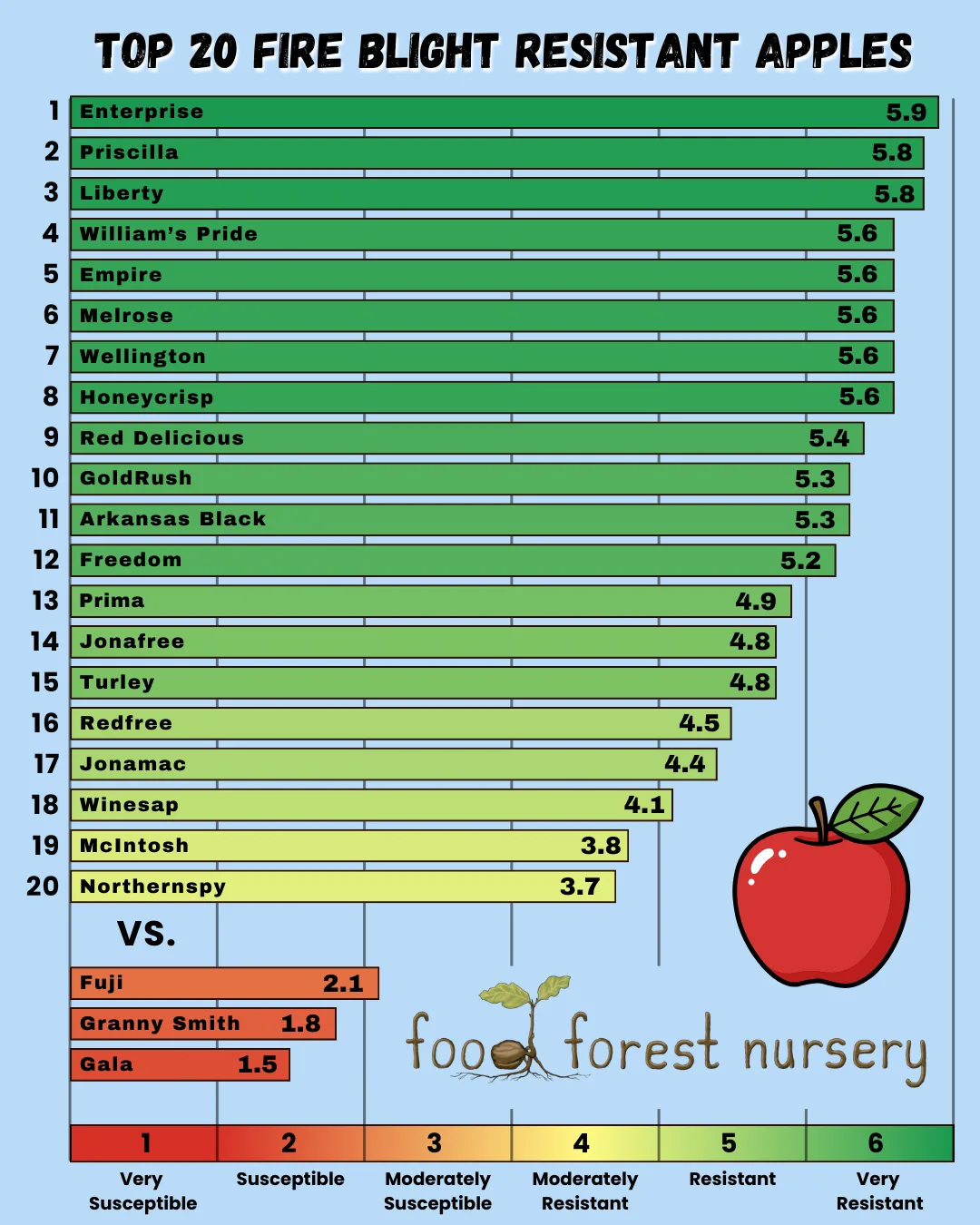
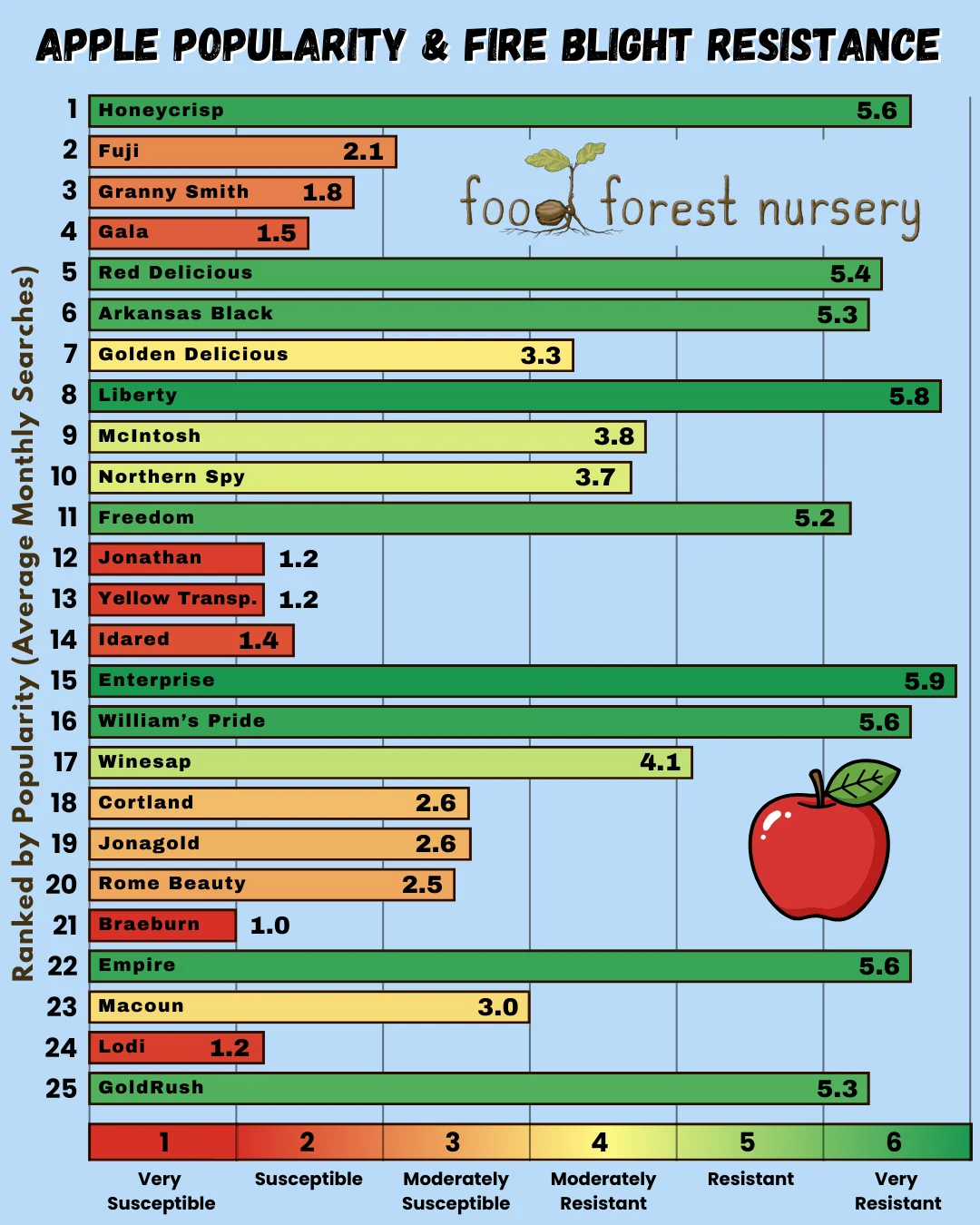
To cut through this confusion, we compiled a comprehensive analysis of 11 independent university and extension research studies. We normalized this diverse data onto a single scale to visualize exactly which trees can stand up to the disease and which require life-support.
The “Permaculture All-Stars” & Resilient Favorites
At the top of our resistance index, we find the varieties that form the backbone of a resilient orchard. These are candidates for lower-input growing, but no resistance score guarantees immunity or a spray-free harvest.
- Enterprise: A strong fire-blight-resistance candidate; symptom-free results in one trial do not establish universal immunity.
- Liberty: Bred for disease resistance, with different resistance levels to scab, rust and fire blight; these are separate diseases.
- Empire: A reliable, high-scoring staple perfect for low-input growers.
- Arkansas Black: Heritage variety with incredible storage and infection-resistant skin.
- GoldRush: Spicy flavor, exceptional keeping quality, and high disease resistance.
- Freedom: A disease-resistant selection whose management needs still depend on local pest and disease pressure.
- Winesap: Vigorous, old-fashioned favorite with rich, tart flavor.
- McIntosh: A classic Northeast variety with respectable resilience.
- Wolf River: Massive fruit with solid resistance; ideal for baking and cider.
The Popularity Trap (Handle with Care)
Conversely, many well-known apples—such as Gala, Fuji, Granny Smith, Jonathan, and Yellow Transparent—rank near the bottom of the resistance index.
We recommend planting these susceptible varieties only if you live in a low-pressure area, such as the arid West or high desert, where cool, dry springs naturally inhibit bacterial growth. If you live in a high-pressure zone with humid springs (like the East, Midwest, or South), growing these varieties requires rigorous vigilance; without it, you are essentially setting a banquet for the bacteria.
The short answer: The best defense against fire blight is planting resistant genetics from the start — varieties like Enterprise, Liberty, and Arkansas Black rank at the top of our 11-study resistance index, while Gala, Fuji, Granny Smith, and Jonathan rank near the bottom and need vigilant management in humid climates. Once a tree is infected, you cannot cure the blackened tissue — you can only prune 8 to 12 inches below it into healthy wood and sanitize your tools between every cut.
Table of Contents
Fire Blight Resistance Apple Database
The most fire blight resistant apple varieties — Enterprise, Liberty, Empire, Arkansas Black, and GoldRush — score highest across 11 university studies, while classic grocery-store varieties like Gala, Fuji, Jonathan, and Granny Smith rate as highly susceptible; use the sortable table below to check any of the 130+ varieties by resistance score, number of studies, and search popularity.
130+ Searchable Varieties
For a granular look at the 130+ varieties, consult the interactive table below. We have averaged the results from 11 studies including Cornell, Purdue, Washington State University, and others and then normalized the results.
How to use this table: You can filter by “Resistance Score” , “Number of Studies” or “Popularity.”
{ “@context”: “https://schema.org”, “@type”: “Dataset”, “name”: “Apple Variety Fire Blight Resistance Database”, “description”: “A compiled dataset of fire blight disease resistance ratings for over 130 apple varieties, normalized from 11 independent university and extension studies.”, “creator”: { “@type”: “Organization”, “name”: “Food Forest Nursery” }, “variableMeasured”: [ “Apple Variety Name”, “Fire Blight Resistance Score (Normalized 1-6)”, “Search Popularity” ], “keywords”: [“Apple Trees”, “Fire Blight”, “Disease Resistance”, “Permaculture”, “Erwinia amylovora”] }Variety | Resistance Score | # of Studies | Search Volume | Avg. | TN | AL | C | CSU | Ontario | Pur 132 | Pur 30 | VT | WSU | MSU | Ext.org |
|---|---|---|---|---|---|---|---|---|---|---|---|---|---|---|---|
| Akane | 4.4 | 4 | 50 | 3.5 | – | – | – | 4 | – | 4 | – | – | 2 | 4 | – |
| Autumn Crisp | 2.4 | 1 | 20 | 2.0 | – | – | – | – | – | – | – | – | 2 | – | – |
| Baldwin | 2.7 | 4 | 90 | 2.3 | – | – | – | 2 | – | 2 | – | 2 | – | – | 3 |
| Beacon | 2.4 | 6 | 20 | 2.0 | – | – | – | 2 | – | 2 | 2 | 2 | 1 | – | 3 |
| Belle de Boskoop | 3.7 | 1 | 70 | 3.0 | – | – | – | 3 | – | – | – | – | – | – | – |
| Ben Davis | 1.0 | 3 | 30 | 1.0 | – | – | – | 1 | – | – | – | 1 | – | – | 1 |
| Black Twig | 1.0 | 1 | 210 | 1.0 | – | – | – | 1 | – | – | – | – | – | – | – |
| Blushing Golden | 3.7 | 2 | 20 | 3.0 | – | – | – | 3 | – | – | – | – | – | 3 | – |
| Braeburn | 1.0 | 6 | 260 | 1.0 | – | 1 | – | 1 | – | 1 | – | 1 | – | 1 | 1 |
| Brandywine | 3.7 | 1 | 20 | 3.0 | – | – | – | 3 | – | – | – | – | – | – | – |
| Burgundy | 1.5 | 4 | 70 | 1.4 | – | – | – | 1 | – | – | – | 1 | 2.5 | – | 1 |
| Cameo | 3.4 | 2 | 90 | 2.8 | – | – | – | – | – | 2 | – | – | 3.5 | – | – |
| Carroll | 5.5 | 3 | 20 | 4.3 | – | – | – | 4 | – | – | – | 4 | – | – | 5 |
| Cox’s Orange Pippin | 4.4 | 2 | 40 | 3.5 | – | – | – | 4 | – | – | – | – | 3 | – | – |
| Dayton | 5.3 | 3 | 50 | 4.2 | – | – | – | – | 4 | 5 | – | – | 3.5 | – | – |
| Discovery | 3.0 | 2 | 20 | 2.5 | – | – | – | 3 | – | – | – | – | 2 | – | – |
| Dolgo | 5.1 | 2 | 30 | 4.0 | – | – | – | 3 | – | – | – | – | 5 | – | – |
| Duchess of Oldenburg | 4.4 | 2 | 30 | 3.5 | – | – | – | 3 | – | – | – | – | 4 | – | – |
| Earligold | 2.4 | 4 | 10 | 2.0 | – | – | – | 2 | – | – | – | 2 | – | 1 | 3 |
| Elstar | 2.4 | 2 | 110 | 2.0 | – | – | – | 2 | – | – | – | – | 2 | – | – |
| Empire | 5.6 | 10 | 210 | 4.4 | 4 | 4 | 4 | 4 | – | 5 | 5 | 4 | 4 | 5 | 5 |
| Fiesta | 5.1 | 1 | 30 | 4.0 | – | – | – | – | – | – | – | – | 4 | – | – |
| Fireside | 5.1 | 1 | 390 | 4.0 | – | – | – | – | – | – | – | – | 4 | – | – |
| Florina | 4.6 | 3 | 20 | 3.7 | – | – | – | 3 | 4 | 4 | – | – | – | – | – |
| Fortune | 3.0 | 1 | 20 | 2.5 | – | – | – | – | – | – | – | – | 2.5 | – | – |
| Ginger Gold | 1.0 | 7 | 140 | 1.0 | 1 | – | – | 1 | – | 1 | – | 1 | 1 | 1 | 1 |
| Gloster | 3.3 | 3 | 20 | 2.7 | – | – | – | 3 | – | – | – | 2 | – | – | 3 |
| Golden Hornet | 3.7 | 1 | 20 | 3.0 | – | – | – | 3 | – | – | – | – | – | – | – |
| Gravenstein | 3.0 | 4 | 260 | 2.5 | – | – | – | 3 | – | 2 | – | 2 | – | – | 3 |
| Grimes Golden | 3.0 | 4 | 320 | 2.5 | – | – | – | 3 | – | 2 | – | 2 | – | – | 3 |
| Haralson | 5.7 | 4 | 260 | 4.5 | – | – | – | 4 | – | 5 | 5 | – | 4 | – | – |
| Idared | 1.4 | 7 | 320 | 1.3 | – | – | – | 1 | – | 1 | 2 | 1 | 2 | 1 | 1 |
| Indian Summer | 5.1 | 1 | 20 | 4.0 | – | – | – | 4 | – | – | – | – | – | – | – |
| Ingrid Marie | 4.4 | 1 | 10 | 3.5 | – | – | – | – | – | – | – | – | 3.5 | – | – |
| James Grieve | 4.4 | 2 | 20 | 3.5 | – | – | – | 4 | – | – | – | – | 3 | – | – |
| Jerseymac | 3.0 | 4 | 0 | 2.5 | – | – | – | 3 | – | 2 | – | 2 | – | – | 3 |
| Jonafree | 4.8 | 6 | 110 | 3.8 | 3 | 3 | – | 3 | 4 | – | 6 | – | 4 | – | |
| Jonagold | 2.6 | 9 | 260 | 2.2 | 1 | 3 | – | 2 | – | 1 | 5 | 1 | 3.5 | 2 | 1 |
| Jonamac | 4.4 | 7 | 40 | 3.5 | – | – | – | 4 | – | 2 | 5 | 2 | 3.5 | 5 | 3 |
| Julyred | 2.4 | 6 | 0 | 2.0 | 1 | 1 | – | 3 | – | 2 | – | 2 | – | – | 3 |
| Keepsake | 6.0 | 3 | 110 | 4.7 | – | – | – | 4 | – | – | – | – | 4 | 6 | – |
| Kidd’s Orange Red | 5.7 | 2 | 20 | 4.5 | – | – | – | 4 | – | – | – | – | 5 | – | – |
| Kingston Black | 1.0 | 1 | 170 | 1.0 | – | – | – | 1 | – | – | – | – | – | – | – |
| Lodi | 1.2 | 8 | 140 | 1.1 | 1 | 1 | – | 1 | – | 1 | 2 | 1 | 1 | – | 1 |
| Lord Lambourne | 3.7 | 1 | 20 | 3.0 | – | – | – | – | – | – | – | – | 3 | – | – |
| Macfree | 5.1 | 3 | 20 | 4.0 | – | – | – | 4 | 4 | 4 | – | – | – | – | – |
| Macoun | 3.0 | 5 | 140 | 2.5 | – | – | – | 3 | – | 2 | – | 2 | 2.5 | – | 3 |
| Maiden Blush | 3.3 | 3 | 70 | 2.7 | – | – | – | 3 | – | – | – | 2 | – | – | 3 |
| Melba | 5.2 | 4 | 20 | 4.1 | – | – | – | 4 | – | – | – | 4 | 3.5 | – | 5 |
| Melrose | 5.6 | 5 | 40 | 4.4 | – | – | – | 4 | – | 4 | 6 | – | 2 | 6 | – |
| Milton | 3.0 | 4 | 0 | 2.5 | – | – | – | 3 | – | 2 | – | 2 | – | – | 3 |
| Monroe | 2.9 | 6 | 0 | 2.4 | – | – | – | 2 | – | 2 | 2 | 2 | 3.5 | – | 3 |
| Murray | 1.5 | 6 | 0 | 1.3 | 1 | 1 | – | 2 | – | 1 | 2 | 1 | – | – | – |
| Nittany | 1.0 | 4 | 20 | 1.0 | – | – | – | 1 | – | – | – | 1 | – | 1 | 1 |
| Northern Spy | 3.7 | 6 | 880 | 3.0 | – | – | – | 4 | – | 2 | 5 | 2 | 2 | – | 3 |
| Northwest Greening | 2.4 | 1 | 70 | 2.0 | – | – | – | – | – | – | – | – | – | 2 | – |
| Northwestern Greening | 5.7 | 4 | 0 | 4.5 | – | – | – | 3 | – | – | 6 | 4 | – | – | 5 |
| NovaEasyGro | 5.7 | 4 | 0 | 4.5 | – | – | – | 4 | 4 | 4 | 6 | – | – | – | – |
| Novamac | 6.0 | 3 | 30 | 4.7 | – | – | – | 3 | – | 6 | 5 | – | – | – | – |
| Ozark Gold | 5.1 | 2 | 90 | 4.0 | – | – | – | 4 | – | – | – | – | – | 4 | – |
| Paulared | 1.2 | 7 | 10 | 1.1 | 1 | 1 | – | 1 | – | 1 | 2 | 1 | – | – | 1 |
| Pinova | 3.9 | 3 | 110 | 3.2 | – | – | – | 3 | – | 4 | – | – | 2.5 | – | – |
| Pitmaston Pineapple | 2.4 | 1 | 40 | 2.0 | – | – | – | – | – | – | – | – | 2 | – | – |
| Pixie Crunch | 5.1 | 1 | 480 | 4.0 | – | – | – | – | – | – | – | – | 4 | – | – |
| Prairie Fire | 5.1 | 1 | 20 | 4.0 | – | – | – | 4 | – | – | – | – | – | – | – |
| Prima | 4.9 | 9 | 20 | 3.9 | 3 | 3 | 4 | 4 | 4 | 3 | 6 | – | 4 | 4 | – |
| Priscilla | 5.8 | 9 | 70 | 4.6 | 4 | 4 | 4 | 4 | 5 | 5 | 6 | 4 | – | – | 5 |
| Pristine | 5.7 | 2 | 260 | 4.5 | – | – | – | – | 4 | 5 | – | – | – | – | – |
| Puritan | 2.7 | 4 | 0 | 2.3 | – | – | – | 3 | – | 1 | – | 2 | – | – | 3 |
| Quinte | 4.7 | 4 | 0 | 3.8 | – | – | – | 4 | – | – | 6 | 2 | – | – | 3 |
| Red Delicious | 5.4 | 9 | 1300 | 4.2 | 4 | 4 | 4 | 3 | – | 5 | 5 | 4 | 4 | – | 5 |
| Red Fuji | 5.1 | 2 | 140 | 4.0 | – | – | – | 4 | – | – | – | – | – | 4 | – |
| Red Yorking | 2.0 | 4 | 0 | 1.8 | – | – | – | 4 | – | – | – | 1 | – | 1 | 1 |
| Redfree | 4.5 | 9 | 110 | 3.6 | 3 | 3 | – | 3 | 4 | 4 | 6 | 2 | 4 | – | 3 |
| Regent | 4.4 | 2 | 110 | 3.5 | – | – | – | 3 | – | – | – | – | – | 4 | – |
| Rhode Island Greening | 2.0 | 4 | 110 | 1.8 | – | – | – | 4 | – | 1 | – | 1 | – | – | 1 |
| Rome Beauty | 2.5 | 6 | 260 | 2.1 | – | – | – | 4 | – | 1 | 2 | 1 | 3.5 | – | 1 |
| Royal Gala | 3.7 | 2 | 480 | 3.0 | – | – | – | 3 | – | – | – | – | – | 3 | – |
| Rubinette | 1.0 | 1 | 140 | 1.0 | – | – | – | 1 | – | – | – | – | – | – | – |
| Santana | 5.1 | 1 | 10 | 4.0 | – | – | – | 4 | – | – | – | – | – | – | – |
| Sir Prize | 4.7 | 4 | 0 | 3.8 | – | – | – | 3 | 4 | 2 | 6 | – | – | – | – |
| Snowdrift | 1.0 | 1 | 20 | 1.0 | – | – | – | 1 | – | – | – | – | – | – | – |
| Spartan | 3.3 | 5 | 70 | 2.7 | – | – | – | 1 | – | – | 5 | 2 | 2.5 | – | 3 |
| Spigold | 2.4 | 4 | 40 | 2.0 | – | – | – | 4 | – | – | – | 1 | – | 2 | 1 |
| Spijon | 2.4 | 4 | 0 | 2.0 | – | – | – | 1 | – | 2 | – | 2 | – | – | 3 |
| Spring Snow | 3.7 | 1 | 20 | 3.0 | – | – | – | 3 | – | – | – | – | – | – | – |
| State Fair | 4.4 | 1 | 260 | 3.5 | – | – | – | – | – | – | – | – | 3.5 | – | – |
| Stayman Winesap | 3.5 | 6 | 110 | 2.8 | 3 | 3 | – | 4 | – | 2 | – | 2 | – | – | 3 |
| Summer Rambo | 2.4 | 3 | 20 | 2.0 | – | – | – | 1 | – | – | – | 2 | – | – | 3 |
| Summerred | 2.4 | 4 | 20 | 2.0 | – | – | – | 1 | – | 2 | – | 2 | – | – | 3 |
| Suncrisp | 1.0 | 1 | 20 | 1.0 | – | – | – | – | – | 1 | – | – | – | – | – |
| Sundance | 3.7 | 2 | 170 | 3.0 | – | – | – | – | – | 5 | – | – | 1 | – | – |
| Sundowner | 5.1 | 1 | 90 | 4.0 | – | – | – | – | – | – | – | – | 4 | – | – |
| Sunrise | 5.1 | 1 | 110 | 4.0 | – | – | – | – | – | – | – | – | 4 | – | – |
| Sweet Sixteen | 1.0 | 1 | 320 | 1.0 | – | – | – | – | – | – | – | – | 1 | – | – |
| Thunderchild | 3.7 | 1 | 10 | 3.0 | – | – | – | 3 | – | – | – | – | – | – | – |
| Topaz | 5.1 | 1 | 20 | 4.0 | – | – | – | 4 | – | – | – | – | – | – | – |
| Trent | 5.1 | 2 | 20 | 4.0 | – | – | – | – | 4 | 4 | – | – | – | – | – |
| Turley | 4.8 | 6 | 0 | 3.8 | 3 | 3 | 4 | 4 | – | – | – | 4 | – | – | 5 |
| Twenty Ounce | 1.0 | 3 | 20 | 1.0 | – | – | – | 1 | – | – | – | 1 | – | – | 1 |
| Viking | 5.7 | 4 | 0 | 4.5 | – | – | – | 4 | – | 5 | – | 4 | – | – | 5 |
| Wagener | 1.0 | 1 | 20 | 1.0 | – | – | – | – | – | – | – | – | 1 | – | – |
| Wayne | 2.6 | 5 | 0 | 2.2 | – | – | – | 2 | – | 2 | 2 | 2 | – | – | 3 |
| Wealthy | 2.9 | 6 | 50 | 2.4 | – | – | – | 3 | – | 2 | 2 | 2 | 2.5 | – | 3 |
| Wellington | 5.6 | 5 | 0 | 4.4 | – | – | 4 | 4 | – | 5 | – | 4 | – | – | 5 |
| William’s Pride | 5.6 | 5 | 260 | 4.4 | – | – | 4 | 4 | 4 | 5 | – | – | 5 | – | – |
| Winter Banana | 1.7 | 2 | 110 | 1.5 | – | – | – | – | – | 2 | – | – | 1 | – | – |
| Yates | 5.1 | 1 | 20 | 4.0 | – | 4 | – | – | – | – | – | – | – | – | – |
| Yellow Transparent | 1.2 | 8 | 390 | 1.1 | 1 | 1 | – | 1 | – | 1 | 2 | 1 | 1 | – | 1 |
| York Imperial | 1.0 | 4 | 70 | 1.0 | – | – | – | 1 | – | 1 | – | 1 | – | – | 1 |
| Zestar! | 3.3 | 3 | 210 | 2.7 | – | – | – | – | – | 3 | 2 | – | 3 | – | – |
| Wolf River | 3.7 | 1 | 1000 | 3.0 | – | – | – | – | – | 3 | – | – | – | – | – |
| Winesap | 4.1 | 7 | 260 | 3.3 | 3 | 3 | – | 4 | – | 2 | 6 | 2 | – | – | 3 |
| Sansa | 1.0 | 1 | 20 | 1.0 | – | – | – | – | – | – | – | – | 1 | – | – |
| Red Rome | 2.4 | 3 | 20 | 2.0 | 1 | 1 | – | 4 | – | – | – | – | – | – | – |
| Pink Lady | 2.8 | 3 | 1600 | 2.3 | – | – | – | 3 | – | 1 | – | – | 3 | – | – |
| Mutsu | 1.9 | 8 | 260 | 1.6 | 1 | 1 | – | 1 | – | 3 | 2 | 1 | – | 3 | 1 |
| Mollies Delicious | 2.6 | 5 | 90 | 2.2 | – | 1 | – | 3 | – | 2 | – | 2 | – | – | 3 |
| McIntosh | 3.8 | 8 | 880 | 3.1 | 3 | 3 | – | 3 | – | 2 | 5 | 2 | 3.5 | – | 3 |
| Liberty | 5.8 | 11 | 880 | 4.6 | 4 | 4 | 4 | 4 | 5 | 5 | 5 | 4 | 4 | 6 | 5 |
| Jonathan | 1.2 | 8 | 390 | 1.1 | 1 | 1 | – | 1 | – | 1 | 2 | 1 | 1 | – | 1 |
| Honeygold | 3.0 | 4 | 590 | 2.5 | – | – | – | 4 | – | 1 | 2 | – | – | 3 | – |
| Honeycrisp | 3.5 | 5 | 5400 | 4.4 | – | – | 4 | – | – | 5 | 5 | – | 3.5 | – | – |
| Granny Smith | 1.8 | 8 | 1900 | 1.6 | – | 1 | – | 2 | – | 1 | 2 | 1 | 2 | 3 | 1 |
| GoldRush | 5.3 | 5 | 110 | 4.2 | – | – | 4 | 4 | 4 | 4 | 5 | – | – | – | – |
| Golden Delicious | 3.3 | 9 | 1300 | 2.7 | 3 | 3 | – | 2 | – | 2 | 2 | 2 | 4 | 3 | 3 |
| Gala | 1.5 | 8 | 1900 | 1.4 | 1 | 1 | – | 2 | – | 1 | 2 | 1 | 2 | – | 1 |
| Fuji | 2.1 | 9 | 1900 | 1.8 | 3 | 1 | – | 1 | – | 1 | 2 | 1 | 4 | 2 | 1 |
| Freedom | 5.2 | 7 | 480 | 4.1 | 3 | 3 | 4 | 4 | 5 | 6 | – | – | 4 | – | |
| Enterprise | 5.9 | 5 | 260 | 4.6 | – | – | 4 | 4 | 5 | 5 | – | – | 5 | – | – |
| Cortland | 2.6 | 7 | 260 | 2.2 | 1 | – | – | 2 | – | 2 | 2 | 2 | 3.5 | – | 3 |
| Arkansas Black | 5.3 | 6 | 1300 | 4.2 | 4 | 4 | 4 | 4 | – | – | – | 4 | – | – | 5 |
| Ambrosia | 2.4 | 1 | 260 | 2.0 | – | – | – | – | – | 2 | – | – | – | – | – |
| Cosmic Crisp | 5.1 | 1 | 4400 | 4.0 | – | – | – | – | – | – | – | – | 4 | – | – |
Meta-Analysis References
- University of Tennessee Extension. “SP277-R.” Bost and Windham (2002) evaluation of fire blight resistance in fruit trees.
- Alabama Cooperative Extension System. “ANR-542.” Hagan et al. (2004) disease susceptibility ratings for apples.
- Clemson Cooperative Extension. “HGIC 2208.” Doubrava and Blake (1999) guide to fire blight management and variety selection.
- Colorado State University Extension. Koski and Jacobi’s assessment of fire blight susceptibility in apple varieties.
- University of Guelph / OMAFRA (Ontario). Cline et al. (1998) research on fire blight resistance in commercial apple cultivars.
- Purdue Extension. “BP-132-W.” Janna Beckerman’s comprehensive disease susceptibility profile.
- Purdue Extension. “BP-30-W.” Disease management strategies and resistance ratings for apples and pears.
- Virginia Tech Extension. Yoder and Biggs’ comparative disease susceptibility tables for mid-Atlantic growers.
- Washington State University / Wiley Plant Pathology. “Fire Blight Susceptibility of New Apple Cultivars.” Controlled inoculation studies of modern varieties.
- American Phytopathological Society (Plant Disease). “Fire Blight Susceptibility of Apple Cultivars.” A two-year replicated field inoculation study of 94 cultivars and breeding parents.
- eXtension.org. “Table of Apple Cultivar Fire Blight Susceptibility.” A compiled aggregation of resistance ratings from multiple university extension systems.
The Geneva® Rootstock Revolution
It is not just the scion (the fruit-producing top) that matters; the rootstock is equally critical. For decades, standard dwarfing rootstocks like M.9 and M.26 were highly susceptible. If a sucker became infected, the bacteria could travel down the trunk and kill the roots—a phenomenon known as Rootstock Blight.
The Geneva® rootstock series (e.g., G.41, G.890, G.214, G.969) has fundamentally altered the risk profile for organic growers. Resistance varies among Geneva selections and should be considered alongside the scion, tree vigor and local disease pressure. A resistant rootstock can reduce rootstock-blight risk, but it does not make the scion immune or guarantee survival of an infected tree.
What Causes Fire Blight? An Ecological Perspective
Erwinia amylovora is a bacterium that overwinters in holdover cankers, reactivates and oozes once spring temperatures pass 65°F (18°C), hitches a ride into open blossoms on insects drawn to the sugary ooze, and then invades the tree’s vascular system through the nectaries.
To manage fire blight without synthetic rescue chemicals, we must understand the organism we are working with. Erwinia amylovora is a bacterium native to North America, where it co-evolved with wild rosaceous plants like crabapples and hawthorns. In the wild, these plants often tolerate the bacteria as asymptomatic carriers. However, when introduced to the domesticated apple (Malus domestica) and pear (Pyrus communis), that evolutionary equilibrium is often shattered.
The Fire Blight Bacteria Cycle of Infection
The pathogen operates on a cycle that capitalizes on the tree’s most vulnerable moments. Understanding this cycle helps us identify the exact moments to intervene.
- Overwintering: The bacteria survive the winter in “holdover cankers”—sunken, darkened lesions on limbs infected in previous years. These cankers act as biological bunkers, protecting the bacteria from freezing temperatures.
- Spring Awakening: As spring warms and sap rises, the bacteria reactivate. When daily temperatures consistently rise above 65°F (18°C), the bacteria multiply rapidly. This proliferation creates immense pressure that forces a sweet, sticky matrix through the bark—the “bacterial ooze”.
- The Vector: This ooze is high in sugar, attracting flies, ants, and beetles. These insects walk across the canker, coating their legs in bacteria, and then fly to the most attractive part of the tree: the open blossom.
- Infection: Once delivered to the flower, the bacteria colonize the stigma (the pollen-receiving tip). Rain or heavy dew then dissolves the bacterial colony and washes it down into the nectaries (nectar glands), where it enters the tree’s vascular system.
- Systemic Invasion: Once inside, the bacteria turn from living on the surface to living inside the tissue, clogging the transport vessels and causing the sudden wilt.
Fire Blight Symptoms and Identification
Look for the telltale “shepherd’s crook” — a wilted shoot tip curled into an inverted J — plus scorched leaves that stay glued to the branch instead of dropping, and amber or milky bacterial ooze on bark and blossoms; frost damage and Nectria twig blight are the two most common look-alikes, but neither produces true bacterial ooze.
Accurate diagnosis is the cornerstone of management. Misidentifying fire blight can lead to the unnecessary removal of trees or, conversely, the rapid spread of an unchecked epidemic.
Shoot Blight: The Shepherd’s Crook
The most iconic symptom of the disease is Shoot Blight. As the bacteria clog the xylem and cut off water to the growing tip, the soft, succulent stem wilts while the tissue below remains turgid. This differential wilting causes the tip to curl over 180 degrees, resembling a shepherd’s crook or an inverted “J”.
Associated with this wilt is the “scorched” appearance. Infected leaves die rapidly but, crucially, they do not fall off. Fire blight “glues” the dead tissue to the branch. On apples, these leaves turn a fire-brown; on pears, they turn an inky charcoal black. This persistent retention of dead leaves is a key diagnostic feature distinguishing blight from other stressors like drought or root rot, where leaves typically drop.

Bacterial Ooze and Cankers
Under humid conditions, you may see droplets of liquid beading up on the bark, infected fruitlets, or blossom clusters. This ooze can be amber, milky, or orange. Its presence confirms an active, highly infectious bacterial population. If you see ooze, do not touch it without immediately sterilizing your hands or tools, as you become a vector for spread.

Distinguishing Look-Alikes
Not every dead branch is fire blight.
- Frost Damage: Usually affects the entire tree or low-lying areas uniformly. Dead tissue may drop or crumble, and there is never bacterial ooze.
- Nectria Twig Blight: A fungal disease that kills from the base of the twig up (girdling), whereas fire blight kills from the tip down. Nectria often displays bright orange fungal pustules.
Preventing Fire Blight through Ecological Management
Prevention centers on avoiding succulent, nitrogen-forced growth (the bacteria’s favorite target), keeping the canopy dry with drip irrigation instead of overhead sprinklers, and designing guilds that keep susceptible ornamental reservoirs — like Bradford pear and wild hawthorn — away from the orchard.
Fire blight is not merely an invader; it is often a symptom of systemic vulnerability. The regenerative approach posits that resilience is grown, not sprayed. We manage the ecosystem to reduce the favorability for the pathogen.
The Nitrogen Trap
There is a direct link between tree vigor and susceptibility. Erwinia amylovora thrives in succulent, rapidly growing tissue. Shoots forced with high nitrogen have thinner cell walls and larger intercellular spaces, making them easy targets for colonization.
A common mistake in organic transition is applying raw manure or heavy blood meal in spring. This causes a “nitrogen spike” and a flush of susceptible growth exactly when the bacteria are most active. Instead, focus on fungal-dominant compost and wood chip mulches (Ramial Chipped Wood). These break down slowly, regulating nitrogen uptake naturally and preventing the lush, watery growth that the bacteria love. Cease all nitrogen inputs after mid-summer to allow the tree to harden off before winter.
Moisture and Airflow
Water is the transport mechanism for the bacteria. Rain or overhead irrigation dissolves the bacterial colonies and washes them into the flower nectaries.
- Irrigation: Never use overhead sprinklers during bloom. Use drip irrigation or soaker hoses to keep the canopy dry.
- Airflow: Ensure proper spacing and pruning to maximize air circulation. Sunlight and wind are natural disinfectants; a dry canopy is a safe canopy.
Guild Design
Biodiversity can dilute disease pressure. Avoid planting highly susceptible ornamental reservoirs near your orchard. Ornamental pears (Bradford/Callery) and wild hawthorns are major vectors that can harbor the disease asymptomatically. Interplanting non-host species like stone fruits (plums, peaches), pawpaws, or persimmons between apple blocks can act as a physical buffer, slowing the spread of the pathogen from tree to tree.
Organic Fire Blight Treatment: Biological Controls
Instead of broad-spectrum chemicals, organic growers rely on competitive colonization — beneficial organisms like Blossom Protect (Aureobasidium pullulans) and Serenade (Bacillus subtilis) that occupy the blossom before the pathogen can, applied preventatively at tight cluster and petal fall.
The sterile orchard is a myth. By attempting to wipe out bacteria with broad-spectrum chemicals, we often clear the stage for the very pathogen we seek to control. The regenerative strategy is Competitive Colonization: flooding the arboreal surface with beneficial microbes so there is no room for Erwinia to establish.
Fire Blight Fungicide Alternatives (Biologicals)
While fire blight is a bacteria, not a fungus, many growers search for “fungicides” to treat it. In the organic toolkit, we use biological antagonistics.
- Blossom Protect (Aureobasidium pullulans): A yeast-like fungus that colonizes the nectaries and sequesters nutrients, effectively starving the fire blight pathogen.
- Serenade (Bacillus subtilis): A bacterial antagonist that produces compounds which punch holes in pathogen cell membranes.
- The Holistic Spray: Pioneered by Michael Phillips, this involves a mix of pure neem oil, liquid fish, and Effective Microorganisms (EM-1). This probiotic cocktail boosts the tree’s immune system (Systemic Acquired Resistance) and colonizes the leaf surface with beneficial life.
These sprays are most effective when applied preventatively during the “tight cluster” and “petal fall” stages, or immediately preceding a warm, wet weather event during bloom.
How to Treat Fire Blight: Pruning & Sanitation
Once you see the shepherd’s crook, cut 8 to 12 inches below the visible necrosis into healthy 2-year-old wood, leave an “ugly stub” rather than a flush cut, and sanitize pruners with 70% isopropyl alcohol or a 10% bleach solution between every single cut to avoid spreading the bacteria yourself.
When prevention fails and you see the dreaded shepherd’s crook, you must act fast. You cannot “cure” the infected tissue; you can only amputate it to save the organism. This is a surgical procedure.
Pruning Fire Blight: The “Ugly Stub” Method
Standard pruning advice tells us to cut flush to the branch collar. However, during an active fire blight infection, this is dangerous. The bacteria often exist in the tissue 6 to 12 inches ahead of the visible symptoms. A flush cut risks introducing the bacteria directly into the main trunk.
- The Cut: Make the cut 8 to 12 inches (20–30 cm) below the visible necrosis (the dead tissue) into healthy, 2-year-old wood.
- The Stub: Do not cut flush to the next branch. Leave a 4–5 inch “ugly stub.” If bacteria are still present at the cut site, the infection will form a small canker on the stub itself. This stub acts as a buffer zone.
- Winter Cleanup: During dormant winter pruning, when the bacteria are inactive, return to the tree and remove the ugly stub with a cut just outside the branch collar, without cutting flush into the trunk. This removes the canker and leaves the tree clean.
Sanitation is Non-Negotiable
You must treat this process like surgery. Dip your pruners in 70% Isopropyl Alcohol or a 10% bleach solution between every single cut. Failure to do this turns your pruners into a vector, inoculating every healthy branch you touch.
Do not compost blighted wood. The bacteria can survive in woody tissue. Burn the branches or bury them deep away from the orchard.

Long-Term Fire Blight Control & Stewardship
Fire blight rarely disappears for good in warm, humid regions, so long-term control means treating it as an annual rhythm — winter inspection for holdover cankers, spring biological applications, and summer vigilance — built on resistant genetics and biologically active soil rather than a one-time fix.
In a regenerative system, we do not aim for sterility; we aim for stability. Fire blight may never disappear entirely from your region, especially if you live in a warm, humid climate. However, by shifting your management paradigm, you can break the cycle of devastation.
The yearly rhythm of the steward involves winter inspection for holdover cankers, spring application of probiotics, and summer vigilance. Over time, a tree grown in biologically active soil with balanced nutrition develops a stronger cuticle and a more robust immune response. By choosing resistant genetics—like those highlighted in our table—and respecting the limitations of your local climate, you act not just as a grower, but as a steward of an ecosystem.
Fire blight is a formidable teacher. It demands that we pay attention to the weather, the soil, and the subtle signals of our trees. But with the tools of regeneration—diversity, biology, and observation—it is a lesson we can master.
Can I use copper sprays?
Copper is allowed in organic standards, but it is a heavy metal that accumulates in the soil and is toxic to earthworms and fungi. In a regenerative system, use it only as a last resort or as a single dormant spray (Silver Tip stage) to reduce overwintering bacteria. Avoid it during the growing season to protect the soil life and fruit finish.
I have an old pear tree that gets blight every year. Should I cut it down?
If the trunk is infected with cankers, it is likely a reservoir spreading bacteria to your other trees. If it is a highly susceptible variety like ‘Bartlett’, removal and replacement with a resistant variety (like ‘Harrow Sweet’ or ‘Kieffer’) is often the most ecological choice to protect the rest of your guild.
Can I cure a tree once it has fire blight?
You cannot “cure” the dead tissue; once a branch is black, it is dead. Removing infected wood may limit further damage, but recovery is not guaranteed; bacteria can extend beyond visible symptoms. If the infection reaches the rootstock (Rootstock Blight), the tree will likely collapse and die.
Can I compost the pruned branches?
It is generally not recommended. While high-temperature commercial composting might kill the bacteria, home compost piles rarely get hot enough to destroy the pathogen in woody cankers. Burning or deep burying is the safest disposal method.
Does fire blight affect my vegetable garden?
No. Erwinia amylovora is specific to the Rose family (Rosaceae). It will not infect tomatoes, peppers, corn, or other vegetables. However, it can affect other ornamentals like photinia, cotoneaster, and pyracantha.
References
- Fire Blight of Apple and Pear – Washington State University Tree Fruit Extension. Erwinia amylovora life cycle, epidemiology, and organic management strategies.
- Fire Blight Fact Sheet – Cornell University College of Agriculture and Life Sciences. Resistance breeding data and rootstock characteristics.
- Organic Fire Blight Management in the Western U.S. – eOrganic / Oregon State University. Integrated pest management and biological control efficacy in organic systems.
Resources & Further Reading
- Purdue Extension — Fire Blight
- Penn State Extension — Home Garden: Fire Blight
- University of Minnesota Extension — Fire Blight
- Ohio State University Extension — Fire Blight of Apples and Pears
- University of Georgia Extension — Fireblight: Symptoms, Causes, and Treatment
- Clemson Cooperative Extension — Fire Blight of Fruit Trees
WSU: Trial-Specific Fire Blight Susceptibility Results
Penn State: Disease-Specific Apple Resistance Ratings