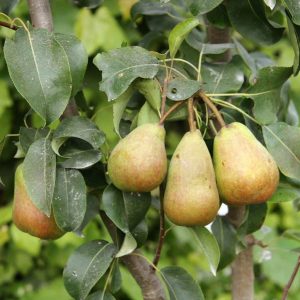
Hosui Asian Pear
$49.95
Hosui Asian Pear (also known as Apple Pear; Pyrus pyrifolia ‘Hosui’) is a Japanese-bred Asian pear consistently rated among the best-tasting of its kind, yielding medium-large, golden-russeted fruit with crisp, fine-grained, very sweet and juicy cream-white flesh. It grows in USDA hardiness zones 5-9 and AHS heat zones 4-9, needs 350-500 chill hours, and requires cross-pollination with a compatible variety such as Shinko Asian Pear or Bartlett Pear to set fruit.
4-5′ Bare Root Grafted Tree
Rootstock: Pyrus calleryana – Standard
A vigorous pear seedling rootstock for a full-size tree, tolerant of heat and wet ground and resistant to fire blight. The standard choice for European and hybrid pears.
• Support: Freestanding; well anchored.
Can’t be shipped to: AK, HI, MT, OR
In stock
Hosui was developed at the NARO Institute of Fruit Tree Science (formerly the Horticultural Research Station) in Japan and released in 1972. The variety’s pedigree was initially reported as a cross of Ri-14 (itself a Kikusui x Yakumo hybrid) and Yakumo, but subsequent DNA-based research by Sawamura et al. (2004) revised that understanding: Kosui was identified as the female parent and Hiratsuka 1 (I-33) as the male parent. The name Hosui translates roughly as “abundant water,” a reference to the variety’s notably high juice content. Hosui was among the first Asian pears widely planted in the Pacific Northwest for commercial production and subsequently spread into home orchards across the Eastern and Southern United States. It ranks consistently among the highest-rated Asian pear cultivars in flavor trials, and its parentage through established mid-century Japanese breeding lines placed it at the center of the post-war wave of improved Pyrus pyrifolia selections.
Hosui's 300 to 450 chill hour requirement places it within reach of growers from Zone 5 through the warmer portions of Zone 9, including most of the Eastern US east of the Rockies. Plant in full sun on well-drained loam or sandy loam with a soil pH of roughly 5.9 to 6.5; consistently waterlogged roots increase susceptibility to canker and root-level pathogens. Consistent moisture during fruit development in early to midsummer is important for achieving the variety's characteristic large fruit size, but avoid overhead irrigation, which prolongs leaf wetness and promotes fire blight and scab infections. Hosui is a spur bearer that produces fruit in clusters, and aggressive annual fruit thinning — to a single fruit per spur, spaced roughly 6 inches apart — is necessary to achieve the 2.75-inch fruit size the variety is known for and to prevent biennial bearing. This is one area where shortcuts translate directly to smaller, lower-quality harvests.
USDA Hardiness Zone: 5-9
AHS Heat Zone: 4-9
Chill Hours: 350-500
Sun Requirements: Full Sun
Soil pH: 5.9-6.5
Soil Type: Well-drained, fertile, moist loam; adaptable to clay or sandy loam
Soil Drainage: Well-drained; does not tolerate waterlogging
Water Requirements: Medium; consistent moisture especially during fruit development
Drought Tolerance: Low to Moderate — requires consistent irrigation in dry climates
Plant Spacing: 10-15 ft apart
Mature Hosui trees reach 12 to 15 feet tall and 8 to 15 feet wide with an upright to slightly spreading crown, well-suited to standard orchard layouts and espalier training on a trellis or fence. Growth rate is moderate to fast on most rootstocks, and the moderately vigorous scaffold architecture typically reaches bearing size within 3 to 5 years from grafted nursery stock, sometimes earlier. The foliage is deciduous with dark green summer leaves that emerge with a distinctive coppery-bronze cast in spring, then transition to red-orange in fall — making Hosui attractive as an edible ornamental in mixed landscapes. The tree is thornless on fruiting wood, though rootstock suckers may produce spines and should be removed promptly. The root system is spreading with lateral scaffold roots, so allow adequate spacing of 10 to 15 feet from adjacent trees and structures.
Mature Height: 12-15 ft tall
Mature Spread: 8-15 ft wide
Growth Habit: Upright to slightly spreading; moderately vigorous
Growth Rate: Moderate to Fast
Foliage Type: Deciduous
Food Forest Layer: Canopy, Sub-canopy
Leaf Color: Dark green (coppery-bronze in spring emergence)
Fall Foliage Color: Red to orange-red
Thorns?: No (fruiting varieties typically thornless; rootstock may produce spines)
Attracts Wildlife: Bees, butterflies, birds
Life Span: can live 50+ years
Hosui is self-incompatible and requires a cross-pollinator blooming at the same time to set fruit reliably. Bloom occurs in late March to mid-April in temperate climates — a mid-spring window that overlaps well with several compatible varieties. Chojuro Asian Pear and Shinseiki Asian Pear are recommended pollinators with overlapping early-to-mid April bloom timing; the European pear Bartlett also blooms within this window and is compatible. Plant pollinators within 50 to 100 feet for adequate bee transfer. Hosui produces abundant, bee-attractive white blossoms that are among the showier spring floral displays in the Asian pear group, and a well-established colony of honeybees or native bumblebees in the vicinity dramatically improves fruit set rates in cool or overcast spring conditions.
Bloom Season: Mid
Bloom Window: Early Apr - Mid Apr
Pollination Requirements: Cross-pollination required; for best yields; plant with another Asian pear or compatible European pear variety blooming at the same time
Pollination Mechanism: Insect-pollinated (bees)
Flower Color: White
Hosui produces medium-large fruit averaging 2.75 inches in diameter and 8 to 12 ounces in weight. The skin is a distinctive golden-brown to brownish-orange russet with prominent lenticels — a visual cue that flavor has fully developed. Flavor is very sweet with low acidity and a clean, refreshing finish; sensory evaluations consistently place Hosui among the highest-rated Asian pear cultivars for eating quality. The flesh is white to cream-colored, fine-grained, and crisp with abundant juice — textural apple-like crunch holds up well both at harvest and in storage. Harvest in temperate climates runs mid- to late August. Refrigerated storage at 32°F with 90 to 95 percent humidity extends shelf life 1 to 5 months, up to 4 to 5 months in optimized cold storage. In the kitchen, Hosui excels fresh, in fruit salads, Asian-style marinades for grilling, and lightly baked preparations where its texture and sweetness concentrate without turning mealy.
Ripening Season: Early
Harvest Window: Mid Aug - Late Aug
Fruit Size: 2.75 inch (medium-large)
Fruit Weight: 8-12 oz
Flavor: Very sweet, juicy, low acid, crisp, refreshing; consistently rated best-tasting Asian pear
Fruit Color: Golden-brown to brownish-orange russeted skin; off-white/cream flesh
Fruit Texture: Crisp, juicy, fine-grained; apple-like texture
Fruit Skin: Russeted (rough, tan-golden russet skin); prominent lenticels
Bearing Habit: Annual bearer; bears on spurs
Years to Bear: 3-5 years (grafted trees may bear in 1-2 years)
Storage Life: 1-5 months refrigerated (32°F, 90-95% humidity); up to 4-5 months cold storage
Culinary Uses: Fresh eating; fruit salads; Asian marinades; baking; preserves; juicing; smoothies
Hosui carries meaningful disease management challenges that growers in humid summer climates should plan for from the outset. Fire blight (Erwinia amylovora) is a serious concern — Hosui is susceptible, so prune out infected wood at least 12 inches below visible symptoms using sterilized tools, and avoid excess nitrogen that produces the succulent shoot growth blight colonizes readily. Pear scab (Venturia nashicola) is similarly a susceptibility; copper-based organic fungicides applied at early green tip through petal fall, combined with prompt removal of infected leaves, reduces carryover inoculum. Powdery mildew (Podosphaera leucotricha) infects new growth during warm, dry weather following humid periods — pruning to open canopy structure and applying OMRI-listed sulfur at first sign limits spread. Botryosphaeria canker enters through wounds and stressed tissue; avoid late-season irrigation and remove dead wood promptly. Fabraea leaf spot (Diplocarpon mespili) is moderate in severity; raking and destroying fallen leaves breaks the overwintering cycle. On the pest front, codling moth (Cydia pomonella) and brown marmorated stink bug (Halyomorpha halys) are susceptible pressure points — kaolin clay barriers applied before egg hatch plus physical exclusion netting are the most effective organic tools. Pear psylla (Cacopsylla pyricola) and oriental fruit moth (Grapholita molesta) present moderate risk; dormant oil sprays and beneficial insect habitat reduce populations.
Fire Blight: Susceptible
Pear Scab: Susceptible
Fabraea Leaf Spot / Entomosporium Leaf Spot: Moderately Susceptible
Powdery Mildew: Susceptible
Anthracnose / Canker: Susceptible
Codling Moth: Susceptible
Pear Psylla: Moderately Susceptible
Brown Marmorated Stink Bug: Susceptible
Oriental Fruit Moth: Moderately Susceptible
- Thin aggressively: Hosui produces fruit in tight clusters; thin to a single fruitlet per spur no later than 4 to 6 weeks after petal fall to reach full fruit-size potential and prevent biennial bearing.
- Protect against fire blight: Avoid high-nitrogen fertilizers that force succulent new growth — fire blight is a genuine threat on Hosui and vigorous shoot tips are the primary infection courts. Sterilize pruning tools between cuts during blight management.
- Plan your pollinator pair: Hosui is self-incompatible; plant a second Asian pear — Shinko or 20th Century are reliable overlapping choices — within 100 feet before the first season to guarantee fruit set from year one.
- Address scab with pre-bloom copper: In humid climates, begin copper fungicide applications at green tip and continue through petal fall on a 7-to-10-day schedule to reduce scab pressure.
- Use kaolin clay for codling moth and stink bug: Surround WP applications beginning at petal fall, reapplied after rain, create a physical barrier against codling moth and brown marmorated stink bug throughout the growing season.
We ship in late winter or early spring based on your USDA hardiness zone.
We strive to ship orders on the scheduled dates listed in the table below. However, please note that the actual shipping date may be subject to change due to factors like weather conditions and order volume.
The specific date for shipping your order will be determined according to your zipcode at the time of checkout.
Our plants are shipped bare root, packed in moist sawdust, and securely wrapped in plastic to prevent the roots from drying out. We use USPS Ground Advantage for shipping, ensuring that your plants typically arrive within 2-5 days after packaging.
In case you're unable to plant the trees immediately upon arrival, we recommend soaking them in water for a few hours and temporarily heeling them in. Ideally, they should be planted within three days of receipt for optimal health.
See our full shipping policy and map here
| Zone | Ship Date |
|---|---|
| 11 - 8b | March 1st, 2027 |
| 8a - 7b | March 8th, 2027 |
| 7a | March 15th, 2027 |
| 6b | March 22nd, 2027 |
| 6a | March 29th, 2027 |
| 5b - 5a | April 12th, 2027 |
| 4b - 4a | April 26th, 2027 |
| 3b - 1a | May 3rd, 2027 |
Our 365-Day Plant Guarantee: We ensure that our plants are delivered to you alive and healthy. If your plant does not survive its first year, you're eligible for store credit under these conditions:
- Your location falls within the appropriate USDA hardiness zone for the plant variety (refer to our hardiness zone map).
- You maintain the roots' moisture and plant within three days of delivery, following the instructions in our Planting Guide.
If you're concerned about your plant's health, please consult our guide, How to Tell if Your Tree is Dead or Dormant. Remember, our plants are shipped in a dormant state and may leaf out at different times based on their species. To check for plant vital
1 review for Hosui Asian Pear
Related products

Common Pear
Checking fit
Moonglow Pear
Checking fitRated 4.75 out of 5
Honeycrisp Apple
Rated 5.00 out of 5$49.95 Select Rootstock This product has multiple variants. The options may be chosen on the product pageChecking fit
Red D’Anjou Pear
Checking fit


Karen Nguyen (verified owner) –
Nice condition