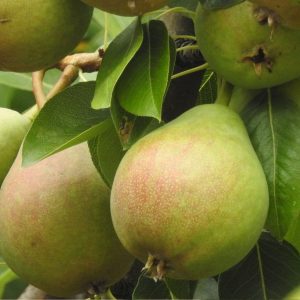
Chojuro Asian Pear
$49.95
Chojuro Asian Pear (also known as Nashi; Pyrus pyrifolia ‘Chojuro’) is a Japanese-origin Asian pear known for its distinctive butterscotch and caramel flavor notes, producing crisp, juicy, 3-inch golden-russet fruit. It grows in USDA hardiness zones 5-9 and AHS heat zones 4-9, needs 350-500 chill hours, and requires cross-pollination with a compatible variety such as Bartlett Pear or Shinko Asian Pear to set fruit.
4-5′ Bare Root Grafted Tree
Rootstock: Pyrus calleryana – Standard
A vigorous pear seedling rootstock for a full-size tree, tolerant of heat and wet ground and resistant to fire blight. The standard choice for European and hybrid pears.
• Support: Freestanding; well anchored.
Can’t be shipped to: AK, HI, MT, OR
Out of stock
Out of stock — back next season
Spring 2027 inventory drops in June. Drop your email and we'll notify you the day this variety is back in stock.
You're on the list. Check your inbox for a confirmation link — click it to lock in your spot. We'll email you the day this variety is back in stock.
Chojuro emerged as one of two landmark chance seedlings in Japanese pear culture around 1890, alongside Nijisseiki (20th Century), during a period when systematic pomological selection was transforming Japanese commercial orchards. Its precise parentage was never documented; the variety arose as an open-pollinated seedling within the Pyrus pyrifolia russet group, and its distinctive thick, rough-textured brown skin is a hallmark of that lineage. Chojuro was introduced to North American orchards in the early twentieth century and became one of the longest-cultivated Asian pear cultivars in North America. It is classified within the Japanese-type russet-skin group, sharing that lineage with Hosui, in contrast to the smooth-skin nashi types. Its heavy cropping tendency and long cold-storage window made it a commercial standby in Japan and the Pacific Northwest before mid-century releases with higher yields shifted industry emphasis. Home orchardists and specialty growers continue to prize it for its distinctive butterscotch-caramel flavor complexity, which sets it apart from the cleaner, more neutral profiles of Shinseiki and 20th Century.
Chojuro occupies zones 5 through 9 and accumulates its roughly 450 chilling hours in most mid-belt temperate climates without difficulty. Blooming in early April, the variety is vulnerable to late frost; sloped ground or elevated positions where cold air drains away from the canopy reduce that risk. Full sun is essential — the thick russet skin requires consistent photosynthate loading for proper sugar development, and partially shaded trees produce smaller, less flavorful fruit. Soil pH between 6.0 and 7.0 suits the variety; it tolerates clay, loam, and sand but insists on well-drained conditions, since standing water at the root zone invites crown rot and compounds fire blight susceptibility. Water needs are moderate at 1 to 2 inches per week; consistent moisture through June and July, when fruit cells are expanding, prevents the coarse texture that follows water stress. Thinning to a single fruit per cluster 14 to 40 days after petal fall is critical for achieving the large 3-inch diameter the variety is capable of.
USDA Hardiness Zone: 5-9
AHS Heat Zone: 4-9
Chill Hours: 350-500
Sun Requirements: Full Sun
Soil pH: 6.0-7.0
Soil Type: Loam, clay, sand
Soil Drainage: Well-drained
Water Requirements: Medium — 1-2 inches per week during growing season
Plant Spacing: 10-15 ft apart
How to Prune: Central leader or modified central leader; remove about 10% of terminal spurs annually in late winter dormancy; thin fruit 14-40 days after petal fall to single fruits per cluster
Chojuro fills backyard food forest canopy slots and small orchard rows comfortably, reaching 12 to 15 feet tall and 9 to 11 feet wide in a rounded, upright form. Growth is fast; a grafted tree establishes the central leader framework quickly, outpacing many European pear seedlings in the first three seasons. The taproot with lateral fibrous branching anchors the tree well on well-drained sites but can slow recovery from prolonged saturation. Training to a central leader or modified central leader works best — removing about 10 percent of terminal spurs annually in late winter prevents overcrowding without provoking excessive vegetative regrowth. Foliage is deciduous, emerging green in spring and shifting to gold and orange-red in autumn, adding seasonal interest to the edible planting. Fruiting wood is thornless; some rootstock selections may produce minor spines near the graft union early on, but these diminish as the tree matures.
Mature Height: 12-15 ft tall
Mature Spread: 9-11 ft wide
Growth Habit: Rounded, upright
Growth Rate: Fast
Foliage Type: Deciduous
Food Forest Layer: Canopy
Leaf Color: Green
Fall Foliage Color: Gold, orange-red
Attracts Wildlife: Bees, Birds
Life Span: Perennial
Chojuro blooms in a tight early April window and is not reliably self-fertile; fruit set without a cross-pollinator is inconsistent and yields fall well short of the variety's production capacity. A compatible Asian pear flowering in the same window is required. 20th Century Asian Pear and Hosui Asian Pear are the most commonly planted companions; both share overlapping early-to-mid April bloom timing in temperate climates. The flowers are white, insect-pollinated, and attractive to managed honeybees and native bees alike — spring colony activity in the vicinity markedly improves fruit set. Space pollinators within 50 feet of the Chojuro tree to keep bee foraging distances short during the relatively brief bloom period.
Bloom Season: Early
Bloom Window: Early Apr - Mid Apr
Pollination Requirements: Requires cross-pollination; not reliably self-fertile
Pollination Mechanism: Insect (bee)
Flower Color: White
Fruit runs large — averaging 3 inches in diameter and 12 to 16 ounces at harvest — with a golden-brown to orange-russet skin that sets Chojuro apart visually from the smoother-skinned 20th Century type. The flesh is crisp and juicy with fine cell structure; flavor centers on rich sweetness with pronounced butterscotch and caramel overtones. The thick russeted skin slows gas exchange during ripening, concentrating the aromatic compounds responsible for this distinctive profile. Harvest runs late August through mid-September in temperate climates. Beyond flavor, Chojuro's most commercially significant trait is cold-storage life: refrigerated at 32°F with high humidity, fruit holds quality for five to six months — among the longest of any Asian pear cultivar — putting it on orchard tables well into winter. Fresh eating is the primary use; the firm texture also holds up in cooking, complements cheese boards, and dries without losing structural integrity.
Ripening Season: Mid
Harvest Window: Late Aug - Mid Sep
Fruit Size: 3 inch
Fruit Weight: 12-16 oz
Flavor: Sweet, rich, distinctive butterscotch/caramel notes; aromatic
Fruit Color: Golden-brown to orange-russet
Fruit Texture: Crisp, juicy
Fruit Skin: Thick, russetted
Bearing Habit: Spur-bearing
Years to Bear: 1-4 years
Storage Life: 5-6 months refrigerated
Culinary Uses: Fresh eating, salads, cooking, preserves, drying
Chojuro carries moderate resistance to fire blight (Erwinia amylovora) — helpful in humid-summer climates but not a substitute for cultural management. Avoid high-nitrogen fertilization that drives succulent shoot growth; prune infected wood 8 inches below visible discoloration and sterilize tools between cuts. Pear scab (Venturia nashicola) and Alternaria black spot (Alternaria alternata) both rate as resistant, reducing fungicide pressure significantly in humid regions. Pseudomonas shoot blight (Pseudomonas syringae) and pear rust (Gymnosporangium fuscum) rate as moderately susceptible: limit overhead irrigation to reduce shoot blight risk; remove nearby juniper (Juniperus spp.) hosts to break pear rust's alternate-host cycle — copper-based organic sprays at green tip provide backup coverage. Among pests, codling moth (Cydia pomonella), pear psylla (Cacopsylla pyricola), and brown marmorated stink bug (Halyomorpha halys) are all susceptible. Pheromone traps set before petal fall establish codling moth timing; follow with kaolin clay from petal fall through June. Pear psylla — which produces honeydew that leads to sooty mold — is controlled with dormant horticultural oil. Stink bug exclusion netting over clusters from late July is the most reliable organic barrier. Aphids (Dysaphis pyri) rate as moderately susceptible; water jets and insecticidal soap handle light pressure without harming beneficials.
Fire Blight: Moderately Resistant
Pear Scab: Resistant
Alternaria Black Spot: Resistant
Pseudomonas Shoot Blight: Moderately Susceptible
Pear Rust: Moderately Susceptible
Codling Moth: Susceptible
Pear Psylla: Susceptible
Aphids: Moderately Susceptible
Brown Marmorated Stink Bug: Susceptible
- Thin aggressively at petal fall: Remove all but one fruit per cluster 14 to 40 days after bloom. Chojuro's large fruit size is only achievable when clusters are thinned early; skipping this step produces undersized, lower-Brix fruit and biennial bearing tendencies.
- Codling moth monitoring: Hang pheromone traps before petal fall to establish first-catch dates; time kaolin clay applications to begin at petal fall and reapply every 7 to 14 days through June to reduce wormy-fruit losses in high-pressure seasons.
- Eliminate juniper hosts for rust management: Pear rust (Gymnosporangium fuscum) requires a Juniperus alternate host to complete its cycle. Removing ornamental junipers within a few hundred feet of the planting is the most effective long-term control; copper-based organic sprays at green tip provide backup protection.
- Plant pollinators before planting Chojuro: Because the variety is not self-fertile, fruit set depends entirely on a compatible companion in bloom simultaneously. Hosui or Shinko planted in the same season as Chojuro ensures the pollinator is established when the primary tree begins bearing.
- Stink bug exclusion from late July: Brown marmorated stink bug damage on Chojuro often appears as corky dimples beneath the russet skin. Fine exclusion netting placed over fruit clusters from late July through harvest is the most reliable organic control.
We ship in late winter or early spring based on your USDA hardiness zone.
We strive to ship orders on the scheduled dates listed in the table below. However, please note that the actual shipping date may be subject to change due to factors like weather conditions and order volume.
The specific date for shipping your order will be determined according to your zipcode at the time of checkout.
Our plants are shipped bare root, packed in moist sawdust, and securely wrapped in plastic to prevent the roots from drying out. We use USPS Ground Advantage for shipping, ensuring that your plants typically arrive within 2-5 days after packaging.
In case you're unable to plant the trees immediately upon arrival, we recommend soaking them in water for a few hours and temporarily heeling them in. Ideally, they should be planted within three days of receipt for optimal health.
See our full shipping policy and map here
| Zone | Ship Date |
|---|---|
| 11 - 8b | March 1st, 2027 |
| 8a - 7b | March 8th, 2027 |
| 7a | March 15th, 2027 |
| 6b | March 22nd, 2027 |
| 6a | March 29th, 2027 |
| 5b - 5a | April 12th, 2027 |
| 4b - 4a | April 26th, 2027 |
| 3b - 1a | May 3rd, 2027 |
Our 365-Day Plant Guarantee: We ensure that our plants are delivered to you alive and healthy. If your plant does not survive its first year, you're eligible for store credit under these conditions:
- Your location falls within the appropriate USDA hardiness zone for the plant variety (refer to our hardiness zone map).
- You maintain the roots' moisture and plant within three days of delivery, following the instructions in our Planting Guide.
If you're concerned about your plant's health, please consult our guide, How to Tell if Your Tree is Dead or Dormant. Remember, our plants are shipped in a dormant state and may leaf out at different times based on their species. To check for plant vital
1 review for Chojuro Asian Pear
Related products

LeConte Pear
Checking fit
Ayers Pear
Checking fit
Red Haven Peach
Checking fitRated 5.00 out of 5
Bartlett Pear
Checking fitRated 5.00 out of 5

Jenifer S. (verified owner) –
This is quite a tall, 1/2 inch diameter bare root tree. The buds look good so far!