Ayers Pear
$49.95
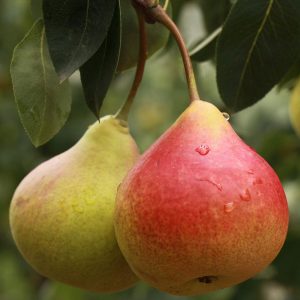
Ayers Pear (Pyrus communis ‘Ayers’) is a fire-blight-resistant European pear developed in Tennessee around 1954 from a Garber × Anjou cross, producing 2.5–3-inch yellow fruit with a red blush and exceptionally sweet, buttery flesh with notes of vanilla. It grows in USDA hardiness zones 5-9 and AHS heat zones 5-9, needs 300-400 chill hours, and benefits significantly from cross-pollination with compatible varieties such as Kieffer Pear or Shinko Asian Pear to maximize yields.
4-5′ Bare Root Grafted Tree
Rootstock: OHxF333 – Semi Dwarf
About two-thirds of standard size, from the Old Home x Farmingdale program bred specifically for fire blight resistance, the disease that ends most pear trees.
• Support: Freestanding; well anchored.
Can’t be shipped to: AK, HI, MT, OR
In stock
Ayers is a European pear (Pyrus communis hybrid) developed in Tennessee and introduced around 1954, bred as a cross of Garber (itself an interspecific Asian x European pear hybrid) and Anjou. The Garber parent contributes heat tolerance and reduced chilling requirement—traits inherited from its Asian pear side—while the Anjou parent brings European pear fruit quality. The resulting cultivar requires only approximately 300–500 chill hours, far fewer than most European pears, and was selected specifically for fire blight resistance and warm-climate performance. These traits have made Ayers the most widely recommended pear for the humid Southeast and mid-South, sometimes called “the pear of the South.” The USDA-NCGR collection at Corvallis holds it as PI 541722 and designates it a “Curator’s Choice.” Ayers ripens in summer—earlier than fall-season European cultivars—and has remained a reliable recommendation for over seventy years of home and commercial production across warm-temperate growing regions.
Ayers performs best in full sun with loamy, well-drained soil in the pH range of 6.0 to 7.0. Heavy or poorly drained soils promote Phytophthora root problems and should be amended or avoided. Water needs run about 1 to 1.5 inches per week during the growing season; consistent moisture through fruit development reduces premature drop and supports the dense, sweet flesh the variety is known for. Avoid high-nitrogen fertilizers, especially in late summer—excess vegetative growth increases fire blight risk by creating soft, rapidly expanding shoot tissue. The 300 to 400 hour chill range places Ayers firmly within reach of Zone 8 winters and even mild Zone 9 locations, but cold hardiness to Zone 5 keeps it reliable wherever those winters arrive reliably. Thin fruit to one per cluster and space clusters 4 to 6 inches apart to concentrate sugars and reduce limb stress from heavy crops. Pears ripen off the tree; pick when the fruit separates cleanly with an upward twist and allow 3 to 5 days at room temperature for full flavor development.
USDA Hardiness Zone: 5-9
AHS Heat Zone: 5-9
Chill Hours: 300-400
Sun Requirements: Full Sun
Soil pH: 6.0-7.0
Soil Type: Loam, well-drained
Soil Drainage: Well-drained
Water Requirements: Medium; 1-1.5 inches per week during growing season
Heat Tolerance: High; tolerates heat and humidity
Plant Spacing: 18-20 ft apart
How to Prune: Train to modified central leader or open center; thin for light penetration; thin fruit to 1 per cluster, 4-6 inches apart
Ayers grows to 15 to 20 feet tall with a spread of 10 to 15 feet, developing an upright pyramidal silhouette that fits moderately sized yards and food forest canopy slots. The moderate growth rate of 1 to 2 feet per year gives the trunk time to develop sound structural wood before heavy crops load the scaffold branches. That upright form benefits from training to a modified central leader in early years: one dominant vertical trunk with lateral scaffolds selected at wide crotch angles minimizes future splitting under crop weight. Spur-bearing habit concentrates fruiting close to the main framework, so annual thinning cuts focus on removing weak or crowded spurs rather than long extension wood. The pyramidal crown casts moderate shade, making it a reasonable canopy element above shade-tolerant understory plants in a food forest design. White flowers with pink overtones open in mid-March to early April, attracting bees before many other fruit trees bloom. Autumn foliage is not particularly ornamental, but the long productive lifespan—up to 75 years—makes structural investment worthwhile.
Mature Height: 15-20 ft tall
Mature Spread: 10-15 ft wide
Growth Habit: Upright, pyramidal
Growth Rate: Moderate; 1-2 feet per year
Foliage Type: Deciduous
Food Forest Layer: Canopy
Attracts Wildlife: Bees, birds
Life Span: 50-75 years
Ayers is partially self-fertile and will set a light crop without a companion, but yield improves substantially with a cross-pollinator in the same bloom window. Flowers open mid-March to early April in a temperate climate, earlier than most European pears, so the partner variety must share that early-to-mid spring slot. Moonglow, Orient, Kieffer, and Hood all bloom in compatible windows and are proven companions in warm-climate pear plantings. Bartlett overlaps in cooler sites but may diverge in timing where winters are mild. Bee pollinators are essential; plant the pollinator within 50 to 100 feet and maintain flowering ground cover nearby to sustain pollinator populations through the critical two-week bloom period. In low-chill climates where bloom extends over a longer, irregular window, having two compatible companions rather than one reduces the risk of missing the cross-pollination window in years with erratic spring temperatures.
Bloom Season: Early
Bloom Window: Mid Mar - Early Apr
Pollination Requirements: Partially self-fertile; cross-pollination strongly recommended for maximum yield
Pollination Mechanism: Insect (bee) pollinated
Flower Color: White with pink overtones
Measuring 2.5 to 3 inches in diameter, fruit develops a yellow skin with a red blush on the sun-exposed cheek. Flavor is distinctly sweet and buttery with vanilla undertones and high sugar content—placing Ayers among the sweeter European varieties available in its ripening window. Texture is smooth and melting when fully ripe, characteristic of traditional European dessert pears. The harvest window runs mid-July to early September, well ahead of fall-ripening standards like Bosc or Anjou, filling a fresh-eating gap in the late-summer fruit calendar. Yield reaches 10 to 15 bushels per mature tree, giving preserving growers enough volume for canning, jams, and dehydrating in addition to fresh use. Storage life is moderate: keep harvested fruit cool and allow 3 to 5 days at room temperature before eating. The high sugar content makes Ayers well suited for preserves and baked applications where concentrated sweetness is an asset. Fruit drops quickly once fully ripe, so monitor the harvest window closely and pick in stages over the extended mid-July to September season.
Ripening Season: Very Early
Harvest Window: Mid Jul - Early Sep
Fruit Size: 2.5-3 inch
Flavor: Very sweet, buttery, with notes of vanilla; high sugar content
Fruit Color: Yellow with red blush
Fruit Texture: Smooth, melting, buttery
Bearing Habit: Spur-bearing
Years to Bear: 3-4 years
Storage Life: Several weeks; ripen at room temperature 3-5 days before eating
Culinary Uses: Fresh eating, preserves, canning, baking
Fire blight (Erwinia amylovora) resistance is Ayers’ most commercially significant trait. Where susceptible European varieties like Bartlett frequently suffer devastating shoot strikes, Ayers carries field-documented resistance that meaningfully reduces losses in humid-summer climates. Prune out any blighted tissue promptly, cutting 8 to 12 inches below visible symptoms with sanitized tools between cuts. Fabraea leaf spot (Diplocarpon mespili), pear scab (Venturia pirina), powdery mildew (Podosphaera leucotricha), and crown gall (Agrobacterium tumefaciens) are all moderately susceptible. For Fabraea and scab, rake and remove fallen leaves each autumn to break the overwintering spore cycle; sulfur-based sprays (OMRI-listed) at petal fall and again two weeks later reduce infection pressure in wet springs. Powdery mildew responds to improved airflow—open up the canopy with selective summer pruning and avoid excess nitrogen. Crown gall prevention centers on planting site selection and clean rootstock; once established in soil, the bacterium persists, so avoid wounding roots during cultivation. Pear psylla (Cacopsylla pyricola), codling moth (Cydia pomonella), plum curculio (Conotrachelus nenuphar), and Japanese beetle (Popillia japonica) are all moderately susceptible. Kaolin clay applied early season creates a physical deterrent for curculio and codling moth; pheromone traps assist timing for codling moth spray windows. Japanese beetle adults are best managed by handpicking combined with neem oil applications during peak emergence.
Fire Blight: Resistant
Fabraea Leaf Spot: Moderately Susceptible
Pear Scab: Moderately Susceptible
Powdery Mildew: Moderately Susceptible
Crown Gall: Moderately Susceptible
Pear Psylla: Moderately Susceptible
Codling Moth: Moderately Susceptible
Plum Curculio: Moderately Susceptible
Japanese Beetle: Moderately Susceptible
- Pick before fully ripe: Pears ripen from the inside out; harvest when fruit twists free with light upward pressure and skin color shifts toward yellow, then ripen 3–5 days at room temperature. Leaving fruit on the tree until soft results in gritty, overripe flesh.
- Keep nitrogen moderate: High-nitrogen inputs push the tender shoot growth that fire blight exploits most aggressively. Use a balanced organic fertilizer only in early spring, and skip supplemental feeding in years of vigorous extension growth.
- Sanitize pruning tools at every cut: Even with Ayers' fire blight resistance, infected tissue can carry the pathogen; dip blades in 70% isopropyl alcohol between cuts when working in or near symptomatic wood.
- Pair with an early-blooming partner: Ayers opens in mid-March to early April — earlier than many European pears. Confirm your chosen pollinator blooms in the same window at your site before planting.
- Thin aggressively the first heavy crop year: Spur-bearing trees can set more fruit than scaffold branches can safely support. Thin to one pear per cluster at 4–6 inch spacing to prevent limb splitting and concentrate sugars for better flavor.
We ship in late winter or early spring based on your USDA hardiness zone.
We strive to ship orders on the scheduled dates listed in the table below. However, please note that the actual shipping date may be subject to change due to factors like weather conditions and order volume.
The specific date for shipping your order will be determined according to your zipcode at the time of checkout.
Our plants are shipped bare root, packed in moist sawdust, and securely wrapped in plastic to prevent the roots from drying out. We use USPS Ground Advantage for shipping, ensuring that your plants typically arrive within 2-5 days after packaging.
In case you're unable to plant the trees immediately upon arrival, we recommend soaking them in water for a few hours and temporarily heeling them in. Ideally, they should be planted within three days of receipt for optimal health.
See our full shipping policy and map here
| Zone | Ship Date |
|---|---|
| 11 - 8b | March 1st, 2027 |
| 8a - 7b | March 8th, 2027 |
| 7a | March 15th, 2027 |
| 6b | March 22nd, 2027 |
| 6a | March 29th, 2027 |
| 5b - 5a | April 12th, 2027 |
| 4b - 4a | April 26th, 2027 |
| 3b - 1a | May 3rd, 2027 |
Our 365-Day Plant Guarantee: We ensure that our plants are delivered to you alive and healthy. If your plant does not survive its first year, you're eligible for store credit under these conditions:
- Your location falls within the appropriate USDA hardiness zone for the plant variety (refer to our hardiness zone map).
- You maintain the roots' moisture and plant within three days of delivery, following the instructions in our Planting Guide.
If you're concerned about your plant's health, please consult our guide, How to Tell if Your Tree is Dead or Dormant. Remember, our plants are shipped in a dormant state and may leaf out at different times based on their species. To check for plant vital
Related products

Summercrisp Pear
Checking fitRated 5.00 out of 5
Hosui Asian Pear
Checking fitRated 5.00 out of 5
Orient Pear
Checking fitRated 5.00 out of 5
Shinseiki Asian Pear
Checking fit


Reviews
There are no reviews yet.