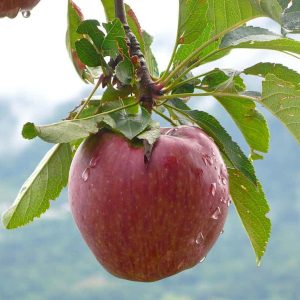
Kieffer Pear
$49.95
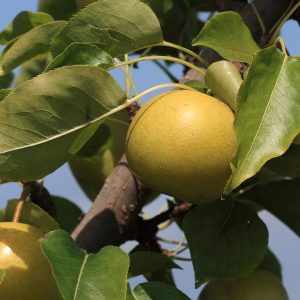
Kieffer Pear (Pyrus communis x Pyrus pyrifolia ‘Kieffer’) is a classic American heirloom pear — a hybrid of European and Asian ancestry — bearing golden-yellow fruit blushed crimson, best cooked into preserves, pear butter, or perry cider. It grows in USDA hardiness zones 4-9 and AHS heat zones 5-9, needs 350-400 chill hours, and benefits significantly from cross-pollination with compatible varieties such as LeConte Pear or Shinko Asian Pear to maximize yields.
4-5′ Bare Root Grafted Tree
Rootstock: OHxF333 – Semi Dwarf
About two-thirds of standard size, from the Old Home x Farmingdale program bred specifically for fire blight resistance, the disease that ends most pear trees.
• Support: Freestanding; well anchored.
Can’t be shipped to: AK, HI, MT, OR
In stock
Kieffer originated as an accidental cross in the nursery of Peter Kieffer near Philadelphia, Pennsylvania, who around 1853 planted Chinese Sand Pear seed alongside Bartlett trees. Open pollination between the two produced the chance seedling that first fruited in 1868 and was subsequently propagated and named by Kieffer. Introduced commercially around 1873, it represents one of the earliest documented Pyrus communis × P. pyrifolia hybrids produced on American soil, predating any formal government breeding program by decades. Its sand pear parentage accounts for the coarse, gritty texture that set it apart from European dessert pears of the era while simultaneously supplying the fire blight tolerance and wide climate adaptability that made it commercially dominant. By the late 19th and early 20th centuries, Kieffer had become the most widely planted pear across the American South and Midwest, sustaining entire canning industries because it held its shape during heat processing far better than European soft-fleshed varieties. Though largely displaced in commercial orchards by higher-quality fire-blight-resistant releases, Kieffer’s historical position as the pear that made the South a pear-growing region remains its defining contribution to American pomology.
Kieffer needs around 350 to 400 chill hours to break dormancy reliably—a moderate requirement that fits comfortably in most temperate and upper-South climates without leaving it vulnerable to late-frost bloom damage in colder zones. Full sun is essential for both productivity and disease management; shade reduces air movement and elevates humidity around the canopy, which compounds susceptibility to leaf-spot pathogens. The tree is more soil-tolerant than most European pears, performing acceptably in heavier clay if drainage is adequate, though standing water during the growing season stresses roots and opens entry points for Phytoplasma vectors. A soil pH of 6.0 to 7.0 supports nutrient availability; soils drifting below 6.0 often trigger iron or manganese deficiencies that mimic disease symptoms. Water consistently during the first two to three years to establish the taproot system, then ease back—mature Kieffer tolerates moderate drought better than most pear cultivars. Avoid high-nitrogen fertility in midsummer, which stimulates the succulent vegetative growth that fire blight bacteria preferentially attack.
USDA Hardiness Zone: 4-9
AHS Heat Zone: 5-9
Chill Hours: 350-400
Sun Requirements: Full Sun
Soil pH: 6.0-7.0
Soil Type: Deep, loam, well-drained soil; tolerates heavier clay soils if drainage is adequate
Soil Drainage: Well-drained; tolerates occasional flooding
Water Requirements: Medium; regular watering during establishment and dry periods
Drought Tolerance: Moderate; established trees tolerate drought well
Heat Tolerance: High; performs well in hot climates down to Zone 9
Plant Spacing: 15-20 ft apart
Container Suitability: No (standard); Dwarf rootstock varieties may be suitable in large containers
Kieffer grows with strong upright vigor, forming an oval to rounded canopy that reaches 15 to 25 feet tall and 15 to 20 feet wide at maturity. The fast growth rate means a young tree can close its canopy quickly, which helps it compete against weeds but also demands early structural pruning to establish a sound scaffold. Lateral branches tend toward narrow crotch angles when unpruned, so selecting wide-angled scaffold limbs in years two and three reduces the risk of bark-inclusion failures under heavy crop loads. The root pattern—a central taproot with spreading lateral fibrous roots—anchors the tree well in most soil types and reduces surface-root competition with nearby plantings. Deciduous foliage is dark green through summer, shifting to golden bronze in fall before drop. Grafted specimens are thorn-free; if a rootstock sucker is allowed to grow, the wild seedling growth can develop thorns, so remove suckers at the graft union promptly. The long-lived framework—trees commonly persist 50 to 75 years—makes site selection a lasting decision.
Mature Height: 15-25 ft tall
Mature Spread: 15-20 ft wide
Growth Habit: Upright, oval to rounded
Growth Rate: Fast
Foliage Type: Deciduous
Food Forest Layer: Canopy
Leaf Color: Dark green
Fall Foliage Color: Golden bronze
Thorns?: No (grafted cultivar; wild seedlings may have thorns)
Attracts Wildlife: Deer, songbirds, butterflies, bees, pollinators
Life Span: 50-75+ years
Kieffer blooms mid-April through early May in temperate climates, producing clusters of white flowers that attract bees and other early-season pollinators. The variety is partially self-fertile: a lone tree will set some fruit most seasons, but crop size and consistency improve noticeably with a cross-pollinator in the vicinity. Any pear variety blooming in the same window works functionally; good confirmed companions include Bartlett, Moonglow, Orient, Hood, Seckel, Bosc, and Anjou. Orient and Moonglow are particularly practical pairings because both share Kieffer’s fire blight tolerance, reducing the disease management burden in a mixed planting. Space pollinators within 50 feet for reliable bee transfer. Kieffer’s bloom comes slightly later than many European pears, which reduces exposure to early-spring frosts in marginal zones—a practical advantage in Zones 4 and 5 where late freezes can wipe out earlier-blooming varieties.
Bloom Season: Mid
Bloom Window: Mid Apr
Pollination Requirements: Partially self-fertile; cross-pollination with another pear variety increases yield significantly
Pollination Mechanism: Insect (primarily bees)
Flower Color: White
Kieffer fruit runs 2.5 to 3.5 inches in diameter, with a golden yellow skin that often develops a crimson or red blush on the sun-exposed side at maturity. The flesh is firm, coarse, and distinctly gritty from stone cells—a direct inheritance from the sand pear parentage. Flavor is mild and sweet with a slightly musky undertone; Brix typically falls in the 11 to 14 range, lower than premium dessert pears like Bartlett. Eaten fresh off the tree, texture is the limiting factor: most palates find it too firm and gritty. The real strength is post-storage and processing. After two to four weeks in cool storage (32–40°F), texture softens and flavor mellows. For canning, pear butter, preserves, and perry (pear cider), the firm flesh holds structure through heat processing far better than soft European cultivars. Storage life of two to three months is excellent for a home-orchard pear. Harvest runs mid-September to mid-October in a temperate climate, and yields of 50 to 200 pounds per tree are achievable on established specimens depending on rootstock.
Ripening Season: Late
Harvest Window: Mid Sep - Mid Oct
Fruit Size: 2.5-3.5 inch
Flavor: Mild, sweet, slightly musky; juicy but somewhat coarse; best for canning and preserves; improves in cool storage
Fruit Color: Golden yellow with crimson/red blush
Fruit Texture: Coarse, firm, gritty; becomes softer with storage ripening
Bearing Habit: Annual bearer; heavy and consistent crops
Years to Bear: 2-4 years
Storage Life: 2-3 months in cool storage
Culinary Uses: Canning; preserves; pear butter; baking; fresh eating (after storage ripening); perry (pear cider)
Kieffer’s most significant asset is its resistance to fire blight (Erwinia amylovora), the most devastating bacterial disease of pears. In humid climates, growers can manage Kieffer orchards with minimal copper sprays, whereas susceptible cultivars require preventive programs from pink-bud through petal fall. For pear scab (Venturia pirina), resistance is moderate—adequate for most seasons but not absolute; rake and remove fallen leaves to reduce overwintering inoculum. Fabraea leaf spot (Diplocarpon mespili) is the main vulnerability; address it through annual dormant pruning to open canopy airflow, prompt removal of infected leaves, and avoiding overhead irrigation. Pear rust (Gymnosporangium sabinae) and pear decline (Phytoplasma pyri) both rate moderately susceptible. Rust management focuses on removing susceptible Juniperus hosts within a few hundred feet. Decline, transmitted by pear psylla (Cacopsylla pyricola), is managed with kaolin clay at petal fall to disrupt settling. Codling moth (Cydia pomonella), oriental fruit moth (Grapholita molesta), and brown marmorated stink bug (Halyomorpha halys) all rate moderately susceptible. Codling moth and oriental fruit moth respond to mating disruption lures or kaolin clay; stink bug exclusion relies on fine-mesh netting or perimeter trap crops.
Fire Blight: Resistant
Pear Scab: Moderately Resistant
Fabraea Leaf Spot: Susceptible
Pear Rust: Moderately Susceptible
Pear Decline: Moderately Susceptible
Pear Psylla: Moderately Susceptible
Codling Moth: Moderately Susceptible
Oriental Fruit Moth: Moderately Susceptible
Brown Marmorated Stink Bug: Moderately Susceptible
- Pick before fully ripe: Harvest Kieffer when skin shifts toward yellow-green but before full gold. Pears ripen from the inside out; bring fruit inside to ripen at 60–65°F for one to two weeks.
- Prune for airflow to manage Fabraea leaf spot: Annual dormant pruning to thin the canopy is your primary defense against Fabraea leaf spot. Remove crossing branches and those shading the interior to promote rapid leaf dry-off after rain.
- Control pear psylla early: Apply kaolin clay from pink-bud stage through petal fall to deter adult psylla. Wash leaf undersides with strong water jets to disrupt nymph colonies before honeydew and sooty mold accumulate.
- Match a bloom-compatible cross-pollinator: Orient and Moonglow share Kieffer's fire blight tolerance — space either variety within 50 feet for reliable bee transfer without introducing a disease-susceptible tree.
- Plan for processing: Kieffer's firm texture and two- to three-month storage life make it a reliable home-orchard canning pear. Process excess fruit promptly after storage softening to avoid losses.
We ship in late winter or early spring based on your USDA hardiness zone.
We strive to ship orders on the scheduled dates listed in the table below. However, please note that the actual shipping date may be subject to change due to factors like weather conditions and order volume.
The specific date for shipping your order will be determined according to your zipcode at the time of checkout.
Our plants are shipped bare root, packed in moist sawdust, and securely wrapped in plastic to prevent the roots from drying out. We use USPS Ground Advantage for shipping, ensuring that your plants typically arrive within 2-5 days after packaging.
In case you're unable to plant the trees immediately upon arrival, we recommend soaking them in water for a few hours and temporarily heeling them in. Ideally, they should be planted within three days of receipt for optimal health.
See our full shipping policy and map here
| Zone | Ship Date |
|---|---|
| 11 - 8b | March 1st, 2027 |
| 8a - 7b | March 8th, 2027 |
| 7a | March 15th, 2027 |
| 6b | March 22nd, 2027 |
| 6a | March 29th, 2027 |
| 5b - 5a | April 12th, 2027 |
| 4b - 4a | April 26th, 2027 |
| 3b - 1a | May 3rd, 2027 |
Our 365-Day Plant Guarantee: We ensure that our plants are delivered to you alive and healthy. If your plant does not survive its first year, you're eligible for store credit under these conditions:
- Your location falls within the appropriate USDA hardiness zone for the plant variety (refer to our hardiness zone map).
- You maintain the roots' moisture and plant within three days of delivery, following the instructions in our Planting Guide.
If you're concerned about your plant's health, please consult our guide, How to Tell if Your Tree is Dead or Dormant. Remember, our plants are shipped in a dormant state and may leaf out at different times based on their species. To check for plant vital
2 reviews for Kieffer Pear
Related products

Honeycrisp Apple
Rated 5.00 out of 5$49.95 Select Rootstock This product has multiple variants. The options may be chosen on the product pageChecking fit
Red Mulberry
Checking fitRated 4.89 out of 5
Summercrisp Pear
Checking fitRated 5.00 out of 5
Shinseiki Asian Pear
Checking fit


Felix d –
Very good product
Cliff C. (verified owner) –