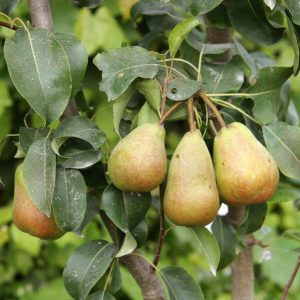

20th Century Asian Pear
$49.95
20th Century Asian Pear (also known as Nijisseiki; Pyrus pyrifolia ‘Nijisseiki’) is a chance-seedling Asian pear discovered in 1898 Japan, bearing crisp, dense, very juicy golden-yellow fruit with mild sweetness suited to fresh eating, salads, and marinades. It grows in USDA hardiness zones 5-9 and AHS heat zones 4-9, needs 300-400 chill hours, and requires cross-pollination with a compatible variety such as Bartlett Pear or Summercrisp Pear to set fruit.
4-5′ Bare Root Grafted Tree
Rootstock: Pyrus calleryana – Standard
A vigorous pear seedling rootstock for a full-size tree, tolerant of heat and wet ground and resistant to fire blight. The standard choice for European and hybrid pears.
• Support: Freestanding; well anchored.
Can’t be shipped to: AK, HI, MT, OR
In stock
20th Century, also sold under its Japanese name Nijisseiki, is one of the most commercially significant Asian pear cultivars worldwide and a standard benchmark in Pacific Coast orchard programs. The variety arose as a chance seedling discovered in 1898 in Matsudo, Chiba Prefecture, Japan, by Gozaemon Cho, reportedly found growing in discarded material—a discovery that earned it the nickname “the pear born in a garbage dump” in Japanese horticultural lore. It was introduced commercially around 1904 and quickly became the dominant variety across Japanese orchards. Parentage is uncertain; the variety appears to be an open-pollinated seedling within Pyrus pyrifolia rather than a deliberate cross, and no definitive pollen parent has been established in the scientific literature. It entered North American trials in the early twentieth century and remains a standard planting in Pacific Coast orchard programs. The name Nijisseiki means “twentieth century” in Japanese, reflecting its era of discovery and commercial rise.
With only 300 to 400 chill hours needed, this variety reaches growers as far south as USDA Zone 9, making it one of the more southerly-adapted Asian pears available. Full sun is essential — at least six hours of direct exposure daily supports the spur development on which yields depend. Well-drained loam or sandy loam is ideal; standing water around roots significantly raises fire blight susceptibility, so low-lying sites should be avoided even when drainage amendments are used. Soil pH in the 6.0 to 7.0 range keeps nutrients available and supports calcium uptake, which influences both fruit firmness and disease resistance. Moderate, consistent irrigation during fruit development from late spring through midsummer prevents moisture-stress cracking and supports full fruit sizing to the cultivar's characteristic 3-inch diameter. Growth is fast enough that a training framework should be established in the first two seasons; neglected trees become difficult to manage and show increased disease pressure in the canopy interior.
USDA Hardiness Zone: 5-9
AHS Heat Zone: 4-9
Chill Hours: 300-400
Sun Requirements: Full Sun
Soil pH: 6.0-7.0
Soil Type: Clay, loam, sand
Soil Drainage: Well-drained
Water Requirements: Medium
Drought Tolerance: Moderate
Heat Tolerance: High
Container Suitability: No
At maturity the tree reaches 15 to 20 feet tall and 12 to 15 feet wide in a rounded, upright form, placing it firmly in the canopy layer of a food forest system. The growth rate is fast relative to European pears, and without structural pruning the scaffold can develop wide-angled crotches that split under heavy crop loads. A modified central-leader system, established in years one through three, distributes weight evenly and improves airflow — both critical given fire blight pressure. The root architecture combines a deep taproot with lateral scaffold roots that extend well beyond the dripline; avoid deep cultivation within that zone. Foliage is dark green through the growing season, turning red to burgundy in autumn, which adds ornamental interest alongside the productive function. The tree is thornless, making harvest and pruning straightforward. Flowers are white, fragrant, and appear in spring, attracting bees and supporting pollinator populations before the main orchard bloom sequence.
Mature Height: 15-20 ft tall
Mature Spread: 12-15 ft wide
Growth Habit: Rounded, Upright
Growth Rate: Fast
Foliage Type: Deciduous
Food Forest Layer: Canopy
Leaf Color: Dark Green
Fall Foliage Color: Red, Burgundy
Thorns?: No
Attracts Wildlife: Bees, Birds, Small Mammals
Life Span: Perennial
Bloom typically runs from late March through late April in a temperate climate, placing it among the earlier-blooming Asian pears and creating overlap with several compatible varieties. Cross-pollination is required; 20th Century is not reliably self-fertile, and single-tree plantings produce little to no fruit. Chojuro Asian Pear and Shinseiki Asian Pear are reliable cross-pollinators with overlapping early-to-mid April bloom timing. Pollination is bee-mediated, so maintaining habitat for native bees and honey bees near the planting improves fruit set materially. Plant at least two compatible varieties within 50 to 100 feet, or graft a second variety onto the same tree where space is limited. Thinning excess fruitlets four to six weeks after petal fall — down to one per cluster — improves individual fruit size and reduces alternate-bearing tendency.
Bloom Season: Mid
Bloom Window: Late Mar - Late Apr
Pollination Requirements: Cross-pollination required; plant two or more Asian pear varieties
Pollination Mechanism: Insect (Bee)
Flower Color: White
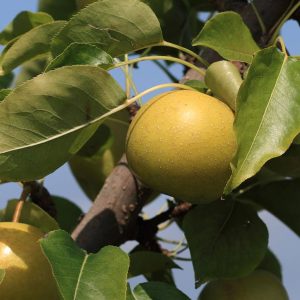
Fruit is round to oblate, measuring approximately 3 inches in diameter, with thin, smooth, yellow-green to golden-yellow skin at maturity. The flesh is dense, very juicy, and crisp with a characteristically clean, sweet, and mild flavor — lower in tannin and acid than most European pears, which makes it a reliable crowd-pleaser for fresh eating. Brix values typically range from 12 to 14 degrees in well-grown fruit. Unlike European pears, Asian pears do not go through a post-harvest softening phase; they are harvested ripe and ready to eat directly from the tree. Refrigerated storage life extends to six months under proper conditions — a significant logistical advantage for home orchardists and small farm operations. Culinary applications go well beyond fresh eating: sliced 20th Century pear is used in salads, smoothies, and meat marinades (the fruit's bromelin-related enzymes tenderize proteins effectively), and it holds shape well enough for light cooking in sauces and desserts.
Ripening Season: Early
Harvest Window: Early Aug - Mid Sep
Fruit Size: 3 inch
Flavor: Sweet, mild, very juicy
Fruit Color: Yellow-green to golden yellow
Fruit Texture: Crisp, dense, very juicy
Fruit Skin: Thin, smooth, yellow-green
Bearing Habit: Spur-bearing
Years to Bear: 2-4 years
Storage Life: 6 months refrigerated
Culinary Uses: Fresh eating, salads, smoothies, marinades (meat tenderizer), sauces, desserts
Fire blight (Erwinia amylovora) is the primary concern — this variety is susceptible and can sustain serious canopy damage in humid seasons. Prune only in dry weather with sterilized tools, cut 12 inches below visible symptoms, and apply copper at bud break and early bloom. Avoid high-nitrogen fertilization, which produces the flush shoot growth the bacterium colonizes. Pear scab (Venturia nashicola) and Fabraea leaf spot (Fabraea maculata) are both moderately susceptible; thorough fall leaf removal eliminates the primary overwintering inoculum for both. Pseudomonas shoot blight (Pseudomonas syringae) exploits frost-damaged tissue — siting away from frost pockets is the most reliable prevention. Pear rust (Gymnosporangium spp.) depends on juniper alternate hosts; removing Eastern red cedar within several hundred feet reduces pressure substantially. Pear psylla (Cacopsylla pyricola) is moderately susceptible; kaolin clay at nymph emergence and insecticidal soap for crawlers are OMRI-listed options. Codling moth (Cydia pomonella) is susceptible — pheromone traps beginning at petal fall guide Spinosad or Bacillus thuringiensis timing to egg hatch. Oriental fruit moth (Grapholita molesta) responds well to mating-disruption dispensers at the block scale. Dormant oil before bud swell suppresses pear blister mite (Eriophyes pyri) overwintering under bud scales.
Fire Blight: Susceptible
Pear Scab: Moderately Susceptible
Fabraea Leaf Spot: Moderately Susceptible
Pseudomonas Shoot Blight: Moderately Susceptible
Pear Rust: Moderately Susceptible
Pear Psylla: Moderately Susceptible
Codling Moth: Susceptible
Oriental Fruit Moth: Moderately Susceptible
Pear Blister Mite: Moderately Susceptible
- Fire blight triage: Keep sterilized pruning tools at hand during fire blight season — blighted shoots must be removed immediately, cutting 12 inches below visible browning into healthy wood and sterilizing between every cut with 70% isopropyl alcohol or a 10% bleach solution.
- Codling moth monitoring: Hang one pheromone trap per 100 feet of row at pink stage; the trap catch triggers the timing for Spinosad sprays at egg hatch, which is far more effective than calendar-based spraying.
- Fruit thinning: Thin to one fruitlet per spur cluster four to six weeks after petal fall; thinning feels counterintuitive but is the biggest driver of fruit sizing and alternate-year bearing prevention.
- Pollinator pairing: Plant Chojuro, Shinseiki, or Hosui within 50 to 100 feet to ensure reliable cross-pollination — 20th Century produces little fruit without a compatible pollen source.
- Harvest timing: Unlike European pears, 20th Century is harvested tree-ripe; lift-test by tilting fruit 90 degrees — if it releases cleanly with the stem intact, it is ready. Do not wait for softening.
We ship in late winter or early spring based on your USDA hardiness zone.
We strive to ship orders on the scheduled dates listed in the table below. However, please note that the actual shipping date may be subject to change due to factors like weather conditions and order volume.
The specific date for shipping your order will be determined according to your zipcode at the time of checkout.
Our plants are shipped bare root, packed in moist sawdust, and securely wrapped in plastic to prevent the roots from drying out. We use USPS Ground Advantage for shipping, ensuring that your plants typically arrive within 2-5 days after packaging.
In case you're unable to plant the trees immediately upon arrival, we recommend soaking them in water for a few hours and temporarily heeling them in. Ideally, they should be planted within three days of receipt for optimal health.
See our full shipping policy and map here
| Zone | Ship Date |
|---|---|
| 11 - 8b | March 1st, 2027 |
| 8a - 7b | March 8th, 2027 |
| 7a | March 15th, 2027 |
| 6b | March 22nd, 2027 |
| 6a | March 29th, 2027 |
| 5b - 5a | April 12th, 2027 |
| 4b - 4a | April 26th, 2027 |
| 3b - 1a | May 3rd, 2027 |
Our 365-Day Plant Guarantee: We ensure that our plants are delivered to you alive and healthy. If your plant does not survive its first year, you're eligible for store credit under these conditions:
- Your location falls within the appropriate USDA hardiness zone for the plant variety (refer to our hardiness zone map).
- You maintain the roots' moisture and plant within three days of delivery, following the instructions in our Planting Guide.
If you're concerned about your plant's health, please consult our guide, How to Tell if Your Tree is Dead or Dormant. Remember, our plants are shipped in a dormant state and may leaf out at different times based on their species. To check for plant vital
Related products

Monterrey Pear
Checking fit
Loring Peach
Checking fitRated 4.50 out of 5
Common Pear
Checking fit
Elberta Peach
Checking fitRated 5.00 out of 5


Reviews
There are no reviews yet.