Moonglow Pear
$49.95
Moonglow Pear (Pyrus communis ‘Moonglow’) is a fire-blight-resistant European pear released by USDA in 1960, producing large, nearly grit-free golden-yellow fruit with a mild, low-acid, juicy sweetness well suited to fresh eating, baking, and preserves. It grows in USDA hardiness zones 5-8 and AHS heat zones 5-9, needs 500-700 chill hours, and requires cross-pollination with a compatible variety such as Bosc Pear or Kieffer Pear to set fruit.
4-5′ Bare Root Grafted Tree
Rootstock: Pyrus Betulifolia – Standard
A vigorous, well-anchored, drought-tolerant pear seedling rootstock that also handles high-pH soils. The usual choice for Asian pears.
• Support: Freestanding; well anchored.
Can’t be shipped to: AK, HI, MT, OR
In stock
Moonglow was released in 1960 by the USDA Agricultural Research Service breeding program at Beltsville, Maryland, under the direction of Dr. John R. Magness, who also released the companion cultivar Dawn in the same year. Its parentage crosses two breeding lines: US-Mich. 437 as the female parent and Roi Charles de Wurtemberg as the male parent. The program that produced Moonglow was initiated at Arlington Farm, Virginia, by Merton B. Waite in 1908, with the explicit goal of combining fire blight resistance with commercial-quality fruit in European pear; when Magness moved the program to Beltsville in 1938, he continued that objective and released Moonglow as its first major success. The result is a vigorous, productive tree bearing large, attractive fruit with mild, juicy flesh and few grit cells, ripening earlier in the season than Bosc or Comice. Its primary significance is practical: Moonglow occupies a mid-season slot and offers fire blight resistance meaningfully stronger than Bartlett, the dominant commercial pear of the same era, giving Eastern orchardists a reliable alternative in humid-climate growing regions.
A mid-range chill requirement of roughly 500 to 700 hours makes Moonglow suitable across a wide belt from Zone 5 through Zone 8, covering most of the Eastern US as well as parts of the Pacific Northwest and elevated inland sites in the South. Full sun — at least eight hours of direct light daily — is necessary for both productivity and disease suppression; shading increases humidity within the canopy and worsens fungal pressure. Moonglow tolerates loam, clay, and sandy soils provided drainage is adequate, since waterlogged roots predispose trees to Phytophthora crown rot. A soil pH of 6.0 to 7.0 keeps iron and manganese bioavailable. Moderate, consistent irrigation during fruit development — roughly from petal fall through early summer — improves fruit size and reduces premature drop; water stress at this stage concentrates sugars but limits overall yield. Avoid heavy nitrogen applications after midsummer, which push succulent vegetative growth that is disproportionately susceptible to fire blight infection.
USDA Hardiness Zone: 5-8
AHS Heat Zone: 5-9
Chill Hours: 500-700
Sun Requirements: Full Sun
Soil pH: 6.0-7.0
Soil Type: Loam, clay, sand (well-drained, fertile, humus-rich preferred)
Soil Drainage: Well-drained
Water Requirements: Medium
Moonglow develops a strongly upright, pyramidal canopy that reaches 18 to 20 feet tall on standard rootstock and 12 to 13 feet wide at maturity. This narrow scaffold suits tighter planting rows and allows better light penetration into the interior than the spreading forms typical of older European pear selections. The growth rate is fast relative to most pome fruits — trees put on substantial leader extension in early years, which shortens the time to first commercial or home-orchard harvest. That vigor also means annual structural pruning is needed to prevent the central leader from becoming too dominant and shading scaffold branches. Dark green foliage turns red to yellow in autumn, and the creamy white flowers open in early to mid-April, providing nectar and pollen for bees during a period when few other fruit trees are blooming. Root architecture follows a taproot-and-lateral pattern; trees establish most efficiently in the first three years if kept weed-free and mulched at the drip line.
Mature Height: 18-20 ft tall
Mature Spread: 12-13 ft wide
Growth Habit: Upright, Pyramidal
Growth Rate: Fast
Foliage Type: Deciduous
Food Forest Layer: Canopy, Sub-canopy
Leaf Color: Dark Green
Fall Foliage Color: Red, Yellow
Attracts Wildlife: Bees, Butterflies, Songbirds
Life Span: 50+ years for standard trees
Moonglow is not self-fertile and requires a compatible cross-pollinator blooming in the same early-April window to set a commercial crop. The white flowers open in early April to mid-April and are pollinated by honeybees and native bees. Bartlett Pear and Bosc Pear are the most reliable documented cross-pollinators based on bloom-time overlap and compatibility testing; Orient and Honeysweet also bloom in this window and work where a second tree is already planted. Avoid pairing Moonglow with other late-blooming European pears whose peak petal fall may miss Moonglow's receptive period. Plant the pollinator within 50 feet for reliable bee transfer, and avoid hedgerow windbreaks that physically separate the canopies.
Bloom Season: Late
Bloom Window: Early Apr - Mid Apr
Pollination Requirements: Requires cross-pollination; not self-fertile
Pollination Mechanism: Insect (bee)
Flower Color: White (creamy white)
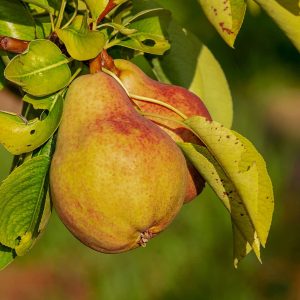
Moonglow produces large fruit measuring 3.0 to 3.5 inches in diameter, with a smooth, thin skin that turns golden yellow and develops a distinct red blush on the sun-exposed side as it approaches maturity. The flesh is soft and very juicy with minimal grit cells — the stone-cell clusters that give inferior pears a gritty texture — making it one of the smoother-textured European pears in this ripening class. Flavor is mild and sweet with low acidity and subtle subacid tanginess; Brix typically runs in the 13 to 15 range at optimum ripeness. Harvest runs from early August through mid-September in temperate climates, and fruit must be picked firm — before the skin yellows fully — then ripened at room temperature for two to three days to reach peak texture. Refrigerated firm fruit holds one to two weeks. Culinary applications include fresh eating, baking, preserving, drying, and perry production; the low-acid, soft flesh breaks down smoothly in cooking and holds sweetness well in jams.
Ripening Season: Early
Harvest Window: Early Aug - Mid Sep
Fruit Size: 3-3.5 inch
Flavor: Mild, sweet, low acid, juicy; subacid with subtle tanginess
Fruit Color: Golden yellow with red blush
Fruit Texture: Soft, juicy, smooth; minimal grit cells
Fruit Skin: Thin, smooth
Bearing Habit: Annual bearer
Years to Bear: 4-6 years
Storage Life: 1-2 weeks refrigerated; ripens at room temperature 2-3 days after harvest
Culinary Uses: Fresh eating, cooking, baking, preserves, jams, drying/dehydration, perry (pear cider)
Among pear diseases in humid growing regions, fire blight (Erwinia amylovora) poses the greatest consequence — and Moonglow carries genuine resistance, a practical advantage that reduces intensive copper-spray programs during bloom. Even resistant trees benefit from sanitation: prune blighted shoots at least 12 inches below visible discoloration, sterilize tools between cuts with 10% bleach, and avoid excessive nitrogen that promotes susceptible succulent tissue. Fabraea leaf spot (Diplocarpon mespili) and pear scab (Venturia pirina) both rate as moderately susceptible; manage both by raking and destroying fallen leaves in autumn to break the spore overwintering cycle, and by maintaining an open canopy through annual pruning to reduce leaf wetness duration. Powdery mildew (Podosphaera leucotricha) and anthracnose/canker (Neofabraea spp.) are susceptible — apply OMRI-listed sulfur or potassium bicarbonate at bud break for mildew; for canker, remove affected wood promptly and paint pruning wounds on branches over two inches in diameter. On the pest side, codling moth (Cydia pomonella), pear psylla (Cacopsylla pyricola), plum curculio (Conotrachelus nenuphar), and pear borer (Synanthedon spp.) all rate as moderately susceptible. Kaolin clay from petal fall through mid-summer reduces curculio egg-laying; pheromone traps calibrate codling moth timing; sticky trunk bands and beneficial nematodes suppress borer larvae in the root crown.
Fire Blight: Resistant
Fabraea Leaf Spot: Moderately Susceptible
Pear Scab: Moderately Susceptible
Powdery Mildew: Susceptible
Anthracnose / Canker: Susceptible
Codling Moth: Moderately Susceptible
Pear Psylla: Moderately Susceptible
Plum Curculio: Moderately Susceptible
Pear Borer: Moderately Susceptible
- Harvest firm, ripen off the tree: Moonglow is a pick-firm pear — allow fruit to ripen at room temperature for two to three days after harvest. Leaving it on the tree too long produces mealy, brown-cored fruit.
- Fire blight pruning hygiene: Despite good resistance, sanitize pruning tools in 70% isopropyl alcohol between every cut during blight season. Resistance reduces incidence but does not eliminate it.
- Manage canopy airflow for fungal diseases: Moderate susceptibility to Fabraea leaf spot and pear scab means annual heading cuts that open the scaffold to sunlight and airflow are one of the highest-return cultural investments.
- Powdery mildew and canker suppression starts at bud break: Apply OMRI-listed sulfur at green-tip stage before infection pressure builds. For canker, inspect trunk and scaffold limbs in late winter and remove affected tissue before spores disperse.
- Cross-pollinator spacing matters: Plant the pollinator tree — Bartlett, Seckel, or Bosc — within 50 feet. Larger distances reduce bee transfer efficiency, especially in cool, cloudy springs.
We ship in late winter or early spring based on your USDA hardiness zone.
We strive to ship orders on the scheduled dates listed in the table below. However, please note that the actual shipping date may be subject to change due to factors like weather conditions and order volume.
The specific date for shipping your order will be determined according to your zipcode at the time of checkout.
Our plants are shipped bare root, packed in moist sawdust, and securely wrapped in plastic to prevent the roots from drying out. We use USPS Ground Advantage for shipping, ensuring that your plants typically arrive within 2-5 days after packaging.
In case you're unable to plant the trees immediately upon arrival, we recommend soaking them in water for a few hours and temporarily heeling them in. Ideally, they should be planted within three days of receipt for optimal health.
See our full shipping policy and map here
| Zone | Ship Date |
|---|---|
| 11 - 8b | March 1st, 2027 |
| 8a - 7b | March 8th, 2027 |
| 7a | March 15th, 2027 |
| 6b | March 22nd, 2027 |
| 6a | March 29th, 2027 |
| 5b - 5a | April 12th, 2027 |
| 4b - 4a | April 26th, 2027 |
| 3b - 1a | May 3rd, 2027 |
Our 365-Day Plant Guarantee: We ensure that our plants are delivered to you alive and healthy. If your plant does not survive its first year, you're eligible for store credit under these conditions:
- Your location falls within the appropriate USDA hardiness zone for the plant variety (refer to our hardiness zone map).
- You maintain the roots' moisture and plant within three days of delivery, following the instructions in our Planting Guide.
If you're concerned about your plant's health, please consult our guide, How to Tell if Your Tree is Dead or Dormant. Remember, our plants are shipped in a dormant state and may leaf out at different times based on their species. To check for plant vital
4 reviews for Moonglow Pear
Related products

Ayers Pear
Checking fit
Red D’Anjou Pear
Checking fit
Hosui Asian Pear
Checking fitRated 5.00 out of 5
Red Mulberry
Checking fitRated 4.89 out of 5


Sean Russell (verified owner) –
Beautiful bare root pear tree thank you.
Clint S. (verified owner) –
nicholas bray (verified owner) –
Look good
Anonymous (verified owner) –
its getting leavs