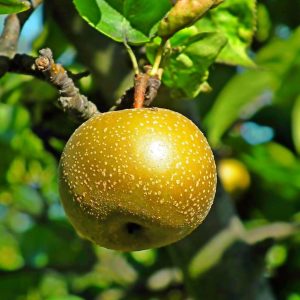
Hachiya Persimmon
$59.95
Hachiya Persimmon (also known as Japanese Persimmon; Diospyros kaki ‘Hachiya’) is an ancient Japanese kaki cultivar bearing giant acorn-shaped fruit 3 to 4 inches long, deepening to deep orange-red with intensely honeyed, apricot-spiced, custard-soft flesh when fully ripe. It grows in USDA hardiness zones 7-10 and AHS heat zones 4-10, needs 200-400 chill hours, and is self-fertile, fruiting reliably without a pollinator partner.
4-5′ Bare Root Grafted Tree
Rootstock: Diospyros virginiana
Grafted onto American persimmon seedling roots — full natural size, very cold hardy, drought tolerant once established. Expect occasional root suckers.
• Support: Freestanding; the deep taproot gives excellent anchorage.
Can’t be shipped to: CA
In stock
Hachiya is an ancient Japanese selection of Diospyros kaki and the dominant commercial astringent persimmon cultivar in California and the Gulf States. Diospyros kaki originated in China and has been cultivated in Japan for approximately 1,300 years; Hachiya is named for a village or district in Gifu Prefecture associated with the cultivar in Japanese pomological tradition, though Western sources rarely document the specific locality. No formal breeding cross produced this variety — it is a selected seedling from traditional cultivation, propagated clonally for centuries. Grafted trees of named Japanese kaki cultivars, including Hachiya, were introduced to the United States beginning in 1870 when the USDA distributed trees to California and Southern states, with additional introductions of Japanese and Chinese varieties continuing through about 1920. Hachiya quickly became the California commercial standard for processed and dried persimmon products. The traditional Japanese craft of hoshigaki — hand-massaging fruit during air-drying over several weeks — is now practiced in both California and across the humid Southeast, and Hachiya is the benchmark cultivar for this technique.
Hachiya performs best in well-drained loam or sandy loam with a soil pH between 6.0 and 7.0; slightly acidic conditions discourage crown gall pressure and support iron availability. The low chill requirement — roughly 100 to 200 hours below 45°F — opens the variety to growers in zones 7 through 10, including the Gulf Coast and warm-winter mid-Atlantic. Sites prone to late spring frosts can damage emerging flowers, which open in late May to early June, so planting on a south-facing slope or near thermal mass reduces frost exposure. Consistent moisture during fruit set (summer) prevents premature drop, but the tree's moderate drought tolerance means irrigation can taper off once fruit has set firmly. Trees planted in poorly drained clay develop Phytophthora root rot readily; raised beds or bermed planting spots are standard mitigation in clay-heavy soils. Soil pH above 7.5 tends to induce chlorosis — amend with sulfur over two seasons rather than a single large application. Full sun drives maximum fruit color development and tannin reduction.
USDA Hardiness Zone: 7-10
AHS Heat Zone: 4-10
Chill Hours: 200-400
Sun Requirements: Full Sun
Soil pH: 6.0-7.0
Soil Type: Loam, sandy loam, clay loam
Soil Drainage: Well-drained
Water Requirements: Medium
Drought Tolerance: Moderate
Heat Tolerance: High
Plant Spacing: 20-25 ft apart
Container Suitability: Not Recommended
How to Prune: Train to modified central leader or open vase when young. Minimal annual pruning thereafter — remove crossing, rubbing, or dead limbs to improve light penetration. Heavier renewal pruning as tree matures to control size.
Mature Hachiya trees reach 15 to 25 feet tall with a spread of 15 to 20 feet in an upright-spreading form — wide enough to serve as a shade canopy but narrow enough to fit a suburban orchard slot with 20- to 25-foot spacing. The deep taproot anchors the tree well against wind and reduces irrigation dependence once established, but also makes transplanting a mature tree difficult; site selection is permanent. Bark is gray-brown with an interlocking block pattern that becomes increasingly textured with age. Foliage emerges in a distinctive sequence: glossy dark green leaves, 5 to 7 inches long, turn orange, red, and yellow in autumn — often while fruit still hangs on the bare branches, creating one of the most striking winter silhouettes in the edible landscape. Growth rate is moderate; expect 12 to 18 inches of extension per year in good conditions. Prune to a modified central leader or open-vase when young, then limit annual cuts to crossing or dead wood — heavy pruning stimulates vegetative growth at the expense of fruit production.
Mature Height: 15-25 ft tall
Mature Spread: 15-20 ft wide
Growth Habit: Upright Spreading
Growth Rate: Moderate
Foliage Type: Deciduous
Food Forest Layer: Canopy
Leaf Color: Dark Green
Fall Foliage Color: Orange, Red, Yellow
Thorns?: No
Attracts Wildlife: Birds, Squirrels, Raccoons, Opossums, Bees
Life Span: 60+ years
Hachiya is parthenocarpic and self-fertile: it sets fruit without pollination, and seedless fruit is common when grown in isolation. Bloom occurs late May through early June in temperate climates — later than most other orchard fruit, which helps it sidestep late frost events that damage earlier bloomers. Flowers are small, cream-white, and borne on current-season growth; they attract bees but do not depend on insect visitation for fruit set. Cross-pollination from a male or second pistillate kaki nearby can increase fruit weight and trigger seed formation — seeded fruits often ripen slightly faster and develop more uniform color — but seeds are not required for commercial-grade production. Planting a second persimmon cultivar (Fuyu, Saijo, or a male Diospyros kaki seedling) within 50 feet improves crop consistency in humid climates where erratic bee activity during bloom is common.
Bloom Season: Very Late
Bloom Window: Late May - Early Jun
Pollination Requirements: Self-Fertile
Pollination Mechanism: Parthenocarpic (self-fertile; cross-pollination by bees improves yield and consistency)
Flower Color: Cream/White
Size reaches 3 to 4 inches in diameter with a typical weight of 7 to 16 oz (200 to 450 g), and an elongated acorn shape distinguishes Hachiya immediately from flat-topped Fuyu types. Skin is smooth, thin, and deep orange to orange-red at maturity. The flesh contains high levels of soluble tannins while firm, making it astringent to the point of inedibility — a common grower error is harvesting at color break rather than waiting for full jelly-soft collapse. Once fully ripe, tannins convert and flavor opens to a honey-sweet profile with apricot, apple, and warm-spice aromatics; texture becomes custard-soft, almost pourable. Brix values in fully ripe Hachiya fall between 18 and 24°, among the highest of any temperate tree fruit. Firm fruits hold 1 to 3 months at 32 to 40°F. Fully softened fruit refrigerates for about a week, while pureed flesh freezes up to 12 months. Primary uses include fresh eating, baking (persimmon bread and pudding), smoothies, and hoshigaki — the traditional method of hand-massaging and air-drying whole fruits over several weeks.
Ripening Season: Very Late
Harvest Window: Mid Oct - Late Dec
Fruit Size: 3-4 inch
Fruit Weight: 7-16 oz (200-450 g)
Flavor: Very sweet, honey-like with notes of apricot, apple, and spice; must be fully soft before eating (highly astringent when firm)
Fruit Color: Deep Orange to Orange-Red
Fruit Texture: Custard-like, jelly-soft when fully ripe; crisp and astringent when unripe
Bearing Habit: Annual bearer
Years to Bear: 2-5 years
Storage Life: 1-3 months at 32-40°F when firm; 5-7 days once fully soft; up to 12 months frozen (pureed)
Culinary Uses: Fresh eating (when fully ripe/soft), baking, puddings, cakes, dried persimmon (hoshigaki), smoothies, jams, purees, persimmon vinegar
Hachiya carries moderate susceptibility across all five tracked diseases, requiring an integrated management approach. Anthracnose (Colletotrichum gloeosporioides) is most problematic in humid-summer climates; prune for open canopy structure to increase airflow and apply copper-based OMRI-listed fungicide sprays at bud swell if the prior season showed fruit spotting. Crown gall (Agrobacterium tumefaciens) enters through root wounds — avoid nicking roots during cultivation, and inspect rootstock graft unions at planting; no effective cure exists once galls form. Cercospora leaf spot (Cercospora kaki) causes defoliation in wet summers; removing and composting leaf litter in fall breaks the inoculum cycle. Phytophthora root rot (Phytophthora spp.) is a drainage problem — good site preparation eliminates most risk. Alternaria leaf spot (Alternaria alternata) appears primarily on stressed trees; consistent irrigation and soil pH management reduces incidence. On the pest side, persimmon borer (Sannina uroceriformis) larvae tunnel into the crown and root flare — monitor for frass at the base, remove infested tissue, and apply Steinernema carpocapsae nematodes as a biological control during summer. Scale insects (Pseudaulacaspis pentagona) are moderately problematic; dormant-season horticultural oil provides reliable suppression. Persimmon psyllid (Trioza diospyri) and fall webworm (Hyphantria cunea) are generally tolerated; handpick webworm nests while small and apply Bacillus thuringiensis (Bt) if populations escalate.
Cercospora Leaf Spot: Moderately Susceptible
Persimmon Wilt: Moderately Susceptible
Botryosphaeria Canker and Dieback: Moderately Susceptible
Anthracnose: Moderately Susceptible
Alternaria Leaf Spot: Moderately Susceptible
Persimmon Borer: Moderately Susceptible
Persimmon Psyllid: Moderately Resistant
White Peach Scale: Moderately Susceptible
- Patience with ripeness: Harvest Hachiya only after the fruit feels completely jelly-soft — firm fruit is strongly astringent. Color alone is not a reliable indicator.
- Accelerate ripening: Place firm, fully colored fruits in a sealed bag with a ripe apple or banana for 2–5 days. Ethylene from the companion fruit triggers tannin conversion without cold storage.
- Crown gall prevention: Inspect bare-root planting stock carefully and reject any with knobby swellings at the root flare. Plant in previously uninfested soil; gall cannot be cured post-establishment.
- Drainage is disease prevention: Because Hachiya is susceptible to Phytophthora root rot, build raised beds or berm planting sites in clay soils rather than relying on drainage amendments alone.
- Pruning timing matters: Fruit sets on current-season growth, so any structural pruning should occur in late winter before new shoots emerge; summer pruning removes fruitwood directly.
We ship in late winter or early spring based on your USDA hardiness zone.
We strive to ship orders on the scheduled dates listed in the table below. However, please note that the actual shipping date may be subject to change due to factors like weather conditions and order volume.
The specific date for shipping your order will be determined according to your zipcode at the time of checkout.
Our plants are shipped bare root, packed in moist sawdust, and securely wrapped in plastic to prevent the roots from drying out. We use USPS Ground Advantage for shipping, ensuring that your plants typically arrive within 2-5 days after packaging.
In case you're unable to plant the trees immediately upon arrival, we recommend soaking them in water for a few hours and temporarily heeling them in. Ideally, they should be planted within three days of receipt for optimal health.
See our full shipping policy and map here
| Zone | Ship Date |
|---|---|
| 11 - 8b | March 1st, 2027 |
| 8a - 7b | March 8th, 2027 |
| 7a | March 15th, 2027 |
| 6b | March 22nd, 2027 |
| 6a | March 29th, 2027 |
| 5b - 5a | April 12th, 2027 |
| 4b - 4a | April 26th, 2027 |
| 3b - 1a | May 3rd, 2027 |
Our 365-Day Plant Guarantee: We ensure that our plants are delivered to you alive and healthy. If your plant does not survive its first year, you're eligible for store credit under these conditions:
- Your location falls within the appropriate USDA hardiness zone for the plant variety (refer to our hardiness zone map).
- You maintain the roots' moisture and plant within three days of delivery, following the instructions in our Planting Guide.
If you're concerned about your plant's health, please consult our guide, How to Tell if Your Tree is Dead or Dormant. Remember, our plants are shipped in a dormant state and may leaf out at different times based on their species. To check for plant vital
5 reviews for Hachiya Persimmon
Related products

20th Century Asian Pear
Checking fit
Common Apple
Checking fit
Honeycrisp Apple
Rated 5.00 out of 5$49.95 Select Rootstock This product has multiple variants. The options may be chosen on the product pageChecking fit
Kieffer Pear
Checking fitRated 5.00 out of 5


myra louie (verified owner) –
The persimmon came quick in 2 days. The roots were full and health. Great Value.
Bruce D. (verified owner) –
These trees also arrived fast and in perfect condition. Very happy with how big and healthy they are. Thanks
Anonymous (verified owner) –
Beautiful, health trees, larger than expected! Very hopeful that they will do well.
Joseph DiNardo (verified owner) –
Trees were well branched and and had an excellent root ball. They were 41/2 ft high when planted at ground level. Will purchase trees from them again.
maryam Sadeghi (verified owner) –
ok