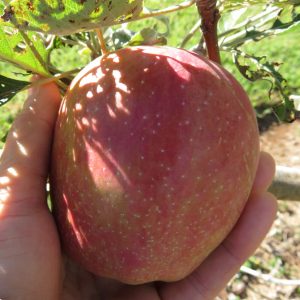
Common Apple
$16.95
Common Apple (Malus domestica) is the cultivated apple, a broadly climate-adaptable deciduous tree whose fruit ranges from tart to sweet and crisp to soft depending on variety, serving every use from fresh eating and cider to baking, drying, and preserves. It grows in USDA hardiness zones 4-9 and AHS heat zones 2-7, needs 600-800 chill hours, and requires cross-pollination with a compatible variety to set fruit.
4-5′ Bare Root Grafted Tree
Propagation: Seedling (own-root)
Can’t be shipped to: AK, HI, MT
In stock
Malus domestica, the cultivated apple, originated in the Tian Shan mountain region of Central Asia, where its primary wild progenitor, Malus sieversii, still grows in the forests of Kazakhstan. Domestication began an estimated 4,000 to 10,000 years ago, with the species then traveling westward along the Silk Road through Persia and the Mediterranean basin before arriving in Western Europe. Modern genomic research, including a DNA analysis published in 2010 and refined by subsequent work, confirmed M. sieversii as the principal wild ancestor, though millennia of hybridization with European crabapple (Malus sylvestris) introduced additional genetic diversity into what became the domesticated apple complex.
Apples reached North America with European colonists in the early seventeenth century — the Pilgrims brought young trees from England, and seedling orchards spread rapidly through the colonies. The species now encompasses over 7,500 named cultivars worldwide, spanning cold-hardy selections rated to Zone 3 through low-chill cultivars viable in Zone 9 subtropical climates. This record represents the species as a whole rather than any single named selection, covering characteristics shared across the cultivated apple complex.
Selecting the right rootstock is as consequential as cultivar choice: dwarfing rootstocks (M.9, M.26, Geneva series) produce trees reaching 8-10 feet that fruit in 2-3 years but require permanent staking and irrigation; semi-dwarf roots (MM.106, MM.111) yield 12-15 foot trees with better drought tolerance; standard seedling roots produce 20-30 foot trees needing 5-7 years to bear but with century-long productive lives. All require full sun — at least 8 hours daily — to develop adequate fruit color and sugars. Soil pH between 6.0 and 6.8 keeps nutrient uptake efficient; below 6.0, manganese and aluminum toxicity can limit growth. Consistent soil moisture during cell division (June drop period) prevents small, misshapen fruit, while good drainage prevents the anaerobic conditions that favor Phytophthora root rot. In humid-summer climates, pruning for canopy openness is the single most impactful cultural practice for disease management — light penetration reduces foliage moisture and slows spore germination of most common fungal pathogens.
USDA Hardiness Zone: 4-9
AHS Heat Zone: 2-7
Chill Hours: 600-800
Sun Requirements: Full Sun
Soil pH: 6.0-6.8
Soil Type: Deep, well-drained loam to sandy clay loam
Soil Drainage: Well-drained
Water Requirements: Medium; consistent, uniform soil moisture
Drought Tolerance: Low to Moderate; established trees tolerate brief drought but fruit production suffers without consistent moisture
Heat Tolerance: Moderate; performs best in temperate climates; fruit quality declines above Zone 8 without low-chill cultivar selection
Plant Spacing: 8-30 ft depending on rootstock (dwarf 8-10 ft; semi-dwarf 12-15 ft; standard 20-30 ft)
Container Suitability: Yes (dwarf rootstocks in large containers)
How to Prune: Prune annually during winter dormancy to open canopy, remove crossing/dead branches, and encourage fruiting spurs. Thin to maintain airflow and light penetration.
Malus domestica presents as an upright to broadly spreading deciduous tree whose final form depends heavily on rootstock vigor and training. On dwarfing roots the crown stays compact and manageable — 8-10 feet in all directions — while standard-vigor roots produce rounded canopies that can spread 25-30 feet with minimal competition. The fibrous lateral root system of grafted trees rarely develops a persistent taproot, which favors replanting flexibility but also limits drought anchoring compared to seedling-grown trees. Bark is gray-brown with furrowed ridges on mature specimens. Spring bloom opens white to soft pink from late March through May, with timing shifting roughly one week per USDA zone. Foliage is medium to dark green through summer, transitioning to yellow-orange in fall before leaf drop. The absence of thorns distinguishes M. domestica from many wild Malus relatives, making harvest and pruning work safe without heavy gloves.
Mature Height: 20-30 ft tall (standard); 12-15 ft tall (semi-dwarf); 8-10 ft tall (dwarf)
Mature Spread: 20-30 ft wide (standard); 12-15 ft wide (semi-dwarf); 8-10 ft wide (dwarf)
Growth Habit: Upright to spreading deciduous tree; rounded crown
Growth Rate: Moderate (12-24 inches per year)
Foliage Type: Deciduous
Food Forest Layer: Canopy, Sub-canopy
Permaculture Role: Canopy or sub-canopy fruit tree; food producer; pollinator magnet; wildlife food source
Leaf Color: Medium to dark green
Fall Foliage Color: Yellow to orange
Thorns?: No
Attracts Wildlife: Bees, butterflies, birds, deer, small mammals
Life Span: productive life 20-50+ years
Most Malus domestica cultivars are self-unfruitful and require a second compatible variety for pollen transfer. Bloom timing is the primary compatibility criterion: both varieties must open flowers within overlapping windows, typically within a span of 10-14 days. Diploid varieties serve as effective pollen donors for each other; triploid cultivars (Mutsu, Gravenstein, Winesap) produce sterile or nearly sterile pollen and should not be relied upon as the sole cross-pollinator — they need two diploid companions to ensure adequate pollen in the planting. Honeybees are the dominant pollinator at commercial scale, though native bees including mason bees and bumblebees are highly effective. For a diverse planting covering the full season spectrum at this nursery, Liberty Apple (mid-season, diploid) and GoldRush Apple (late-season, diploid) represent compatible companions across a wide bloom range.
Bloom Season: Early
Bloom Window: Mid Mar - Mid May
Pollination Requirements: Cross-pollination required; most cultivars are self-unfruitful. Plant two or more compatible cultivars that bloom simultaneously.
Pollination Mechanism: Insect-pollinated (primarily bees)
Flower Color: White to pink (pink in bud, opening to white with pink flush)
Ploidy: Diploid (2n=2x=34); some cultivars are triploid
Across the Malus domestica complex, fruit size ranges from 2.5 to 4 inches in diameter and 150 to over 300 grams, with flavor spanning from sharp tartness (high malic acid, low Brix) in varieties like Granny Smith to honey-sweet low-acid profiles above 14 Brix in selections like Honeycrisp. Flesh texture varies from coarse-grained and soft (McIntosh type) to notably crisp with high turgor pressure (Honeycrisp, SweeTango). Skin color ranges from solid red to bi-colored blush, solid yellow, or green-yellow. Storage life spans 1-4 weeks at room temperature for early cultivars and up to 4-6 months in controlled-atmosphere cold storage for late-season keepers like Fuji or GoldRush. Culinary applications are equally broad: fresh eating, baking (pies, tarts, crisps), sauce and butter production, juicing, hard and sweet cider, drying, and preserving as jams and jellies. Fruit flesh is edible raw; seeds contain amygdalin but incidental seed consumption poses minimal risk.
Ripening Season: Mid
Harvest Window: Late Jul - Early Nov
Fruit Size: 2.5-4 inch
Flavor: Ranges from tart to sweet depending on cultivar; complex aromatic flavor
Fruit Color: Red, yellow, or green depending on cultivar
Fruit Texture: Firm, crisp flesh (varies by cultivar from very firm to soft at maturity)
Fruit Skin: Smooth, thin to medium skin with natural wax coating
Bearing Habit: Annual to biennial bearing; primarily on spurs (spur-type) or tips (tip-bearing); regular annual bearing on most modern cultivars
Years to Bear: 2-3 years (dwarf), 4-5 years (semi-dwarf), 5-7 years (standard)
Storage Life: 1-6 months depending on cultivar; 1-4 weeks at room temperature; up to 4-6 months in refrigerated cold storage
Culinary Uses: Fresh eating, baking (pies, tarts, crisps), sauces (applesauce, apple butter), juicing, cider (sweet and hard), drying, preserving (jams, jellies), vinegar
Malus domestica carries moderate susceptibility to all five primary apple diseases and all four key pests — making cultivar selection for resistance critical in humid-summer climates. Apple scab (Venturia inaequalis) overwinters on leaf litter; remove fallen leaves in autumn and apply a 3-4 inch organic mulch ring to suppress ascospore release in spring. Fire blight (Erwinia amylovora) spreads through open blossoms and fresh wounds; prune strikes at least 8 inches below visible infection during dry weather, sterilizing tools between cuts with 70% isopropyl solution. Powdery mildew (Podosphaera leucotricha) favors vigorous succulent growth — avoid excess nitrogen and prune to open the canopy so foliage dries quickly after rain. Cedar apple rust (Gymnosporangium juniperi-virginianae) requires both apple and Eastern red cedar hosts; removing junipers within 1,000 feet reduces inoculum pressure. Black rot (Botryosphaeria obtusa) enters through wounds — protect trunks with guards and remove mummified fruit promptly. Codling moth (Cydia pomonella) and plum curculio (Conotrachelus nenuphar) are the primary early-season fruit pests; kaolin clay at petal fall and Codling Moth Granulosis Virus (CMGV) provide OMRI-listed control. Apple maggot (Rhagoletis pomonella) is monitored with red sphere traps; sticky traps reduce adults without chemicals. Brown marmorated stink bug (Halyomorpha halys) is managed with exclusion netting during the late-season window.
Apple Scab: Moderately Susceptible
Fire Blight: Moderately Susceptible
Powdery Mildew: Moderately Susceptible
Cedar Apple Rust: Moderately Susceptible
Black Rot: Moderately Susceptible
Codling Moth: Susceptible
Plum Curculio: Susceptible
Apple Maggot: Susceptible
Brown Marmorated Stink Bug: Susceptible
- Rootstock first: Match rootstock to your site. Dwarfing roots (M.9, Geneva 41) maximize precocity but need permanent support and irrigation; MM.111 offers drought tolerance where water is unreliable.
- Scab management window: Primary infection runs green tip through petal fall. Missed applications cannot be compensated later — use kaolin clay or copper OMRI materials on the infection timeline, not a calendar schedule.
- Fire blight pruning: Cut strikes 8–12 inches below visible infection; sterilize tools between cuts. Prune during dry weather — wet conditions spread the bacterium.
- Thinning is non-optional: Hand-thin to one apple per spur (6 inches apart) within 4–6 weeks of bloom. Unthinned crops trigger biennial bearing and increase disease susceptibility.
- Pest monitoring baseline: Hang red sphere traps for apple maggot and delta traps for codling moth at petal fall. Trap catches calibrate spray timing far more accurately than calendar schedules.
We ship in late winter or early spring based on your USDA hardiness zone.
We strive to ship orders on the scheduled dates listed in the table below. However, please note that the actual shipping date may be subject to change due to factors like weather conditions and order volume.
The specific date for shipping your order will be determined according to your zipcode at the time of checkout.
Our plants are shipped bare root, packed in moist sawdust, and securely wrapped in plastic to prevent the roots from drying out. We use USPS Ground Advantage for shipping, ensuring that your plants typically arrive within 2-5 days after packaging.
In case you're unable to plant the trees immediately upon arrival, we recommend soaking them in water for a few hours and temporarily heeling them in. Ideally, they should be planted within three days of receipt for optimal health.
See our full shipping policy and map here
| Zone | Ship Date |
|---|---|
| 11 - 8b | March 1st, 2027 |
| 8a - 7b | March 8th, 2027 |
| 7a | March 15th, 2027 |
| 6b | March 22nd, 2027 |
| 6a | March 29th, 2027 |
| 5b - 5a | April 12th, 2027 |
| 4b - 4a | April 26th, 2027 |
| 3b - 1a | May 3rd, 2027 |
Our 365-Day Plant Guarantee: We ensure that our plants are delivered to you alive and healthy. If your plant does not survive its first year, you're eligible for store credit under these conditions:
- Your location falls within the appropriate USDA hardiness zone for the plant variety (refer to our hardiness zone map).
- You maintain the roots' moisture and plant within three days of delivery, following the instructions in our Planting Guide.
If you're concerned about your plant's health, please consult our guide, How to Tell if Your Tree is Dead or Dormant. Remember, our plants are shipped in a dormant state and may leaf out at different times based on their species. To check for plant vital
Related products

Anna Apple
Checking fit
Arkansas Black Apple
Rated 4.67 out of 5$49.95 Select Rootstock This product has multiple variants. The options may be chosen on the product pageChecking fit
McIntosh Apple
Checking fitRated 5.00 out of 5
Siberian Crabapple
Checking fitRated 4.60 out of 5


Reviews
There are no reviews yet.