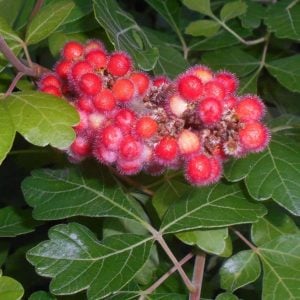


Gray Dogwood
$11.95
Gray Dogwood (also known as Panicled Dogwood; Cornus racemosa) is a native, colonial, multi-stemmed shrub with creamy-white flowers, reddish-purple fall foliage, and wildlife-dense white berries, used in shrub borders, rain gardens, riparian buffers, and erosion control. It grows in USDA hardiness zones 4-8 and AHS heat zones 1-8.
1-2′ Bare Root Seedling Tree
Propagation: Seedling (own-root)
In stock
Gray Dogwood is a straight wild-type species entry with no cultivated parentage. Cornus racemosa occurs naturally across eastern and central North America, ranging from Maine and southern Ontario south through the Atlantic states to South Carolina and west through the Midwest to Arkansas, occupying woodland edges, floodplain margins, shrubby thickets, and disturbed upland sites across this range. The species was formally described by Samuel Lathrop Rafinesque in 1830, though it had been noted in earlier botanical surveys of the eastern states. It spread naturally across its range over millennia through bird-dispersed seed and vegetative suckering rather than through any human selection or breeding program. Cornus racemosa carries two common names that reflect its field identification characters: panicled dogwood, referencing its paniculate flower clusters that distinguish it from the flat-topped Cornus alternifolia, and gray-stemmed dogwood, describing the silver-gray bark that gives it a distinctive winter silhouette different from the red stems of Cornus sericea. The USDA Natural Resources Conservation Service documents its native occurrence across approximately 30 states and three Canadian provinces.
Gray Dogwood's most practical quality for growers is its tolerance of a wide range of soil conditions — it establishes in loam, clay, sandy loam, and rocky soils with pH anywhere from 6.0 to 8.0, a span few native shrubs match. That pH flexibility allows it to function in rain garden situations where calcium-rich runoff from concrete or masonry raises soil pH above what acid-loving plants can tolerate. Average to moist moisture suits it best; once established, it handles occasional dry periods without significant dieback, though prolonged drought slows spread of the sucker colony. Full sun drives the densest fruit production and strongest fall color, while part shade is acceptable — particularly in humid climates where afternoon shade reduces powdery mildew pressure. Plant spacing of 10 to 15 feet per stem accounts for the suckering habit; shrubs gradually fill a buffer strip or hedgerow over 5 to 8 years without requiring replanting. Low salt tolerance means it performs poorly directly adjacent to treated roadways, so leave at least one buffer row between the planting and any heavily salted pavement.
USDA Hardiness Zone: 4-8
AHS Heat Zone: 1-8
Sun Requirements: Full Sun to Partial Shade
Soil pH: 6.0-8.0
Soil Type: Adaptable; loam, clay, sandy loam, rocky soils
Soil Drainage: Well-drained to moist; tolerates wet and dry
Water Requirements: Average to Moist; tolerates occasional drought once established
Drought Tolerance: Moderate
Heat Tolerance: Moderate; performs best in temperate humid climates
Plant Spacing: 10-15 ft apart
Container Suitability: Not Recommended
How to Prune: Prune in late winter to early spring before new growth. Remove root suckers annually to control spread. Can be coppiced or hard-pruned to rejuvenate old stems. Minimal pruning needed in naturalized settings.
Gray Dogwood develops as a multi-stemmed deciduous shrub reaching 10 to 15 feet at maturity, with a rounded crown. The rhizomatous root system produces suckers that gradually expand the colony outward — this growth pattern makes the shrub ideal as an erosion-control planting on slopes, stream banks, or pond margins, where roots bind soil between establishment seasons. Sucker removal along the perimeter maintains a defined edge; in naturalized settings no intervention is needed. Stems are gray-barked even in youth, providing winter interest that most deciduous shrubs lack. Leaf color is gray-green through summer, transitioning to reddish-purple to dusky purplish-red in fall — a reliable late-season display. Creamy-white paniculate flower clusters open in May through July, followed by white berries on red-pink pedicels in late summer. The contrast between white fruit and pinkish-red fruiting stems is the most-cited ornamental feature in native plant literature. Growth rate is medium; a rooted cutting reaches 4 to 6 feet in three to four growing seasons.
Mature Height: 10-15 ft tall
Mature Spread: 10-15 ft wide
Growth Habit: Multi-stemmed deciduous shrub; suckering/colonial; rounded to spreading
Growth Rate: Moderate
Foliage Type: Deciduous
Food Forest Layer: Shrub
Permaculture Role: Wildlife Habitat Plant; Erosion Control; Windbreak Component; Soil Stabilizer
Leaf Color: Gray-green to medium green
Fall Foliage Color: Reddish-purple to dusky purplish-red
Thorns?: No
Attracts Wildlife: Birds; Bees; Butterflies; Small mammals; Specialist native bees
Life Span: Long-lived perennial shrub; colonies persist indefinitely via suckering
Gray Dogwood produces creamy-white paniculate flowers from May through July, with peak bloom in most temperate climates falling in late May to mid-June. The flowers are entomophilous — pollinated by bees, butterflies, and other insects — with four specialist Andrena mining bee species documented as obligate visitors, meaning these bees depend on Cornus racemosa specifically. The species is self-fertile to a degree, and established colonies typically set a full crop without a specific cross-pollinator because the suckering habit generates multiple genetically distinct stems from root sprouts over time. However, planting near other dogwood species — Silky Dogwood, Red Osier Dogwood, or Roughleaf Dogwood — increases pollinator activity and fruit set in newly established single-clone plantings. No special action is needed for ornamental or wildlife plantings; growers focused on maximizing berry crop for bird habitat should site the shrub in full sun to optimize nectar production and pollinator visitation.
Bloom Season: Mid
Bloom Window: Mid May - Mid Jul
Pollination Requirements: Cross-pollination by insects; self-fertile to some degree
Pollination Mechanism: Entomophilous (insect-pollinated); primarily bees and butterflies
Flower Color: Creamy white
Gray Dogwood produces small white to grayish-white drupes, each roughly 3 to 5 mm in diameter, borne in clusters on pinkish-red to coral fruiting pedicels. The berries ripen in late summer — typically August through September in temperate climates — and persist on the pedicels after fruit drop, maintaining ornamental red-stem color through winter. The fruit flesh is thin, with high fat content relative to most native berries, making it an important high-energy food for migrating songbirds fueling up in late summer and fall. Over 90 bird species have been documented consuming the berries, including wood thrush, cedar waxwing, American robin, gray catbird, and multiple woodpecker species. The berries are bitter and astringent to humans — not toxic, but not palatable — so this shrub functions as a wildlife food plant rather than a culinary one. The high-fat drupe composition means Gray Dogwood contributes caloric value to bird populations at exactly the season when migratory energy demands peak, giving it a conservation significance that exceeds what its modest fruit size would suggest.
Gray Dogwood carries notably strong resistance to the two diseases that most frequently limit dogwood plantings: Spot Anthracnose (Elsinoë corni) and Dogwood Anthracnose (Discula destructiva). Both are rated as highly resistant, a meaningful advantage over Flowering Dogwood (Cornus florida), which is highly susceptible to Discula destructiva in humid eastern landscapes. Powdery Mildew (Erysiphe pulchra / Phyllactinia guttata) and Botryosphaeria Canker (Botryosphaeria spp.) are rated at moderate resistance — generally manageable without intervention, though airflow matters. Crown Canker / Phytophthora Root Rot (Phytophthora spp.) is also moderately resistant; avoid planting in poorly drained areas or where irrigation consistently wets the crown. Dogwood Sawfly (Macremphytus tarsatus) is the one pest where this species shows moderate susceptibility. Larvae are yellowish-white with black markings and feed in groups on leaf undersides; hand-picking or targeted applications of OMRI-listed insecticidal soap or spinosad at early instar is effective. Inspect foliage in mid-summer and act promptly before defoliation affects plant vigor. Dogwood Borer (Synanthedon scitula) is moderately resistant but can attack stems weakened by mechanical damage — avoid wounding bark during mowing or pruning, which are the primary entry points for larvae. Scale insects (Calico Scale and Oystershell Scale) are similarly moderately resistant; dormant-season applications of OMRI-listed horticultural oil address any buildup before populations reach damaging levels.
Spot Anthracnose: Resistant
Powdery Mildew: Moderately Resistant
Dogwood Anthracnose: Resistant
Crown Canker / Phytophthora Root Rot: Moderately Resistant
Botryosphaeria Canker: Moderately Resistant
Dogwood Sawfly: Moderately Susceptible
Dogwood Borer: Moderately Resistant
Scale Insects: Moderately Resistant
Dogwood Club Gall Midge: Moderately Resistant
- Manage the colony perimeter: Remove suckers at the outer edge annually in late winter if you need a contained planting; leave them in place for erosion control or wildlife buffer applications.
- Watch for Dogwood Sawfly: Inspect the undersides of leaves in July for colonies of yellowish-white larvae. Hand-pick small infestations early; treat larger ones with OMRI-listed insecticidal soap or spinosad spray at first instar before significant defoliation occurs.
- Avoid bark wounds near the base: Dogwood Borer larvae enter through damaged bark — keep mowers and string trimmers well away from stems to remove the primary infection pathway.
- Use in rain garden design: Wide pH tolerance and a preference for moist to average conditions make Gray Dogwood one of the few native shrubs that performs reliably in rain garden overflow zones.
- Apply dormant oil in early spring: If scale insects have been observed, a pre-bud-break application of OMRI-listed horticultural oil smothers overwintering crawlers without disrupting specialist bee populations that arrive with the blooms.
We ship in late winter or early spring based on your USDA hardiness zone.
We strive to ship orders on the scheduled dates listed in the table below. However, please note that the actual shipping date may be subject to change due to factors like weather conditions and order volume.
The specific date for shipping your order will be determined according to your zipcode at the time of checkout.
Our plants are shipped bare root, packed in moist sawdust, and securely wrapped in plastic to prevent the roots from drying out. We use USPS Ground Advantage for shipping, ensuring that your plants typically arrive within 2-5 days after packaging.
In case you're unable to plant the trees immediately upon arrival, we recommend soaking them in water for a few hours and temporarily heeling them in. Ideally, they should be planted within three days of receipt for optimal health.
See our full shipping policy and map here
| Zone | Ship Date |
|---|---|
| 11 - 8b | March 1st, 2027 |
| 8a - 7b | March 8th, 2027 |
| 7a | March 15th, 2027 |
| 6b | March 22nd, 2027 |
| 6a | March 29th, 2027 |
| 5b - 5a | April 12th, 2027 |
| 4b - 4a | April 26th, 2027 |
| 3b - 1a | May 3rd, 2027 |
Our 365-Day Plant Guarantee: We ensure that our plants are delivered to you alive and healthy. If your plant does not survive its first year, you're eligible for store credit under these conditions:
- Your location falls within the appropriate USDA hardiness zone for the plant variety (refer to our hardiness zone map).
- You maintain the roots' moisture and plant within three days of delivery, following the instructions in our Planting Guide.
If you're concerned about your plant's health, please consult our guide, How to Tell if Your Tree is Dead or Dormant. Remember, our plants are shipped in a dormant state and may leaf out at different times based on their species. To check for plant vital
2 reviews for Gray Dogwood
Related products

Aromatic Sumac
Checking fitRated 5.00 out of 5
Nannyberry
Checking fit
White Oak
Checking fitRated 5.00 out of 5
Redbud
Checking fitRated 4.33 out of 5


Sheryl S. (verified owner) –
Healthy looking bare root plants with strong root systems. It is about 18″ tall. Carefully packaged, but without a lot of wasteful packaging. Thank you!
Nicole Hamilton (verified owner) –
I planted both roughleaf and gray dogwood fairly near each other to form thickets on either side of a tree. All of them are starting to leaf out. :D