Redbud
$11.95
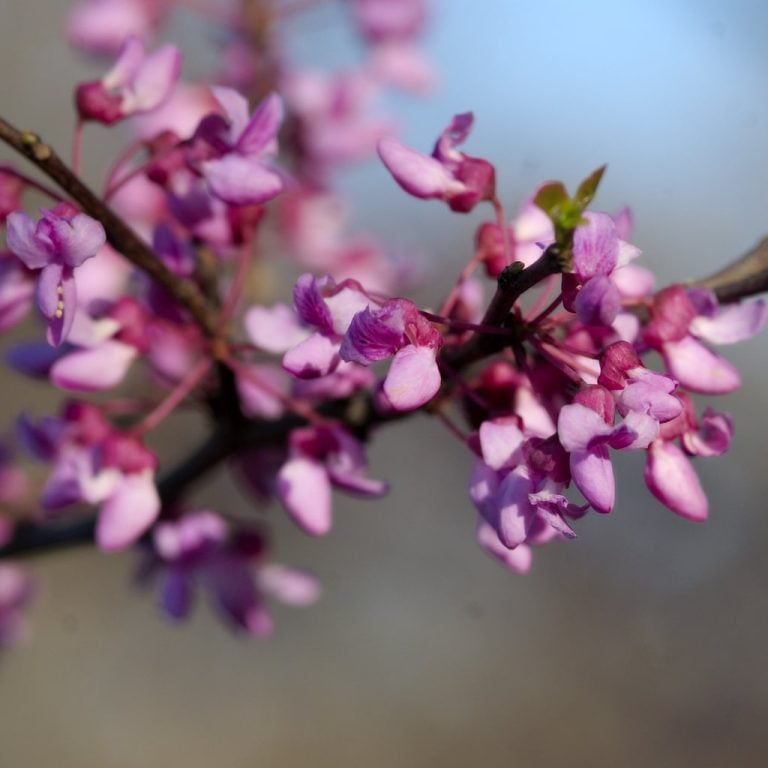
Redbud (also known as American Judas Tree; Cercis canadensis) is a native eastern North American tree that smothers its bare branches in clusters of pink to rose-purple flowers each spring before the leaves emerge, with edible flowers, young leaves, and pods adding culinary interest to its wildlife value. It grows in USDA hardiness zones 4-9 and AHS heat zones 2-9.
1-2′ Bare Root Seedling Tree
Propagation: Seedling (own-root)
In stock
Eastern Redbud is the straight species of Cercis canadensis — no breeding program, no parentage — a wild-type native whose natural range extends from southern Ontario and Nebraska south through the Ozark Plateau, the Appalachians, and into northern Florida and Texas. Carl Linnaeus formally described the species in 1753 from herbarium material, and by 1755 the English Quaker merchant-botanist Peter Collinson was cultivating it in Britain through colonial plant exchanges. George Washington planted redbuds at Mount Vernon and Thomas Jefferson at Monticello, cementing the species’ early place in American designed landscapes. As a species entry it encompasses the full breadth of wild genetic variation, meaning seedlings can vary noticeably in flower intensity, canopy architecture, and fall color. Gardeners seeking consistent ornamental traits may prefer a named cultivar; those prioritizing ecological function, local genotype diversity, and lower cost will find the species form a compelling choice.
Eastern Redbud performs across an unusually wide pH band, from 4.5 to 7.5, but root health deteriorates quickly in standing water, and its primary cultural vulnerability is Botryosphaeria canker entering through bark wounds and drought-stressed tissue. Keeping the root zone consistently moist through the first two to three growing seasons reduces that susceptibility substantially. Once established, the taproot gives moderate drought resilience, though extended dry stretches in heavy clay soil compound canker pressure. Full sun accelerates flowering and maintains a tighter crown; partial shade is tolerated and actually slows canker development in very hot, humid summers by reducing bark temperatures. Avoid planting in low spots where cold air pools in spring — late frosts can destroy the flower display even where the tree itself is hardy. Well-drained loam or clay loam suits it best; sandy soils retain too little moisture during establishment.
USDA Hardiness Zone: 4-9
AHS Heat Zone: 2-9
Sun Requirements: Full Sun to Partial Shade
Soil pH: 4.5-7.5
Soil Type: Loam, clay, sandy loam
Soil Drainage: Well-drained
Water Requirements: Medium
Drought Tolerance: Low
Heat Tolerance: Moderate
Plant Spacing: 20-30 ft apart
Container Suitability: Not Suitable (taproot; does not transplant well)
How to Prune: Prune in late summer or fall after bloom; remove dead or crossing branches; minimize pruning wounds to reduce canker entry points
The species form matures at 20 to 30 feet tall with a spread of 25 to 35 feet, giving a broadly rounded to irregularly spreading crown that widens more than it rises in open situations. Multi-stemmed forms are common from the wild and from nursery production; single-trunk specimens are available but require early training. The deep taproot stabilizes the tree against wind throw but makes transplanting difficult once a tree exceeds sapling size — plant from container at the correct permanent location and avoid moving it. Heart-shaped dark green leaves emerge after bloom and turn clear yellow in autumn. Growth rate is medium, averaging 7 to 10 feet of new growth per decade under decent conditions. Branching is somewhat zigzag and informal, which gives the crown an attractive open texture visible in winter. Prune only in late summer or fall after the bloom cycle; wounds cut in spring or early summer invite canker entry at their most vulnerable point.
Mature Height: 20-30 ft tall
Mature Spread: 25-35 ft wide
Growth Habit: Rounded to Broad Spreading, Multi-stemmed or Single Trunk
Growth Rate: Moderate
Foliage Type: Deciduous
Food Forest Layer: Sub-canopy
Permaculture Role: Pollinator Plant, Wildlife Habitat, Edible Landscape, Understory Element
Leaf Color: Dark Green
Fall Foliage Color: Yellow
Thorns?: No
Attracts Wildlife: Bees, Butterflies, Hummingbirds, Birds, Songbirds
Life Span: 20-50 years
Eastern Redbud is self-fertile — seed pods form on isolated trees without a pollinator companion. Flowering occurs from late March through late April in temperate climates, with the bloom appearing directly on bark along main stems and even on major roots at the soil surface, a trait called cauliflory that is rare among temperate North American trees. Flowers are bee-pollinated; the metallic green sweat bee Habropoda laboriosa is a specialist forager on Cercis, using the flowers as one of its primary early-season protein sources. Bumblebees, mason bees, and honeybees also work the blooms heavily. Planting multiple trees or cultivars of Cercis canadensis increases cross-pollination and pod set without being required for any fruiting. Redbud also serves as a larval host plant for 12 or more Lepidoptera species, including Henry's Elfin butterfly, whose caterpillars feed exclusively on Cercis foliage.
Bloom Season: Late
Bloom Window: Late Mar - Late Apr
Pollination Requirements: Self-Fertile
Pollination Mechanism: Insect (Bee-Pollinated)
Flower Color: Pink to Rose-Purple
Redbud produces no edible fleshy fruit; the ornamental and edible value lies in its flowers, young foliage, and immature seed pods. The flowers are mildly sweet with a light tang, high in vitamin C, and suitable for fresh use in salads, pickling as a caper substitute, or candying for garnishes. Young leaves are edible raw or lightly cooked and share the slightly acidic flavor profile. Immature flat seed pods — harvested before they toughen in early summer — can be eaten raw or briefly sautéed; mature pods are fibrous and not palatable. Dried mature pods persist through winter and are a reliable seed source for cardinals, grosbeaks, quail, and tree sparrows. Squirrels cache the seeds actively. The aesthetic value of the spring bloom is the tree's primary landscape currency: magenta-pink flowers blanketing bare branches create one of the most photographed native understory displays in Eastern deciduous forests.
Bearing Habit: Annual (seed pods produced annually after establishment)
Culinary Uses: Flowers used raw in salads, pickled as caper substitute, or candied; young pods eaten raw or cooked; high in vitamin C
Botryosphaeria canker (Botryosphaeria dothidea) is the most serious structural threat; the species shows clear susceptibility and the fungus enters through bark wounds, pruning cuts, and drought-stressed tissue. Prune only in late summer or fall when wound-sealing callus forms most efficiently, disinfect pruning tools between cuts with 70% isopropyl alcohol, and maintain even soil moisture to eliminate the water-stress windows canker exploits. Remove infected limbs at least 6 inches below visible discoloration; never compost this material. Verticillium wilt (Verticillium dahliae) persists in soil for years with no organic cure — avoid sites where tomatoes, strawberries, or dahlias have grown recently, and prioritize well-drained soil to limit fungal activity. Leaf spot (Mycosphaerella cercidicola), anthracnose (Gnomonia cercidis), and gray mold dieback (Botrytis cinerea) are moderately susceptible but rarely tree-threatening; selective branch thinning and clearing mulch from the root flare improves airflow and reduces infection pressure. Twomarked treehoppers (Enchenopa binotata), soft scales (Parthenolecanium corni), wood borers (Agrilus otiosus), and whitemarked tussock moth (Hemerocampa leucostigma) all register moderate susceptibility. OMRI-listed horticultural oil applied in late winter controls overwintering scale populations before hatch. Borer pressure correlates directly with tree stress — vigorous, well-watered trees attract Agrilus far less than declining specimens.
Botryosphaeria Canker: Susceptible
Verticillium Wilt: Susceptible
Leaf Spot: Moderately Susceptible
Anthracnose: Moderately Susceptible
Gray Mold / Dieback: Moderately Susceptible
Twomarked Treehopper: Moderately Susceptible
Scales: Moderately Susceptible
Wood Borers: Moderately Susceptible
Whitemarked Tussock Moth: Moderately Susceptible
- Time pruning carefully: Cuts made in spring or early summer are prime entry points for Botryosphaeria canker. Restrict all pruning to late summer or fall after the bloom cycle has fully finished.
- Establish moisture before canker sets in: The taproot needs two to three seasons to anchor; consistent moisture during this window is the most effective canker-prevention measure available.
- Avoid Verticillium-prone ground: Do not plant in beds with a history of susceptible crops like tomatoes, strawberries, or dahlias — Verticillium dahliae persists in soil for years with no organic cure.
- Apply dormant horticultural oil: Late-winter application of OMRI-listed horticultural oil before bud break suppresses overwintering scale populations before they hatch and spread to fresh bark.
We ship in late winter or early spring based on your USDA hardiness zone.
We strive to ship orders on the scheduled dates listed in the table below. However, please note that the actual shipping date may be subject to change due to factors like weather conditions and order volume.
The specific date for shipping your order will be determined according to your zipcode at the time of checkout.
Our plants are shipped bare root, packed in moist sawdust, and securely wrapped in plastic to prevent the roots from drying out. We use USPS Ground Advantage for shipping, ensuring that your plants typically arrive within 2-5 days after packaging.
In case you're unable to plant the trees immediately upon arrival, we recommend soaking them in water for a few hours and temporarily heeling them in. Ideally, they should be planted within three days of receipt for optimal health.
See our full shipping policy and map here
| Zone | Ship Date |
|---|---|
| 11 - 8b | March 1st, 2027 |
| 8a - 7b | March 8th, 2027 |
| 7a | March 15th, 2027 |
| 6b | March 22nd, 2027 |
| 6a | March 29th, 2027 |
| 5b - 5a | April 12th, 2027 |
| 4b - 4a | April 26th, 2027 |
| 3b - 1a | May 3rd, 2027 |
Our 365-Day Plant Guarantee: We ensure that our plants are delivered to you alive and healthy. If your plant does not survive its first year, you're eligible for store credit under these conditions:
- Your location falls within the appropriate USDA hardiness zone for the plant variety (refer to our hardiness zone map).
- You maintain the roots' moisture and plant within three days of delivery, following the instructions in our Planting Guide.
If you're concerned about your plant's health, please consult our guide, How to Tell if Your Tree is Dead or Dormant. Remember, our plants are shipped in a dormant state and may leaf out at different times based on their species. To check for plant vital
3 reviews for Redbud
Related products
- SOLD OUT

Blackhaw
Checking fitRated 4.85 out of 5 
Aronia Berry
Checking fitRated 5.00 out of 5
Ohio Buckeye
Checking fitRated 5.00 out of 5
Pecan
Checking fitRated 4.33 out of 5


Ekaterina Sorokina (verified owner) –
Carol Helman (verified owner) –
no comment
Mike Parks (verified owner) –
Already have buds