$11.95Original price was: $11.95.$9.56Current price is: $9.56.
Blackhaw (also known as Nannyberry; Viburnum prunifolium) is a native shrub or small tree bearing clusters of white flowers followed by blue-black drupes whose sweetness intensifies after the first frost, with deep red to purple fall foliage and broad appeal to birds and butterflies. It grows in USDA hardiness zones 3-9 and AHS heat zones 3-9.
1-2′ Bare Root Seedling Plant Propagation: Seedling (own-root)
Blackhaw is the straight native species Viburnum prunifolium, with no breeding program or cultivar selection involved. Its native range spans Connecticut west to Michigan and Kansas, south to Georgia and Texas, encompassing a broad band of the eastern and central United States where it grows along forest edges, stream banks, and open woodlands. The species epithet prunifolium — Latin for plum-leaved — refers to the resemblance of its leaves to those of Prunus species. Indigenous peoples throughout its range used the bark medicinally, and the practice was documented by both Native American and Appalachian folk medicine traditions. European settlers harvested the fruit for preserves. Blackhaw is notable among viburnums for its structural versatility: it can develop as a multi-stemmed suckering shrub or, given space and time, grow into a single-trunk small tree reaching 15 feet — a flexibility uncommon in the genus. It belongs to Adoxaceae following the early 21st-century reclassification of Viburnum from Caprifoliaceae.
Blackhaw's broad pH tolerance — from strongly acidic soils at 4.5 to alkaline soils at 8.0 — is the broadest of any viburnum commonly sold, which means growers rarely need to amend soil chemistry. The species accepts clay, loam, and sandy soils, tolerating poor and rocky substrates where more demanding viburnums fail. Full sun to part shade allows it to function as both an edge specimen and an understory plant in filtered light, though fruit production is heavier in full sun. Water requirements are low to moderate; established plants handle extended drought through a fibrous root system with spreading stolons. Irrigation during the establishment year promotes faster rooting, but once anchored the plant rarely needs supplemental water outside prolonged dry spells. Avoid consistently saturated soil, which promotes Armillaria root rot over time. Pruning should happen immediately after flowering because blooms form on old wood — cutting before mid-June removes very little growth while preserving next year's bloom buds.
USDA Hardiness Zone: 3-9 AHS Heat Zone: 3-9 Sun Requirements: Full Sun to Partial Shade Soil pH: 4.5-8.0 Soil Type: Clay, loam, sand; tolerates poor and rocky soils Soil Drainage: Well-drained; tolerates occasional dryness Water Requirements: Low to Medium; drought tolerant once established Drought Tolerance: High Heat Tolerance: High How to Prune: Prune immediately after flowering; blooms on old wood. Remove suckers to maintain single-trunk form or allow to sucker for multi-stemmed shrub.
At maturity, Blackhaw reaches 12–15 feet tall and 6–12 feet wide in its default multi-stemmed form, though deliberate sucker removal and single-stem training through the first two or three seasons yields a small specimen tree with a defined trunk and rounded crown. The slow growth rate — unusual among shrubs planted for screening — means structural framework forms over years rather than months, producing dense, interlocking branch architecture that supports heavy bird traffic in fall. Glossy dark green leaves turn red to deep purple in autumn, providing ornamental interest well into the season. The suckering root system spreads gradually, which aids erosion control on slopes but requires monitoring where spread is unwanted. The thornless stems make this a safe choice for planting near foot-traffic areas. Flowers appear mid-April through early June as flat-topped white clusters along the previous year's wood, making bloom timing easy to plan around winter pruning schedules.
Mature Height: 12-15 ft tall Mature Spread: 6-12 ft wide Growth Habit: Multi-stemmed upright shrub; can be trained as single-trunk small tree Growth Rate: Slow Foliage Type: Deciduous Food Forest Layer: Shrub Leaf Color: Glossy dark green Fall Foliage Color: Red to deep purple Thorns?: No Attracts Wildlife: Birds, butterflies, native bees, squirrels, chipmunks Life Span: Perennial (long-lived shrub/tree)
Blackhaw requires cross-pollination with a genetically distinct individual for reliable fruit production — planting a single specimen results in negligible fruit set. White flat-topped flower clusters (corymbs) open mid-April through early June depending on latitude, with earlier bloom in southern portions of the range and later bloom northward. Insect pollinators — primarily native bees and butterflies — move pollen between individuals when bloom windows overlap. Arrowwood Viburnum (Viburnum dentatum) provides a compatible bloom-window overlap and also serves as a larval host for Spring Azure and Summer Azure butterflies. Plant at least two shrubs within 50–60 feet of each other to ensure pollinator transfer. The flat flower heads are also important early-season food for native bees emerging from winter dormancy.
Bloom Season: Mid Bloom Window: Mid Apr - Early Jun Pollination Requirements: Cross-pollination required for fruit production; plant two or more genetically distinct individuals Pollination Mechanism: Insect-pollinated (bees, butterflies) Flower Color: White
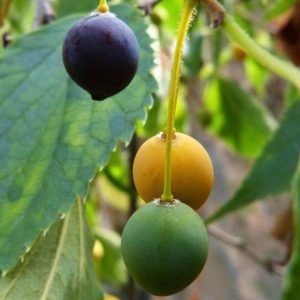
Ripening from early September through late November, Blackhaw produces small drupes measuring roughly 0.3–0.5 inch in diameter that progress through a striking color sequence — green to yellow to pink-red to blue-black — before reaching full maturity. Flavor is sweet with thin flesh and a large central stone; the flesh-to-pit ratio is low compared to cultivated fruits, but the taste sharpens and sweetens noticeably after the first hard frost, making late-harvest timing important for peak quality. Birds and small mammals, including squirrels and chipmunks, compete actively for the fruit once it ripens. For human use, the drupes work best in jams, jellies, and preserves where the flesh is pressed and the stones discarded. Fresh eating is possible but limited by the stone size. Medicinal traditions around the bark are documented historically, though commercial use or overconsumption of any plant part warrants caution — the structured data notes that overdose may cause nausea, dizziness, or visual disturbances.
Ripening Season: Mid Harvest Window: Early Sep - Late Nov Fruit Size: 0.3-0.5 inch Flavor: Sweet; thin flesh with large stone; flavor improves after frost Fruit Color: Blue-black at maturity; transitions from green to yellow to pink-red to blue-black Fruit Texture: Thin-fleshed drupe with large stone Culinary Uses: Eaten fresh off the bush; jams, jellies, and preserves; flavor improves after frost
Blackhaw carries moderate resistance across all five tracked diseases, making it one of the lower-maintenance native shrubs in the landscape. Powdery mildew (Erysiphe viburni) resistance is moderate; in sites with poor airflow or heavy shade, this fungal pathogen colonizes leaf surfaces. Prune for open branch architecture and avoid overhead irrigation in late afternoon. Botryosphaeria dieback (Botryosphaeria spp.) resistance is also moderate; drought stress and physical wounds are the primary entry points, so consistent soil moisture during establishment and avoiding pruning during hot, dry spells limits infection. Fungal leaf spot (Cercospora spp., Phyllosticta spp.) resistance is moderate — fallen leaf removal in autumn disrupts the overwintering cycle. Armillaria root rot (Armillaria mellea) draws moderate susceptibility; avoid soil compaction around the root zone and do not plant in sites with a history of Armillaria infestation. Anthracnose (Colletotrichum spp.) shows moderate resistance; keeping mulch pulled back from the crown reduces soil-splash inoculation. On the pest side, Viburnum Leaf Beetle (Pyrrhalta viburni), oystershell scale (Lepidosaphes ulmi), aphids (Neoceruraphis viburnicola), and spider mites (Oligonychus illicis) all rate moderate resistance. Monitor new growth in spring; strong water sprays dislodge early infestations. Neem oil or insecticidal soap (OMRI-listed) controls scale crawlers and soft-bodied insects when applied at the right life-cycle stage.
Train to Single Trunk Early: If a small specimen tree is the goal, select one dominant stem and remove competing basal suckers during the first two or three growing seasons — the slow growth rate makes later corrective pruning more disruptive.
Wait for Frost Before Harvesting: Fruit flavor improves dramatically after the first hard frost. Waiting pays off in sweetness and quality over harvesting early.
Plant Two or More for Fruit: Cross-pollination is required. Space compatible individuals within 50–60 feet and ensure bloom overlap; Arrowwood Viburnum is a reliable pairing.
Prune Only After Flowering: Blackhaw blooms on old wood. Hold pruning until June at the earliest — cutting before flowers fade removes the following season's fruit-bearing wood.
We ship in late winter or early spring based on your USDA hardiness zone.
We strive to ship orders on the scheduled dates listed in the table below. However, please note that the actual shipping date may be subject to change due to factors like weather conditions and order volume.
The specific date for shipping your order will be determined according to your zipcode at the time of checkout.
Our plants are shipped bare root, packed in moist sawdust, and securely wrapped in plastic to prevent the roots from drying out. We use USPS Ground Advantage for shipping, ensuring that your plants typically arrive within 2-5 days after packaging.
In case you're unable to plant the trees immediately upon arrival, we recommend soaking them in water for a few hours and temporarily heeling them in. Ideally, they should be planted within three days of receipt for optimal health.
Our 365-Day Plant Guarantee: We ensure that our plants are delivered to you alive and healthy. If your plant does not survive its first year, you're eligible for store credit under these conditions:
You maintain the roots' moisture and plant within three days of delivery, following the instructions in our Planting Guide.
If you're concerned about your plant's health, please consult our guide, How to Tell if Your Tree is Dead or Dormant. Remember, our plants are shipped in a dormant state and may leaf out at different times based on their species. To check for plant vital
13 reviews for Blackhaw
Rated 5 out of 5
William Parker (verified owner)–
While the above ground branches were small, roots were quite sizable. Definitely what you want out of bare root plant.
Rated 5 out of 5
cindy h. (verified owner)–
Very well packed and with good notice of delivery. I got 2! Thank you.
Rated 4 out of 5
Lee K. (verified owner)–
Rated 5 out of 5
Sheryl S. (verified owner)–
Healthy looking bare root plants with strong root systems. They were about 18″ tall. Carefully packaged, but without a lot of wasteful packaging. Thank you!
Rated 5 out of 5
Jennifer G. (verified owner)–
The Blackhawk arrived healthy and strong. Looking forward to watching it grow.
Rated 5 out of 5
Phoebe D. (verified owner)–
Nice live starter plants
Rated 4 out of 5
Nicole Hamilton (verified owner)–
Only one of the two has grown leaves but I haven’t given up on the other one yet.
Rated 5 out of 5
Flavia (verified owner)–
Arrived well packed and healthy. I ordered 2 and received 4.
Rated 5 out of 5
Hannah (verified owner)–
Hard to know for sure with wee dormant plants, but there was no mold and the root systems looked very healthy! Got them in the ground and excited to see how they do!
Rated 5 out of 5
Brittany R. (verified owner)–
Roots looked amazing! I potted mine up until I figure out where I want to put them.
William Parker (verified owner) –
While the above ground branches were small, roots were quite sizable. Definitely what you want out of bare root plant.
cindy h. (verified owner) –
Very well packed and with good notice of delivery. I got 2! Thank you.
Lee K. (verified owner) –
Sheryl S. (verified owner) –
Healthy looking bare root plants with strong root systems. They were about 18″ tall. Carefully packaged, but without a lot of wasteful packaging. Thank you!
Jennifer G. (verified owner) –
The Blackhawk arrived healthy and strong. Looking forward to watching it grow.
Phoebe D. (verified owner) –
Nice live starter plants
Nicole Hamilton (verified owner) –
Only one of the two has grown leaves but I haven’t given up on the other one yet.
Flavia (verified owner) –
Arrived well packed and healthy. I ordered 2 and received 4.
Hannah (verified owner) –
Hard to know for sure with wee dormant plants, but there was no mold and the root systems looked very healthy! Got them in the ground and excited to see how they do!
Brittany R. (verified owner) –
Roots looked amazing! I potted mine up until I figure out where I want to put them.
Allison (verified owner) –
Plants arrived on time, and they are thriving!
Michelle (verified owner) –
So far so good, slowly growing.
James (verified owner) –
See above!