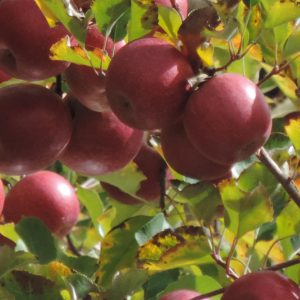

Prairie Fire Crabapple
$39.95
Prairie Fire Crabapple (Malus ‘Prairifire’) is a dense, upright-rounded ornamental crabapple bred at the University of Illinois with resistance to four major diseases, producing deep carmine-to-magenta spring blooms, orange-red fall color, and small purplish-red fruit ideal for jelly and wildlife habitat. It grows in USDA hardiness zones 4-8 and AHS heat zones 3-8, and needs about 650-1000 chill hours.
3-4′ Bare Root Grafted Tree
Rootstock: B118 – Semi Dwarf
A Budagovsky selection at roughly 85-90% of standard, so nearly full size. Exceptionally cold hardy and well anchored.
• Support: Freestanding; no staking required.
Can’t be shipped to: AK, HI
In stock
Prairifire Crabapple was introduced in 1982 by Dr. Daniel Dayton at the University of Illinois, Urbana-Champaign, as an ornamental byproduct of the PRI program — a collaborative disease-resistance initiative among Purdue University, Rutgers University, and the University of Illinois launched in 1945 to breed scab- and fire blight-resistant apple varieties for commercial orchards. Documented parentage traces through a complex multi-generation cross: ((Malus x zumi ‘Calocarpa’ x Malus sieversii f. niedzwetzkyana) x Malus x atrosanguinea) x Malus ‘Liset,’ a lineage that accounts for both the deep carmine flower color and the resistance profile. The inclusion of M. sieversii f. niedzwetzkyana contributed red pigmentation through foliage and fruit; Liset brought the compact rounded canopy and persistent small fruit. Prairifire does not carry a plant patent; it entered the nursery trade as an unprotected release from the university program. The Iowa Nursery and Landscape Association named it Tree of the Year in 1996. It has since become one of the most widely planted disease-resistant crabapples in the Midwest and mid-Atlantic, with a documented performance record across university trials spanning four decades.
Prairie Fire adapts to a wide pH range — roughly 5.5 to 7.0 — and handles loam, clay, or sandy soils provided drainage is adequate. Waterlogged roots invite Phytophthora collar rot even on an otherwise disease-resistant tree, so planting on a slight grade or raised bed pays dividends in persistently wet sites. Full sun is the non-optional variable here: fewer than six hours of direct light reduces flower density and softens the foliage color intensity that makes this cultivar distinctive. Once established, Prairie Fire tolerates brief dry spells through moderate drought resistance, but consistent moisture during the first two growing seasons accelerates canopy establishment. Dormant-season pruning — late winter before bud swell — keeps the dense interior open without creating fresh wounds during the fire blight infection window. Mulching the root zone to a 3-inch depth conserves moisture and suppresses competing turf, which is especially valuable on the fibrous, shallow root system during establishment. Fertilize lightly if at all; heavy nitrogen promotes succulent shoot growth that is more prone to bacterial infection even on resistant stock.
USDA Hardiness Zone: 4-8
AHS Heat Zone: 3-8
Sun Requirements: Full Sun
Soil pH: 5.5-7.0
Soil Type: Loam, clay, or sandy soils; adaptable to wide range
Soil Drainage: Well-drained; tolerates occasional wet
Water Requirements: Medium; drought-tolerant once established
Drought Tolerance: Moderate; established trees tolerate brief dry periods
Plant Spacing: 15-20 ft apart
How to Prune: Prune in late winter while dormant; avoid spring pruning as fresh cuts provide entry points for fire blight bacteria. Remove water sprouts and crossing branches to improve airflow.
Prairie Fire builds a dense, upright-rounded crown reaching 15 to 20 feet tall and equally wide at maturity — proportions that suit it to specimen placement or small groupings without overrunning adjacent structures. The fibrous, laterally spreading root system is shallow enough to coexist with lawn areas yet anchors the tree firmly once established. Foliage opens in a deep purple-maroon, one of the deepest among named cultivars, before transitioning to dark green with reddish-tinged veins and petioles by midsummer; fall color shifts to orange-red before leaf drop. The absence of thorns simplifies pruning and makes the tree safe near paths and play areas. Growth rate is moderate — typically 12 to 18 inches of new growth per season under good conditions — so the tree fills its intended space within 8 to 12 years without aggressive annual management. The dense branching pattern benefits from selective thinning every three to five years to maintain interior light and airflow, which reinforces the disease resistance the cultivar already carries.
Mature Height: 15-20 ft tall
Mature Spread: 15-20 ft wide
Growth Habit: Dense, upright-rounded
Growth Rate: Moderate
Foliage Type: Deciduous
Food Forest Layer: Canopy, Sub-canopy
Leaf Color: Purple to maroon on emergence; dark green with reddish-tinged veins and petioles at maturity
Fall Foliage Color: Orange to red
Thorns?: No
Attracts Wildlife: Birds, bees, butterflies, native pollinators
Life Span: 50-150 years
Prairie Fire is self-fertile, meaning it sets a crop without a designated partner, though fruit load and consistency improve with a nearby pollen source that overlaps its late April to mid-May bloom window. Deep carmine buds open to deep pinkish-red flowers that attract bees and native pollinators in strong numbers — a useful trait for orchards where Prairie Fire also serves as a universal pollen donor for nearby apple and crabapple cultivars blooming in the same period. Snowdrift Crabapple and Sugar Tyme Crabapple are compatible companions with reliable bloom overlap. Flower scent is light but detectable at close range. In years with a late frost during the bloom window, self-fertility provides some insurance — partial fruit set from even a few open flowers rather than a total crop loss.
Bloom Season: Late
Bloom Window: Late Apr - Mid May
Pollination Requirements: Self-fertile; cross-pollination improves fruit set
Pollination Mechanism: Insect (bee-pollinated)
Flower Color: Deep pink-red (carmine/magenta buds opening to deep pinkish-red flowers)
The fruit is small — about half an inch in diameter — and ripens to a purplish-red to dark maroon. Flavor is sharply tart with high pectin content, making raw eating unappealing but processing straightforward. Cooked into jelly, the high pectin load means consistent gel without commercial pectin additives; the deep pigment carries into the finished product as a rich ruby color. Prairie Fire fruit also works in preserves, apple butter blended with sweeter varieties, and cider blends where tannin and acidity are desirable. A defining characteristic is persistence: fruit clings to the tree through fall and into winter, providing a food source for cedar waxwings, robins, and mockingbirds long after other food sources are depleted. Off-tree shelf life is short for fresh use, so harvest-to-process timing matters. The seeds carry trace cyanogenic compounds as in all Malus species — not a practical safety concern at normal use levels, but seeds should not be eaten in quantity.
Fruit Size: 0.5 inch
Flavor: Tart; high pectin; suitable primarily for processing (jelly, preserves)
Fruit Color: Purplish-red to dark maroon
Bearing Habit: Annual; persistent fruit through fall and winter
Storage Life: Persistent on tree through winter; short off-tree for fresh use
Culinary Uses: Jelly, preserves, apple butter, cider, applesauce; best cooked or processed due to tartness and high pectin content
Prairie Fire's disease profile is one of the strongest in the ornamental crabapple category. Apple scab (Venturia inaequalis) is highly resistant, eliminating the spray program most cultivars require. Fire blight (Erwinia amylovora) is also highly resistant — a meaningful advantage in humid-summer climates where bloom-period infection pressure is high. Cedar-apple rust (Gymnosporangium juniperi-virginianae) and powdery mildew (Podosphaera leucotricha) round out a four-disease package that allows organic management without routine fungicide applications. Pest pressure requires more attention. Japanese beetle (Popillia japonica), eastern tent caterpillar (Malacosoma americanum), woolly apple aphid (Eriosoma lanigerum), and San Jose scale (Comstock perniciosa) are all moderately susceptible. Hand-pick Japanese beetles in early morning and apply kaolin clay before peak emergence. Remove eastern tent caterpillar egg masses during dormant pruning; destroy any tents that form before larvae disperse. Woolly apple aphid colonies respond to strong water sprays or OMRI-listed insecticidal soap. Dormant oil before bud break smothers overwintering San Jose scale crawlers.
Apple Scab: Very Resistant
Fire Blight: Very Resistant
Cedar-Apple Rust: Very Resistant
Powdery Mildew: Very Resistant
Leaf Spot / Frogeye Leaf Spot: Resistant
Japanese Beetle: Moderately Susceptible
Eastern Tent Caterpillar: Moderately Susceptible
Woolly Apple Aphid: Moderately Susceptible
San Jose Scale: Moderately Susceptible
- Time pruning precisely: Prune in the dormant window — late winter before bud swell. Fresh cuts in warm, humid spring weather open fire blight infection courts; sterilize tools between cuts if disease is present.
- Manage Japanese beetle early: Scout when adults emerge in early summer; hand-knock into soapy water in the morning and apply kaolin clay before peak populations establish.
- Control tent caterpillar at the egg stage: Inspect branch forks during dormant pruning; remove and destroy egg masses before hatch and physically remove any tents that form in spring.
- Dormant oil for scale: A thorough application before green tip smothers San Jose scale crawlers and reduces the season's starting population.
- Use as apple orchard pollinator: Prairie Fire blooms late April to mid-May and provides compatible pollen for most standard apple cultivars; place one within 50 feet of an apple block.
We ship in late winter or early spring based on your USDA hardiness zone.
We strive to ship orders on the scheduled dates listed in the table below. However, please note that the actual shipping date may be subject to change due to factors like weather conditions and order volume.
The specific date for shipping your order will be determined according to your zipcode at the time of checkout.
Our plants are shipped bare root, packed in moist sawdust, and securely wrapped in plastic to prevent the roots from drying out. We use USPS Ground Advantage for shipping, ensuring that your plants typically arrive within 2-5 days after packaging.
In case you're unable to plant the trees immediately upon arrival, we recommend soaking them in water for a few hours and temporarily heeling them in. Ideally, they should be planted within three days of receipt for optimal health.
See our full shipping policy and map here
| Zone | Ship Date |
|---|---|
| 11 - 8b | March 1st, 2027 |
| 8a - 7b | March 8th, 2027 |
| 7a | March 15th, 2027 |
| 6b | March 22nd, 2027 |
| 6a | March 29th, 2027 |
| 5b - 5a | April 12th, 2027 |
| 4b - 4a | April 26th, 2027 |
| 3b - 1a | May 3rd, 2027 |
Our 365-Day Plant Guarantee: We ensure that our plants are delivered to you alive and healthy. If your plant does not survive its first year, you're eligible for store credit under these conditions:
- Your location falls within the appropriate USDA hardiness zone for the plant variety (refer to our hardiness zone map).
- You maintain the roots' moisture and plant within three days of delivery, following the instructions in our Planting Guide.
If you're concerned about your plant's health, please consult our guide, How to Tell if Your Tree is Dead or Dormant. Remember, our plants are shipped in a dormant state and may leaf out at different times based on their species. To check for plant vital
Related products

Pink Lady Apple
$49.95 Select Rootstock This product has multiple variants. The options may be chosen on the product pageChecking fit
Robinson Crabapple
Checking fit
Jonathan Apple
Checking fit
Arkansas Black Apple
Rated 4.67 out of 5$49.95 Select Rootstock This product has multiple variants. The options may be chosen on the product pageChecking fit


Reviews
There are no reviews yet.