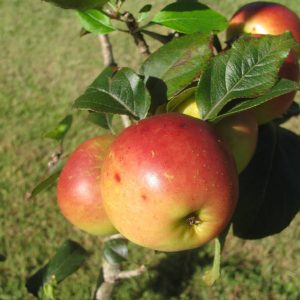
Sugar Tyme Crabapple
$39.95
Sugar Tyme Crabapple (Malus ‘Sutyzam’) is an upright oval ornamental crabapple originating as a chance seedling in Michigan, bearing white flowers from pale-pink buds and bright-red fruit that clings through winter, with high pectin content making it excellent for jams, jellies, and preserves. It grows in USDA hardiness zones 4-8 and AHS heat zones 3-8, and needs about 400-500 chill hours.
3-4′ Bare Root Grafted Tree
Rootstock: Malus domestica
Full-size tree with the deepest, most drought-tolerant root system.
Longest-lived option; takes a few extra years to begin bearing.
• Support: Freestanding; no staking required.
Can’t be shipped to: AK, HI
Out of stock
Out of stock — back next season
Spring 2027 inventory drops in June. Drop your email and we'll notify you the day this variety is back in stock.
You're on the list. Check your inbox for a confirmation link — click it to lock in your spot. We'll email you the day this variety is back in stock.
Sugar Tyme originated as a chance seedling discovered in 1965 in Haslett, Michigan, in the garden of Milton Baron, a professor of landscape architecture at Michigan State University who had planted a tree of the older cultivar ‘Calocarpa’ on the property. Baron recognized the seedling as unusual and showed it to Jim Zampini of Lake County Nursery in Perry, Ohio, who confirmed its commercial potential. Zampini introduced it commercially in 1988 under the patented clone name ‘Sutyzam’ (Plant Patent PP7062). Professor Baron passed away in 2014 at age 101. The cultivar’s parentage is effectively the open-pollinated progeny of ‘Calocarpa,’ placing it within the Malus hybrid complex without a documented male parent. Sugar Tyme won the 1999 Michigan Growers’ Choice Award and became one of the most widely planted crabapples in North American commerce, valued for heavy persistent red fruiting and reliable clean foliage. A later compact selection, Sweet Sugar Tyme, entered the Proven Winners portfolio targeting smaller residential sites.
Sugar Tyme performs best in full sun — at least six hours of direct light daily — where air circulation is maximized and foliage dries quickly after rain, limiting fungal pressure. Soil pH in the 5.5–6.8 range suits it; outside this window, micronutrient uptake suffers. Well-drained loam or sandy loam is the target: this cultivar does not tolerate waterlogged soils, and standing water around the root zone creates conditions favorable for Phytophthora crown and root rot, its one notable disease vulnerability. Moderate, consistent moisture during the growing season is ideal, particularly through fruit set in early summer; once established after two to three seasons, the tree tolerates short dry spells reasonably well. Avoid planting near junipers or Eastern red cedar within several hundred feet — these species serve as alternate hosts for cedar-apple rust. Prune immediately after spring bloom to avoid disrupting the following season's flower buds; heavy pruning in late summer or fall pushes tender new growth susceptible to fire blight entering winter.
USDA Hardiness Zone: 4-8
AHS Heat Zone: 3-8
Sun Requirements: Full Sun
Soil pH: 5.5-6.8
Soil Type: Loam, clay loam, sandy loam; well-drained
Soil Drainage: Well-drained; does not tolerate waterlogged conditions
Water Requirements: Medium; moderate and consistent moisture; drought tolerant once established
Drought Tolerance: Moderate; tolerates drought once established
Plant Spacing: 12-15 ft from other trees and structures
Container Suitability: Yes, in large containers (25+ gallon); the Proven Winners Sweet Sugar Tyme is specifically bred for smaller form and containers
How to Prune: Prune immediately after spring bloom; remove dead, damaged, or crossing branches; thin center to improve airflow; avoid heavy fall pruning (stimulates tender growth susceptible to fire blight)
Sugar Tyme grows to 14–18 feet tall with an 11–15-foot spread in an upright oval form — proportions that make it manageable in residential lots without requiring aggressive annual pruning to maintain clearance. The branch architecture is moderately dense and self-thinning enough that interior shading rarely becomes a serious maintenance problem, though removing crossing or inward-facing branches every few years after bloom improves airflow and keeps the canopy open. Dark green foliage through summer transitions to bronze-yellow tones in fall before leaf drop. The root system is fibrous near the surface with deeper anchoring roots; it is not aggressively invasive but benefits from a mulch ring out to the dripline to moderate soil temperature and moisture. The tree is thornless, which simplifies pruning and routine maintenance. At moderate-to-fast growth rate, it typically reaches functional landscape size within four to six years, filling a specimen or accent role while still young.
Mature Height: 14-18 ft tall
Mature Spread: 11-15 ft wide
Growth Habit: Upright oval
Growth Rate: Moderate to Fast
Foliage Type: Deciduous
Food Forest Layer: Canopy, Sub-canopy
Leaf Color: Dark green
Fall Foliage Color: Bronze-yellow
Thorns?: No
Attracts Wildlife: Birds, bees, butterflies, pollinators
Life Span: typically 40-70+ years in landscape
Sugar Tyme flowers mid-April through early May in a temperate climate, opening white from pale pink buds — a flowering window that overlaps with a wide range of Malus cultivars and apple varieties, making cross-pollination straightforward to arrange. Most crabapples, including Sugar Tyme, produce minimal viable self-pollen and fruit most reliably when a compatible cross-pollinator blooms simultaneously within bee foraging range (generally 100 feet or less is ideal, though bees routinely travel further). Any diploid apple or crabapple with overlapping bloom serves as a functional cross-pollinator. Good on-site companions include Snowdrift Crabapple, which shares a nearly identical bloom window, and Callaway Crabapple, a slightly earlier bloomer that still provides adequate overlap. Pollination is accomplished primarily by honey bees and native bees attracted to the fragrant white blossoms, which carry a mild sweet scent.
Bloom Season: Early
Bloom Window: Mid Apr - Early May
Pollination Requirements: Cross-pollination recommended; most crabapples are self-unfruitful but readily cross-pollinate with apple and other crabapple cultivars in bloom simultaneously
Pollination Mechanism: Insect (primarily bees)
Flower Color: White (opening from pale pink buds)
The fruit is a half-inch-diameter crabapple, bright red at maturity, with tart, astringent flavor typical of small-fruited Malus selections — high in pectin and acidic enough that fresh eating is not the primary use case. The culinary value is in processing: jams, jellies, crabapple butter, preserves, and cider blends all benefit from the high pectin content, which sets reliably without commercial additives. Harvested in late September through October, fruit stored refrigerated keeps one to two months. More significantly for landscape purposes, unpicked fruit persists on the branches through winter, providing a consistent food source for cedar waxwings, American robins, thrushes, and other frugivorous birds through the coldest months. This persistence is a key selection criterion distinguishing Sugar Tyme from cultivars whose fruit drops quickly after ripening. Fruit weight runs small — well under 10 grams per fruit — but the volume of annual production on a mature tree compensates, with heavy clustered sets covering most branch tips. Seeds and stems contain cyanogenic glycosides and should not be consumed.
Ripening Season: Late
Harvest Window: Late Sep - Mid Oct
Fruit Size: 0.5 inch
Fruit Color: Bright red
Bearing Habit: Annual bearer; abundant and reliable fruit set each year
Storage Life: Fruit persistent on tree through winter (months); harvested fruit stores 1-2 months refrigerated
Culinary Uses: Jams, jellies, preserves, crabapple butter, cider, wine, vinegar; high pectin content makes excellent preserves; too tart for fresh eating
Sugar Tyme carries genuine resistance to apple scab (Venturia inaequalis), the fungal disease that historically forced intensive spray programs on susceptible crabapples in humid climates — a practical advantage for organic and low-input growers. Fire blight (Erwinia amylovora), cedar-apple rust (Gymnosporangium juniperi-virginianae), and powdery mildew (Podosphaera leucotricha) all rate moderately resistant; occasional infection is possible in high-pressure years, but the tree avoids severe damage without intervention. The one disease vulnerability worth managing proactively is crown and root rot (Phytophthora cactorum): avoid heavy clay or low-lying areas where water pools after rain. On the pest side, Japanese beetle (Popillia japonica), eastern tent caterpillar (Malacosoma americanum), woolly apple aphid (Eriosoma lanigerum), and San Jose scale (Quadraspidiotus perniciosus) all rate as moderately susceptible. Hand-remove Japanese beetles into soapy water during peak emergence; remove tent caterpillar nests by hand in early morning before larvae disperse. Woolly aphid colonies respond to insecticidal soap or neem oil; apply dormant horticultural oil just before bud swell to manage San Jose scale.
Apple Scab: Resistant
Fire Blight: Moderately Resistant
Cedar-Apple Rust: Moderately Resistant
Powdery Mildew: Moderately Resistant
Crown Rot / Root Rot: Moderately Susceptible
Japanese Beetle: Moderately Susceptible
Eastern Tent Caterpillar: Moderately Susceptible
Woolly Apple Aphid: Moderately Susceptible
San Jose Scale: Moderately Susceptible
- Site away from junipers: Cedar-apple rust requires both Malus and Juniperus hosts; planting several hundred feet from Eastern red cedar or ornamental junipers lowers infection pressure in humid climates.
- Prune after spring bloom: Prune immediately after bloom, not in fall — fall pruning stimulates tender growth that enters winter susceptible to fire blight canker infections.
- Dormant oil for scale control: Apply horticultural oil just before bud swell when temperatures are above 32°F; this single application reduces San Jose scale and woolly apple aphid populations for the season.
- Drainage first: Crown rot (Phytophthora) is site-driven; if soil drains poorly, amend with coarse organic matter and plant on a berm rather than treating after the fact.
- Leave fruit for wildlife: Persistent red fruit feeds migratory and overwintering birds; leave remaining fruit after November if wildlife support is a planting goal.
We ship in late winter or early spring based on your USDA hardiness zone.
We strive to ship orders on the scheduled dates listed in the table below. However, please note that the actual shipping date may be subject to change due to factors like weather conditions and order volume.
The specific date for shipping your order will be determined according to your zipcode at the time of checkout.
Our plants are shipped bare root, packed in moist sawdust, and securely wrapped in plastic to prevent the roots from drying out. We use USPS Ground Advantage for shipping, ensuring that your plants typically arrive within 2-5 days after packaging.
In case you're unable to plant the trees immediately upon arrival, we recommend soaking them in water for a few hours and temporarily heeling them in. Ideally, they should be planted within three days of receipt for optimal health.
See our full shipping policy and map here
| Zone | Ship Date |
|---|---|
| 11 - 8b | March 1st, 2027 |
| 8a - 7b | March 8th, 2027 |
| 7a | March 15th, 2027 |
| 6b | March 22nd, 2027 |
| 6a | March 29th, 2027 |
| 5b - 5a | April 12th, 2027 |
| 4b - 4a | April 26th, 2027 |
| 3b - 1a | May 3rd, 2027 |
Our 365-Day Plant Guarantee: We ensure that our plants are delivered to you alive and healthy. If your plant does not survive its first year, you're eligible for store credit under these conditions:
- Your location falls within the appropriate USDA hardiness zone for the plant variety (refer to our hardiness zone map).
- You maintain the roots' moisture and plant within three days of delivery, following the instructions in our Planting Guide.
If you're concerned about your plant's health, please consult our guide, How to Tell if Your Tree is Dead or Dormant. Remember, our plants are shipped in a dormant state and may leaf out at different times based on their species. To check for plant vital
Related products

Ein-Shemer Apple
Checking fitRated 5.00 out of 5
Arkansas Black Apple
Rated 4.67 out of 5$49.95 Select Rootstock This product has multiple variants. The options may be chosen on the product pageChecking fit
Winesap Apple
Rated 5.00 out of 5$49.95 Select Rootstock This product has multiple variants. The options may be chosen on the product pageChecking fit
Dorsett Golden Apple
Checking fitRated 5.00 out of 5

Reviews
There are no reviews yet.