$11.95Original price was: $11.95.$9.56Current price is: $9.56.
Osage Orange (also known as Hedge Apple; Maclura pomifera) is a rugged native tree of the Ozarks and Red River drainage whose dense, thorny form makes an impenetrable windbreak or security hedge, with rot-resistant wood, bold yellow fall color, and chartreuse 4–6 inch fruit that shelters wildlife. It grows in USDA hardiness zones 4-9 and AHS heat zones 4-10.
1-2′ Bare Root Seedling Tree Propagation: Seedling (own-root)
Osage Orange is not a cultivated variety in the conventional sense but a wild-type species native to a historically tight range centered on the Red River drainage of Oklahoma, Texas, Arkansas, and Louisiana, with no named parentage or formal breeding program behind it. Maclura pomifera is the sole North American member of its genus in the Moraceae family. The Osage people prized its exceptionally dense, rot-resistant wood above all others for bow-making, giving rise to the French common name bois d’arc (bow-wood), later anglicized to bodark. Prior to barbed wire, Osage Orange hedgerows were planted so extensively across the Midwest from the 1840s through the 1880s that the species effectively defined the agricultural landscape of the Great Plains frontier — an estimated 60,000 miles of living fence at the practice’s peak. Individual trees are seedling-grown from wild-type stock; no standardized cultivar has been formally selected, so specimens vary naturally in thorniness, form, and fruit production. Its spread across the Eastern United States is largely a result of deliberate human planting rather than natural range expansion.
Few trees match Osage Orange for soil adaptability. It grows in clay, loam, sand, shallow rocky ground, and high-organic muck — tolerating both drought and periodic flooding once rooted — within a soil pH range of 5.0 to 8.0. That range encompasses nearly every soil type encountered across the Eastern and Central United States, which explains its successful naturalization far beyond its native range. Full sun is the one condition it insists on; canopy shade suppresses growth and reduces the dense branching that makes hedgerows effective. Drought tolerance is high after the first two seasons, so irrigation during establishment is the primary cultural investment. For windbreak or hedgerow applications, plant at 3 to 5 feet on center and allow to thicket; for specimen or shade use, space 30 to 40 feet apart. Prune in late winter before bud break, wearing heavy gloves — thorns are stiff and sharp. Heavy renewal cuts are tolerated well; the tree resprouts vigorously. No fertilization is typically needed on average soils; excess nitrogen encourages rank, weakly structured growth.
USDA Hardiness Zone: 4-9 AHS Heat Zone: 4-10 Sun Requirements: Full Sun Soil pH: 5.0-8.0 Soil Type: Adaptable to clay, loam, sand; tolerates poor, shallow rocky, and high organic soils Soil Drainage: Well-drained to occasionally wet; tolerates both drought and periodic flooding Water Requirements: Low once established; drought tolerant Drought Tolerance: High Heat Tolerance: High Plant Spacing: 30-40 ft for shade/specimen use; 3-5 ft for hedgerow/living fence planting Container Suitability: Not suitable How to Prune: Prune in late winter/early spring before bud break; remove dead, crossing, or rubbing branches; can be heavily cut back for hedgerow renewal; wear heavy gloves due to thorns
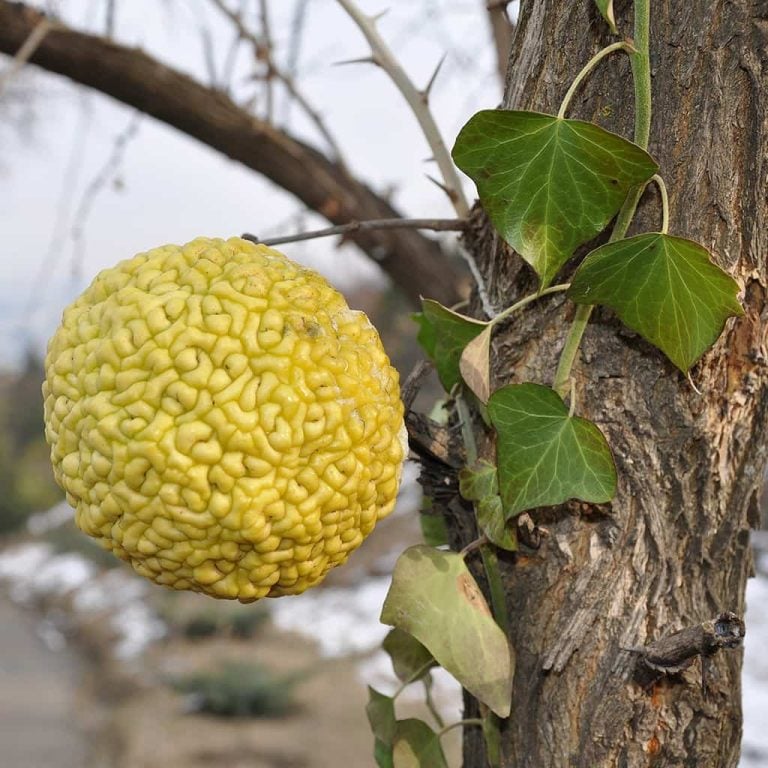
Mature Osage Orange trees develop a short trunk that divides early into a low, rounded, irregular crown reaching 35 to 60 feet tall and equally wide. The growth rate is fast for a tree of this longevity — documented specimens exceed 200 years — with young trees putting on several feet per year when sited in full sun on good ground. Bark is deeply furrowed and orange-brown on mature trunks, characteristic enough to identify the species by feel. Branches are armed with stiff, straight thorns that make unmanaged specimens impenetrable — a quality intentionally exploited in living fence applications. The diffuse lateral root system spreads widely and produces adventitious suckers, which can extend a hedgerow naturally but require management in landscape settings to prevent unwanted colonization. Fall foliage turns a clean yellow before leaf drop. The heavy, wrinkled fruit — yellow-green, 4 to 6 inches in diameter — persists on female trees into winter, providing seasonal interest and wildlife value even after leaf fall.
Mature Height: 35-60 ft tall Mature Spread: 35-60 ft wide Growth Habit: Rounded; short trunk with a low, rounded, irregular crown; dense branching Growth Rate: Fast Foliage Type: Deciduous Food Forest Layer: Canopy Permaculture Role: Windbreak tree; living fence/security hedge; timber/fuelwood provider; wildlife shelter Leaf Color: Dark green, glossy Fall Foliage Color: Yellow Thorns?: Yes Attracts Wildlife: Squirrels, small mammals, songbirds (for nesting/shelter); larval host for Ceratomia hagenii and Archips argyrospilus moths Life Span: 200+ years documented
Osage Orange is dioecious: male and female flowers are borne on entirely separate trees, so fruit production requires at least one tree of each sex within wind-pollination range. Bloom occurs from May through June, with inconspicuous green flowers that shed and receive pollen by wind rather than insect transfer. The practical implication is that any Osage Orange purchased without a known sex designation will have a 50/50 chance of being male or female. Growers wanting fruit — whether for wildlife value, the characteristic hedge-apple display, or seed harvest — should plant multiple seedling-grown trees to ensure sex representation, or source paired male and female plants where available. Male trees are valued in windbreak rows for their form and wood without the mess of heavy fruit drop. A compatible companion tree such as Osage Orange planted within reasonable proximity provides the cross-pollination necessary for female trees to set fruit.
Bloom Season: Mid Bloom Window: Mid May - Mid Jun Pollination Requirements: Cross-pollination required; dioecious — must have both male and female trees Pollination Mechanism: Wind pollinated Flower Color: Green (inconspicuous)
The "fruit" of Osage Orange is botanically a syncarp — a compound structure formed from dozens of fused female flowers — rather than a simple fruit. It reaches 4 to 6 inches in diameter, weighs roughly 1 to 2 pounds, and turns from pale green to a bumpy chartreuse-yellow when ripe in September through November. The interior contains a milky latex sap that causes skin irritation in sensitive individuals; direct contact should be handled with gloves. Raw flesh is not palatable to humans, though the seeds inside can be extracted and roasted. Wildlife value is primarily from squirrels, which tear into the fruit to access the seeds; the structure itself is too dense and latex-laden for most birds or deer. The primary commercial and historical uses have nothing to do with the fruit: the extremely dense, rot-resistant heartwood (one of the hardest in North America) is prized for fence posts, tool handles, archery bows, and turning stock. Posts cut from Osage Orange heartwood routinely last 50 years or more in ground contact without treatment.
Ripening Season: Mid Harvest Window: Mid Sep - Mid Nov Fruit Size: 4-6 inch Fruit Color: Yellow-green (chartreuse) when ripe Fruit Texture: Bumpy, wrinkled, rough surface; firm; contains milky latex sap Culinary Uses: Seeds edible (roasted); fruit pulp marginally edible but not palatable; primarily non-culinary — grown for timber, windbreak, and ornamental value
Osage Orange carries a strong disease profile relative to its family. Leaf Spot caused by Cercospora maclura and Powdery Mildew caused by Phyllactinia guttata are both well controlled by this species — it shows a high level of natural resistance to both, meaning infected trees typically experience cosmetic leaf blemishing late in the season without structural damage or meaningful defoliation. No spray program is warranted for either disease on established trees. Root Rot caused by Phytophthora spp. is more worth monitoring, particularly during establishment on poorly draining sites. Osage Orange tolerates periodic flooding but does not thrive in persistently saturated soil; ensuring adequate drainage at planting eliminates most Phytophthora risk. On the pest side, Sphinx Moth larvae (Ceratomia hagenii) and Fruit-Tree Leafroller (Archips argyrospilus) both show moderate susceptibility, meaning populations can build during warm, humid seasons. For Sphinx Moth larvae, hand-picking and Bacillus thuringiensis (Bt) applications during early larval stages are effective organic controls. Leafroller pressure responds well to dormant-season removal of egg masses on bark and branches. Scale insects (Coccidae) are held in check naturally and rarely require intervention on healthy trees. Overall, Osage Orange demands less disease and pest management than most cultivated fruit or nut trees of comparable size.
Plant two trees for fruit set: Osage Orange is dioecious — a single tree will never produce fruit. Plant at least two seedling-grown trees to ensure both sexes are present.
Site away from foot traffic: Thorns are rigid enough to puncture boots and tires. Reserve thorned individuals for hedgerow use; keep them well away from pathways, parking, and play areas.
Control root suckering early: The lateral root system produces suckers that spread beyond the planting footprint. Mow or cut suckers at grade during the first few years before they become woody.
Manage Sphinx Moth larvae with Bt: If populations build, apply Bacillus thuringiensis targeting early-instar larvae when leaf feeding is visible — effective without synthetic inputs.
Harvest posts from young-diameter wood: Limbs 3–4 inches in diameter have standout ground-contact longevity. Annual pruning of hedgerow specimens yields rot-resistant post material without harvesting the main stem.
We ship in late winter or early spring based on your USDA hardiness zone.
We strive to ship orders on the scheduled dates listed in the table below. However, please note that the actual shipping date may be subject to change due to factors like weather conditions and order volume.
The specific date for shipping your order will be determined according to your zipcode at the time of checkout.
Our plants are shipped bare root, packed in moist sawdust, and securely wrapped in plastic to prevent the roots from drying out. We use USPS Ground Advantage for shipping, ensuring that your plants typically arrive within 2-5 days after packaging.
In case you're unable to plant the trees immediately upon arrival, we recommend soaking them in water for a few hours and temporarily heeling them in. Ideally, they should be planted within three days of receipt for optimal health.
Our 365-Day Plant Guarantee: We ensure that our plants are delivered to you alive and healthy. If your plant does not survive its first year, you're eligible for store credit under these conditions:
You maintain the roots' moisture and plant within three days of delivery, following the instructions in our Planting Guide.
If you're concerned about your plant's health, please consult our guide, How to Tell if Your Tree is Dead or Dormant. Remember, our plants are shipped in a dormant state and may leaf out at different times based on their species. To check for plant vital





Reviews
There are no reviews yet.