
New Logan Black Raspberry
$14.95
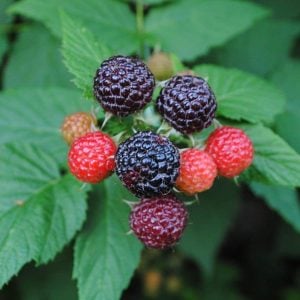
New Logan Black Raspberry (also known as Blackcap Raspberry; Rubus occidentalis) is a black raspberry cultivar derived from wild Rubus occidentalis, ripening ahead of peak summer heat with firm, sweet-tart, deep black-purple fruit suited to fresh eating, jam, and baking. It grows in USDA hardiness zones 4-8 and AHS heat zones 2-7, needs 800-1600 chill hours, and is self-fertile, fruiting reliably without a pollinator partner.
1-2′ Bare Root Plant
Propagation: Own-root
Out of stock
Out of stock — back next season
Spring 2027 inventory drops in June. Drop your email and we'll notify you the day this variety is back in stock.
You're on the list. Check your inbox for a confirmation link — click it to lock in your spot. We'll email you the day this variety is back in stock.
New Logan is a black raspberry (Rubus occidentalis) cultivar with documented cold hardiness and early ripening, but its breeding origin, parentage, and release institution are poorly documented in published pomological literature. The ‘New’ designation likely reflects a stabilized or selected strain derived from Logan, a 19th-century cultivar chosen from wild Rubus occidentalis populations valued across the upper Midwest and Northeast for cold hardiness and high anthocyanin content; however, the specific selection history, controlled crosses if any, and release date have not been confirmed in sources consulted for this entry. Some horticultural references describe it as a Zone 3-hardy variety with medium to large drupelets and early ripening suited to northern growing seasons, consistent with Logan-lineage ancestry, but treat any parentage claims beyond that wild-species background as undocumented. The variety is considered largely rare today — botanical conservationists have noted that locating existing plants would be valuable for preservation — suggesting it fell from wide commercial distribution at some point in the 20th century. Until additional primary-source breeding records become available, the origin of New Logan should be understood as provisionally documented.
Placing New Logan in full sun with good air circulation addresses its most critical cultural need: the arching cane structure traps humidity, and stagnant air accelerates fungal disease pressure. Sandy loam to loam soils with a pH between 5.6 and 6.5 keep iron and manganese available while discouraging crown rot. Incorporating 2 to 4 inches of compost before planting raises organic matter, improves drainage, and buffers pH drift — all three matter for cane health. Consistent moisture of 1 to 2 inches per week is most important during the bloom-to-fruit window (late spring through mid-July); drought stress during this period deflates fruit size and lowers Brix. Drip irrigation under mulch is the most efficient delivery method and avoids wetting foliage. Summer tip-pinching of primocanes at 24 to 30 inches redirects energy into lateral branching, roughly doubling the fruiting surface compared to unpinched canes.
USDA Hardiness Zone: 4-8
AHS Heat Zone: 2-7
Chill Hours: 800-1600
Sun Requirements: Full Sun
Soil pH: 5.6-6.5
Soil Type: Sandy loam to loam, high organic matter
Soil Drainage: Well-drained
Water Requirements: Medium; 1-2 inches per week
Drought Tolerance: Moderate
Heat Tolerance: Low to Moderate; struggles above 90°F
Plant Spacing: 3-4 ft apart, 8-10 ft between rows
How to Prune: Tip primocanes at 24-30 inches in summer to encourage laterals; remove spent floricanes to ground after harvest; thin new canes in spring
Primocanes emerge from the crown in spring as stiff, upright stems covered in glaucous bloom and recurved thorns, then arch progressively as they reach 4 to 6 feet during their first growing season. The second year, those same canes (now floricanes) push lateral branches that carry this season's fruit clusters before dying back. This biennial cane cycle means the planting always contains two distinct age classes; understanding that distinction is the key to correct pruning. The spreading crown gradually produces suckers and tip-layering shoots, forming a thicket over time if not managed with defined rows. Mature spread reaches 4 to 8 feet. Foliage is deciduous with a green upper surface and distinctly pale, almost whitish underside — a quick visual ID marker distinguishing it from red raspberries. The thorny canes make an effective wildlife exclusion hedge when grown as a hedgerow.
Mature Height: 4-6 ft tall
Mature Spread: 4-8 ft wide
Growth Habit: Arching, thicket-forming shrub with biennial canes; erect primocanes arch and droop as floricanes
Growth Rate: Fast
Foliage Type: Deciduous
Food Forest Layer: Shrub
Leaf Color: Green (light green above, pale/whitish beneath)
Thorns?: Yes
Attracts Wildlife: Bees; butterflies; songbirds; small mammals; black bears
Life Span: Perennial (crown is long-lived; individual canes are biennial)
New Logan is self-fertile and pollinates through both insect activity and some degree of self-pollination within each flower. White five-petaled blooms open from late April through early June depending on spring temperatures, and bees — particularly native bumblebees and mining bees — are the primary agents moving pollen between flowers. Because the variety is self-compatible, a solo planting reliably sets fruit. That said, cross-pollination from a nearby black raspberry such as Jewel Black Raspberry or Cumberland Black Raspberry can increase average drupelet set per berry, which translates to heavier fruit weight per cluster. The spring bloom period coincides with peak native bee activity, so avoiding insecticide applications during flowering protects this natural pollinator service.
Bloom Season: Early
Bloom Window: Late Apr - Early Jun
Pollination Requirements: Self-fertile
Pollination Mechanism: Insect-pollinated (bees); also self-pollinating
Flower Color: White
Berries ripen from mid-June through mid-July in a temperate climate, tracking ahead of most red raspberry varieties and finishing harvest before peak summer heat. Fruit measures 0.5 to 0.75 inch in diameter at maturity and detaches cleanly from the receptacle, leaving a hollow core — the standard black raspberry picking characteristic that distinguishes it from blackberries. Flavor is sweet-tart with rich, concentrated berry notes and detectable tartness; the flavor profile is notably more intense than red raspberries due to higher anthocyanin and organic acid levels. Shelf life fresh is 2 to 3 days under refrigeration, making prompt processing critical; the fruit freezes notably well for up to 12 months with minimal texture loss. High anthocyanin concentration also makes New Logan ideal for jams, jellies, syrups, and baked goods. Yield runs 2 to 6 quarts per plant at maturity, with high-end yields achievable on well-maintained, tip-pinched floricanes.
Ripening Season: Very Early
Harvest Window: Mid Jun - Mid Jul
Fruit Size: 0.5-0.75 inch
Flavor: Sweet-tart, rich, slightly tart; good for fresh eating, freezing, and jam
Fruit Color: Deep black-purple when ripe (progresses green to red to black)
Fruit Texture: Firm, juicy, with small drupelets; hollow core when picked
Bearing Habit: Floricane-bearing (fruit on second-year canes)
Years to Bear: 2-3 years
Storage Life: 2-3 days fresh; up to 1 year frozen
Culinary Uses: Fresh eating; jams and jellies; freezing; baking (pies, cobblers, muffins); syrups; smoothies; wine
Orange rust (Arthuriomyces peckianus) is the most serious threat to New Logan — infected plants cannot be cured and must be removed and destroyed immediately to prevent airborne spore spread to neighboring canes. Scout each spring for orange pustules on the undersides of new leaves; early removal before sporulation is the only effective organic control. Raspberry mosaic virus complex (Black Raspberry Necrosis Virus) is equally serious: the virus is aphid-vectored and has no cure, so controlling aphid populations with strong water sprays or insecticidal soap and starting with certified virus-free planting stock are the two most important preventative steps. Anthracnose (Elsinoe veneta) and cane blight (Leptosphaeria coniothyrium) show moderate susceptibility — prune out and dispose of infected canes during winter cleanup, thin to 4 to 5 canes per hill for airflow, and apply copper-based organic fungicides at bud swell if disease history warrants. Spur blight (Didymella applanata) resistance is moderate. Spotted wing drosophila (Drosophila suzukii) attacks ripening fruit; monitor with red-sphere traps from first color change and harvest promptly. Raspberry crown borer (Pennisetia marginata), Japanese beetle (Popillia japonica), and raspberry cane borer (Oberea bimaculata) are all moderately susceptible — remove wilted shoot tips to address cane borers and hand-pick beetles during peak emergence.
Orange Rust: Susceptible
Anthracnose: Moderately Susceptible
Cane Blight: Moderately Susceptible
Spur Blight: Moderately Resistant
Raspberry Mosaic Virus Complex: Susceptible
Spotted Wing Drosophila: Susceptible
Raspberry Crown Borer: Moderately Susceptible
Japanese Beetle: Moderately Susceptible
Raspberry Cane Borer: Moderately Susceptible
- Tip primocanes early: Pinch or cut primocanes at 24–30 inches in late June or early July to force lateral branches; this single practice can double your fruiting wood for the following season.
- Orange rust is urgent: Any plant showing bright orange pustules on leaf undersides in spring must be dug out entirely — roots and all — and destroyed; do not compost. The pathogen is systemic and the plant cannot recover.
- Start with certified stock: Raspberry Mosaic Virus Complex enters the planting through infected material; sourcing certified virus-indexed plants eliminates the most common entry point.
- Harvest daily at peak: Spotted Wing Drosophila populations spike mid-summer and target fully ripe fruit within hours; pick every 1–2 days at peak ripeness and refrigerate or freeze promptly.
- Mulch for moisture and pH: A 3-inch pine bark or wood chip mulch layer stabilizes soil moisture between rainfall events and gradually acidifies the top few inches of soil toward the target pH of 5.6–6.5.
We ship in late winter or early spring based on your USDA hardiness zone.
We strive to ship orders on the scheduled dates listed in the table below. However, please note that the actual shipping date may be subject to change due to factors like weather conditions and order volume.
The specific date for shipping your order will be determined according to your zipcode at the time of checkout.
Our plants are shipped bare root, packed in moist sawdust, and securely wrapped in plastic to prevent the roots from drying out. We use USPS Ground Advantage for shipping, ensuring that your plants typically arrive within 2-5 days after packaging.
In case you're unable to plant the trees immediately upon arrival, we recommend soaking them in water for a few hours and temporarily heeling them in. Ideally, they should be planted within three days of receipt for optimal health.
See our full shipping policy and map here
| Zone | Ship Date |
|---|---|
| 11 - 8b | March 1st, 2027 |
| 8a - 7b | March 8th, 2027 |
| 7a | March 15th, 2027 |
| 6b | March 22nd, 2027 |
| 6a | March 29th, 2027 |
| 5b - 5a | April 12th, 2027 |
| 4b - 4a | April 26th, 2027 |
| 3b - 1a | May 3rd, 2027 |
Our 365-Day Plant Guarantee: We ensure that our plants are delivered to you alive and healthy. If your plant does not survive its first year, you're eligible for store credit under these conditions:
- Your location falls within the appropriate USDA hardiness zone for the plant variety (refer to our hardiness zone map).
- You maintain the roots' moisture and plant within three days of delivery, following the instructions in our Planting Guide.
If you're concerned about your plant's health, please consult our guide, How to Tell if Your Tree is Dead or Dormant. Remember, our plants are shipped in a dormant state and may leaf out at different times based on their species. To check for plant vital
Related products

Encore Raspberry
Checking fit
Glencoe Raspberry
Checking fit
Boyne Raspberry
Checking fit
Jewel Black Raspberry
Checking fitRated 4.60 out of 5

Reviews
There are no reviews yet.