Boyne Raspberry
$12.95
Boyne Raspberry (Rubus idaeus ‘Boyne’) is a Canadian-bred red raspberry selected for outstanding cold hardiness, bearing tender, juicy, sweet-tart fruit on vigorous suckering canes suited to northern growing conditions. It grows in USDA hardiness zones 3-7 and AHS heat zones 1-6, needs 800-1000 chill hours, and is self-fertile, fruiting reliably without a pollinator partner.
1-2′ Bare Root Plant
Propagation: Own-root
In stock
Boyne was selected in 1949 from the cross Chief × Indian Summer, made in 1947 at the Canada Department of Agriculture Experimental Farm in Morden, Manitoba. It was formally named and released in 1960 after testing that extended from the Peace River area of Alberta east to the Maritimes and south into the northern United States. Chief contributed cold hardiness from northern Rubus idaeus germplasm while Indian Summer added productivity and primocane potential under short-season conditions. Morden’s breeding program — operating in one of the coldest agricultural zones in Canada — selected explicitly for cane survival under continental winter conditions that eliminate most European and American varieties. Boyne emerged from that selection pressure as the benchmark summer-bearing red raspberry for Zone 3 growers, a reputation it has held for more than six decades. Its public-domain status has kept it widely available to home growers and small farms throughout the upper Midwest and Canadian Prairie provinces, where no subsequent release has fully displaced it in cold-hardiness testing.
Boyne's cold hardiness is an asset, but that same northern breeding means it dislikes prolonged heat — summer temperatures regularly above 90°F accelerate cane stress and reduce fruit quality. Situate the planting where afternoon shade provides some relief in warmer parts of Zones 6–7. Soil preparation matters more here than for many small fruits: Boyne's shallow fibrous roots — roughly 90% confined to the top 20 inches — are highly sensitive to waterlogging, which accelerates crown rot and root disease. Raised beds or gently sloped sites with well-drained sandy loam to clay loam at pH 5.5–6.5 are ideal. During fruit development and harvest in late June through mid-July, consistent moisture up to 2 inches per week prevents drupelet abortion on berries; drip irrigation protects foliage from the humidity that promotes mold. Mulching with wood chips at 3–4 inches keeps soil temperatures stable and suppresses the weed competition that costs Boyne its shallow root zone.
USDA Hardiness Zone: 3-7
AHS Heat Zone: 1-6
Chill Hours: 800-1000
Sun Requirements: Full Sun
Soil pH: 5.5-6.5
Soil Type: Sandy loam to clay loam; fertile, well-drained
Soil Drainage: Well-drained; avoid waterlogged or poorly drained soils
Water Requirements: Medium to High; up to 2 inches per week during fruit development and harvest
Drought Tolerance: Low
Heat Tolerance: Low to Moderate; performs best in cool northern climates, struggles where summers regularly exceed 90°F
Plant Spacing: 2-3 ft apart in rows, 6-8 ft between rows
How to Prune: Remove all floricanes (second-year canes) at ground level immediately after harvest; thin primocanes to 4-6 strongest per hill or 6 inches apart in rows in early spring
Boyne produces upright, thorny floricane-fruiting canes that reach 4–6 feet tall in a single season, spreading 2–3 feet wide per established hill. The canes are stiff enough to remain partly self-supporting, though a two-wire trellis system at 3 and 5 feet reliably improves air circulation and simplifies harvest. Vigorous sucker production is one of Boyne's defining traits — primocanes emerge freely from the shallow crown and root system, enabling a managed hedgerow to fill in quickly. Left unmanaged, suckering expands the planting footprint over time, so establishing clear row boundaries with a spade or mowing between rows every season maintains a tidy structure. Floricanes fruit once in their second year, then die; removing spent floricanes at ground level immediately after harvest redirects energy to new primocane development. Leaves are dark green above with a whitish-gray underside — a visual cue that distinguishes Rubus idaeus from some native blackberry species when canes are young.
Mature Height: 4-6 ft tall
Mature Spread: 2-3 ft wide
Growth Habit: Upright, suckering shrub; thorny canes with vigorous sucker production
Growth Rate: Moderate to Fast
Foliage Type: Deciduous
Food Forest Layer: Shrub
Leaf Color: Green (dark green above, whitish-gray underside)
Thorns?: Yes
Attracts Wildlife: Birds, bees, butterflies, native pollinators
Life Span: 8-15 years (productive planting life)
Boyne is self-fertile, meaning every cane produces viable pollen and the flowers set fruit without cross-pollination. Bloom runs from mid-April through late May in temperate climate, with white five-petaled flowers opening progressively up the floricane. Honeybees and native bumblebees are the primary pollinators and substantially increase fruit set and berry uniformity compared to self-pollination alone — dense pollinator habitat near the planting directly improves yield. Cross-pollination with other red raspberry varieties is not required but can extend the combined harvest window when cultivars like Killarney or Latham with slightly different timing are interplanted nearby.
Bloom Season: Very Early
Bloom Window: Mid Apr - Late May
Pollination Requirements: Self-fertile; no cross-pollinator required
Pollination Mechanism: Insect-pollinated (bees); self-fertile
Flower Color: White
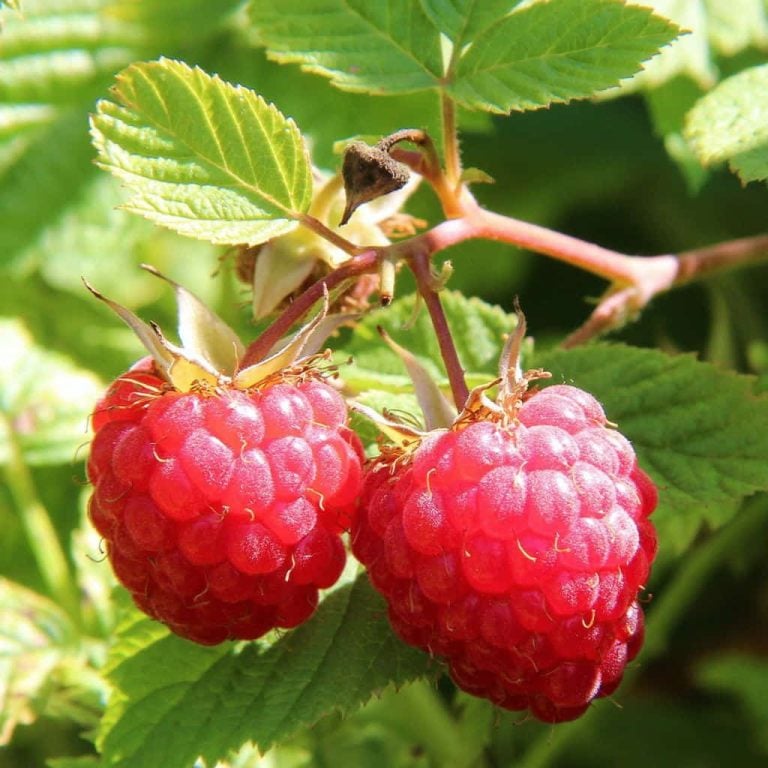
Boyne produces deep red, tender-juicy berries averaging about 0.5–0.75 inches across and roughly 2.1 grams each — smaller than newer commercial varieties but with a pronounced sweet-tart flavor profile that many growers describe as the definitive classic raspberry taste. The berries are tender and soft-textured at full ripeness, which makes them harvest-window sensitive: they move from peak quality to overripe within one to two days in the field under warm conditions, and refrigerated shelf life is only 1–3 days. For fresh eating, freezing, and processing this is not a constraint, but commercial fresh-market operations requiring longer transit tolerance will find the texture limiting. Harvest runs from late June through mid-July in temperate climate, with yields of 1.5–3 quarts per plant or 2–3 tons per acre under managed hedgerow production. Culinary applications span fresh eating, jam, preserves, pies, baking, smoothies, wine, and fruit processing. Young shoots are edible raw or cooked, and dried leaves are widely used for herbal tea.
Ripening Season: Very Early
Harvest Window: Late Jun - Mid Jul
Fruit Size: 0.5-0.75 inch
Fruit Weight: 2.1 g
Flavor: Sweet-tart; good classic raspberry flavor; excellent for fresh eating, freezing, and processing
Fruit Color: Deep red
Fruit Texture: Tender and juicy; soft
Bearing Habit: Summer-bearing (floricane); produces one crop per year on second-year canes
Years to Bear: 1-2 years
Storage Life: 1-3 days refrigerated; best used fresh or frozen immediately after harvest
Culinary Uses: Fresh eating, freezing, jam, preserves, pies, baking, smoothies, wine, processing
Boyne carries genuine resistance to Phytophthora Root Rot (Phytophthora fragariae var. rubi), a practical advantage on sites with imperfect drainage — this resistance requires avoiding waterlogged soils, since even resistant plants are compromised when anaerobic conditions persist. The variety is moderately susceptible to Gray Mold (Botrytis cinerea), Spur Blight (Didymella applanata), and Cane Blight (Leptosphaeria coniothyrium), three diseases sharing a common intervention: pruning for airflow. Remove spent floricanes immediately after harvest, thin primocanes to four to six per hill, and avoid overhead irrigation to keep foliage dry during humid periods. Anthracnose (Elsinoe veneta) is the most significant disease concern — fall sanitation (destroying infected prunings) and copper-based organic fungicides applied at green tip in spring reduce inoculum load. Spotted Wing Drosophila (Drosophila suzukii) is the primary harvest-window pest, targeting soft ripe fruit; yellow sticky traps combined with Spinosad (OMRI-listed) applied at early color change on a 7-day schedule are the most reliable organic tools. Japanese Beetle (Popillia japonica) and Raspberry Crown Borer (Pennisetia marginata) warrant monitoring — hand-picking beetles at dawn and replacing mulch annually to disrupt crown borer larvae are practical first responses. Spider Mite (Tetranychus urticae) pressure rises under hot, dry conditions; maintaining soil moisture and introducing predatory mites (Phytoseiidae) early suppresses outbreaks.
Gray Mold: Moderately Susceptible
Phytophthora Root Rot: Resistant
Spur Blight: Moderately Susceptible
Cane Blight: Moderately Susceptible
Anthracnose: Susceptible
Spotted Wing Drosophila: Moderately Susceptible
Japanese Beetle: Moderately Susceptible
Raspberry Crown Borer: Moderately Susceptible
Spider Mite: Moderately Susceptible
- Cut floricanes at ground level immediately after harvest: Leaving spent second-year canes in place harbors Cane Blight and Spur Blight inoculum and shades out primocane development — remove and dispose of them rather than composting.
- Thin primocanes in early spring, not late fall: Boyne's winter hardiness means some late-fall dieback is normal; wait until green growth appears in spring to identify viable canes before thinning to four to six per hill.
- Monitor for Spotted Wing Drosophila starting at first color change: Trap monitoring helps time any spinosad application before eggs are laid — treating at fruit-fly catch spike is more effective than calendar sprays.
- Manage row width to limit Anthracnose: Boyne's suckering habit can create dense clumps with poor air movement; keeping rows narrower than 18 inches through regular cultivation reduces the humid microclimate that Anthracnose and Gray Mold require.
- Install a two-wire trellis before canes reach 3 feet: Retrofitting support to established Boyne rows is difficult because of dense suckering; a simple T-post system at planting with wires at 3 and 5 feet prevents lodging and makes harvest and pruning significantly easier.
We ship in late winter or early spring based on your USDA hardiness zone.
We strive to ship orders on the scheduled dates listed in the table below. However, please note that the actual shipping date may be subject to change due to factors like weather conditions and order volume.
The specific date for shipping your order will be determined according to your zipcode at the time of checkout.
Our plants are shipped bare root, packed in moist sawdust, and securely wrapped in plastic to prevent the roots from drying out. We use USPS Ground Advantage for shipping, ensuring that your plants typically arrive within 2-5 days after packaging.
In case you're unable to plant the trees immediately upon arrival, we recommend soaking them in water for a few hours and temporarily heeling them in. Ideally, they should be planted within three days of receipt for optimal health.
See our full shipping policy and map here
| Zone | Ship Date |
|---|---|
| 11 - 8b | March 1st, 2027 |
| 8a - 7b | March 8th, 2027 |
| 7a | March 15th, 2027 |
| 6b | March 22nd, 2027 |
| 6a | March 29th, 2027 |
| 5b - 5a | April 12th, 2027 |
| 4b - 4a | April 26th, 2027 |
| 3b - 1a | May 3rd, 2027 |
Our 365-Day Plant Guarantee: We ensure that our plants are delivered to you alive and healthy. If your plant does not survive its first year, you're eligible for store credit under these conditions:
- Your location falls within the appropriate USDA hardiness zone for the plant variety (refer to our hardiness zone map).
- You maintain the roots' moisture and plant within three days of delivery, following the instructions in our Planting Guide.
If you're concerned about your plant's health, please consult our guide, How to Tell if Your Tree is Dead or Dormant. Remember, our plants are shipped in a dormant state and may leaf out at different times based on their species. To check for plant vital
Related products

Nantahala Raspberry
Checking fit
Encore Raspberry
Checking fit
Jewel Black Raspberry
Checking fitRated 4.60 out of 5
Nova Raspberry
Checking fit


Reviews
There are no reviews yet.