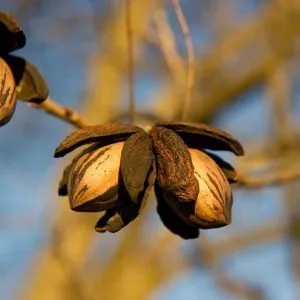
Jackson Pecan
$59.95
Jackson Pecan (also known as Thirty-Three Pecan; Carya illinoinensis) is a Gulf Coast heirloom pecan introduced in 1917 from Ocean Springs, Mississippi, producing very large nuts with firm, mild, buttery kernels that separate readily from the shell — excellent for pies, pralines, and roasting. It grows in USDA hardiness zones 7-9 and AHS heat zones 7-10, and needs 300-750 chill hours, and requires cross-pollination with a compatible variety such as Cape Fear Pecan or Elliot Pecan for reliable nut set.
3-4′ Bare Root Grafted Tree
Rootstock: Pecan Seedling
Grafted onto a pecan seedling, so the tree reaches its full natural size on a deep taproot. No dwarfing effect.
• Support: Freestanding; the deep taproot gives excellent anchorage.
Can’t be shipped to: AK, AZ, CA, HI, NM, TX
Out of stock
Out of stock — back next season
Spring 2027 inventory drops in June. Drop your email and we'll notify you the day this variety is back in stock.
You're on the list. Check your inbox for a confirmation link — click it to lock in your spot. We'll email you the day this variety is back in stock.
Jackson pecan was introduced in 1917 by a Mr. Betchel of Ocean Springs, Jackson County, Mississippi, placing it among the early Gulf Coast seedling selections that dominated pecan commerce before formal hybridization programs. Parentage is not formally documented; as an early twentieth-century open-pollinated selection it carries no recorded cross. The variety’s Mississippi Gulf Coast origins put it in the same geographic and temporal cohort as Stuart, Schley, and Forkert — seedling selections identified by nurserymen and growers in Jackson County during the era when Ocean Springs was a center of early pecan propagation. Jackson produces a large, high-quality nut and has been noted in southeastern trials for reasonable scab tolerance relative to older coastal selections. Mississippi State University Extension has listed it among varieties suited to south Mississippi home landscape orchards. As a Type I (protandrous) cultivar, Jackson sheds pollen before its own pistils become receptive, making it useful as a pollen source in orchards planted with Type II cultivars. Its history in commerce spans more than a century, though newer improved releases have largely displaced it in commercial settings.
Jackson thrives in deep, well-drained alluvial or loam soils with a pH of 5.5–7.0 — the deep profile is not incidental, since pecan taproots regularly extend 10 ft or more and draw heavily on subsoil moisture during nut fill in late summer. Waterlogged root zones invite Phytophthora and restrict oxygen exchange, so avoid low spots and heavy clay. Full sun is non-negotiable; any shading from competing trees cuts photosynthate to the developing kernels.
Foliar zinc sulfate applications at budbreak and again in early summer are essential, not optional — pecans are notoriously zinc-hungry and deficiency shows up fast as rosette (little-leaf), stunting shoot growth before you realize the canopy is in trouble. Water consistently during shell hardening and kernel fill (July through September in temperate climates) since drought stress at that stage collapses kernel plumpness and drives up blank nut percentage. Trees start bearing in 6–10 years; expect 10–15 years before full production.
USDA Hardiness Zone: 7-9
AHS Heat Zone: 7-10
Chill Hours: 300-750
Sun Requirements: Full Sun
Soil pH: 5.5-7.0
Soil Type: Deep, fertile sandy loam to clay loam; native to bottomland alluvial soils
Soil Drainage: Well-drained to moderately well-drained
Water Requirements: Medium
Drought Tolerance: Moderate
Heat Tolerance: High; requires long, hot summers to ripen nuts
Plant Spacing: 40-70 ft apart
Container Suitability: Not suitable; deep taproot requires in-ground planting
Jackson is a large, long-lived deciduous tree reaching 60–100 ft tall with a broad spreading canopy that can span 40–75 ft at full maturity, so site selection with decades of growth in mind is the right frame. The canopy's natural spreading habit provides dense summer shade, which makes it attractive as a dual-purpose shade and production tree in yard-scale plantings — though that same density requires proactive pruning to maintain airflow and light penetration into the bearing wood.
Growth rate is moderate, which means Jackson adds meaningful height each year while staying manageable compared to some faster-growing rootstocks. Foliage is deciduous, with pinnately compound leaves that emerge late in spring — an advantage in late-frost-prone areas since delayed budbreak reduces frost damage risk. The bark is gray and ridged at maturity, and the tree's deep taproot system makes transplanting large specimens difficult; start with container-grown or bare-root young trees and disturb roots as little as possible at planting.
Mature Height: 70-100 ft tall
Mature Spread: 40-75 ft wide
Growth Habit: Upright spreading; large deciduous tree with broad, rounded crown
Growth Rate: Moderate
Foliage Type: Deciduous
Food Forest Layer: Canopy
Permaculture Role: Canopy/overstory tree; nut crop; wildlife habitat; mast provider; shade
Leaf Color: Green
Attracts Wildlife: Squirrels, white-tailed deer, wild turkey, crows, woodpeckers, songbirds, opossums, raccoons
Life Span: productive for 200+ years
Jackson is a Type I (protandrous) pecan, meaning it sheds pollen before its own female flowers are receptive. In the current pecan pollination chart, its pollen-shed window is Apr 24 - Apr 28 and its receptive window is Apr 24 - May 3. Reliable crops need a compatible cross-pollinizer whose pollen shed overlaps that receptive window. Best matches from the current article matrix: Cape Fear (Type I), Stuart (Type II), Elliot (Type II). Pecans are wind-pollinated; plant compatible varieties in the same yard, food forest, or orchard block with open airflow rather than relying on an unknown tree several properties away.
Bloom Season: Early
Bloom Window: Pollen shed: Apr 24 - Apr 28; receptive: Apr 24 - May 3
Pollination Requirements: Cross-pollination required; Type I (protandrous): sheds pollen first, then becomes receptive later; needs a compatible cross-pollinizer whose pollen shed overlaps its receptive window
Pollination Mechanism: Wind-pollinated
Flower Color: Greenish-yellow
Ploidy: Diploid (2n=32)
Jackson produces medium-sized nuts averaging 33–38 per pound, with an above-average kernel recovery of 52–56% — meaning more than half of the in-shell weight is usable kernel. The shell cracks cleanly, releasing halves with minimal crumble, which matters for fresh eating and retail presentation. Kernel flavor is rich and buttery, with the characteristic pecan sweetness that deepens when nuts are briefly roasted.
Pecans are calorie-dense and nutritionally substantial, rich in monounsaturated fats, tocopherols, and minerals. For storage, cure fresh-harvested nuts in a single layer at room temperature for two weeks to equalize moisture, then refrigerate in sealed containers for six months or freeze for up to two years. Jackson's well-filled kernels hold quality well in storage. Culinary uses span the full pecan repertoire — pies, pralines, roasted snack mixes, and savory applications in grain salads and compound butters.
Ripening Season: Very Late
Harvest Window: Mid Oct - Late Nov
Fruit Size: Very large
Fruit Weight: 33-38 nuts per pound; 52-56% kernel
Flavor: Rich, buttery, mild flavor; high-quality kernel
Fruit Color: Shell: tan/brown; kernel: golden to light brown
Fruit Texture: Firm; kernel separates readily from shell
Fruit Skin: Hard shell; shell breaks cleanly away from kernel
Bearing Habit: Annual, though may bear lightly in alternate years; tends toward single nut per cluster
Years to Bear: 5-10 years
Culinary Uses: Fresh eating, pecan pie, pralines, baking, salted/roasted snack, cooking oil, desserts
In humid climates, Pecan Scab (Venturia effusa) is the primary disease threat, and Jackson carries moderate susceptibility — in wet seasons, scab can move through the canopy and shuck tissue quickly, cutting kernel fill. Managing it without synthetics centers on site selection: open sites with good air drainage dry foliage faster after rain, slowing spore germination. Avoid overhead irrigation during the growing season.
Downy Spot (Mycosphaerella caryigena) and Vein Spot (Gnomonia nerviseda) are secondary leaf diseases that cause early defoliation in wet years, depleting the tree's energy reserves. Both respond to the same airflow and dry-foliage practices that reduce scab pressure. Zonate Leaf Spot (Cristulariella moricola) appears after storm events; general canopy hygiene is the primary cultural response. Powdery Mildew (Microsphaera penicillata) is typically a late-season cosmetic issue in drier periods.
Pecan Weevil (Curculio caryae) is the most damaging pest — apply Surround WP kaolin clay when nutlets reach water stage and reapply after rain. Pecan Nut Casebearer (Acrobasis nuxvorella) and Hickory Shuckworm (Cydia caryana) are managed with pheromone trap monitoring and timed Bt or spinosad applications. Black Pecan Aphid (Melanocallis caryaefoliae) causes angular yellow leaf spots; reflective mulch and lacewing releases keep populations in check.
Pecan Scab: Moderately Resistant
Downy Spot: Moderately Susceptible
Vein Spot: Susceptible
Zonate Leaf Spot: Moderately Susceptible
Powdery Mildew: Moderately Susceptible
Pecan Weevil: Moderately Susceptible
Pecan Nut Casebearer: Moderately Susceptible
Hickory Shuckworm: Moderately Susceptible
Black Pecan Aphid: Moderately Susceptible
- Zinc at budbreak: Apply foliar zinc sulfate as leaves emerge and again six weeks later — deficiency causes rosette and stunted shoots fast.
- Plant a Type II companion first: Jackson will not crop without Elliot, Kanza, or Stuart within 150 ft; confirm the companion is established before planting Jackson.
- Kaolin clay timing: Begin Surround WP when nutlets reach water stage (late July) and reapply after rain to block Pecan Weevil egg-laying.
- Open sites beat hedgerows: Airflow is your best non-spray scab control — avoid planting where tree lines restrict wind movement through the canopy.
We ship in late winter or early spring based on your USDA hardiness zone.
We strive to ship orders on the scheduled dates listed in the table below. However, please note that the actual shipping date may be subject to change due to factors like weather conditions and order volume.
The specific date for shipping your order will be determined according to your zipcode at the time of checkout.
Our plants are shipped bare root, packed in moist sawdust, and securely wrapped in plastic to prevent the roots from drying out. We use USPS Ground Advantage for shipping, ensuring that your plants typically arrive within 2-5 days after packaging.
In case you're unable to plant the trees immediately upon arrival, we recommend soaking them in water for a few hours and temporarily heeling them in. Ideally, they should be planted within three days of receipt for optimal health.
See our full shipping policy and map here
| Zone | Ship Date |
|---|---|
| 11 - 8b | March 1st, 2027 |
| 8a - 7b | March 8th, 2027 |
| 7a | March 15th, 2027 |
| 6b | March 22nd, 2027 |
| 6a | March 29th, 2027 |
| 5b - 5a | April 12th, 2027 |
| 4b - 4a | April 26th, 2027 |
| 3b - 1a | May 3rd, 2027 |
Our 365-Day Plant Guarantee: We ensure that our plants are delivered to you alive and healthy. If your plant does not survive its first year, you're eligible for store credit under these conditions:
- Your location falls within the appropriate USDA hardiness zone for the plant variety (refer to our hardiness zone map).
- You maintain the roots' moisture and plant within three days of delivery, following the instructions in our Planting Guide.
If you're concerned about your plant's health, please consult our guide, How to Tell if Your Tree is Dead or Dormant. Remember, our plants are shipped in a dormant state and may leaf out at different times based on their species. To check for plant vital
Related products

Kanza Pecan
Checking fitRated 4.50 out of 5
Zinner Pecan
Checking fit
Cape Fear Pecan
Checking fit
Kiowa Pecan
Checking fit

Reviews
There are no reviews yet.