$59.95Original price was: $59.95.$47.96Current price is: $47.96.
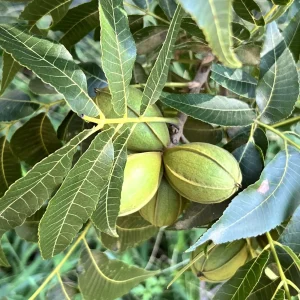
Elliot Pecan (Carya illinoinensis ‘Elliot’) is a large shade and nut tree bearing thin-shelled pecans with a firm, crisp, high-oil kernel, valued for its virtual immunity to pecan scab in humid climates. It grows in USDA hardiness zones 7-9 and AHS heat zones 8-10, and needs 300-850 chill hours, and requires cross-pollination with a compatible variety such as Caddo Pecan or Desirable Pecan for reliable nut set.
3-4′ Bare Root Grafted Tree Rootstock: Pecan Seedling
Pecan Seedling (Standard): Grafted onto a pecan seedling, so the tree reaches its full natural size on a deep taproot. No dwarfing effect.
• Support: Freestanding; the deep taproot gives excellent anchorage.
Elliott pecan originated as a chance seedling discovered around 1912 by H. Elliott in Milton, Santa Rosa County, Florida. In 1919 the Elliott family shared bud wood with Harlan Farms Nursery in Paxton, Florida, where proprietor Mr. Harlan planted a 15-acre trial orchard. Commercial promotion accelerated when Otis Mathis acquired that orchard and championed the variety through the Florida Pecan Growers Association, which credits him with establishing Elliott as an industry staple across the Gulf Coast. The Georgia Extension Service formally recommended Elliott in the early 1960s for its outstanding resistance to pecan scab — a disease that makes spray programs mandatory for most southeastern cultivars — a recommendation that spread its planting from Florida north into Georgia and Alabama. Parentage is unknown; as an open-pollinated selection it carries no formal cross record. Elliott is protogynous (Type II), and its high percentage of scab-resistant seedlings from open-pollinated seed has made it an important source of resistance in university breeding programs. It remains the benchmark low-input cultivar for humid coastal regions where scab pressure is most intense.
Elliot reaches 70–100 feet tall at maturity and needs generous spacing — plan for at least 60–70 feet between trees to allow for full canopy development and adequate air circulation. It performs best in USDA zones 7–9 and is well adapted to the heat and humidity of the Gulf Coast and Southeast. In a temperate climate, nuts mature in early October. Elliot is an alternate bearer, meaning it will produce heavier crops in some years and lighter crops in others — a normal trait for pecans that can be partially offset by thinning in heavy years and maintaining consistent soil nutrition. Well-drained, deep loamy soils with a pH of 5.5–7.0 are ideal; the tap root can reach extraordinary depths in loose soils. Foliar zinc sulfate applications are essential from leafout onward, as pecans are notably zinc-hungry and deficiency — visible as rosette foliage — sharply reduces yield. First nuts typically appear at 8–12 years from planting. Growth rate is moderate; patience is the primary requirement for this long-lived canopy tree.
USDA Hardiness Zone: 7-9 AHS Heat Zone: 8-10 Chill Hours: 300-850 Sun Requirements: Full Sun Soil pH: 5.5-7.0 Soil Type: Deep, fertile sandy loam to clay loam; native to bottomland alluvial soils Soil Drainage: Well-drained to moderately well-drained Water Requirements: Medium Drought Tolerance: Moderate Heat Tolerance: High; adapted to hot, humid summers of the southeastern US Plant Spacing: 60-80 ft apart Container Suitability: Not suitable; large canopy tree, requires deep, native soil
Elliot is a large, spreading deciduous tree that ultimately forms a broad, dense canopy characteristic of the species. Mature height ranges from 70–100 feet, with a spread that can match or exceed height in open settings. The compound pinnate leaves — typically 11–17 leaflets per leaf — cast deep shade beneath the canopy and drop cleanly in autumn. Growth rate is moderate; trees put on steady height in youth but slow as the crown fills out. The bark develops deep furrows with age, and the overall form is stately enough to serve as a landscape specimen as well as a nut producer. Foliage is not fragrant. Native to central and eastern North America, Elliot fits naturally into food forest canopy layers, woodland plantings, windbreaks, and large-scale shade plantings. It supports a wide range of wildlife: squirrels, white-tailed deer, wild turkey, woodpeckers, songbirds, crows, raccoons, and opossums all rely on the mast crop. Salt tolerance is low; avoid sites with road salt exposure or brackish conditions. Wind tolerance is also low — young trees benefit from staking in exposed locations.
Mature Height: 50-100 ft tall Mature Spread: 30-75 ft wide Growth Habit: Upright spreading; broadly oval, open crown with massive ascending limbs Growth Rate: Moderate Foliage Type: Deciduous Food Forest Layer: Canopy Permaculture Role: Canopy/overstory tree; nut crop; wildlife habitat; mast provider; shade Leaf Color: Medium to dark green Fall Foliage Color: Yellow to golden brown Attracts Wildlife: Squirrels, white-tailed deer, wild turkey, crows, woodpeckers, songbirds, opossums, raccoons Life Span: 100-300+ years
Elliot is a Type II (protogynous) pecan, meaning it has receptive female flowers before its own catkins shed pollen. In the current pecan pollination chart, its pollen-shed window is Apr 28 - May 5 and its receptive window is Apr 20 - Apr 29. Reliable crops need a compatible cross-pollinizer whose pollen shed overlaps that receptive window. Best matches from the current article matrix: Oconee (Type I), Desirable (Type I), Caddo (Type I). Pecans are wind-pollinated; plant compatible varieties in the same yard, food forest, or orchard block with open airflow rather than relying on an unknown tree several properties away.
Bloom Season: Mid Bloom Window: Pollen shed: Apr 28 - May 5; receptive: Apr 20 - Apr 29 Pollination Requirements: Cross-pollination required; Type II (protogynous): becomes receptive first, then sheds pollen later; needs a compatible cross-pollinizer whose pollen shed overlaps its receptive window Pollination Mechanism: Wind-pollinated Flower Color: Yellow-green catkins (male); inconspicuous green pistillate flowers (female)
Elliot produces medium-sized nuts averaging around 77 per pound — roughly 5.9 grams each — that consistently earn high marks for flavor and eating quality. The shell cracks cleanly into full halves, which is valuable for both fresh eating and any culinary use where presentation matters. Kernel percentage is solid, and the nuts fill out well under the humid conditions where the variety excels. Harvest falls in early October, placing Elliot in the mid-season window ahead of later varieties like Stuart. The flavor is described as rich and genuinely excellent rather than merely acceptable — an important distinction in a variety sometimes planted primarily for its disease profile rather than nut quality. Pecans are versatile in the kitchen: whole halves work in pies, pralines, brittles, and salads, while rough-chopped kernels add texture to baked goods, grain dishes, and nut butters. The high oil content that gives pecans their buttery flavor also means shelled nuts should be refrigerated or frozen for longer storage.
Ripening Season: Mid Harvest Window: Early Oct Fruit Weight: 77 nuts per pound (5.9 g/nut) Flavor: Great flavor; shells into halves easily Fruit Color: Tan to light brown; husks green turning brown at maturity Fruit Texture: Firm, crisp kernel with high oil content; thin shell relative to nut size Fruit Skin: Thin shell; cracks cleanly into plump halves Bearing Habit: Alternate bearing Years to Bear: 8-12 years Storage Life: In-shell: 9-12 months at room temperature; 1-2 years refrigerated; 2-4 years frozen Culinary Uses: Fresh eating; baking (pies, pralines, cookies, breads); salads; savory dishes; confections; nut butter; pressed oil
Elliot's defining advantage is proven resistance to pecan scab (Venturia effusa) — the single most economically damaging disease in humid-region pecan production. Scab infects both shucks and kernels, causing shriveled, worthless nuts in susceptible varieties that go unsprayed; Elliot's virtually immune response means it can produce reliable crops in the Gulf Coast and Southeast without the fungicide programs that more susceptible varieties require. It also carries good resistance to downy spot (Mycosphaerella caryigena), a foliage disease that can cause premature defoliation and weaken trees over time. These two resistances together make Elliot genuinely low-spray-viable in climates where other varieties would need six or more fungicide applications per season. The exception is powdery mildew (Microsphaera penicillata), where Elliot shows susceptibility — a liability in seasons with poor airflow and moderate humidity. Cultural management centers on canopy thinning to improve air circulation and reducing leaf wetness duration. For insect pressure, Pecan Weevil, Nut Casebearer, Hickory Shuckworm, and Black Pecan Aphid are the primary pests; kaolin-clay barriers (Surround WP) reduce weevil feeding organically, and beneficial insect habitat supports natural casebearer and aphid suppression.
Foliar zinc from leafout: Apply zinc sulfate at leafout and repeat every 2–3 weeks through summer — zinc deficiency directly reduces nut fill; mottled leaflets are the first sign.
Alternate bearing management: Thin nuts in heavy-crop years to 1–2 per cluster to direct energy into each nut and build reserves for the following season.
Prune for airflow to limit powdery mildew: Powdery mildew develops in dense canopies — prune periodically to open the center and improve light penetration as the tree matures.
Kaolin clay against weevil: Apply kaolin clay to shucks at water stage and repeat after rain; weevil adults lay eggs inside developing shucks, so coverage timing is critical.
Plan for full size and patience: Site 60–70 feet from structures — enormous at maturity. Expect little production the first 8 years; full crops take a decade or more.
We ship in late winter or early spring based on your USDA hardiness zone.
We strive to ship orders on the scheduled dates listed in the table below. However, please note that the actual shipping date may be subject to change due to factors like weather conditions and order volume.
The specific date for shipping your order will be determined according to your zipcode at the time of checkout.
Our plants are shipped bare root, packed in moist sawdust, and securely wrapped in plastic to prevent the roots from drying out. We use USPS Ground Advantage for shipping, ensuring that your plants typically arrive within 2-5 days after packaging.
In case you're unable to plant the trees immediately upon arrival, we recommend soaking them in water for a few hours and temporarily heeling them in. Ideally, they should be planted within three days of receipt for optimal health.
Our 365-Day Plant Guarantee: We ensure that our plants are delivered to you alive and healthy. If your plant does not survive its first year, you're eligible for store credit under these conditions:
You maintain the roots' moisture and plant within three days of delivery, following the instructions in our Planting Guide.
If you're concerned about your plant's health, please consult our guide, How to Tell if Your Tree is Dead or Dormant. Remember, our plants are shipped in a dormant state and may leaf out at different times based on their species. To check for plant vital
4 reviews for Elliot Pecan
Rated 5 out of 5
Maria S. (verified owner)–
The tree came with HUGE roots! I had to build a biggee gopher basket. But im3so excited to see it leaf out.
Rated 5 out of 5
Vanessa (verified owner)–
Rated 5 out of 5
angddd52 (verified owner)–
I just now received my first order with two pecan trees and I could not believe how large they were!!!!!! The end of the long box was opened but no matter , you had put a big stong bamboo stalk in to protect my trees! Roots look great.And they were packaged with great care. I had ordered a few plum trees and they look great, for except the chickasaw was broke off at the plant line. That does not matter. When I can order a couple more things i want, I will ask you to replace the little plum bareroot tree. I definitely will start ordering more next spring from this company. What great healthy and good looking trees they are. Thank you!!! Angela Dodge from Malvern. Arkansas
Maria S. (verified owner) –
The tree came with HUGE roots! I had to build a biggee gopher basket. But im3so excited to see it leaf out.
Vanessa (verified owner) –
angddd52 (verified owner) –
I just now received my first order with two pecan trees and I could not believe how large they were!!!!!! The end of the long box was opened but no matter , you had put a big stong bamboo stalk in to protect my trees! Roots look great.And they were packaged with great care. I had ordered a few plum trees and they look great, for except the chickasaw was broke off at the plant line. That does not matter. When I can order a couple more things i want, I will ask you to replace the little plum bareroot tree. I definitely will start ordering more next spring from this company. What great healthy and good looking trees they are. Thank you!!! Angela Dodge from Malvern. Arkansas
ANGELA (verified owner) –
What a huge plant with great root system.