$59.95Original price was: $59.95.$47.96Current price is: $47.96.
Caddo Pecan (Carya illinoinensis) is a large, spreading pecan developed from a Brooks × Alley cross at the USDA’s Georgia field station in the 1920s and released in 1968, producing 1–1.5-inch golden-kerneled nuts with high kernel-to-shell ratio and consistent yields. It grows in USDA hardiness zones 6-9 and AHS heat zones 6-9, and needs 300-800 chill hours, and requires cross-pollination with a compatible variety such as Elliot Pecan or Kanza Pecan for reliable nut set.
3-4′ Bare Root Grafted Tree Rootstock: Pecan Seedling
Pecan Seedling (Standard): Grafted onto a pecan seedling, so the tree reaches its full natural size on a deep taproot. No dwarfing effect.
• Support: Freestanding; the deep taproot gives excellent anchorage.
Caddo pecan was developed from a controlled cross of Brooks x Alley made in 1922 or 1923 at the U.S. Pecan Field Station in Philema, Georgia. The resulting seedling underwent decades of evaluation before being released in 1968 through the USDA pecan breeding program based in Brownwood, Texas. The variety name honors the Caddo Nation, indigenous people historically connected to the pecan-rich river valleys of the South Central United States — consistent with the USDA program’s tradition of naming selections after Native American nations. Caddo’s parentage from the Brooks and Alley lines, both early Georgia selections, targeted kernel quality and productivity in humid southeastern conditions. At release, Caddo was recognized for its precocious bearing habit — entering production at an early age and maintaining high output in mature trees without severe alternate bearing — and a kernel percentage consistently around 54 percent with a high proportion of fancy-grade, golden-colored kernels. USDA trials across Louisiana, Mississippi, and Georgia documented its performance under sustained Venturia effusa pressure, establishing its reputation as a low-spray option in humid climates.
Caddo thrives in the deep, well-drained alluvial and loam soils of river bottoms but adapts better than most cultivars to heavier clay-loam profiles when drainage is adequate. Target a soil pH of 5.5 to 7.0; outside that range, zinc and other micronutrient availability drops sharply. Pecan zinc deficiency, visible as rosette foliage and die-back, is the single most common nutrient failure in home plantings and the fix is inexpensive: apply foliar zinc sulfate at budbreak and again in early summer, every season without exception.
Trees reach 60 to 100 feet at maturity and require 40 to 50 feet of spacing to maintain canopy airflow, which directly reduces scab pressure. Caddo grows at a moderate pace and typically begins bearing at six to ten years from planting, with full production by the early teen years. Annual bearing is a characteristic strength of this cultivar. It tolerates AHS Heat Zones 6 through 9 and is well suited to temperate climates where summer heat accumulates adequately for nut fill.
USDA Hardiness Zone: 6-9 AHS Heat Zone: 6-9 Chill Hours: 300-800 Sun Requirements: Full Sun Soil pH: 5.5-7.0 Soil Type: Deep, fertile sandy loam to clay loam; native to bottomland alluvial soils Soil Drainage: Well-drained to moderately well-drained Water Requirements: Medium Drought Tolerance: Moderate Plant Spacing: 60-80 ft apart Container Suitability: Not suitable; develops deep taproot incompatible with containers
Caddo produces a large, spreading deciduous canopy that earns its classification as a full shade tree at maturity. Foliage is the compound pinnate leaf typical of Juglandaceae, emerging bronze-green in spring and turning yellow-gold before drop in autumn. Growth rate is moderate for the genus, meaning annual extension of one to two feet under good nutrition rather than the aggressive push seen in Desirable or Stuart.
Salt tolerance is low, making coastal planting inadvisable. Wind tolerance is similarly low; newly planted trees benefit from a stake or windbreak during the first two seasons while tap roots anchor. Deer find young foliage and catkins palatable, so protection fencing is advisable until the trunk reaches four inches in caliper. Once established, Caddo is a wildlife cornerstone: squirrels, wild turkey, woodpeckers, songbirds, raccoons, and white-tailed deer all use the mast crop, making it a high-value permaculture canopy layer species for food forests, naturalized woodlands, and multi-function homestead plantings.
Mature Height: 70-100 ft tall Mature Spread: 40-75 ft wide Growth Habit: Large deciduous tree with rounded, spreading crown Growth Rate: Moderate Foliage Type: Deciduous Food Forest Layer: Canopy Permaculture Role: Canopy/overstory tree; nut crop; wildlife habitat; mast provider; shade Leaf Color: Medium green (compound, 9-17 leaflets) Fall Foliage Color: Yellow to yellow-brown Thorns?: No Attracts Wildlife: Squirrels, white-tailed deer, wild turkey, crows, woodpeckers, songbirds, opossums, raccoons Life Span: 200-300+ years
Caddo is a Type I (protandrous) pecan, meaning it sheds pollen before its own female flowers are receptive. In the current pecan pollination chart, its pollen-shed window is Apr 22 - Apr 27 and its receptive window is Apr 26 - May 5. Reliable crops need a compatible cross-pollinizer whose pollen shed overlaps that receptive window. Best matches from the current article matrix: Elliot (Type II), Kanza (Type II), Syrup Mill (Type I). Pecans are wind-pollinated; plant compatible varieties in the same yard, food forest, or orchard block with open airflow rather than relying on an unknown tree several properties away.
Bloom Season: Mid Bloom Window: Pollen shed: Apr 22 - Apr 27; receptive: Apr 26 - May 5 Pollination Requirements: Cross-pollination required; Type I (protandrous): sheds pollen first, then becomes receptive later; needs a compatible cross-pollinizer whose pollen shed overlaps its receptive window Pollination Mechanism: Wind-pollinated Flower Color: Yellow-green (catkins) Ploidy: Diploid (2n=32)
Caddo produces medium-small nuts running approximately 70 per pound, with a kernel percentage consistently measured at 54 to 55 percent in USDA trials. That kernel fraction is high for a nut at this count-per-pound, meaning more edible yield per tree than larger-nutted types that sacrifice kernel fill for shell volume.
The shell is thin and cracks cleanly, releasing intact halves with minimal picking. Kernel color is golden-amber; flavor is rich and buttery with the moderate tannin character typical of Carya illinoinensis. The nuts are suited to direct fresh eating, culinary pastry and confectionery use, and longer-term storage when dried to below eight percent moisture. Caddo's smaller nut size makes it a natural fit for pecan halves in baked goods where a large nut would overpower individual servings. Yields are characteristically consistent from year to year, a trait growers value more than peak output that alternates with off years.
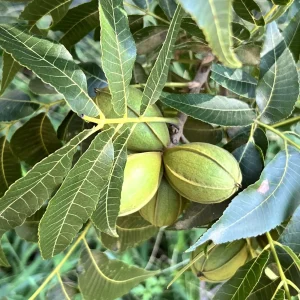
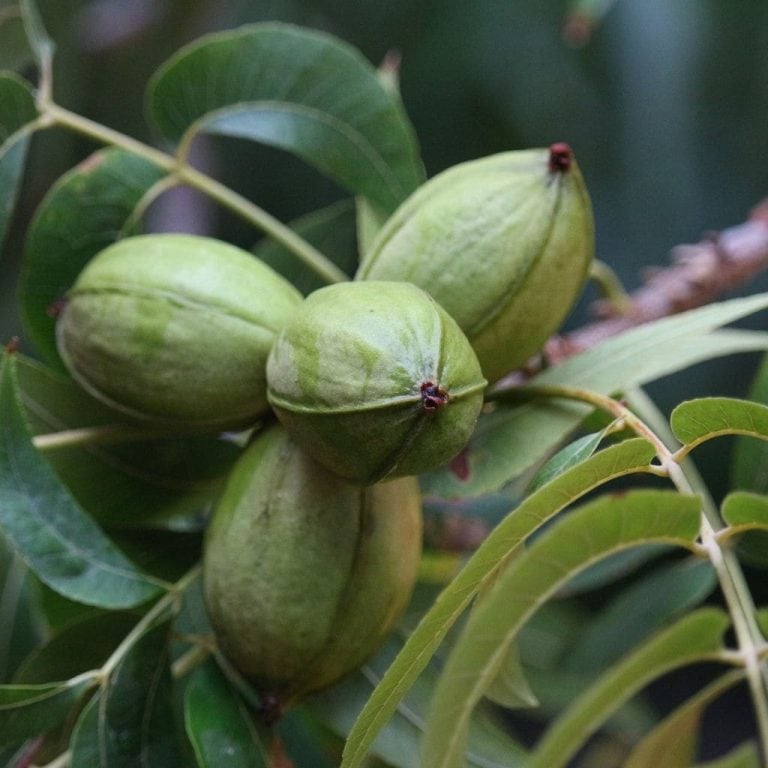
Ripening Season: Late Harvest Window: Early Oct - Late Oct Fruit Size: 1-1.5 inch Fruit Weight: 70 nuts per pound Flavor: Rich, sweet pecan flavor; attractive golden-colored kernels with high kernel-to-shell ratio Fruit Color: Tan to brown shell; golden yellow kernel Fruit Texture: 54-55% kernel; consistently high yields of quality nuts Fruit Skin: Thin brown shell that splits into 4 sections at maturity Bearing Habit: Annual bearing with low alternate-bearing tendency (alternate bearing index 0.32); precocious Years to Bear: 5-7 years (grafted trees) Storage Life: In-shell: 6 months refrigerated; 2+ years frozen Culinary Uses: Eaten raw, roasted, or salted; used in pies, cakes, bread, candies, ice cream, pralines, and confectionery; pressed for pecan oil
Caddo's defining agronomic strength is its resistance to Pecan Scab (Venturia effusa), the most destructive pecan disease in humid climates. USDA and university trial data rate it among the more resistant older cultivars, making it viable in high-rainfall locations where susceptible varieties like Stuart require repeated spray programs to produce a marketable crop.
Downy Spot (Mycosphaerella caryigena) and Vein Spot (Gnomonia nerviseda) cause cosmetic foliar damage but rarely threaten yield when canopy airflow is maintained through correct spacing. Zonate Leaf Spot (Cristulariella moricola) and Powdery Mildew (Microsphaera penicillata) are minor concerns at this site.
On the pest side, Pecan Weevil (Curculio caryae) is managed with Surround WP kaolin clay applied at shuck split. Pecan Nut Casebearer (Acrobasis nuxvorella) pressure is monitored with pheromone traps; Bt or spinosad targets first-generation larvae. Hickory Shuckworm (Cydia caryana) damage is reduced through fall sanitation of dropped shucks combined with Bt or spinosad. Black Pecan Aphid (Melanocallis caryaefoliae) infestations are suppressed with reflective mulch early in the season and lacewing releases once populations establish.
Foliar zinc every year: Apply zinc sulfate at budbreak and again in early summer without exception; zinc deficiency is the most common Caddo failure mode and the easiest to prevent.
Space for airflow: Plant trees 40 to 50 feet apart from the start; crowding sacrifices canopy airflow that keeps scab pressure manageable without sprays.
Add a Type II pollinator: Plant at least one Type II companion such as Kanza or Elliot within 150 feet before the first growing season; nut set requires cross-pollination.
Protect young trees and remove dropped shucks: Install deer fencing until the trunk reaches 4 inches in caliper; rake and remove dropped shucks each fall to break the Hickory Shuckworm cycle.
We ship in late winter or early spring based on your USDA hardiness zone.
We strive to ship orders on the scheduled dates listed in the table below. However, please note that the actual shipping date may be subject to change due to factors like weather conditions and order volume.
The specific date for shipping your order will be determined according to your zipcode at the time of checkout.
Our plants are shipped bare root, packed in moist sawdust, and securely wrapped in plastic to prevent the roots from drying out. We use USPS Ground Advantage for shipping, ensuring that your plants typically arrive within 2-5 days after packaging.
In case you're unable to plant the trees immediately upon arrival, we recommend soaking them in water for a few hours and temporarily heeling them in. Ideally, they should be planted within three days of receipt for optimal health.
Our 365-Day Plant Guarantee: We ensure that our plants are delivered to you alive and healthy. If your plant does not survive its first year, you're eligible for store credit under these conditions:
You maintain the roots' moisture and plant within three days of delivery, following the instructions in our Planting Guide.
If you're concerned about your plant's health, please consult our guide, How to Tell if Your Tree is Dead or Dormant. Remember, our plants are shipped in a dormant state and may leaf out at different times based on their species. To check for plant vital
Reviews
There are no reviews yet.