$59.95Original price was: $59.95.$47.96Current price is: $47.96.
Cape Fear Pecan (Carya illinoinensis ‘Cape Fear’) is a North Carolina–bred pecan selected from open-pollinated Schley seed, producing rich, buttery golden kernels on a tall upright tree with moderate scab resistance for humid Southeastern conditions. It grows in USDA hardiness zones 6-9 and AHS heat zones 6-9, and needs 300-850 chill hours, and requires cross-pollination with a compatible variety such as Elliot Pecan or Desirable Pecan for reliable nut set.
3-4′ Bare Root Grafted Tree Rootstock: Pecan Seedling
Pecan Seedling (Standard): Grafted onto a pecan seedling, so the tree reaches its full natural size on a deep taproot. No dwarfing effect.
• Support: Freestanding; the deep taproot gives excellent anchorage.
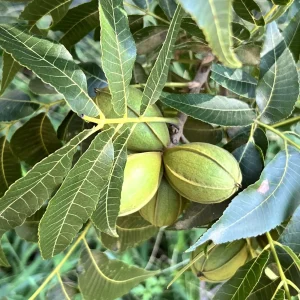
Cape Fear pecan was selected from a seedling orchard grown at the Coastal Plain Research Station at Willard, North Carolina, from open-pollinated seed of the cultivar ‘Schley’ — a late nineteenth-century Mississippi selection that had become one of the most widely planted southeastern pecans. The selection and evaluation work was conducted by horticulturalists at North Carolina State University, and Cape Fear was released for commercial planting specifically targeting the Carolinas and the Atlantic coastal plain, where late-season humidity and high disease pressure make scab management the defining challenge. Its Schley ancestry contributed large nut size and high kernel percentage; the selection process emphasized cultivars that could perform with reduced spray inputs compared to older varieties like Stuart under eastern disease pressure. NC State and extension programs from Alabama north through Virginia have included Cape Fear in recommended cultivar lists, and its track record of moderate scab resistance under attentive cultural management earned it lasting grower loyalty even as more resistant introductions became available. It produces medium-to-large nuts averaging approximately 7.5 to 8.2 grams with roughly 55 percent golden kernel.
Cape Fear is best suited to USDA Zones 6–9 and performs most consistently in deep, well-drained loam or sandy loam soils with a pH of 5.5–7.0. Like all pecans, it demands deep rooting room — at least 5 feet of unobstructed, well-drained profile — because waterlogged subsoils cause chronic zinc deficiency and root disease that no spray program can fully correct. Select a site with full sun and good air movement: pecan scab spreads fastest where canopy humidity lingers after rain, so low-lying pockets or sites hemmed in by windbreaks invite heavier disease pressure.
Zinc nutrition is not optional for Cape Fear. Apply foliar zinc sulfate at budbreak and repeat in early summer; zinc-deficient trees show "mouse-ear" leaf symptoms and yield collapses even when the tree otherwise looks healthy. Cape Fear is an alternate bearer by habit — heavy crop years are typically followed by lighter ones — so thinning in heavy years and consistent fertilization help even out production. Establish trees with 60–70-foot spacing to allow full crown development over decades.
USDA Hardiness Zone: 6-9 AHS Heat Zone: 6-9 Chill Hours: 300-850 Sun Requirements: Full Sun Soil pH: 5.5-7.0 Soil Type: Deep, fertile sandy loam to clay loam; native to bottomland alluvial soils Soil Drainage: Well-drained to moderately well-drained Water Requirements: Medium Drought Tolerance: Moderate Plant Spacing: 30-40 ft apart Container Suitability: No
Cape Fear grows into a large, spreading deciduous tree reaching 60–80 feet tall with a broad rounded canopy of similar width at maturity. The moderate growth rate means trees begin bearing meaningful crops in 6–10 years under good cultural conditions. Compound pinnate leaves cast dense summer shade, making Cape Fear a practical dual-purpose planting in food forests and homestead settings where canopy cover has independent value.
The alternate-bearing habit is pronounced — growers who plant a single tree experience more dramatic boom-bust cycles than those maintaining a mixed-variety planting where cultivars offset each other's off-years. Bark is gray-brown and deeply furrowed on mature trunks. Root depth and breadth make established trees considerably drought-tolerant, though consistent moisture during nut fill in August and September directly influences kernel quality.
Mature Height: 70-100 ft tall Mature Spread: 40-75 ft wide Growth Habit: Upright, tall, oval crown; open growth habit Growth Rate: Moderate Foliage Type: Deciduous Food Forest Layer: Canopy Permaculture Role: Canopy/overstory tree; nut crop; wildlife habitat; mast provider; shade Leaf Color: Dark green Fall Foliage Color: Yellow Thorns?: No Attracts Wildlife: Squirrels, white-tailed deer, wild turkey, crows, woodpeckers, songbirds, opossums, raccoons Life Span: 100-200+ years
Cape Fear is a Type I (protandrous) pecan, meaning it sheds pollen before its own female flowers are receptive. In the current pecan pollination chart, its pollen-shed window is Apr 24 - May 1 and its receptive window is Apr 26 - May 5. Reliable crops need a compatible cross-pollinizer whose pollen shed overlaps that receptive window. Best matches from the current article matrix: Elliot (Type II), Syrup Mill (Type I), Gafford (Type I). Pecans are wind-pollinated; plant compatible varieties in the same yard, food forest, or orchard block with open airflow rather than relying on an unknown tree several properties away.
Bloom Season: Mid Bloom Window: Pollen shed: Apr 24 - May 1; receptive: Apr 26 - May 5 Pollination Requirements: Cross-pollination required; Type I (protandrous): sheds pollen first, then becomes receptive later; needs a compatible cross-pollinizer whose pollen shed overlaps its receptive window Pollination Mechanism: Wind-pollinated Flower Color: Green (catkins; inconspicuous)
Cape Fear produces large, oblong nuts typically running 45–55 nuts per pound, with a well-defined shell that cracks cleanly to release full, intact halves. Kernel percentage runs approximately 52–56%, which is considered good for a variety of its era, and the golden-yellow kernel has a rich, buttery pecan flavor with moderate sweetness. Harvest falls mid-season in most of its adapted range — October in Zones 7–8, occasionally extending into early November at the northern edge of Zone 6.
The nuts shell well by hand and adapt readily to mechanical cracking, making Cape Fear practical for both home harvest and small-scale commercial processing. Kernels store well for 6–9 months under refrigeration and up to two years when vacuum-sealed and frozen. In the kitchen, Cape Fear's full-sized halves make it well suited to pecan pies, pralines, candied preparations, and charcuterie boards. Fresh-cracked, the flavor is noticeably richer than vacuum-packed store pecans, which has made farm-direct sales a practical option for growers with even a modest number of mature trees.
Ripening Season: Late Harvest Window: Early Oct - Late Oct Fruit Weight: 7.5-8.2 g (approximately 55 nuts per pound) Flavor: Rich, buttery; high-quality kernel with golden color Fruit Color: Shell: brown with dark stripes; kernel: cream to golden Bearing Habit: Alternate bearing; overbears Years to Bear: 5-7 years Culinary Uses: Fresh eating; baking (pies, cakes, cookies); candies; pralines; ice cream; trail mix
Cape Fear carries moderate resistance to pecan scab (Venturia effusa), the single most economically damaging disease for Eastern pecan growers. Moderate resistance means it will show some lesion development in high-pressure wet years but does not require the intensive spray schedules demanded by susceptible cultivars. Prioritize canopy airflow through selective pruning and avoid overhead irrigation — both meaningfully reduce scab inoculum load in humid climates.
Resistance data for downy spot (Mycosphaerella caryigena), vein spot (Gnomonia nerviseda), zonate leaf spot (Cristulariella moricola), and powdery mildew (Microsphaera penicillata) is not well characterized for Cape Fear in published trials; maintain good airflow and sanitation as baseline management. For insects: Pecan weevil (Curculio caryae) is the most damaging harvest pest — apply Surround WP kaolin clay at gel stage, repeating after rain. Monitor pecan nut casebearer (Acrobasis nuxvorella) with pheromone traps and apply Bt or spinosad timed to hatch. Hickory shuckworm (Cydia caryana) damage is reduced by removing fallen shucks after harvest. Black pecan aphid (Melanocallis caryaefoliae) outbreaks respond to lacewing releases and reflective mulch; avoid late-season nitrogen that promotes soft new growth.
Pair with a Type II companion: Cape Fear will not set meaningful crops without a protogynous pollinator — Elliot or Stuart are proven, widely available choices for humid Eastern sites.
Never skip foliar zinc: Apply zinc sulfate at budbreak and again in early summer; zinc deficiency suppresses yield and is the most common correctable cause of underperformance in pecan.
Manage alternate bearing with thinning: In heavy on-years, hand-thinning clusters to one nut per cluster improves kernel fill and moderates the severity of the following off-year.
Prioritize airflow for scab: Even with its moderate resistance, Cape Fear benefits from open canopy structure; prune annually to remove crossing and interior branches that trap humidity after rain.
Start kaolin clay early for weevil: Begin Surround WP applications at gel stage — waiting until shuck split is too late, as weevils oviposit before the shuck opens.
We ship in late winter or early spring based on your USDA hardiness zone.
We strive to ship orders on the scheduled dates listed in the table below. However, please note that the actual shipping date may be subject to change due to factors like weather conditions and order volume.
The specific date for shipping your order will be determined according to your zipcode at the time of checkout.
Our plants are shipped bare root, packed in moist sawdust, and securely wrapped in plastic to prevent the roots from drying out. We use USPS Ground Advantage for shipping, ensuring that your plants typically arrive within 2-5 days after packaging.
In case you're unable to plant the trees immediately upon arrival, we recommend soaking them in water for a few hours and temporarily heeling them in. Ideally, they should be planted within three days of receipt for optimal health.
Our 365-Day Plant Guarantee: We ensure that our plants are delivered to you alive and healthy. If your plant does not survive its first year, you're eligible for store credit under these conditions:
You maintain the roots' moisture and plant within three days of delivery, following the instructions in our Planting Guide.
If you're concerned about your plant's health, please consult our guide, How to Tell if Your Tree is Dead or Dormant. Remember, our plants are shipped in a dormant state and may leaf out at different times based on their species. To check for plant vital
Reviews
There are no reviews yet.
Be the first to review “Cape Fear Pecan”Cancel Reply
Reviews
There are no reviews yet.