Hull Blackberry
$11.95
Hull Blackberry (Rubus sp.) is a thornless USDA-bred blackberry with large, very sweet black berries — described as among the sweetest of the thornless varieties — on semi-erect canes that benefit from trellis support. It grows in USDA hardiness zones 5-9 and AHS heat zones 5-8, needs 450-650 chill hours, and is self-fertile, fruiting reliably without a pollinator partner.
12-18″ Bare Root Plant
Propagation: Own-root
Can’t be shipped to: AK, FL, HI, SC
In stock
Hull Thornless Blackberry was developed by USDA Agricultural Research Service scientists, primarily Jack Hull at the University of Illinois, from a cross of SIUS 47 x Thornfree made in 1964, selected in 1967, and released in 1981. It is the fifth in a series of tetraploid, genetically thornless blackberry hybrids developed through the USDA and cooperating state agencies — a lineage that includes Smoothstem (1966), Thornfree (1966), Black Satin (1974), and Dirksen Thornless (1974) — and predates the celebrated Chester (1985) by four years. The cultivar honors John W. (Jack) Hull, the breeder who spent his career across the University of Maryland, the University of Arkansas, and USDA developing thornless caneberry germplasm. Hull’s semi-erect habit and mid-season ripening position it in the center of the Beltsville thornless series chronologically and commercially. It was among the earliest thornless selections considered by extension services to have genuinely good flavor — a distinction from its predecessors, which sacrificed eating quality for thornlessness. Hull is no longer widely grown in commercial operations due to limited shelf life, but remains a productive and historically significant home-garden selection.
Hull Thornless Blackberry thrives in full sun with at least six to eight hours of direct light daily; shaded sites reduce fruit set and invite disease. Plant in well-drained, slightly acidic soil in the pH 5.5–6.5 range, amending with compost before planting to improve both drainage and water retention. Semi-erect canes arch outward and reach considerable length in their second year — a simple two-wire trellis set at roughly three and five feet keeps the planting tidy and improves air circulation. Consistent moisture during flowering and fruit development is important; drip irrigation reduces leaf wetness that can encourage disease. Thin to four to six vigorous primocanes per plant each spring and cut all floricanes to the ground immediately after harvest. Hull's lower chilling requirement — approximately 400 to 500 hours — makes it a stronger candidate than Chester in the warmer portions of USDA zones 5–8. Hardy through Zone 5 winters with good site selection and minimal tip protection.
USDA Hardiness Zone: 5-9
AHS Heat Zone: 5-8
Chill Hours: 450-650
Sun Requirements: Full Sun
Soil pH: 5.5-6.5
Soil Type: Sandy loam to clay loam; fertile, moderate water-holding capacity
Soil Drainage: Well-drained
Water Requirements: Medium
Drought Tolerance: Moderate
Heat Tolerance: High
Plant Spacing: 3-4 ft in row; 10 ft between rows
How to Prune: Floricane (biennial cane) type: after harvest, remove all spent floricanes at the base; tip primocanes at 3-4 feet to encourage laterals; prune laterals to 12-14 inches in winter; train semi-erect canes to a 2-wire trellis
Hull Thornless Blackberry grows as a semi-erect shrub with long, arching canes that typically reach six to eight feet when left unpruned — trellising channels that energy into a cleaner, more productive form. Canes are completely smooth and thornless along their full length, eliminating the scratched arms and snagged clothing that trailing or erect thorny types bring to harvest. Foliage is deep green and divided into leaflets typical of Rubus hybrids, turning bronze in autumn before dropping. The shrub's open, arching architecture allows reasonable airflow through the canopy when properly managed, which moderates humidity at the cane surface. First-year canes (primocanes) produce leaves only; fruit develops on second-year wood (floricanes). Mature plants spread two to three feet in an untrained row. The vigorous root system establishes quickly and anchors the planting reliably, even on sloped sites with adequate drainage. Suitable for Zones 5 through 8.
Mature Height: 5-8 ft tall
Mature Spread: 4-8 ft wide
Growth Habit: Semi-erect thornless canes; requires trellis support
Growth Rate: Fast
Foliage Type: Deciduous
Food Forest Layer: Shrub
Permaculture Role: Food production; wildlife habitat and forage; living/thorny hedge and barrier
Leaf Color: Green
Fall Foliage Color: Red to orange-purple
Thorns?: No
Attracts Wildlife: Pollinators (bees); songbirds and game birds; small mammals
Life Span: 10-15+ years
Hull Thornless Blackberry is fully self-fertile, so a single planting produces a complete crop without a second variety nearby. Flowers are white to pale pink, five-petaled, and open in clusters along floricanes in late spring — typically May into early June across most of the adaptable range. Like all blackberries, Hull relies on insect activity to transfer pollen within and between flowers; native bees and honeybees are the most effective visitors, and plantings near flowering herbs or wildflowers see noticeably better fruit set. Bloom arrives at mid-season timing, after the risk of the hardest late frosts has passed in most Zone 5–8 locations, though an unseasonable freeze during open-flower stage can reduce the crop. No companion variety is required, but planting Hull alongside other mid-season blackberries extends harvest and supports overall pollinator activity in the garden.
Bloom Season: Early
Bloom Window: Late Apr - Late May
Pollination Requirements: Self-fertile
Pollination Mechanism: Self-fertile; insect-pollinated (bees improve fruit set and berry size)
Flower Color: White
Ploidy: Tetraploid (4x)
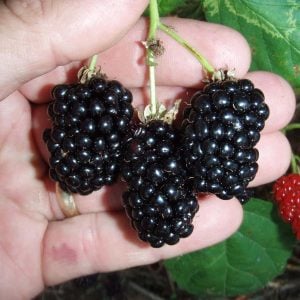
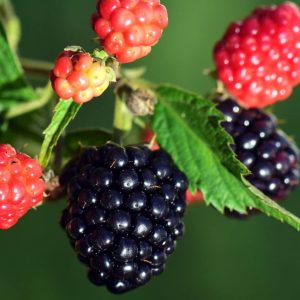
Hull Thornless Blackberry produces large, glossy black drupelets that form elongated berries with good firmness for a thornless type. Flavor is rich and balanced — sweet with enough acidity to give the berry character fresh off the cane, and that balance holds well through cooking, preserving, and freezing. Mid-season harvest in temperate climates typically runs through mid-July, placing Hull squarely in the main summer berry window after early-season types and before the latest fall producers. The firm texture means berries ship and store better than softer varieties, an advantage for anyone putting up large volumes for the freezer or selling at market. Hull performs well across the kitchen: fresh eating, jam, jelly, pie, cobbler, and juice extraction are all natural fits. Berries are borne in long clusters that make harvest efficient, and the thornless canes mean the job gets done without gloves.
Fruit Size: 0.8-1.2 inch
Flavor: Sweet, mild flavor; described as one of the sweetest thornless varieties
Fruit Color: Black
Fruit Texture: Firm
Bearing Habit: Floricane (bears on second-year canes)
Years to Bear: 2 years
Storage Life: Short; 1-2 days fresh; best consumed immediately after harvest
Culinary Uses: Fresh eating, jams, jellies, pies, cobblers, smoothies, wine, preserves
Orange rust is the most critical disease concern for Hull in humid gardens. Hull carries susceptibility to orange rust, caused by Gymnoconia nitens, and growers in the eastern half of the country should scout actively throughout the season. The first sign is systemic distortion of new shoots in spring, followed by bright orange powdery spore masses on the undersides of leaves by early summer. There is no curative option — any plant showing symptoms must be removed and destroyed immediately; orange rust is systemic and will not clear on its own, and infected plants become a perpetual spore source for neighboring plantings. Purchase certified disease-free stock and avoid planting near wild Rubus populations, which can harbor the pathogen. Botrytis fruit rot can become a problem during wet weather at harvest; harvest promptly and improve canopy airflow through timely pruning. Spotted wing drosophila and brown marmorated stink bug are the primary insect threats; both are managed most effectively by harvesting ripe fruit on a two-to-three-day schedule and using exclusion netting during peak adult flight. Good cultural practices — full-sun siting, trellis support, consistent pruning, and drip rather than overhead irrigation — form the foundation of a healthy Hull planting regardless of pest or disease pressure.
Orange Rust: Susceptible
Rosette / Double Blossom: Moderately Susceptible
Anthracnose: Moderately Susceptible
Cane Blight: Moderately Susceptible
Botrytis Fruit Rot / Gray Mold: Moderately Susceptible
Spotted Wing Drosophila: Moderately Susceptible
Raspberry Crown Borer: Moderately Susceptible
Brown Marmorated Stink Bug: Moderately Susceptible
Japanese Beetle: Moderately Susceptible
- Scout for orange rust early: Check the undersides of young leaves in spring for orange spore masses. Remove and destroy entire infected plants at the first sign — the disease is systemic and cannot be treated.
- Trellis before canes run: Install a two-wire trellis at three and five feet the year you plant. Semi-erect canes arch hard; training from the start prevents a tangled mass that's difficult to manage.
- Harvest every two to three days: Hull's berries are sweetest at peak ripeness and drop or spoil quickly after. Frequent picking also deprives spotted wing drosophila of overripe fruit to colonize.
- Cut floricanes right after harvest: Don't wait until dormancy. Removing spent second-year canes immediately after fruiting improves airflow and reduces disease carryover into the following season.
We ship in late winter or early spring based on your USDA hardiness zone.
We strive to ship orders on the scheduled dates listed in the table below. However, please note that the actual shipping date may be subject to change due to factors like weather conditions and order volume.
The specific date for shipping your order will be determined according to your zipcode at the time of checkout.
Our plants are shipped bare root, packed in moist sawdust, and securely wrapped in plastic to prevent the roots from drying out. We use USPS Ground Advantage for shipping, ensuring that your plants typically arrive within 2-5 days after packaging.
In case you're unable to plant the trees immediately upon arrival, we recommend soaking them in water for a few hours and temporarily heeling them in. Ideally, they should be planted within three days of receipt for optimal health.
See our full shipping policy and map here
| Zone | Ship Date |
|---|---|
| 11 - 8b | March 1st, 2027 |
| 8a - 7b | March 8th, 2027 |
| 7a | March 15th, 2027 |
| 6b | March 22nd, 2027 |
| 6a | March 29th, 2027 |
| 5b - 5a | April 12th, 2027 |
| 4b - 4a | April 26th, 2027 |
| 3b - 1a | May 3rd, 2027 |
Our 365-Day Plant Guarantee: We ensure that our plants are delivered to you alive and healthy. If your plant does not survive its first year, you're eligible for store credit under these conditions:
- Your location falls within the appropriate USDA hardiness zone for the plant variety (refer to our hardiness zone map).
- You maintain the roots' moisture and plant within three days of delivery, following the instructions in our Planting Guide.
If you're concerned about your plant's health, please consult our guide, How to Tell if Your Tree is Dead or Dormant. Remember, our plants are shipped in a dormant state and may leaf out at different times based on their species. To check for plant vital
1 review for Hull Blackberry
Related products

Prime Ark Freedom Blackberry
Checking fitRated 5.00 out of 5
Jostaberry
Checking fitRated 4.83 out of 5
Blueray Blueberry
Checking fit
Sweetie Pie Blackberry
Checking fit


Nolan N. (verified owner) –
This was my first order from Food Forest and everything was great. My plants shipped and arrived on time. They were packaged well and appear to be healthy. Good Forest Nursery made a very good first impression!