

Prime Ark Freedom Blackberry
$11.95
Prime Ark Freedom Blackberry (Rubus hybrid ‘APF-153T’) is the world’s first thornless primocane-fruiting blackberry, delivering two crops per season on erect self-supporting canes, with large firm 1–1.5 inch fruit carrying sweet rich flavor and low acidity. It grows in USDA hardiness zones 5-9 and AHS heat zones 5-9, needs 500-700 chill hours, and is self-fertile, fruiting reliably without a pollinator partner.
12-18″ Bare Root Plant
Propagation: Own-root
Can’t be shipped to: AK, FL, HI, SC
In stock
Prime Ark Freedom was released in 2013 by the University of Arkansas fruit breeding program under John R. Clark, protected by U.S. Plant Patent PP26,990. It stands as the world’s first thornless primocane-fruiting blackberry to reach commercial release — a combination that breeders had pursued for decades without success. Primocane-fruiting types bear on current-season growth, meaning plants produce a fall harvest even in climates where winter kills overwintered canes. Prime Ark Freedom is the fourth cultivar in the UA Prime-Ark primocane series, following the thorned Prime-Jan and Prime-Jim (2004) and Prime-Ark 45 (2009); achieving thornlessness alongside the primocane trait required additional selection cycles beyond those earlier releases. The variety was developed with warm-climate growers specifically in mind: its low chilling requirement of roughly 100 to 200 hours opens blackberry growing in Zone 8 and Zone 9 regions where standard floricane types fail to break dormancy adequately.
Prime Ark Freedom performs reliably across USDA zones 6–9. Its chill requirement of approximately 100–200 hours makes it one of the few everbearing blackberries suited to Zone 8 and 9, where standard cultivars often under-perform. Plant in full sun in well-drained soil with a pH of 5.5–6.5; amend heavy clay with compost and consider raised beds on sites with persistent moisture.
Space plants 3–5 feet apart in the row — erect primocane types produce dense, upright canes that compete for light when crowded. Consistent moisture during fruit development, roughly one inch per week, is critical; water stress during the fall primocane crop reduces berry size and triggers early cane senescence. Mulch 3–4 inches deep to retain moisture and suppress weeds through the long harvest window. Fertilize lightly in early spring and again after the June floricane crop to fuel new primocane growth.
USDA Hardiness Zone: 5-9
AHS Heat Zone: 5-9
Chill Hours: 500-700
Sun Requirements: Full Sun
Soil pH: 5.5-6.5
Soil Type: Sandy loam to clay loam; fertile, moderate water-holding capacity
Soil Drainage: Well-drained
Water Requirements: Medium
Drought Tolerance: Moderate
Heat Tolerance: High heat and humidity tolerance
Plant Spacing: 3-5 ft apart
How to Prune: Tip primocanes at 12-15 inches tall (remove 3/4-1 inch) to encourage branching; tip again at 30 inches. Cut all canes to ground in late winter/early spring if growing as single-crop primocane type. For two crops, leave floricanes over winter and remove after they fruit.
Prime Ark Freedom grows as an erect thornless shrub, producing strong upright canes that require minimal trellising compared to trailing or semi-erect types. Canes are smooth and spineless along their entire length — a trait inherited through careful breeding and maintained reliably across plant generations. The growth habit is vigorous: primocanes extend several feet in a single season, which powers the extended fall harvest but also means canes need annual management to keep the planting productive.
The two-cane system defines how this plant is managed. Floricane canes (second-year wood) fruit in June and are removed at ground level after harvest to direct the plant's energy toward developing new primocanes. Those primocanes then fruit from July onward. In warmer zones where winters rarely kill canes outright, some growers mow all canes to the ground after the fall crop and manage the planting as a single-crop primocane-only system — this sacrifices the June crop but simplifies pruning and reduces disease pressure from aging floricane wood.
Mature Height: 4-10 ft tall
Mature Spread: 3-6 ft wide
Growth Habit: Erect thornless primocane-fruiting; rapid growth rate
Growth Rate: Fast
Foliage Type: Deciduous
Food Forest Layer: Shrub
Permaculture Role: Food production; wildlife habitat and forage; living/thorny hedge and barrier
Leaf Color: Green
Fall Foliage Color: Red to orange-purple
Thorns?: No
Attracts Wildlife: Pollinators (bees); songbirds and game birds; small mammals
Life Span: productive 10-15 years
Prime Ark Freedom is fully self-fertile — a single plant produces a complete crop without any companion variety. Pollination is accomplished by insects, primarily bumblebees and solitary native bees, which transfer pollen between flowers on the same plant or across nearby canes. Planting two or more plants generally improves fruit set and berry size through more thorough pollen coverage.
Flowering occurs in two waves. Floricane flowers appear in late spring (typically May–June in Zone 6–7); primocane flowers begin opening in midsummer and continue until frost closes the season. This extended bloom period sustains pollinator activity well into fall. Avoid overhead irrigation during bloom on either crop — wet pollen reduces fertilization rates and widens the infection window for fungal pathogens of open flowers.
Bloom Season: Mid
Bloom Window: Late Apr - Early Jun | Mid Jun - Mid Jul
Pollination Requirements: Self-fertile
Pollination Mechanism: Self-fertile; insect-pollinated (bees improve fruit set and berry size)
Flower Color: White to pink
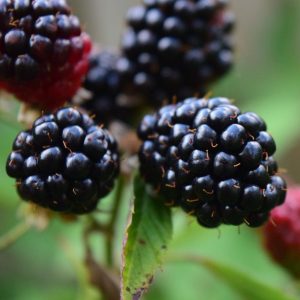
A firm, glossy black exterior at full ripeness covers berries reaching 1 to 1.5 inches in diameter. The flesh is juicy with a balanced sweet-tart flavor profile — less tart than many wild-type blackberries, but with enough acid to hold its character fresh or cooked. Flavor quality is consistent across both the June floricane crop and the later primocane crop, though the floricane berries often develop slightly deeper color because they ripen under lower ambient temperatures.
The dual-harvest season extends fresh eating from early summer through fall, far beyond what a standard floricane planting allows. Berries freeze well and hold shape adequately for jam, pie filling, and preserves. The absence of thorns makes hand-picking quick and comfortable for the whole harvest window, which becomes especially practical during the longer July-through-frost primocane season. Floricane and primocane crops can be used interchangeably in any recipe; the primocane fruit tends to be slightly larger on well-watered plants.
Ripening Season: Very Early
Harvest Window: Mid Jun | Mid Jul
Fruit Size: 1-1.5 inch
Fruit Weight: 9-10 g average; up to 16 g
Flavor: Sweet, rich blackberry flavor with low acidity; 8-10 Brix
Fruit Color: Black
Fruit Texture: Firm, juicy
Bearing Habit: Primocane-fruiting (everbearing); thornless; two crops per year
Years to Bear: 1 year
Yield: 10 per plant per year
Storage Life: Short; 2-3 days at room temperature, up to 1 week refrigerated; not recommended for long-distance shipping
Culinary Uses: Fresh eating, jams, jellies, pies, cobblers, smoothies, wine, juices, frozen
Prime Ark Freedom carries no documented resistance to orange rust (Gymnoconia nitens) or rosette/double blossom (Cercosporella rubi) — both serious diseases of erect blackberries in the humid Eastern US. Manage orange rust through early roguing of infected canes, which show powdery orange spore masses on leaf undersides; there is no recovery once a plant is infected, so removal and destruction are the only effective responses. Rosette is similarly managed by cutting out and destroying affected canes showing abnormal flower proliferation.
Botrytis fruit rot (Botrytis cinerea) is a genuine concern during wet summers and poses particular risk to the primocane crop when late-season rains coincide with peak ripeness. Harvest berries promptly at full color, improve airflow through the planting with proper cane thinning, and avoid overhead watering after bloom.
Spotted wing drosophila (Drosophila suzukii) and brown marmorated stink bug (Halyomorpha halys) are significant pests of the fall primocane crop, which ripens directly during peak SWD and BMSB flight periods (August through October). Row covers or fine-mesh netting installed at fruit set provide the most effective physical barrier; hand-harvesting on a frequent schedule — every two to three days at peak ripeness — limits the window for SWD egg-laying and reduces stink bug feeding damage.
Orange Rust: Moderately Susceptible
Rosette / Double Blossom: Moderately Susceptible
Anthracnose: Moderately Resistant
Cane Blight: Moderately Resistant
Botrytis Fruit Rot / Gray Mold: Moderately Susceptible
Spotted Wing Drosophila: Moderately Susceptible
Raspberry Crown Borer: Moderately Susceptible
Brown Marmorated Stink Bug: Moderately Susceptible
Japanese Beetle: Moderately Susceptible
- Manage two cane generations deliberately: After the June floricane crop finishes, remove all second-year canes at ground level immediately — this redirects energy to developing primocanes and improves airflow through the planting.
- Net the fall crop against SWD: The primocane harvest overlaps precisely with spotted-wing drosophila peak season. Install fine-mesh row covers at fruit set on primocanes and harvest every two to three days to prevent infestation of ripe fruit.
- Water consistently through the long primocane harvest: Water stress reduces berry size and causes early cane tip dieback. Maintain roughly one inch per week through mulched drip irrigation rather than overhead watering, which worsens Botrytis risk.
- Fruit arrives in Year 1: Unlike floricane-only types that need two seasons before producing, the primocane crop arrives the first summer after planting — plan harvest infrastructure before the plant goes in the ground.
- Rogue orange rust immediately: Orange powdery spores on leaf undersides signal a systemic infection with no cure — dig and remove the entire plant to prevent spread to neighboring canes.
We ship in late winter or early spring based on your USDA hardiness zone.
We strive to ship orders on the scheduled dates listed in the table below. However, please note that the actual shipping date may be subject to change due to factors like weather conditions and order volume.
The specific date for shipping your order will be determined according to your zipcode at the time of checkout.
Our plants are shipped bare root, packed in moist sawdust, and securely wrapped in plastic to prevent the roots from drying out. We use USPS Ground Advantage for shipping, ensuring that your plants typically arrive within 2-5 days after packaging.
In case you're unable to plant the trees immediately upon arrival, we recommend soaking them in water for a few hours and temporarily heeling them in. Ideally, they should be planted within three days of receipt for optimal health.
See our full shipping policy and map here
| Zone | Ship Date |
|---|---|
| 11 - 8b | March 1st, 2027 |
| 8a - 7b | March 8th, 2027 |
| 7a | March 15th, 2027 |
| 6b | March 22nd, 2027 |
| 6a | March 29th, 2027 |
| 5b - 5a | April 12th, 2027 |
| 4b - 4a | April 26th, 2027 |
| 3b - 1a | May 3rd, 2027 |
Our 365-Day Plant Guarantee: We ensure that our plants are delivered to you alive and healthy. If your plant does not survive its first year, you're eligible for store credit under these conditions:
- Your location falls within the appropriate USDA hardiness zone for the plant variety (refer to our hardiness zone map).
- You maintain the roots' moisture and plant within three days of delivery, following the instructions in our Planting Guide.
If you're concerned about your plant's health, please consult our guide, How to Tell if Your Tree is Dead or Dormant. Remember, our plants are shipped in a dormant state and may leaf out at different times based on their species. To check for plant vital
6 reviews for Prime Ark Freedom Blackberry
Related products

Jostaberry
Checking fitRated 4.83 out of 5
White Imperial Currant
Checking fitRated 4.92 out of 5
Kiowa Blackberry
Checking fit
Perfection Red Currant
Checking fitRated 4.90 out of 5


Traci B. (verified owner) –
Excited about my plants!
Amanda D. (verified owner) –
They arrived nicely packaged and damage free. Plants were dormant, so excited to see their growth this year!
Anonymous (verified owner) –
Beautiful, big plants. Came on time.
Michael S. –
My plant was lost in shipment but the other two blackberry varieties I purchased were much larger and healthier than others I have purchased elsewhere for roughly the same price and I am certain this would have been as well. Food Forest Nursery also provided excellent customer service to resolve the issue with the lost plant.
Steven Peavler (verified owner) –
Just planted on Saturday.
Kyle Johnson (verified owner) –
Awake!