
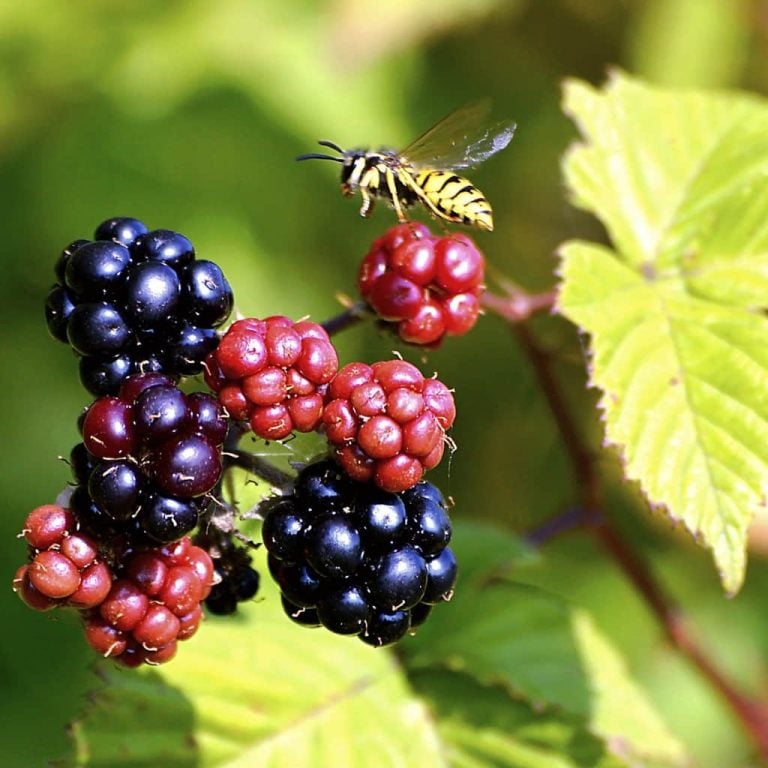
Wild Blackberry
$8.95
Wild Blackberry (also known as Allegheny Blackberry; Rubus spp.) is a native eastern North American species complex forming arching, prickly thickets that produce sweet, mildly spicy black fruit and provide dense cover and forage for pollinators, songbirds, and small mammals. It grows in USDA hardiness zones 4-9 and AHS heat zones 3-9, needs 300-500 chill hours, and is self-fertile, fruiting reliably without a pollinator partner.
12-18″ Bare Root Plant
Propagation: Seedling (own-root)
Can’t be shipped to: AK, FL, HI, SC
Out of stock
Out of stock — back next season
Wild Blackberry (Rubus spp.) is not a cultivar but a species complex — primarily Rubus allegheniensis (Common Blackberry) alongside closely related native Rubus taxa — that has colonized forest edges, roadsides, and disturbed ground across Eastern North America for thousands of years. No single breeding institution or release date applies; this is the unselected wild genetic stock that plant breeders at the University of Arkansas, USDA-ARS, and land-grant universities drew upon when developing the modern cultivar lineage. The thorny, upright canes, wide chill adaptability, and generalist soil tolerance of native Rubus populations provided the foundational germplasm from which thornlessness, larger fruit, and higher yields were selected over decades of breeding work. Multiple native species intergrade across their ranges and natural hybrids occur freely, meaning the name covers genuine genetic diversity rather than a single uniform type. For food forest and native-plant gardeners, that breadth — and the ecological roles wild brambles fill that selected cultivars cannot — is precisely the point of growing the species rather than a named variety.
Related products
American Plum
Checking fit- SOLD OUT
Red Mulberry
Checking fit 
Smooth Sumac
Checking fit
American Persimmon
Checking fit
Leah (verified owner) –
Hopefully can make some homemade blackberry cobbler in the years to come like my grandmama!