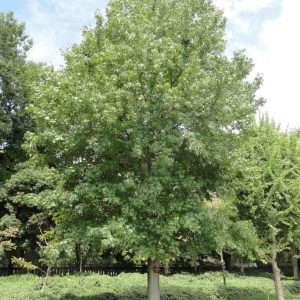
Slender Silhouette Sweetgum
$59.95
Slender Silhouette Sweetgum (also known as Columnar Sweetgum; Liquidambar styraciflua ‘Slender Silhouette’) is a strikingly narrow, columnar selection of native American sweetgum, reaching 50-60 feet tall on a footprint of only 4-6 feet wide, with the species’ brilliant multi-color fall foliage packed into a dramatic vertical accent form. It grows in USDA hardiness zones 5-9.
4-5′ Bare Root Grafted Tree
Rootstock: Liquidambar styraciflua
Grafted onto sweetgum seedling roots, giving the cultivar its full natural size and the species’ tolerance of wet ground.
• Support: Freestanding; no staking required.
In stock
‘Slender Silhouette’ is a naturally occurring fastigiate (columnar) selection of American sweetgum, discovered growing wild along a railroad track near the Franklin County, Tennessee nursery of Don Shadow sometime before the turn of the century, according to the University of Arkansas Cooperative Extension. Shadow, a fourth-generation nurseryman known for introducing numerous notable woody-plant selections, recognized the seedling’s unusually tight, upright branching pattern — a naturally occurring bud mutation rather than the product of a breeding program — and propagated it for the nursery trade. It has since become, in the words of the dendrological reference Trees and Shrubs Online, ‘probably the best clone sold so far of a narrowly fastigiate Sweet-gum with erect branches.’ No plant patent number, royalty requirement, or licensing restriction was located for this selection across university extension profiles or the wholesale nursery catalogs (J. Frank Schmidt & Son, Greenleaf Nursery, Pleasant Run Nursery, and others) that propagate and sell it, consistent with an open, freely propagable introduction. Botanically it remains the same species as wild-type sweetgum (GUM-200) — the fastigiate growth habit arose from a single mutation affecting branch angle and apical dominance, not from hybridization, so its underlying wood, foliage, and root biology match the species.
'Slender Silhouette' shares the species' wide adaptability to soil texture — thriving in clay, loam, or sandy soils — and tolerates roughly the same acidic-to-neutral pH range (4.5 to 7.0) as wild sweetgum, including the same vulnerability to iron chlorosis on alkaline sites above pH 7.0; North Carolina State Extension confirms this specific cultivar can develop the same interveinal yellowing on high-pH soils. The single most important site-selection variable for this cultivar, however, is soil fertility and depth: multiple university and nursery sources agree that 'Slender Silhouette' performs best — and holds its tight, narrow habit — when planted in comparatively lean, average, or even poor soils. In rich, fertile, heavily fertilized ground it can grow so fast that branches split away from the trunk, undermining both its form and its structural integrity. Give it full sun for the best density and fall color, though it tolerates part shade; the University of Arkansas Cooperative Extension specifically cautions against full-shade sites. Like the species, it tolerates occasional wet soil, but also establishes well in average landscape soil with routine watering during the first year, becoming drought-tolerant once established. Because of its narrow mature spread of only 4-6 feet, it can be planted far closer to structures, walkways, and property lines than the 40-60 foot spread of wild-type sweetgum — a genuine advantage in space-constrained landscapes — though its ultimate height of 50-60 feet still calls for overhead clearance from power lines.
USDA Hardiness Zone: 5-9
Sun Requirements: Full Sun to Partial Shade; best density, form, and fall color in full sun — avoid full-shade sites
Soil pH: 4.5-7.0 (acidic to neutral); cultivar-specific NC State data lists tolerance to neutral soils up to ~8.0, but alkaline sites above 7.0 risk iron chlorosis
Soil Type: Clay, Loam, Sand; tolerates a wide range of soil textures
Soil Drainage: Good drainage preferred; also tolerates moist, occasionally dry, or occasionally wet sites (wet-site tolerant)
Water Requirements: Medium; consistent moisture during first-year establishment, moderate drought tolerance once mature
Drought Tolerance: Moderate (once established)
Heat Tolerance: High (inherited from species; native to the humid Southeast and widely grown through zone 9)
Plant Spacing: 4-6 ft apart for a dense narrow screen or allée; 8-10+ ft apart for specimen use with full air circulation
Container Suitability: Not Suitable (50-60 ft mature height)
How to Prune: Minimal pruning once established. Remove competing/co-dominant leaders in the first several years to preserve the single-trunk columnar form; prune out crossing or damaged branches in late winter to early spring while dormant. Avoid heavy nitrogen fertilization, which accelerates growth and increases the risk of branch splitting.
The defining trait of 'Slender Silhouette' is its extraordinarily narrow, fastigiate silhouette: a single dominant trunk with steeply upright branches that hold the crown at nearly the same width from base to top, producing a true columnar 'exclamation point' form rather than the broad oval-rounded crown of wild sweetgum. Mature trees reach 50-60 feet tall but only 4-6 feet wide — roughly one-tenth the footprint of the species at a comparable height. Growth is fast, particularly as a young tree, and the tree develops the same glossy, dark green, star-shaped, 5-7 lobed leaves as the species. Because rapid growth on fertile soil can cause branches to split from the trunk, growers should watch young trees for weak crotch angles and remove competing leaders early; trees grown on leaner soil grow slightly slower but hold a tighter, sturdier column. Its slim profile makes it one of the few large-canopy-height trees that can be planted in narrow tree lawns, medians, and tight side yards.
Mature Height: 50-60 ft tall
Mature Spread: 4-6 ft wide
Growth Habit: Fastigiate/Columnar; extremely narrow, upright branching holds the crown at nearly uniform width from base to top, unlike the broad pyramidal-to-oval crown of the species
Growth Rate: Fast, especially as a young tree; slows somewhat (and holds a tighter form) on leaner soils
Foliage Type: Deciduous
Food Forest Layer: Canopy
Permaculture Role: Canopy Tree — narrow-footprint vertical accent/screen rather than a broad shade canopy
Leaf Color: Dark Green, glossy (summer); star-shaped, 5-7 lobed
Fall Foliage Color: Yellow, Orange, Red, Burgundy — color develops less predictably/uniformly tree-to-tree than the species
Thorns?: No
Attracts Wildlife: Birds and small mammals (reduced compared to the species due to sparse, erratic gumball/seed production); larval host for Imperial Moth, Luna Moth, and Hickory Horned Devil (leaf-chemistry-dependent, unaffected by reduced fruiting)
Like the species, 'Slender Silhouette' is monoecious, with separate male and female flowers on the same tree, so no companion pollinator is required. North Carolina State Extension describes the same inconspicuous yellow-green, catkin-like spring flowers found on wild sweetgum. Pollination is entirely by wind. Because flowering biology is unaffected by the vegetative bud mutation that produces this cultivar's columnar habit, bloom timing (spring) and flower appearance match the species closely; no cultivar-specific bloom-window study was located, so this entry follows the species' documented bloom timing.
Bloom Season: Mid
Bloom Window: Early Apr - Late May (inherited from species; floral phenology is not altered by the vegetative bud mutation that produces the columnar habit)
Pollination Requirements: Wind-pollinated; monoecious (separate male and female flowers on the same tree); self-fertile — no companion pollinator required
Pollination Mechanism: Wind (anemophilous); monoecious tree with separate male and female catkin-like inflorescences
Flower Color: Yellow-Green (inconspicuous)
Unlike the species, 'Slender Silhouette' is frequently marketed as a low-fruiting or 'nearly sterile' selection — though, as the University of Arkansas Cooperative Extension puts it, claims of being completely fruitless are 'probably more wishful thinking than reality.' In practice, multiple university and nursery sources agree the cultivar does produce the same spiny, woody, roughly 1 to 1.5 inch gumball capsules as wild sweetgum, but in dramatically reduced and erratic quantities — Trees and Shrubs Online calls it 'a nearly sterile cultivar, producing few gumballs,' and North Carolina State Extension notes fruit set is 'much less in number than the species,' occurring irregularly from year to year. Young trees in particular tend to set very little fruit, with production increasing somewhat with age but never approaching the heavy annual seed crops of wild-type sweetgum. This is a meaningful trade-off for buyers: the reduced gumball drop is a genuine landscaping advantage (less lawn litter, less slip hazard on walkways), but it correspondingly reduces the tree's value as a wildlife seed source compared to the species — songbirds and small mammals that rely on sweetgum's heavy winter seed crop will find substantially less forage on this cultivar. It retains the species' documented role as a larval host for the Imperial Moth, Luna Moth, and Hickory Horned Devil, since caterpillar host use depends on leaf chemistry rather than seed production.
Fruit Color: Green (immature) ripening to Brown (mature, woody); spiky ~1-1.5 in diameter gumball capsules — same appearance as the species but produced in dramatically reduced, erratic quantity
Culinary Uses: Resin historically used as chewing gum and balsam flavoring (species-level ethnobotanical use)
No dedicated cultivar-specific disease or pest trials were located for 'Slender Silhouette'; because its columnar habit arose from a single growth-form mutation rather than from breeding for pest or disease resistance, it is expected to share the species' underlying susceptibility profile, and the ratings on this record are carried over from wild-type sweetgum (GUM-200). In practice, both North Carolina State Extension and the University of Arkansas Cooperative Extension describe this cultivar as essentially problem-free in the landscape to date, with 'no serious insect pests or disease problems' reported — though this partly reflects its shorter track record in wide cultivation rather than proven superior resistance. The same iron chlorosis risk on alkaline soils applies, confirmed directly for this cultivar by North Carolina State Extension. Bleeding necrosis, fungal leaf spots, and wood rot/trunk decay organisms are all recognized issues for the species on North Carolina State's broader pest and disease list and should be watched for on this cultivar as well. Forest tent caterpillar, spongy moth (gypsy moth), American plum borer, and scale insects are the same species-wide insect concerns; because 'Slender Silhouette' carries far fewer branches and a smaller canopy volume than the species at the same height, outbreak-level defoliation may be easier to spot and treat promptly. As with the species, avoid trunk wounds and disinfect pruning tools between cuts.
Bleeding Necrosis: Moderately Susceptible
Fungal Leaf Spots: Moderately Resistant
Wood Rot and Trunk Decay: Moderately Resistant
Iron Chlorosis: Susceptible
Sweetgum Blight: Moderately Susceptible
Forest Tent Caterpillar: Susceptible
Spongy Moth / Gypsy Moth: Susceptible
American Plum Borer: Moderately Resistant
Scale Insects: Moderately Resistant
- Choose a Lean Site on Purpose: Plant in average-to-poor soil rather than rich, heavily amended ground — this slows growth just enough to preserve the tight columnar form and helps prevent the branch-splitting that occurs when this cultivar grows too fast.
- Watch Young Trees for Competing Leaders: Remove any co-dominant stems or wide-angled competing branches in the first few years while the tree is establishing its single-trunk columnar structure.
- Take Advantage of the Narrow Footprint: At only 4-6 feet wide at maturity, 'Slender Silhouette' can be planted in medians, narrow side yards, and tree lawns where the 40-60 foot spread of standard sweetgum would never fit — but still allow for its full 50-60 foot mature height and keep it clear of overhead lines.
- Don't Expect (or Promise) a Fruitless Tree: Marketing sometimes describes this selection as gumball-free; in reality it produces the same spiny capsules as the species, just far fewer and less predictably. Set buyer expectations accordingly rather than guaranteeing zero fruit drop.
- Site for Full Sun: Avoid shaded planting sites, which the University of Arkansas Cooperative Extension specifically cautions against; full sun produces the densest form and best fall color.
We ship in late winter or early spring based on your USDA hardiness zone.
We strive to ship orders on the scheduled dates listed in the table below. However, please note that the actual shipping date may be subject to change due to factors like weather conditions and order volume.
The specific date for shipping your order will be determined according to your zipcode at the time of checkout.
Our plants are shipped bare root, packed in moist sawdust, and securely wrapped in plastic to prevent the roots from drying out. We use USPS Ground Advantage for shipping, ensuring that your plants typically arrive within 2-5 days after packaging.
In case you're unable to plant the trees immediately upon arrival, we recommend soaking them in water for a few hours and temporarily heeling them in. Ideally, they should be planted within three days of receipt for optimal health.
See our full shipping policy and map here
| Zone | Ship Date |
|---|---|
| 11 - 8b | March 1st, 2027 |
| 8a - 7b | March 8th, 2027 |
| 7a | March 15th, 2027 |
| 6b | March 22nd, 2027 |
| 6a | March 29th, 2027 |
| 5b - 5a | April 12th, 2027 |
| 4b - 4a | April 26th, 2027 |
| 3b - 1a | May 3rd, 2027 |
Our 365-Day Plant Guarantee: We ensure that our plants are delivered to you alive and healthy. If your plant does not survive its first year, you're eligible for store credit under these conditions:
- Your location falls within the appropriate USDA hardiness zone for the plant variety (refer to our hardiness zone map).
- You maintain the roots' moisture and plant within three days of delivery, following the instructions in our Planting Guide.
If you're concerned about your plant's health, please consult our guide, How to Tell if Your Tree is Dead or Dormant. Remember, our plants are shipped in a dormant state and may leaf out at different times based on their species. To check for plant vital
Related products

Sweetgum
Checking fitRated 5.00 out of 5
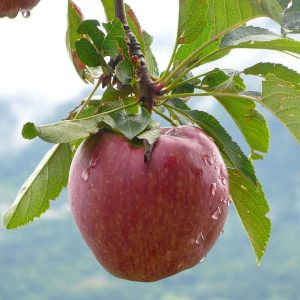
Honeycrisp Apple
Rated 5.00 out of 5$49.95 Select Rootstock This product has multiple variants. The options may be chosen on the product pageChecking fit
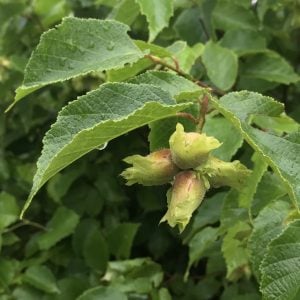
American Hazelnut
Checking fitRated 4.57 out of 5
Common Apple
Checking fit

Reviews
There are no reviews yet.