
Ponca Blackberry
$11.95
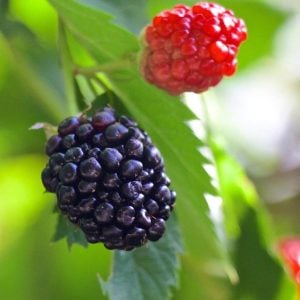
Ponca Blackberry (Rubus) is an erect, thornless blackberry released in 2019 by the University of Arkansas, celebrated by its own breeding program as the highest achievement for sweetness — sub-acid, firm black fruit that holds its texture even in rainy conditions. It grows in USDA hardiness zones 6-9 and AHS heat zones 5-9, needs 400-600 chill hours, and is self-fertile, fruiting reliably without a pollinator partner.
12-18″ Bare Root Plant
Propagation: Own-root
Can’t be shipped to: AK, FL, HI, SC
In stock
Ponca was released in 2019 by the University of Arkansas fruit breeding program under John R. Clark, with the U.S. Plant Patent USPP33330 granted in 2021. The cross that produced Ponca was made by hand pollination in 2008, and the selected seedling first fruited in summer 2012 before advancing through multi-year trials. It belongs to the UA erect thornless series — the lineage behind Ouachita, Navaho, and other varieties that have defined commercial and home-garden blackberry growing across humid regions since the 1990s. The program’s stated priorities for Ponca were twofold: push ripening as early as possible within the erect thornless class and deliver strong disease resistance where earlier series members had shown vulnerability. Within the UA portfolio, Ponca represents the current leading edge of flavor refinement, with trial evaluations consistently highlighting its very sweet, low-acid profile as a notable advance over older siblings.
Ponca performs well across USDA Zones 6–9, requiring an estimated 300–500 chill hours — a range that suits most of the South, mid-Atlantic, and lower Midwest. Plant in full sun with well-drained soil amended to a pH of 5.5–6.5. Erect canes reach 4–5 feet and benefit from a simple post-and-wire trellis to support fruit-laden primocanes through harvest. Set plants 3–4 feet apart in rows spaced 8–10 feet. Consistent moisture during cane development and fruit swell drives yield and berry size; drip irrigation reduces leaf wetness and lessens fungal pressure. After harvest, remove all floricanes at the soil line and tip primocanes at 42–48 inches to encourage lateral branching and next season's fruit set. Apply a balanced fertilizer in early spring as buds break; avoid heavy nitrogen late in the season, which promotes soft growth vulnerable to winter injury.
USDA Hardiness Zone: 6-9
AHS Heat Zone: 5-9
Chill Hours: 400-600
Sun Requirements: Full Sun
Soil pH: 5.5-6.5
Soil Type: Sandy loam to clay loam; fertile, moderate water-holding capacity
Soil Drainage: Well-drained
Water Requirements: Medium
Drought Tolerance: Moderate
Heat Tolerance: High
Plant Spacing: 3-4 ft in-row; 10-12 ft between rows
How to Prune: Tip primocanes at 3-4 feet to encourage lateral branching; thin to 5-6 canes per row in early spring; prune laterals to 12 inches; remove floricanes at ground level after fruiting
Ponca produces stiff, self-supporting erect canes that reach 4–5 feet tall — compact enough for smaller garden plots while still delivering commercial-scale yields when managed with annual tipping. Canes are completely thornless, a trait bred into the UA erect series, making harvest, pruning, and training comfortable without protective gear. The plant establishes quickly from bare-root or container stock, sending up vigorous primocanes in the first growing season and bearing on floricanes in year two. Foliage is dark green and dense, providing good canopy closure between rows. Root suckers emerge readily and can be used for propagation or managed by mowing. The compact upright habit keeps fruit off the ground and improves air circulation compared to trailing types, which aligns well with Ponca's strong fungal resistance profile.
Mature Height: 4-5 ft tall
Mature Spread: 3-4 ft wide
Growth Habit: Erect, thornless canes; primocanes have shortened internodes
Growth Rate: Fast
Foliage Type: Deciduous
Food Forest Layer: Shrub
Permaculture Role: Food production; wildlife habitat and forage; living/thorny hedge and barrier
Leaf Color: Green
Fall Foliage Color: Red to orange-purple
Thorns?: No
Attracts Wildlife: Pollinators (bees); songbirds and game birds; small mammals
Life Span: Perennial
Ponca is fully self-fertile and does not require a second variety for fruit set. A single plant will produce a full crop without a pollination partner, making it practical for small gardens where space limits variety count. Flowering occurs in mid-to-late spring, with white blossoms attracting native bees, honeybees, and bumblebees that improve fruit set and uniformity even without cross-pollination. Because Ponca is insect-pollinated, locating plants away from heavy pesticide spray zones during bloom protects visiting pollinators and supports consistent berry development. Planting multiple Ponca plants, or pairing with another early-ripening UA variety, maximizes yield without introducing pollination complexity. The early bloom window means flowers typically open before the peak of summer heat, reducing heat-stress impact on fruit set in warmer portions of its range.
Bloom Season: Very Early
Bloom Window: Late Apr - Early May
Pollination Requirements: Self-fertile
Pollination Mechanism: Self-fertile; insect-pollinated (bees improve fruit set and berry size)
Flower Color: White with purple tinge
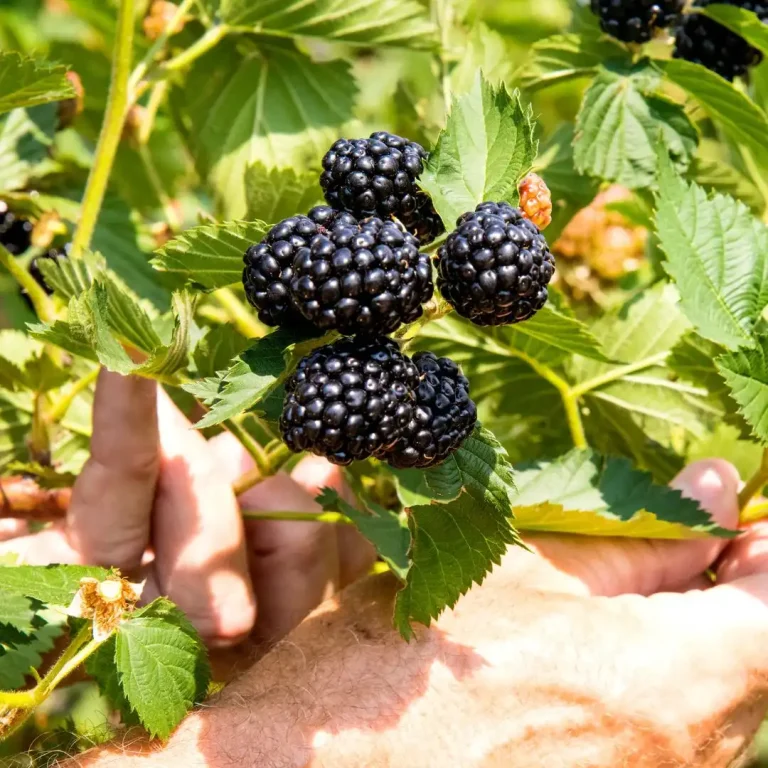
Ponca produces glossy black berries averaging 6.8 grams — a substantial size for an early-season erect thornless type. The flavor profile is notably sweet with very low acidity, placing it at the lower end of the sub-acid range compared to most other UA thornless varieties. That sweetness without tartness makes Ponca berries approachable fresh off the cane for those who find conventional blackberry tang too sharp. Berries separate cleanly from the plug when ripe, releasing without tearing or juice loss. The early June harvest window in temperate climates means Ponca comes in ahead of mid-season varieties like Natchez, allowing extended picking across a longer combined blackberry season. Use fresh, in preserves, baked into cobblers and pies, or frozen for later use — the firm texture holds well after freezing without becoming watery.
Ripening Season: Very Early
Harvest Window: Early Jun
Fruit Size: 0.75-1 inch
Fruit Weight: 6.8 g
Flavor: Exceptional sweetness; sub-acid; described as 'highest achievement for a sweet, enjoyable berry' by the UA breeding program
Fruit Color: Black
Fruit Texture: Firm; firmness maintained even in rainy conditions
Bearing Habit: Floricane-fruiting (fruit on second-year canes); secondary bud crop possible
Years to Bear: 1-2 years
Yield: 12.7
Storage Life: 7+ days; comparable to Caddo, Ouachita, and Osage; sweet flavor retained in storage; low red drupelet reversion
Culinary Uses: Fresh eating, jams, jellies, baking, canning, freezing
Ponca carries very strong resistance to both orange rust, caused by Gymnoconia nitens, and anthracnose, caused by Elsinoe veneta — the two fungal diseases most damaging to blackberries grown in humid climates. Orange rust is systemic and incurable once established, typically requiring whole-plant removal; Ponca's immunity-level resistance removes this risk entirely. Anthracnose causes cane lesions and fruit spotting under wet spring conditions; Ponca shows the same very strong resistance profile. No resistance rating is established for rosette or cane blight in published trial data. Botrytis fruit rot remains a risk during wet harvest periods, particularly when berries are left on the cane past peak ripeness — prompt harvest and good canopy airflow are the primary management tools. Spotted wing drosophila and brown marmorated stink bug are universal pressures on soft fruit; Ponca's very early June harvest reduces the overlap window with peak SWD flight compared to mid- and late-season varieties.
Orange Rust: Very Resistant
Rosette / Double Blossom: Moderately Resistant
Anthracnose: Very Resistant
Cane Blight: Moderately Susceptible
Botrytis Fruit Rot / Gray Mold: Moderately Resistant
Spotted Wing Drosophila: Susceptible
Raspberry Crown Borer: Moderately Susceptible
Brown Marmorated Stink Bug: Susceptible
Japanese Beetle: Susceptible
- Tip primocanes early: Cutting canes back to 42–48 inches in midsummer forces laterals that carry most of next year's fruit; skipping this step cuts yield significantly.
- Harvest on time: Ponca's very sweet, low-acid profile means overripe berries soften quickly; pick every 2–3 days at peak color to avoid botrytis and SWD pressure.
- Soil pH discipline: Keep pH between 5.5 and 6.5; above 7.0, iron and manganese become unavailable and cane vigor drops noticeably.
- Remove floricanes promptly: Cutting spent canes to the ground right after harvest improves airflow and removes inoculum sources for any fungal pathogens present.
We ship in late winter or early spring based on your USDA hardiness zone.
We strive to ship orders on the scheduled dates listed in the table below. However, please note that the actual shipping date may be subject to change due to factors like weather conditions and order volume.
The specific date for shipping your order will be determined according to your zipcode at the time of checkout.
Our plants are shipped bare root, packed in moist sawdust, and securely wrapped in plastic to prevent the roots from drying out. We use USPS Ground Advantage for shipping, ensuring that your plants typically arrive within 2-5 days after packaging.
In case you're unable to plant the trees immediately upon arrival, we recommend soaking them in water for a few hours and temporarily heeling them in. Ideally, they should be planted within three days of receipt for optimal health.
See our full shipping policy and map here
| Zone | Ship Date |
|---|---|
| 11 - 8b | March 1st, 2027 |
| 8a - 7b | March 8th, 2027 |
| 7a | March 15th, 2027 |
| 6b | March 22nd, 2027 |
| 6a | March 29th, 2027 |
| 5b - 5a | April 12th, 2027 |
| 4b - 4a | April 26th, 2027 |
| 3b - 1a | May 3rd, 2027 |
Our 365-Day Plant Guarantee: We ensure that our plants are delivered to you alive and healthy. If your plant does not survive its first year, you're eligible for store credit under these conditions:
- Your location falls within the appropriate USDA hardiness zone for the plant variety (refer to our hardiness zone map).
- You maintain the roots' moisture and plant within three days of delivery, following the instructions in our Planting Guide.
If you're concerned about your plant's health, please consult our guide, How to Tell if Your Tree is Dead or Dormant. Remember, our plants are shipped in a dormant state and may leaf out at different times based on their species. To check for plant vital
Related products

Navaho Blackberry
Checking fitRated 4.88 out of 5
Snowbank Blackberry
Checking fit
Triple Crown Blackberry
Checking fitRated 5.00 out of 5
Perfection Red Currant
Checking fitRated 4.90 out of 5


Reviews
There are no reviews yet.