

Niwot Black Raspberry
$14.95
Niwot Black Raspberry (Rubus occidentalis ‘Niwot’) is the first primocane-fruiting black raspberry, delivering two harvests per season — a summer floricane crop and a fall primocane flush — with glossy black, mildly sweet, large-for-type berries. It grows in USDA hardiness zones 4-8 and AHS heat zones 2-7, needs 800-1000 chill hours, and is self-fertile, fruiting reliably without a pollinator partner.
1-2′ Bare Root Plant
Propagation: Own-root
Out of stock
Out of stock — back next season
Niwot is the product of a decades-long private breeding program conducted by Peter H. Tallman, beginning in Poughkeepsie, New York in the late 1980s and continuing in Longmont, Colorado. The founding parent, W1, was a primocane-fruiting wild black raspberry discovered in an overgrown residential area in Poughkeepsie in 1986 and collected in 1988 — a trait that is nearly absent in Rubus occidentalis. A second wild selection, W2, was collected near Rogers, Arkansas in 1991 for its large berry size and vigor. The controlled cross that ultimately yielded Niwot (breeding code 9866, W2 × S3) was made in 1998; the selected clone passed through three further generations of selection before the final plant, designated PT-2A4, was named and patented in 2016 (USPP27131). The cultivar represents the first commercially released primocane-fruiting black raspberry developed through deliberate selection of a wild trait, offering growers a documented dual-season crop — fall primocane harvest followed by a conventional summer floricane flush the following year.
Related products

Black Hawk Raspberry
Checking fit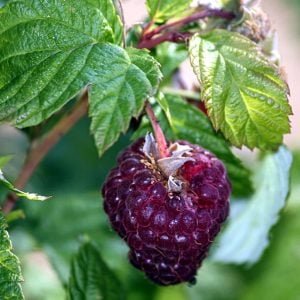
Brandywine Raspberry
Checking fit
Himbo Top Raspberry
Checking fit
Boyne Raspberry
Checking fit
Reviews
There are no reviews yet.