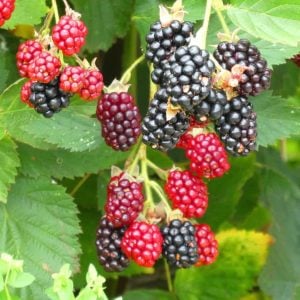

Navaho Blackberry
$11.95
Navaho Blackberry (Rubus ‘Navaho’) is a thornless, erect-caned blackberry from the University of Arkansas bearing firm 1-inch black fruit with high sugar content, rated among the best of the Arkansas erect varieties for fresh eating, jams, pies, and cobblers. It grows in USDA hardiness zones 6-9 and AHS heat zones 4-9, needs 800-900 chill hours, and is self-fertile, fruiting reliably without a pollinator partner.
12-18″ Bare Root Plant
Propagation: Own-root
Can’t be shipped to: AK, FL, HI, SC
In stock
Navaho blackberry was released in 1988 by the University of Arkansas fruit breeding program under plant patent USPP6679, developed by Dr. James N. Moore, the founder of the UA caneberry program. It originated from a hand-pollinated cross of Arkansas Selection 583 x Arkansas Selection 631 made in 1977 at the Clarksville, Arkansas experiment station. Seeds germinated in 1978, seedlings fruited in 1980, and selection Ark. 1172 was advanced for its thornless canes, erect habit, and high fruit quality. Navaho was the second erect thornless release from the UA program after Arapaho (1993, an earlier ripening sibling), and the two varieties together established the commercial template for erect thornless blackberry production in the United States. Moore, who began systematic blackberry improvement at Arkansas in 1964, developed Navaho as part of an eight-cultivar portfolio that reshaped the American bramble industry. USPP6679 has since expired, making Navaho freely propagable. Its late-ripening slot — extending the harvest season after earlier UA releases finish — and its high sugar content relative to other erect types sustain its popularity in home gardens and small commercial plantings decades after its introduction.
Navaho performs reliably across USDA hardiness zones 5–9, suiting a wide range of climates from the upper Midwest through the Deep South. Its 800–900 chill hours requirement places Navaho in the mid-chill category — well suited to climates with reliable winter cold across the Mid-Atlantic, Upper South, Midwest, and the northern half of the Southeast. The plant hardens adequately for zone 5 winters, and the chill threshold is comfortably met across most of zones 5–8.
Plant in full sun — six or more hours of direct light daily — on a well-drained site with soil pH held between 5.5 and 6.5. Acidifying amendments such as elemental sulfur correct alkaline soils before planting; a pre-plant soil test prevents pH guesswork. Navaho's erect canes stand without wire support, which simplifies row establishment, though a single-wire guide at mid-height tidies the row in high-wind sites. Space plants 2–3 feet apart in the row and keep rows 8–10 feet apart for air circulation. Consistent soil moisture during the first season builds the root mass that drives subsequent fruit load.
USDA Hardiness Zone: 6-9
AHS Heat Zone: 4-9
Chill Hours: 800-900
Sun Requirements: Full Sun
Soil pH: 5.5-6.5
Soil Type: Adaptable; tolerates clay soil
Soil Drainage: Well-drained
Water Requirements: Medium
Drought Tolerance: Moderate
Heat Tolerance: High
Plant Spacing: 3-4 ft in row; rows 8-12 ft apart
How to Prune: Tip primocanes at 30-36 inches to encourage lateral branching; remove floricanes immediately after harvest; prune laterals to 12-16 inches in winter
Navaho produces upright, thornless canes that reach a compact mature height, typically shorter than trellised trailing types, making it one of the more manageable erect blackberries in the UA series. The thornless character runs through the entire cane surface — harvesters can work the row barehanded without scratches or snagging.
The plant follows the standard erect bramble cycle: primocanes emerge in the first year and carry foliage only; floricanes develop from those primocanes in the second year and bear the fruit crop. After harvest, floricanes are cut to the ground and removed, directing the plant's energy into the new primocane flush. This biennial cane pattern is straightforward once growers understand the two-year rhythm. Navaho's compact habit lends itself to smaller garden plots, row plantings along fences, or food forest shrub-layer placement where a less-aggressive footprint is preferred.
Mature Height: 4-6 ft tall
Mature Spread: 3-4 ft wide
Growth Habit: Erect; upright, self-supporting canes; no trellis required
Growth Rate: Fast
Foliage Type: Deciduous
Food Forest Layer: Shrub
Permaculture Role: Food production; wildlife habitat and forage; living/thorny hedge and barrier
Leaf Color: Green
Fall Foliage Color: Red to orange-purple
Thorns?: No
Attracts Wildlife: Pollinators (bees); songbirds and game birds; small mammals
Life Span: productive for 10-15 years
Navaho is self-fertile and does not require a second blackberry cultivar to set a full crop. Insects — primarily native bees and honeybees — carry pollen between flowers on the same plant, so even a single-plant planting produces fruit reliably. No cross-pollinator is needed, though planting multiple thornless varieties in proximity can increase pollinator activity and slightly improve fruit set.
Flowering occurs in mid-spring in temperate climates, with bloom timing shifting slightly earlier in warmer zones and later in cooler ones. The flowers are white, five-petaled, and attractive to a broad range of native pollinators. Fruit ripening follows in mid to late July in a temperate climate, with harvest spread over two to three weeks — a useful trait for home gardeners who prefer a staggered picking window rather than a compressed single-week harvest.
Bloom Season: Early
Bloom Window: Mid Apr - Late May
Pollination Requirements: Self-fertile
Pollination Mechanism: Self-fertile; insect-pollinated (bees improve fruit set and berry size)
Flower Color: White to pale pink
Navaho fruit measures approximately 1 inch in diameter — small to medium by erect thornless standards — with a firm, glossy black skin at full ripeness. The flavor profile centers on high sugar content that places it among the sweetest-rated selections in the University of Arkansas erect series, with acidity present but clearly secondary to sweetness. The drupelets are well-packed and the berry holds its shape well after picking.
The firm texture supports fresh eating, baking, and freezing equally well. Navaho berries do not turn mushy quickly after harvest, which extends the window for jam-making and preserves. The high sugar content reduces the need for added sweetener in cooked preparations. Frozen berries retain flavor through winter smoothies and baking. The combination of a sweet flavor profile and firm texture makes Navaho a reliable dual-purpose blackberry for both garden-fresh eating and processed products.
Ripening Season: Early
Harvest Window: Late Jun - Late Jul
Fruit Size: 1 inch
Fruit Weight: 5.1 g
Flavor: Sweet, high sugar content (excellent); rated among the best of Arkansas erect varieties
Fruit Color: Black
Fruit Texture: Firm
Bearing Habit: Floricane (second-year canes bear fruit)
Years to Bear: 2-3 years
Yield: 10-15 per plant at maturity
Storage Life: 21 days refrigerated at 2°C; excellent postharvest quality
Culinary Uses: Fresh eating, jams, jellies, pies, cobblers, smoothies, wine, freezing
Navaho carries no documented resistance rating for orange rust (Gymnoconia nitens) and should be treated as susceptible — erect types in general are considered at risk, and orange rust, once established in a planting, is incurable. Remove and destroy any infected canes immediately; do not compost them. Rosette or double blossom (Cercosporella rubi), anthracnose (Elsinoe veneta), and cane blight (Leptosphaeria coniothyrium) similarly lack published resistance data for Navaho; maintaining adequate row spacing and removing spent floricanes promptly after harvest reduces humidity-driven pressure from all three.
Botrytis fruit rot (Botrytis cinerea) is a confirmed susceptibility — harvest ripe fruit promptly and avoid overhead irrigation during ripening to limit gray mold spread. Spotted wing drosophila (Drosophila suzukii) is susceptible; harvest on a tight schedule as fruit color up, since delay concentrates infestation. Brown marmorated stink bug (Halyomorpha halys) feeding is a susceptibility as well; row covers during ripening and perimeter trap crops reduce pressure. Japanese beetle adults may feed on foliage; hand removal and kaolin-clay applications are the primary organic-approved responses.
Orange Rust: Susceptible
Rosette / Double Blossom: Resistant
Anthracnose: Moderately Resistant
Cane Blight: Moderately Susceptible
Botrytis Fruit Rot / Gray Mold: Moderately Susceptible
Spotted Wing Drosophila: Moderately Susceptible
Raspberry Crown Borer: Moderately Susceptible
Brown Marmorated Stink Bug: Moderately Susceptible
Japanese Beetle: Moderately Susceptible
- Cut floricanes at ground level after harvest: Removing spent second-year canes immediately after the crop reduces fungal inoculum (Botrytis, anthracnose) and gives new primocanes room and light.
- Harvest on a tight schedule: Check the row every 2–3 days once berries begin turning and do not leave ripe fruit on the cane — delay increases both spotted-wing drosophila infestation and Botrytis fruit rot.
- Watch for orange rust early: Bright orange spore masses on the underside of leaves in spring signal systemic infection; pull and bag the entire plant immediately — there is no cure and the pathogen spreads rapidly.
- Use drip or soaker irrigation: Overhead watering during bloom and ripening elevates humidity at berry level, feeding Botrytis; ground-level irrigation keeps foliage and fruit dry.
- One wire keeps erect canes upright: A single horizontal wire at 3–4 feet prevents canes from leaning in exposed sites without the cost of a full trellis system.
We ship in late winter or early spring based on your USDA hardiness zone.
We strive to ship orders on the scheduled dates listed in the table below. However, please note that the actual shipping date may be subject to change due to factors like weather conditions and order volume.
The specific date for shipping your order will be determined according to your zipcode at the time of checkout.
Our plants are shipped bare root, packed in moist sawdust, and securely wrapped in plastic to prevent the roots from drying out. We use USPS Ground Advantage for shipping, ensuring that your plants typically arrive within 2-5 days after packaging.
In case you're unable to plant the trees immediately upon arrival, we recommend soaking them in water for a few hours and temporarily heeling them in. Ideally, they should be planted within three days of receipt for optimal health.
See our full shipping policy and map here
| Zone | Ship Date |
|---|---|
| 11 - 8b | March 1st, 2027 |
| 8a - 7b | March 8th, 2027 |
| 7a | March 15th, 2027 |
| 6b | March 22nd, 2027 |
| 6a | March 29th, 2027 |
| 5b - 5a | April 12th, 2027 |
| 4b - 4a | April 26th, 2027 |
| 3b - 1a | May 3rd, 2027 |
Our 365-Day Plant Guarantee: We ensure that our plants are delivered to you alive and healthy. If your plant does not survive its first year, you're eligible for store credit under these conditions:
- Your location falls within the appropriate USDA hardiness zone for the plant variety (refer to our hardiness zone map).
- You maintain the roots' moisture and plant within three days of delivery, following the instructions in our Planting Guide.
If you're concerned about your plant's health, please consult our guide, How to Tell if Your Tree is Dead or Dormant. Remember, our plants are shipped in a dormant state and may leaf out at different times based on their species. To check for plant vital
16 reviews for Navaho Blackberry
Related products

Apache Blackberry
Checking fitRated 5.00 out of 5
Natchez Blackberry
Checking fitRated 4.25 out of 5
Chester Blackberry
Checking fit
Arapaho Blackberry
Checking fitRated 4.67 out of 5


Tracy J. (verified owner) –
Planted great customer service. Plant looks great
Jessica T. (verified owner) –
Katherine K. (verified owner) –
Good quality plant and roots and it was shipped well protected.
Amy (verified owner) –
Verna B. (verified owner) –
I was so excited when I got them! Before I unwrapped them they already had new growth on them. Very very healthy!!
Brian Hoy (verified owner) –
Very happy, Years of great berries to come.
Ashley Wesenberg (verified owner) –
Can’t wait for it to produce
Tina EPPLIN (verified owner) –
Carrie (verified owner) –
My order arrived at the very week I requested for a Spring planting. All bare roots were in great shape. No obstacles here. Derek is working hard to please.
Rebecca Williams (verified owner) –
Can’t wait to get berries so I can make a homemade blackberry cobbler!!
Megan S. (verified owner) –
Plants arrived in great shape. Healthy and ready to plant.
millie clark (verified owner) –
The stem is completely brown no growth yet.
Steven Peavler (verified owner) –
Just planted on Saturday.
Mike Parks (verified owner) –
Good roots
Marisa Feathers (verified owner) –
Came in terrific condition, bundled with all our other plants, and it is thriving.
Sabrina N. (verified owner) –
Stayed dormant for some time and then sprung up!