$59.95Original price was: $59.95.$47.96Current price is: $47.96.
Lipan Pecan (Carya illinoinensis) is a USDA-ARS release valued for large, high-quality nuts and strong resistance to pecan scab. It grows across USDA Hardiness Zones 5 to 9, the widest cold range of our newer pecan varieties, and tolerates AHS Heat Zone 3 to 9 conditions as well. Lipan needs 350 to 500 chill hours each winter to break dormancy and bear well. Because it is a Type I pollen shedder, plant it with a Type II partner like Kanza for a dependable nut set.
3-4′ Bare Root Grafted Tree Rootstock: Pecan Seedling
Pecan Seedling (Standard): Grafted onto a pecan seedling, so the tree reaches its full natural size on a deep taproot. No dwarfing effect.
• Support: Freestanding; the deep taproot gives excellent anchorage.
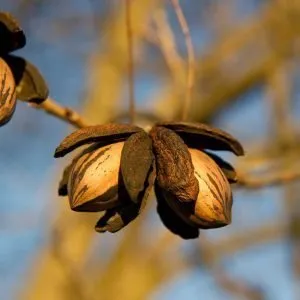
Lipan pecan stands out for its large, high-quality nuts and notably strong resistance to pecan scab, a fungal disease that can wreck a pecan crop in humid growing regions. The nuts crack easily and open to cream to golden kernels with excellent flavor, making Lipan a dependable pick for growers who want size and disease resistance in the same tree.
Lipan is a USDA-ARS release bred by T. E. Thompson at the agency’s Brownwood, Texas station. It began as a cross between ‘Cheyenne’ and ‘Pawnee’ made in 1986, and it was tracked for years afterward under the trial designation 1986-3-624 before earning its formal release in 2011. That long evaluation window let breeders confirm the scab resistance and nut quality that define the variety today.
Lipan is rated Advanced in care, mainly because pecans are large, long-lived trees that need steady attention while they establish: deep, regular watering in the early years, annual monitoring for scab and nut pests, and enough open space to reach a mature canopy without crowding. Give it well-drained soil in full sun, since standing water and heavy shade both cut into nut production.
Lipan has Low salt tolerance, so avoid sites near roads that get de-icing salt or soils irrigated with saline water; salt buildup in the root zone shows up as leaf scorch and slowed growth. Low wind tolerance means some wind protection pays off, since exposed trees risk limb breakage and can shed nuts before they finish maturing.
Lipan's AHS Heat Zone 3 to 9 rating means it handles long, hot summers about as well as it handles cold winters, but in a Zone 7 temperate climate it performs best where summer heat builds steadily rather than swinging between extremes.
USDA Hardiness Zone: 5-9 AHS Heat Zone: 3-9 Chill Hours: 350-500 Sun Requirements: Full Sun Soil pH: 5.5-7.0 Soil Type: Deep, fertile sandy loam to clay loam; native to bottomland alluvial soils Soil Drainage: Well-drained to moderately well-drained Water Requirements: Medium Drought Tolerance: Moderate
Lipan grows into an erect, rounded pecan tree, reaching 70 to 100 feet tall and 40 to 75 feet wide at maturity, so plan for the footprint of a large shade tree when you choose a site. It is deciduous with a moderate growth rate, and it is native to central and eastern North America, which makes it a good fit for naturalized or woodland-style plantings as well as a dedicated nut orchard.
Deer find Lipan susceptible to browsing, so young trees need protection until the trunk and lower branches grow out of easy reach. The mature canopy supports a wide range of wildlife, including squirrels, white-tailed deer, wild turkey, woodpeckers, songbirds, crows, raccoons, and opossums, all of which will compete with you for the nut crop.
Beyond nut production, Lipan works as shade, a windbreak, and a canopy layer in food forest design, and its mature size makes it a strong anchor tree for permaculture plantings built around long-term nut yield.
Lipan is a Type I, protandrous pecan: it sheds its pollen before its own pistils become receptive, so a single tree cannot reliably pollinate itself. Cross-pollination from a Type II variety, one whose female flowers open while Lipan is still shedding pollen, is required for a consistent nut set. Without a compatible partner nearby, expect a light and unpredictable crop even from an otherwise healthy tree, since nut set depends entirely on pollen arriving from another tree at the right moment.
Plant Lipan with a Type II pollinator such as Kanza, Elliot, or Stuart. USDA-ARS specifically pairs Lipan with Kanza in its own trials, so Kanza is the safest first choice if you are only adding one pollinator tree.
Pollination Requirements: Cross-pollination required; Type I (Protandrous): pollen shed before pistils are receptive; requires a Type II cross-pollinator nearby Pollination Mechanism: Wind-pollinated Ploidy: Diploid (2n)
Lipan produces large pecans, running about 44 to 46 nuts per pound (roughly 9.8 grams each), with a kernel percentage of 53 to 55 percent, so you get a substantial amount of usable nut meat for every shell you crack. The shell itself is thin and easy to crack, opening to reveal cream to golden kernels with excellent flavor that hold up well eaten out of hand, baked into recipes, or sold at a premium over smaller-nutted varieties.
Harvest lands in mid-October, roughly two weeks after Pawnee and two weeks before Desirable, which makes Lipan a useful bridge variety if you are staggering harvest across an orchard. Its shell suture is very strong, so nuts resist splitting open on the tree even if wet weather or a busy harvest season delays picking, giving you more flexibility than many other pecan varieties without risking nut quality.
Ripening Season: Late Harvest Window: Mid Oct Fruit Size: 1-3 inch Fruit Weight: 9.8 g Flavor: Excellent flavor, light golden nut meats Fruit Color: Cream/Tan Fruit Skin: Thin, easy-to-crack tan shell Years to Bear: 5-7 years
Pecan scab (Venturia effusa) is the disease that makes or breaks a pecan planting in humid regions, and Lipan carries a resistant rating against it. USDA-ARS reports Lipan as more scab resistant than both Pawnee and Desirable, two widely planted varieties that often need a fungicide program to produce clean nuts. That built-in resistance is the practical reason to choose Lipan on sites where summer humidity runs high.
Lipan has not been individually rated for pecan weevil, pecan nut casebearer, hickory shuckworm, or black pecan aphid, so manage all four with the same cultural toolkit you would use on any pecan. Clean up fallen nuts and shucks each season to break weevil and shuckworm cycles, check nut set for casebearer webbing, and watch new growth for the stippling that signals black aphid feeding. Lean on variety selection and cultural prevention first, add mechanical or biological controls next, and reach for an OMRI-listed organic product only if you truly need to intervene, never a synthetic pesticide. Also watch for downy spot, vein spot, zonate leaf spot, and powdery mildew, which respond to the same sanitation and airflow practices that keep scab pressure down.
Widest cold range of our new pecans: Lipan's USDA Zone 5 to 9 rating gives you more planting flexibility than most recent pecan releases.
Don't rush the harvest: Lipan's strong shell suture resists splitting, so a delayed pick past mid-October still comes off clean.
Plan for a pollinator up front: As a Type I, protandrous shedder, Lipan needs a Type II variety like Kanza within pollination range.
Protect young trees from deer: Lipan is susceptible to browsing, so cage or fence saplings until they outgrow reach.
We ship in late winter or early spring based on your USDA hardiness zone.
We strive to ship orders on the scheduled dates listed in the table below. However, please note that the actual shipping date may be subject to change due to factors like weather conditions and order volume.
The specific date for shipping your order will be determined according to your zipcode at the time of checkout.
Our plants are shipped bare root, packed in moist sawdust, and securely wrapped in plastic to prevent the roots from drying out. We use USPS Ground Advantage for shipping, ensuring that your plants typically arrive within 2-5 days after packaging.
In case you're unable to plant the trees immediately upon arrival, we recommend soaking them in water for a few hours and temporarily heeling them in. Ideally, they should be planted within three days of receipt for optimal health.
Our 365-Day Plant Guarantee: We ensure that our plants are delivered to you alive and healthy. If your plant does not survive its first year, you're eligible for store credit under these conditions:
You maintain the roots' moisture and plant within three days of delivery, following the instructions in our Planting Guide.
If you're concerned about your plant's health, please consult our guide, How to Tell if Your Tree is Dead or Dormant. Remember, our plants are shipped in a dormant state and may leaf out at different times based on their species. To check for plant vital
Reviews
There are no reviews yet.