Gladiator Crabapple
$39.95
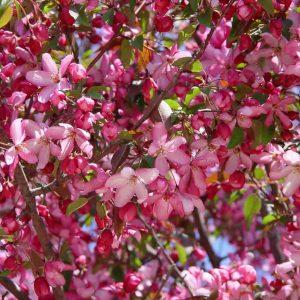
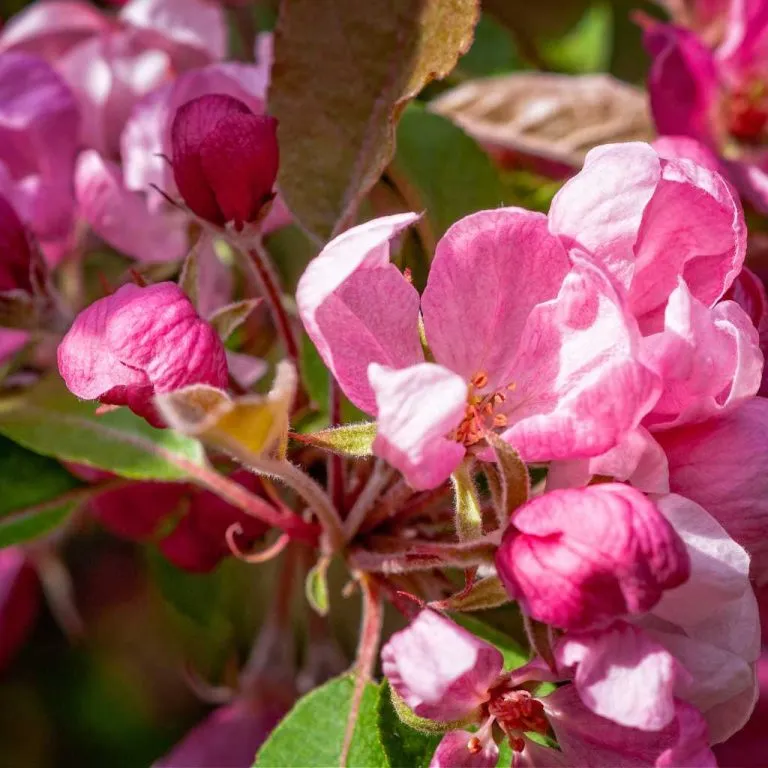
Gladiator Crabapple (Malus x adstringens ‘Durleo’) is a columnar rosybloom crabapple with deep bronze-purple foliage, bright pink flowers opening from red buds, and persistent reddish-purple fruit that lingers through fall and winter to feed birds and wildlife. It grows in USDA hardiness zones 4-8 and AHS heat zones 2-7, and needs about 800-1000 chill hours.
3-4′ Bare Root Grafted Tree
Rootstock: B118 – Semi Dwarf
A Budagovsky selection at roughly 85-90% of standard, so nearly full size. Exceptionally cold hardy and well anchored.
• Support: Freestanding; no staking required.
Can’t be shipped to: AK, HI
In stock
Gladiator Crabapple is a rosybloom selection introduced by Prairie Shade Nursery and distributed through the trade under the trademark by Jeffries Nurseries Ltd., of Portage la Prairie, Manitoba, Canada. It is protected by U.S. Plant Patent PP20,167 under the cultivar name ‘Durleo.’ The variety was selected from Royalty Crabapple, itself one of the foundational rosybloom selections, and its Malus x adstringens classification places it within the cold-hardy prairie hybrid complex developed for survival in Zone 2 through 3 climates — among the most cold-tolerant crabapple lineages available. The rosybloom trait, expressed as red pigmentation through flowers, emerging foliage, and fruit, traces to Malus niedzwetzkyana in the background breeding of the adstringens group. Gladiator’s commercially distinguishing characteristic is its narrowly columnar habit — roughly twice as tall as wide — which separates it from the broad-spreading form of Royalty and most other rosyblooms, making it one of the only selections in this cold-hardy group suited to narrow streetscapes or tight hedgerow placements where horizontal spread is a constraint.
Gladiator's zone 2 hardiness is not incidental — the adstringens parentage was assembled with Canadian prairie winters in mind, so cold hardiness is structural, not marginal. Chill requirements of roughly 800 to 1,000 hours place it firmly in mid-belt and northern temperate climates; growers at the warmer edge of its range should site it where cold air settles slightly in winter hollows to ensure adequate dormancy. In humid climates, airflow around the narrow crown is an asset: the columnar habit naturally limits interior canopy congestion, which reduces the microclimate conditions that favor fungal disease. Plant in full sun — shaded conditions not only reduce flowering but can weaken the dark foliage pigmentation that defines this cultivar's ornamental value. Soil pH between 6.0 and 7.0 keeps iron and manganese available; outside that band, foliage can pale. Consistent moisture during the first two growing seasons establishes a deep root system, after which drought tolerance is moderate and irrigation can taper. Avoid low-lying areas with persistent wet soils; standing water promotes Phytophthora root issues common to the Rosaceae family.
USDA Hardiness Zone: 4-8
AHS Heat Zone: 2-7
Sun Requirements: Full Sun
Soil pH: 6.0-7.0
Soil Type: Adaptable to most soil types including clay loam, silt loam, and sandy loam; prefers average to moist, well-drained soils
Soil Drainage: Well-drained; tolerates average moist conditions but not waterlogged
Water Requirements: Medium; requires approximately 1 inch of water per week; drought tolerant once established
Drought Tolerance: Moderate; drought tolerant once established
Plant Spacing: 9-12 ft apart
The columnar form — 18 to 20 feet tall but only 9 to 10 feet wide — distinguishes Gladiator from virtually every other ornamental crabapple in commerce. That narrow oval profile makes it workable under power lines, along fence lines, or as a repeated accent in formal allées where a spreading canopy would be impractical. Foliage emerges dark purple in spring and matures to bronze-purple through summer, holding color into fall rather than fading to green the way some rosyblooms do midseason. The deciduous leaf drop in autumn reveals the clean branching structure, which provides winter interest and makes dormant pruning straightforward. Growth rate runs moderate at roughly 6 to 12 inches per year, so the tree reaches functional screening height within five to seven years without requiring aggressive annual cuts to manage spread. Root architecture is typical of grafted Malus: moderately spreading, non-invasive, compatible with standard lawn and pavement margins at the 9-to-12-foot spacing recommended for hedgerow use.
Mature Height: 18-20 ft tall
Mature Spread: 9-10 ft wide
Growth Habit: Columnar/narrowly upright; narrow oval
Growth Rate: Moderate; approximately 6-12 inches per year
Foliage Type: Deciduous
Food Forest Layer: Canopy, Sub-canopy
Leaf Color: Dark bronze-purple; glossy; emerges dark purple and matures to bronze-purple
Fall Foliage Color: Dark purple
Attracts Wildlife: Bees, butterflies, birds, hummingbirds
Life Span: 40+ years under ideal conditions
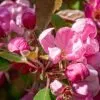
Gladiator opens bright pink blossoms from plump red buds in mid-April through late May — a bloom window that overlaps with most spring-flowering apple and crabapple cultivars, making pollinator pairing straightforward. The tree is self-fertile, producing crabapples without a partner, but fruit set density increases meaningfully when a compatible diploid crabapple blooms within roughly 50 feet. For best results, pair with a cultivar whose bloom window overlaps the mid-to-late portion of Gladiator's range; Prairie Fire Crabapple and Robinson Crabapple both carry overlapping bloom windows and are suitable companions. Bees are the primary transfer agents; the fragrant flowers attract both honeybees and native solitary bees. Wind assists incidentally, but insect activity drives meaningful cross-pollination.
Bloom Season: Late
Bloom Window: Mid Apr - Late May
Pollination Requirements: Self-fertile; cross-pollination improves fruit set
Pollination Mechanism: Insect-pollinated (bees primary); wind-assisted
Flower Color: Bright pink; opens from plump red buds
Gladiator produces small reddish-purple crabapples roughly 3/8 inch in diameter — at the petite end of the crabapple size spectrum. The fruits are tart and astringent at fresh eating but carry sufficient pectin and sugar for crabapple jelly, preserves, and acidic-fruit vinegar when harvested after the first light frost softens the tannins slightly. Fruit color deepens to reddish-purple by early fall and persists on the branches well into winter, providing several months of ornamental interest and a reliable food source for cedar waxwings, robins, and other frugivorous birds when ground-level food is scarce. Yield is modest given the small fruit size and narrow crown, but the persistent fruit characteristic is more valuable for wildlife and four-season landscape display than for culinary volume. No documented Brix values appear in extension literature for this cultivar; flavor intensity is typical of rosybloom crabapples — high acid, moderate sugar, pronounced tannin.
Fruit Size: 0.375 inch
Fruit Color: Reddish-purple; persistent through fall into winter
Culinary Uses: Crabapple jelly, preserves, and wildlife food; fruit too tart for fresh eating
Gladiator carries strong resistance to the four diseases that most commonly drive ornamental crabapple failure in humid climates. Apple scab (Venturia inaequalis) resistance eliminates the need for protective fungicide programs even in wet springs — a clear advantage for organic and low-input growers. Fire blight (Erwinia amylovora) resistance is similarly strong; prune flagging shoots at least 12 inches below visible infection and sterilize tools between cuts to limit spread. Cedar-apple rust (Gymnosporangium juniperi-virginianae) resistance reduces pressure to manage nearby eastern red cedar hosts. Powdery mildew (Podosphaera leucotricha) resistance is strong, requiring no spray program. Anthracnose (Apiognomonia erythrostoma) shows moderate resistance; remove fallen leaf litter promptly in wet springs to reduce overwintering spore load. All four pest categories — spirea aphid (Aphis citricola), eastern tent caterpillar (Malacosoma americanum), San Jose scale (Quadraspidiotus perniciosus), and Japanese beetle (Popillia japonica) — show moderate susceptibility. Scout shoot tips weekly from late April through June; insecticidal soap controls aphid colonies before populations establish. Tent caterpillar egg masses overwinter on small branches — hand-remove in late winter before hatch. Apply horticultural oil before bud break to suppress San Jose scale. Hand-pick Japanese beetle adults in early morning or use kaolin clay; avoid pheromone traps, which draw more beetles than they catch.
Apple Scab: Resistant
Fire Blight: Resistant
Cedar-Apple Rust: Resistant
Powdery Mildew: Resistant
Anthracnose: Moderately Resistant
Spirea Aphid: Moderately Susceptible
Eastern Tent Caterpillar: Moderately Susceptible
San Jose Scale: Moderately Susceptible
Japanese Beetle: Moderately Susceptible
- Aphid early action: Scout shoot tips weekly from late April through June; insecticidal soap at first detection prevents honeydew fouling and sooty mold that follow heavy infestations.
- Tent caterpillar egg masses: Check branches in February and March for shiny, varnish-coated egg bands on thin twigs; remove and destroy before hatch to avoid spring defoliation.
- Dormant oil for scale: Apply horticultural oil above 40°F but before green tip — this single application suppresses San Jose scale without disrupting spring pollinators.
- Columnar spacing for hedgerows: The narrow habit allows 9-foot spacing in a screen; maintain adequate airflow between trunks in humid climates to limit foliar disease pressure.
- Japanese beetle hand-picking: Knock adults into soapy water in early morning when sluggish; skip pheromone traps, which attract more beetles than they catch.
We ship in late winter or early spring based on your USDA hardiness zone.
We strive to ship orders on the scheduled dates listed in the table below. However, please note that the actual shipping date may be subject to change due to factors like weather conditions and order volume.
The specific date for shipping your order will be determined according to your zipcode at the time of checkout.
Our plants are shipped bare root, packed in moist sawdust, and securely wrapped in plastic to prevent the roots from drying out. We use USPS Ground Advantage for shipping, ensuring that your plants typically arrive within 2-5 days after packaging.
In case you're unable to plant the trees immediately upon arrival, we recommend soaking them in water for a few hours and temporarily heeling them in. Ideally, they should be planted within three days of receipt for optimal health.
See our full shipping policy and map here
| Zone | Ship Date |
|---|---|
| 11 - 8b | March 1st, 2027 |
| 8a - 7b | March 8th, 2027 |
| 7a | March 15th, 2027 |
| 6b | March 22nd, 2027 |
| 6a | March 29th, 2027 |
| 5b - 5a | April 12th, 2027 |
| 4b - 4a | April 26th, 2027 |
| 3b - 1a | May 3rd, 2027 |
Our 365-Day Plant Guarantee: We ensure that our plants are delivered to you alive and healthy. If your plant does not survive its first year, you're eligible for store credit under these conditions:
- Your location falls within the appropriate USDA hardiness zone for the plant variety (refer to our hardiness zone map).
- You maintain the roots' moisture and plant within three days of delivery, following the instructions in our Planting Guide.
If you're concerned about your plant's health, please consult our guide, How to Tell if Your Tree is Dead or Dormant. Remember, our plants are shipped in a dormant state and may leaf out at different times based on their species. To check for plant vital
Related products

Profusion Crabapple
Checking fit
Dorsett Golden Apple
Checking fitRated 5.00 out of 5
Cinnamon Spice Apple
Checking fit
Jonathan Apple
Checking fit

Reviews
There are no reviews yet.