Dwarf Everbearing Mulberry
$29.95
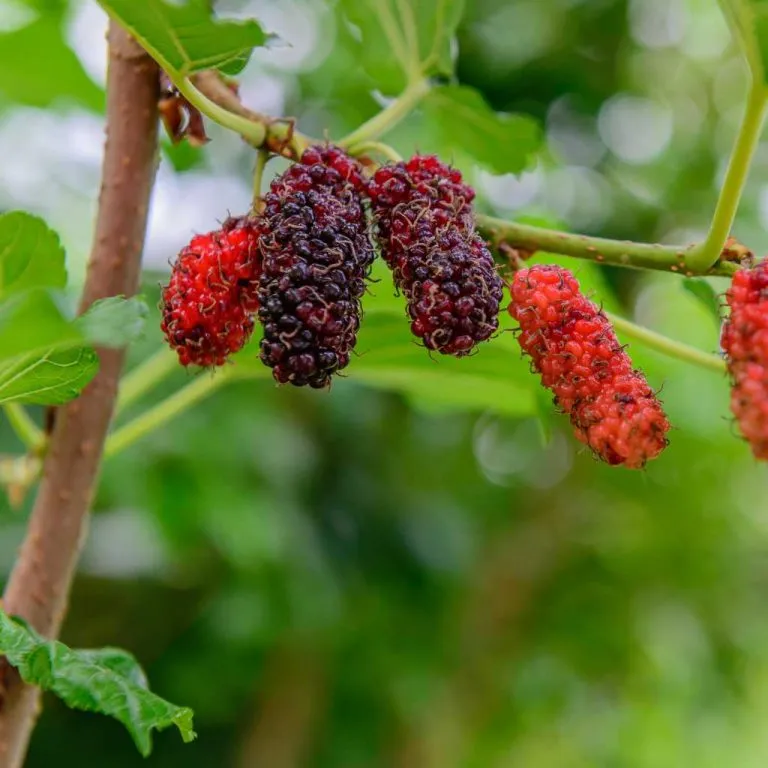
Dwarf Everbearing Mulberry (also known as Dwarf Black Mulberry; Morus nigra ‘Dwarf Everbearing’) is a compact black mulberry selection bearing deep purple-black fruit with a sweet-tart, wine-like flavor reminiscent of blackberry with hints of raspberry, produced over an extended everbearing season on a shrub that can be kept to 4–6 feet. It grows in USDA hardiness zones 5-10 and AHS heat zones 4-9, needs 200-400 chill hours, and is self-fertile, fruiting reliably without a pollinator partner.
2-3′ Bare Root Tree
Propagation: Own-root
Out of stock
Out of stock — back next season
Spring 2027 inventory drops in June. Drop your email and we'll notify you the day this variety is back in stock.
You're on the list. Check your inbox for a confirmation link — click it to lock in your spot. We'll email you the day this variety is back in stock.
Dwarf Everbearing Mulberry is a compact selection of Morus nigra, the black mulberry native to western Asia — principally modern Iran and Turkey — where the species has been cultivated for fruit for at least 2,000 years across the Mediterranean and Middle East. Morus nigra was valued throughout that history for fruit quality rather than for silk production, the trade that made its white-mulberry relative (Morus alba) globally important. The specific selection sold under the names Dwarf Everbearing, Gerardi Dwarf, and Dwarf Everbearing Black Mulberry appears to have entered the North American nursery market in the early 2000s as demand for compact, container-suitable fruiting plants grew. Its origin is clonal rather than bred: the plant is a compact, naturally small-statured form of M. nigra propagated vegetatively from selected stock rather than produced through intentional crossing or formal release. No breeder or institution is documented as the originator. Considerable confusion exists in the nursery trade about the true species identity of plants sold under this name, and some sources question whether all propagated material is authentic M. nigra.
Container suitability is the growing story here. Because the root system stays fibrous and non-invasive in dwarf form, this mulberry thrives in large containers — a 15- to 25-gallon pot allows adequate root volume while keeping the plant movable. In-ground plantings prefer loamy, well-drained soil with a pH of 5.5 to 6.5; the species tolerates sandy or clay soils but not waterlogged conditions, where root oxygen depletion leads to decline. Full sun drives the heaviest fruit set — fewer than six hours per day noticeably reduces yield. Water needs run moderate: roughly an inch per week during the growing season, but established plants handle drought well. A pH below 5.5 can lock out calcium and magnesium, so test and amend with lime if needed. Prune between fruit flushes rather than all at once, which maintains a manageable framework and keeps fruiting wood at reachable height. Avoid pruning into new growth during active fruiting — the sap bleeds readily. In Zone 5 and 6 containers, move pots to an unheated garage or shed for winter protection.
USDA Hardiness Zone: 5-10
AHS Heat Zone: 4-9
Chill Hours: 200-400
Sun Requirements: Full Sun
Soil pH: 5.5-6.5
Soil Type: Loam; tolerates sandy and clay soils; avoid waterlogged conditions
Soil Drainage: Well-drained
Water Requirements: Medium; approximately 1 inch per week during the growing season; drought-tolerant once established
Drought Tolerance: High; drought-resistant once established
Heat Tolerance: High; thrives in hot summers
Plant Spacing: 6-10 ft apart for garden planting; 2-3 ft for hedgerow use; 15-20 ft for standard tree spacing
Container Suitability: Excellent; well-suited for container growing; minimum 1-gallon pot initially with upsizing as plant matures; can be kept under 2 feet with pruning
How to Prune: Prune between fruit flushes to maximize yields and maintain a strong branch framework; light pruning keeps fruit at reachable height; can be topped to maintain 2-6 feet; winter pruning only when fully dormant to reduce bleeding
Unpruned, the plant reaches 10 to 15 feet tall, but consistent heading keeps it to 4 to 6 feet — a scale that fits comfortably on a patio or deck. The growth habit is multi-stemmed and somewhat spreading rather than strictly upright, so pruning to a central leader or a short trunk with 3 to 4 scaffold branches reduces crowding. Growth rate is moderate to fast, typically 1.5 to 3 feet per year in good conditions. Leaves are broad, medium to dark green, and turn yellow in fall — ornamentally undistinctive but useful as livestock fodder (goats and chickens readily eat them). Bark on older wood becomes furrowed and gray-brown. Because the root pattern is fibrous with brittle lateral roots, container soil can compact over time; repot every 2 to 3 years, loosening the root ball at each repotting. The plant is thornless, which simplifies hand-harvesting. Birds are attracted heavily to ripe fruit, so netting is practical in high-pressure situations.
Mature Height: 4-6 ft tall (pruned); up to 10-15 ft tall unpruned
Mature Spread: 4-8 ft wide
Growth Habit: Compact, multi-stemmed shrub to small tree; can be trained as single-trunk or maintained as a bush
Growth Rate: Moderate to Fast
Foliage Type: Deciduous
Food Forest Layer: Sub-canopy, Shrub
Permaculture Role: Productive fruit tree; wildlife attractor; livestock fodder; dynamic accumulator; understory or shrub layer
Leaf Color: Medium to dark green
Fall Foliage Color: Yellow
Thorns?: No
Attracts Wildlife: Birds, small mammals, butterflies, beneficial insects
Life Span: 100+ years
Pollination is wind-driven and self-sufficient. Dwarf Everbearing Mulberry is monoecious, carrying separate male catkins and female flower spikes on the same plant, so no external pollen donor is needed for fruit set. The bloom window runs from mid-April through early June — an extended window that corresponds to the plant's everbearing nature. Female flowers open sequentially along new growth, which explains why ripening is staggered rather than concentrated. No insect transfer is required, though bees and other insects do visit the small, chartreuse-to-cream catkins. Because fruit set begins on the earliest-opening female flowers while later flowers are still developing, the plant carries green, ripening, and fully ripe fruit simultaneously for much of summer. Nearby mulberry varieties of any species can contribute additional pollen and may incrementally increase fruit set, but the plant will produce a full crop on its own.
Bloom Season: Very Late
Bloom Window: Mid Apr - Early Jun
Pollination Requirements: Self-fertile; no pollinator required
Pollination Mechanism: Wind; monoecious (separate male and female flowers on same plant)
Flower Color: Chartreuse to cream/white; catkins
Berries run 0.75 to 1.0 inch in diameter, smaller than Illinois Everbearing but typical for Morus nigra selections. Flavor is the compensating factor: documented Brix values for M. nigra run 5 to 14 percent depending on sun exposure and ripeness, with a sweet-tart profile featuring wine-like depth and raspberry undertones — distinctly richer than the milder flavor of M. alba or the M. alba × rubra hybrid. Fruit turns deep purple-black at full maturity; picking even a day early yields noticeably more acidity and less sweetness. Skin is thin and stains heavily — gloves and a sacrificial shirt are practical gear. Storage life is short: fresh fruit keeps 1 to 3 days refrigerated, and texture deteriorates quickly once picked. Freezing is the most reliable preservation method; berries freeze cleanly on a sheet tray before bagging. The culinary range is wide — fresh eating, jams, jellies, pies, juice, wine, and syrups are all standard uses. The harvest window running from late May through early October means multiple separate picking sessions rather than a single-event harvest.
Ripening Season: Very Late
Harvest Window: Late May - Early Oct
Fruit Size: 0.75-1 inch
Flavor: Sweet-tart with rich, wine-like depth; similar to blackberry but sweeter; complex flavor with hints of raspberry
Fruit Color: Deep purple-black at maturity
Fruit Texture: Soft, juicy; tender and easily bruised
Fruit Skin: Thin, tender; stains heavily
Bearing Habit: Everbearing; continuous fruit production throughout the growing season with multiple flushes
Years to Bear: 2-3 years
Storage Life: 1-3 days fresh; freeze well; best eaten immediately off the plant
Culinary Uses: Fresh eating, jams, jellies, pies, tarts, juice, wine, smoothies, syrups, dried fruit; leaves used for tea and food wrapping
Armillaria Root Rot (Armillaria mellea) is the one area where this variety shows solid resistance — a meaningful advantage given how widespread Armillaria is in orchard soils. Powdery Mildew (Phyllactinia corylea) and Mulberry Whitefly (Tetraleurodes mori) also fall in the moderate resistance range, reducing management burden under typical conditions. Three diseases warrant active management. Bacterial Blight (Pseudomonas syringae pv. mori) is moderately susceptible; it enters through wounds and frost-cracked bark, so pruning only during dry weather and avoiding overhead irrigation reduces infection pressure significantly. Canker Diseases (Cytospora and Nectria species) are also moderately susceptible; remove and dispose of (do not compost) any cankered wood promptly, cutting at least 6 inches below visible discoloration. Cercospora Leaf Spot (Cercospora moricola) favors humid conditions — thinning the canopy and raking fallen leaves in autumn break the disease cycle effectively. On the pest side, Comstock Mealybug (Pseudococcus comstocki) and Scale Insects (including San Jose Scale, Comstock quadraspidiotus perniciosus) are moderately susceptible. For mealybugs, insecticidal soap or neem oil applied at egg hatch in late spring controls populations before they establish. Dormant-season horticultural oil applied just before bud break is the primary control for scale. Mulberry Borer (Megacyllene caryae) causes moderate pressure; exit holes in bark signal infestation and warrant pruning out affected limbs promptly.
Armillaria Root Rot: Resistant
Bacterial Blight: Moderately Susceptible
Cercospora Leaf Spot: Moderately Susceptible
Powdery Mildew: Moderately Resistant
Canker Diseases: Moderately Susceptible
Mulberry Whitefly: Moderately Resistant
Comstock Mealybug: Moderately Susceptible
Mulberry Borer / Hickory Borer: Moderately Resistant
Scale Insects: Moderately Susceptible
- Container upsizing schedule: Start in a 5-gallon pot, then move to 15 gallons, then 25+ gallons — skipping sizes causes rootbound stress and reduces yield. Repot in early spring before leaf-out.
- Bacterial Blight prevention: Prune only during dry weather, and sterilize pruning tools between cuts with a 10% bleach solution or 70% isopropyl alcohol — blight spreads readily on wet cutting surfaces.
- Canker management: At the first sign of sunken, discolored bark, remove the limb with a 6-inch clean margin and apply an OMRI-listed copper-based pruning sealant to limit reinfection.
- Harvest timing by color: Wait until fruit is uniformly deep purple-black with slight give under finger pressure. Firm fruit with any red tone is underripe — the sweetness jump in the final 24–48 hours of ripening is pronounced.
- Scale and mealybug control: Apply OMRI-listed horticultural oil in late winter before buds break, then follow with insecticidal soap at first crawler emergence for mealybug. Repeat applications 7 to 10 days apart improve coverage on protected life stages.
We ship in late winter or early spring based on your USDA hardiness zone.
We strive to ship orders on the scheduled dates listed in the table below. However, please note that the actual shipping date may be subject to change due to factors like weather conditions and order volume.
The specific date for shipping your order will be determined according to your zipcode at the time of checkout.
Our plants are shipped bare root, packed in moist sawdust, and securely wrapped in plastic to prevent the roots from drying out. We use USPS Ground Advantage for shipping, ensuring that your plants typically arrive within 2-5 days after packaging.
In case you're unable to plant the trees immediately upon arrival, we recommend soaking them in water for a few hours and temporarily heeling them in. Ideally, they should be planted within three days of receipt for optimal health.
See our full shipping policy and map here
| Zone | Ship Date |
|---|---|
| 11 - 8b | March 1st, 2027 |
| 8a - 7b | March 8th, 2027 |
| 7a | March 15th, 2027 |
| 6b | March 22nd, 2027 |
| 6a | March 29th, 2027 |
| 5b - 5a | April 12th, 2027 |
| 4b - 4a | April 26th, 2027 |
| 3b - 1a | May 3rd, 2027 |
Our 365-Day Plant Guarantee: We ensure that our plants are delivered to you alive and healthy. If your plant does not survive its first year, you're eligible for store credit under these conditions:
- Your location falls within the appropriate USDA hardiness zone for the plant variety (refer to our hardiness zone map).
- You maintain the roots' moisture and plant within three days of delivery, following the instructions in our Planting Guide.
If you're concerned about your plant's health, please consult our guide, How to Tell if Your Tree is Dead or Dormant. Remember, our plants are shipped in a dormant state and may leaf out at different times based on their species. To check for plant vital
Related products

Elberta Peach
Checking fitRated 5.00 out of 5- SOLD OUT

Illinois Everbearing Mulberry
Checking fit 
Anna Apple
Checking fit
Warren Pear
Checking fit

Reviews
There are no reviews yet.