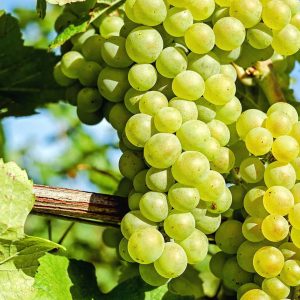
Thomcord Grape
$24.95
Thomcord Grape (Vitis labrusca x Vitis vinifera) is a USDA-bred seedless vine that delivers the bold, jammy Concord-style flavor that home growers love in a berry that is lighter, sweeter, and slightly firmer than its famous parent. It grows in USDA hardiness zones 5-9 and AHS heat zones 6-10, needs 200-400 chill hours, and is self-fertile, fruiting reliably without a pollinator partner.
1-2′ Bare Root Vine
Propagation: Own-root
Can’t be shipped to: AK, HI, ID, OR, WA
Out of stock
Out of stock — back next season
Spring 2027 inventory drops in June. Drop your email and we'll notify you the day this variety is back in stock.
You're on the list. Check your inbox for a confirmation link — click it to lock in your spot. We'll email you the day this variety is back in stock.
Thomcord was bred by research horticulturist David W. Ramming and technician Ronald L. Tarailo at the USDA Agricultural Research Service Horticultural Crops Research Laboratory in Fresno, California. The cross was made in 1983, pairing Thompson Seedless (Vitis vinifera) with Concord (Vitis labrusca) using embryo rescue to extract viable seed from the near-sterile Thompson pollen recipient — a technically demanding procedure that yielded only three viable seedlings from 1,231 emasculations. The original Thomcord seedling was planted in 1984 in cooperation with California State University, Fresno, selected in 1986, and evaluated under the accession number A29-67 for more than a decade before public release in 2003. The breeding objective was to demonstrate zygotic (fertilized-egg) origin for embryo-rescued plants, but the agronomic result proved commercially significant: full-sized, seedless, blue-black clusters carrying the distinctive labrusca aroma of Concord. Thomcord entered public domain without patent encumbrance.
Thomcord's low chill requirement — roughly 100 to 400 hours below 45°F — places it within reach of growers from Zone 5 cold climates down through Zone 9 warm winters, a broader fit than most labrusca types. Full sun is essential: clusters shaded by dense canopy produce less sugar and are more vulnerable to fungal pressure. A well-drained loam or sandy loam at pH 5.5 to 6.5 supports healthy cane growth; standing water after rain events invites Phytophthora and Botrytis. During the critical period from fruit set through veraison (late June into August), consistent moderate moisture prevents berry cracking that opens entry points for Black Rot and Botrytis. Soil pH management also affects nutrient availability — potassium, which grapes draw heavily during berry development, becomes limiting below pH 5.5. Established vines tolerate moderate dry spells but perform best with drip irrigation. Spacing at 8 to 10 feet on a sturdy trellis allows adequate airflow, which is the single most cost-effective cultural tool for fungal disease reduction.
USDA Hardiness Zone: 5-9
AHS Heat Zone: 6-10
Chill Hours: 200-400
Sun Requirements: Full Sun
Soil pH: 5.5-6.5
Soil Type: Loam, sandy loam, Well-drained
Soil Drainage: Well-drained
Water Requirements: Medium; drought tolerant once established
Drought Tolerance: Moderate
Heat Tolerance: High
Plant Spacing: 8-10 ft apart
Container Suitability: Possible in large containers (15-20 gallons); requires sturdy support
How to Prune: Spur pruning on bilateral cordon or quadrilateral trellis; remove 90% of prior season's growth annually while dormant
As a climbing woody perennial, Thomcord extends 10 to 20 feet of vine length on support structures over its productive life, with a lateral spread of 6 to 10 feet. Growth rate is fast once established, filling an arbor or pergola within two to three seasons. The deciduous foliage is medium green through summer, shifting to yellow or red in fall before drop. Annual spur pruning on a bilateral cordon or quadrilateral trellis is not optional — removing approximately 90% of the prior season's growth each dormant period redirects the vine's energy into fruit-bearing wood rather than unproductive vegetative extension. Without disciplined pruning, Thomcord quickly produces excessive shoot growth, shades its own fruiting zone, and surrenders much of its yield potential. The deep, spreading root system anchors well in most soils but benefits from initial mulching to regulate temperature and moisture near the crown.
Mature Height: 10-20 ft tall (on trellis)
Mature Spread: 6-10 ft wide
Growth Habit: Climbing vine; deciduous woody perennial
Growth Rate: Fast
Foliage Type: Deciduous
Food Forest Layer: Vine
Permaculture Role: Climber/Vine; edible fruiting vine for vine layer
Leaf Color: Medium green
Fall Foliage Color: Yellow to red
Attracts Wildlife: Bees, birds (robins, cedar waxwings, cardinals, orioles, woodpeckers, thrushes), raccoons, deer, squirrels
Life Span: 20-50+ years (grapevines are long-lived perennials)
Thomcord carries perfect hermaphroditic flowers — both stamens and pistil present — and pollinates itself reliably without any companion vine. Blooms emerge late May through mid-June on the current season's canes. The pollination mechanism is primarily wind-assisted, with incidental contributions from foraging insects. Because the variety is fully self-fertile, growers planting a single vine can expect a full crop from the first bearing season onward. Yield studies show no measurable increase from proximity to other grape varieties, which simplifies spacing decisions in small home vineyard layouts. Flower clusters form at the basal nodes of new shoots, so spur pruning that retains two to three buds per spur preserves adequate fruiting positions.
Bloom Season: Very Late
Bloom Window: Late May - Mid Jun
Pollination Requirements: Self-fertile; no cross-pollinator required
Pollination Mechanism: Self-fertile; wind-assisted and insect pollination
Flower Color: White to greenish-white
Ploidy: Diploid
Berries reach 0.7 to 0.8 inch in diameter and weigh 3.0 to 3.5 grams each, placing them in the same size range as Mars and Venus. Clusters average 341 grams — substantially larger than typical Concord clusters. The flavor profile is the defining trait: bold, aromatic Concord character with the labrusca foxy quality dialed back slightly and sweetness pushed forward compared to pure Concord. The skin adheres to the flesh (not a true slip-skin), and no seeds are present. Brix levels reported in USDA trials run high enough for fresh eating with bright sweetness. Storage life runs 2 to 4 weeks under refrigeration, longer than many fresh-eating grapes. The culinary range is broad: fresh table use, grape juice, jelly, jam, preserves, home winemaking, and drying into raisins. The leaves are edible for dolma preparation; young cooked shoots are also used culinarily. Berry color at ripeness is blue-black with a whitish waxy bloom. Harvest falls late July through mid-August in temperate climates.
Ripening Season: Very Early
Harvest Window: Late Jul - Mid Aug
Fruit Size: 0.7-0.8 inch (medium, comparable to Mars and Venus; 3-3.5 g per berry)
Fruit Weight: 3-3.5 g per berry; clusters average 341 g
Flavor: Bold Concord grape flavor (labrusca/foxy), lighter and sweeter than pure Concord; aromatic, sweet, jammy
Fruit Color: Blue-black with whitish bloom
Fruit Texture: Medium-soft flesh; slightly firmer than Concord
Fruit Skin: Medium thickness; adheres to flesh (not slip-skin)
Bearing Habit: Annual bearer on current season's canes; productive on spur-pruned bilateral or quadrilateral trellis
Years to Bear: 2-3 years
Yield: 29-36 per vine average
Storage Life: 2-4 weeks refrigerated
Culinary Uses: Fresh eating (table grape); juice; jelly; jam; preserves; wine; raisins (dried); grape leaves for cooking
Among the two primary fungal concerns — Black Rot (Guignardia bidwellii) and Downy Mildew (Plasmopara viticola) — both rate as moderately susceptible. For Black Rot, remove mummified berries during dormant pruning (they carry overwintering spores) and apply OMRI-listed copper at bud break through bloom. Downy Mildew pressure spikes during extended leaf-wetness periods; shoot positioning and leaf removal near the fruit zone reduce infection windows. Botrytis Bunch Rot (Botrytis cinerea) rates as moderately resistant, but the tight seedless cluster structure creates humidity pockets near harvest — thin heavily laden clusters and harvest promptly. Powdery Mildew (Erysiphe necator) also shows moderate resistance; occasional OMRI-listed sulfur during shoot elongation maintains that advantage. Crown Gall (Agrobacterium vitis) is moderately susceptible, so protect the trunk from cultivation wounds — the bacteria enter almost exclusively through injury sites. Japanese Beetle (Popillia japonica) is the highest-pressure pest; hand-pick adults during the July flight peak and use floating row cover on high-value sections. Grape Berry Moth (Paralobesia viteana), Spotted Wing Drosophila (Drosophila suzukii), and Eastern Grape Leafhopper (Erythroneura comes) all rate as moderately susceptible — monitor with sticky traps, harvest before fruit softens excessively, and support parasitoid populations with companion plantings like yarrow and buckwheat.
Black Rot: Moderately Susceptible
Powdery Mildew: Moderately Resistant
Downy Mildew: Moderately Susceptible
Botrytis Bunch Rot: Moderately Resistant
Crown Gall: Moderately Susceptible
Grape Berry Moth: Moderately Susceptible
Japanese Beetle: Susceptible
Spotted Wing Drosophila: Moderately Susceptible
Eastern Grape Leafhopper: Moderately Susceptible
- Annual Hard Pruning: Remove 90% of prior-season canes each dormant period; retaining too many buds shifts energy to shoots over fruit and worsens disease by closing the canopy.
- Black Rot Sanitation: Collect and destroy mummified berries and diseased debris before bud break — mummies are the primary source of inoculum for the following season.
- Japanese Beetle Defense: Hand-pick adults and knock them into soapy water during the July flight peak; avoid using beetle traps near the vineyard as they attract more beetles than they catch.
- Botrytis Window: Remove a few leaves around fruit clusters at veraison to improve airflow and light penetration; this single step cuts bunch rot risk significantly at minimal labor cost.
- Crown Gall Prevention: Prune only during dry weather in late winter; avoid wounding the lower trunk, as Agrobacterium vitis enters almost exclusively through injury sites.
We ship in late winter or early spring based on your USDA hardiness zone.
We strive to ship orders on the scheduled dates listed in the table below. However, please note that the actual shipping date may be subject to change due to factors like weather conditions and order volume.
The specific date for shipping your order will be determined according to your zipcode at the time of checkout.
Our plants are shipped bare root, packed in moist sawdust, and securely wrapped in plastic to prevent the roots from drying out. We use USPS Ground Advantage for shipping, ensuring that your plants typically arrive within 2-5 days after packaging.
In case you're unable to plant the trees immediately upon arrival, we recommend soaking them in water for a few hours and temporarily heeling them in. Ideally, they should be planted within three days of receipt for optimal health.
See our full shipping policy and map here
| Zone | Ship Date |
|---|---|
| 11 - 8b | March 1st, 2027 |
| 8a - 7b | March 8th, 2027 |
| 7a | March 15th, 2027 |
| 6b | March 22nd, 2027 |
| 6a | March 29th, 2027 |
| 5b - 5a | April 12th, 2027 |
| 4b - 4a | April 26th, 2027 |
| 3b - 1a | May 3rd, 2027 |
Our 365-Day Plant Guarantee: We ensure that our plants are delivered to you alive and healthy. If your plant does not survive its first year, you're eligible for store credit under these conditions:
- Your location falls within the appropriate USDA hardiness zone for the plant variety (refer to our hardiness zone map).
- You maintain the roots' moisture and plant within three days of delivery, following the instructions in our Planting Guide.
If you're concerned about your plant's health, please consult our guide, How to Tell if Your Tree is Dead or Dormant. Remember, our plants are shipped in a dormant state and may leaf out at different times based on their species. To check for plant vital
Related products
- SOLD OUT

Marquis Grape
Checking fit 
Niagara Grape
Checking fitRated 5.00 out of 5- SOLD OUT

Flame Seedless Grape
Checking fit 
Catawba Grape
Checking fitRated 5.00 out of 5

Reviews
There are no reviews yet.