

Spicebush
$11.95
Spicebush (also known as Wild Allspice; Lindera benzoin) is a keystone native shrub of eastern woodland edges whose aromatic berries serve as an allspice substitute and whose foliage hosts the Spicebush Swallowtail, Eastern Tiger Swallowtail, and Promethea Silkmoth, with yellow fall color and bright red fruit on multi-stemmed, broadly rounded form. It grows in USDA hardiness zones 4-9 and AHS heat zones 1-9.
1-2′ Bare Root Seedling Plant
Propagation: Seedling (own-root)
In stock
Spicebush is the straight native species Lindera benzoin, a member of the Laurel family with no breeding history or cultivar selection behind it. Its native range spans eastern North America from southern Maine south to Florida and west through Kansas and eastern Texas, where it grows naturally in moist woodland understories along stream banks and floodplain edges. Indigenous peoples across this range — including the Cherokee, who formally taught European settlers its uses — dried and powdered the fruit as a spice and prepared bark and leaf teas for medicinal purposes. During both the Revolutionary War and the Civil War, colonists dried and crushed the berries as a field substitute for allspice when trade imports from Britain were cut off. The genus Lindera places it in a group of some 100 species centered in eastern Asia; benzoin is the sole North American representative. What FFN offers is the native genotype, valued for ecological authenticity across its natural range rather than any selected or improved trait.
Spicebush naturally colonizes moist floodplain soils with a broad pH tolerance — anywhere from 4.5 to 7.5 — which reflects its ability to thrive under both acid woodland and near-neutral alluvial conditions. While it tolerates occasional flooding and clay, it performs noticeably better in loamy soils that retain moisture without waterlogging for extended periods. Site selection matters most for fruit production: female plants in moderate to full shade will flower and leaf out reliably, but berry set improves with morning sun and good insect access. Plan for at least one male plant within 50 to 100 feet of every five or six female plants to ensure adequate pollination by native bees, flies, and ants. In humid-summer climates, the naturally moist woodland microclimate it prefers also creates conditions favorable for Laurel Wilt spread via the Redbay Ambrosia Beetle, so site monitoring is important (see disease section). Space plants 8 to 12 feet apart; they spread slowly by root sprouts and eventually form layered multi-stem thickets in undisturbed settings.
USDA Hardiness Zone: 4-9
AHS Heat Zone: 1-9
Sun Requirements: Full Sun to Full Shade
Soil pH: 4.5-7.5
Soil Type: Sandy loam, loam, clay loam; tolerates clay
Soil Drainage: Moist to wet; tolerates occasional flooding
Water Requirements: Medium; prefers consistent moisture
Drought Tolerance: Low to Moderate
Plant Spacing: 8-12 ft apart
Container Suitability: Yes (large containers, 7+ gallon)
How to Prune: Prune immediately after flowering (blooms on old wood); remove dead or crossing branches; minimal pruning needed
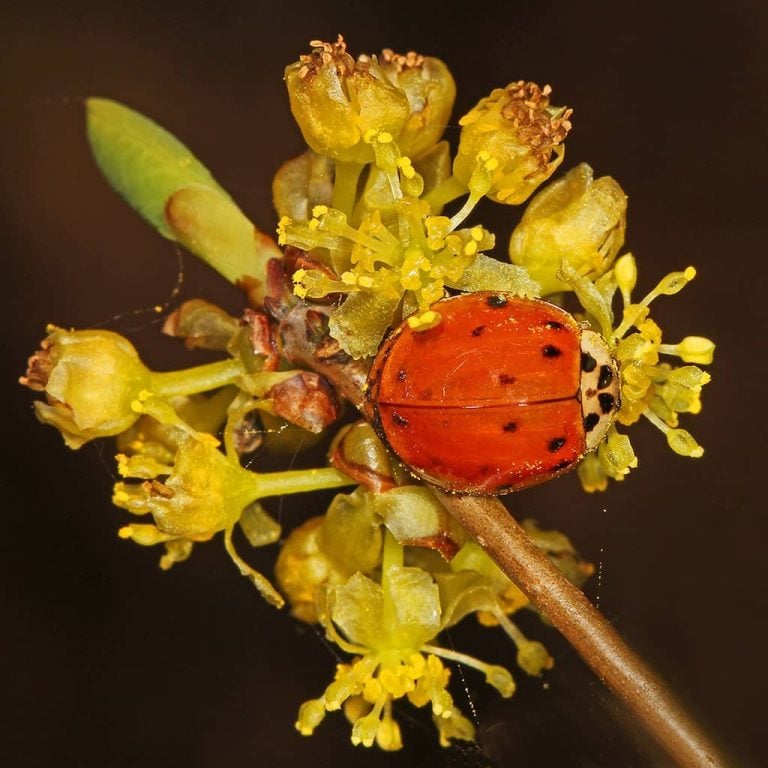
The broad, rounded, multi-stemmed form — typically 6 to 12 feet tall and equally wide — suits spicebush to naturalized plantings and woodland garden edges where a medium-scale shrub fills structural gaps without crowding taller canopy trees. Stems root shallowly with a fibrous pattern that anchors well in riparian soils but makes bare-root transplanting impractical; establish from containers in early spring or fall for best results. Pale yellow to greenish yellow flowers open in clusters directly on the bare stems in early to mid spring — one of the earliest shrub bloomers in eastern woodlands, often preceding forsythia in cold springs. Dark green summer foliage turns clear golden yellow in autumn, adding a second season of landscape interest. All vegetative parts emit a distinctly spicy-citrus fragrance when bruised, a trait that helps identify the species and contributes to moderate deer avoidance. Growth rate is slow to moderate; minimal pruning is needed beyond removing dead or crossing branches immediately after flowering, since buds form on old wood.
Mature Height: 6-12 ft tall
Mature Spread: 6-12 ft wide
Growth Habit: Multi-stemmed deciduous shrub; broad, rounded form
Growth Rate: Slow to Moderate
Foliage Type: Deciduous
Food Forest Layer: Shrub
Permaculture Role: Understory shrub; wildlife support plant; native spice plant; butterfly host
Leaf Color: Dark green (upper surface); lighter green (underside)
Fall Foliage Color: Yellow to golden yellow
Thorns?: No
Attracts Wildlife: Spicebush Swallowtail butterfly (larval host), Eastern Tiger Swallowtail (larval host), Promethea Silkmoth (larval host), native bees, Wood Thrush, Veery, Gray Catbird, Northern Bobwhite, Northern Cardinal, other migratory birds
Life Span: Perennial (long-lived shrub; 50+ years in suitable habitat)
Spicebush is dioecious — individual plants are either male or female, and only female plants bear fruit. Fruit set on female plants depends on having a male plant within pollinator flight range, 50 to 100 feet. Early March through mid April bloom timing means spicebush flowers before other shrubs are in leaf, giving early-season pollinators — native bees, small flies, and ants — clear access. One male per five to six females is the standard recommendation for reliable berry crops; a single male can service a larger grouping in open sites. When sourcing plants, confirm sex at point of sale — males are sometimes sold as unnamed companion plants. Nurseries often stock unsexed seedlings; planting three or more individuals increases the probability of getting at least one male. Because this is a straight species rather than a selected cultivar, any male Lindera benzoin plant serves as a compatible pollinator regardless of source.
Bloom Season: Mid
Bloom Window: Early Mar - Mid Apr
Pollination Requirements: Cross-pollination required; dioecious — male and female plants needed for fruit set
Pollination Mechanism: Insect-pollinated (bees, flies, ants)
Flower Color: Pale yellow to greenish yellow
The berries ripen from green to glossy bright red between late August and early October, forming oval drupes about 0.5 inch across. Flavor is pungent and aromatic — a sharp peppery heat up front, then a lingering allspice-citrus warmth that most spice comparisons describe as a blend of allspice, bay, and black pepper. Dried and ground, the berries substituted for allspice historically and remain a functional culinary spice: use in spice rubs, baked goods, or as a whole berry in braises. Fresh berries are edible but intensely flavored; drying concentrates the volatile oils. Leaves and young twigs share the same aromatic compound profile and can be used to make herbal tea or add flavor to stocks. Wildlife value rivals culinary value: the high-fat berry is a critical migration fuel for Wood Thrush, Veery, Gray Catbird, Northern Bobwhite, and Northern Cardinal. In a food forest context, the shrub functions equally as a spice producer and a wildlife support node.
Ripening Season: Mid
Harvest Window: Late Aug - Early Oct
Fruit Size: 0.5 inch
Flavor: Peppery, spicy, aromatic; reminiscent of allspice with citrus notes
Fruit Color: Bright red (ripening from green)
Bearing Habit: Annual bearer (on female plants only; requires nearby male for pollination)
Culinary Uses: Allspice substitute (dried, ground berries), herbal tea (leaves and twigs), spice rub, flavoring for meats and baked goods
The most serious threat is Laurel Wilt, caused by Raffaelea lauricola and vectored by the Redbay Ambrosia Beetle (Xyleborus glabratus). Spicebush is susceptible to the disease and extremely vulnerable to beetle attack; infected plants can die within weeks as the fungus blocks vascular tissue. No curative treatment exists once infection is established. Prevention is the only strategy: inspect stems monthly for fine sawdust-tube frass that signals boring activity, remove and dispose of infested wood off-site immediately, and avoid wounding stems since fresh cuts attract the beetle. Where the beetle is established, grow spicebush in mixed native communities rather than monocultures to reduce population pressure. Anthracnose (Colletotrichum spp.) causes moderate leaf spotting during wet springs; rake and remove fallen leaves in autumn and thin interior stems for better airflow. Powdery Mildew (Erysiphe spp.) develops on shaded foliage in warm humid conditions; morning sun and adequate spacing reduce leaf surface humidity. Spicebush Swallowtail caterpillars (Papilio troilus) feed on foliage and cause localized defoliation. Supporting this butterfly is a primary reason to grow spicebush, so caterpillar feeding should be tolerated on established plants; hand-removal is warranted only when a newly planted specimen is severely stressed. Thrips (Pseudophilothrips spp.) cause moderate leaf stippling; remove weedy understory plants and apply reflective mulch to reduce populations.
Laurel Wilt: Susceptible
Anthracnose: Moderately Susceptible
Powdery Mildew: Moderately Susceptible
Spicebush Swallowtail Caterpillar: Susceptible
Redbay Ambrosia Beetle: Very Susceptible
Thrips: Moderately Susceptible
- Confirm plant sex before purchase: Only female plants produce berries; at least one male per five to six females is required for reliable fruit set. Purchase three or more seedlings to maximize the chance of getting both sexes.
- Monitor for Redbay Ambrosia Beetle: Check stem bases and branch crotches monthly for fine sawdust tubes indicating boring activity. Remove and dispose of infested material off-site immediately — do not compost. In the southeastern US, beetle pressure is highest and plant loss can be rapid.
- Welcome the caterpillars: Spicebush Swallowtail caterpillars are the ecological payoff of planting this shrub. Localized defoliation rarely harms an established plant; resist the urge to remove them unless the plant is newly established and under stress.
- Site for both shade tolerance and fruit production: Foliage thrives in full shade, but berry crops improve with morning sun and good insect access. A north-facing woodland edge with two to three hours of sun is a practical compromise.
We ship in late winter or early spring based on your USDA hardiness zone.
We strive to ship orders on the scheduled dates listed in the table below. However, please note that the actual shipping date may be subject to change due to factors like weather conditions and order volume.
The specific date for shipping your order will be determined according to your zipcode at the time of checkout.
Our plants are shipped bare root, packed in moist sawdust, and securely wrapped in plastic to prevent the roots from drying out. We use USPS Ground Advantage for shipping, ensuring that your plants typically arrive within 2-5 days after packaging.
In case you're unable to plant the trees immediately upon arrival, we recommend soaking them in water for a few hours and temporarily heeling them in. Ideally, they should be planted within three days of receipt for optimal health.
See our full shipping policy and map here
| Zone | Ship Date |
|---|---|
| 11 - 8b | March 1st, 2027 |
| 8a - 7b | March 8th, 2027 |
| 7a | March 15th, 2027 |
| 6b | March 22nd, 2027 |
| 6a | March 29th, 2027 |
| 5b - 5a | April 12th, 2027 |
| 4b - 4a | April 26th, 2027 |
| 3b - 1a | May 3rd, 2027 |
Our 365-Day Plant Guarantee: We ensure that our plants are delivered to you alive and healthy. If your plant does not survive its first year, you're eligible for store credit under these conditions:
- Your location falls within the appropriate USDA hardiness zone for the plant variety (refer to our hardiness zone map).
- You maintain the roots' moisture and plant within three days of delivery, following the instructions in our Planting Guide.
If you're concerned about your plant's health, please consult our guide, How to Tell if Your Tree is Dead or Dormant. Remember, our plants are shipped in a dormant state and may leaf out at different times based on their species. To check for plant vital
4 reviews for Spicebush
Related products

Bur Oak
Checking fit
Aronia Berry
Checking fitRated 5.00 out of 5
Shumard Oak
Checking fit
Nannyberry
Checking fit


Cara –
Since Spicebush requires both a male and a female plant to set fruit, I’d like to be able to specify male and/or female plants when I place my order. Is this possible? Thank you!
derekcarter44 –
No it’s not possible because these are seedlings.
Hannah (verified owner) –
Hard to know for sure with wee dormant plants, but there was no mold and the root systems looked very healthy! Got them in the ground and excited to see how they do!
Annabelle (verified owner) –
Arrived in good condition.
Ned Kaup (verified owner) –
Good
Terrell (verified owner) –
Both arrived bare and took some time to show life, but they did.