Royalty Purple Raspberry
$14.95
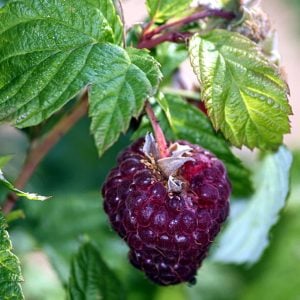
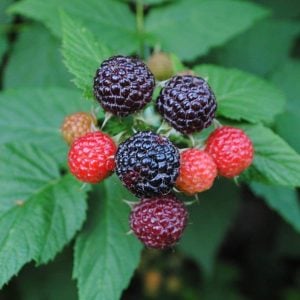
Royalty Purple Raspberry (Rubus x neglectus ‘Royalty’) is a large Cornell-bred purple raspberry whose fruit shifts from tart red-ripe to richly sweet with black raspberry notes at full purple ripeness, holding color exceptionally well when frozen or canned. It grows in USDA hardiness zones 4-8 and AHS heat zones 2-7, needs 800-1000 chill hours, and is self-fertile, fruiting reliably without a pollinator partner.
1-2′ Bare Root Plant
Propagation: Own-root
In stock
Royalty was developed by the Small Fruits Breeding Program at Cornell University’s New York State Agricultural Experiment Station in Geneva, New York, by John C. Sanford, Donald K. Ourecky, and George L. Slate, and named in fall 1982 under the experimental designation N.Y. 632. The breeding cross — NY 252 (Cumberland × Newburgh) × NY 17861 (Newburgh × Indian Summer) — was made in 1954; the specific clone was selected in 1957 and tested for twenty-five years before release. That red-by-red-and-purple pedigree places Royalty in the purple raspberry class (Rubus × neglectus) but makes it genetically 3/4 red raspberry and only 1/4 black raspberry — a composition that gives it strong vigor and cold hardiness relative to more balanced purple hybrids. The U.S. Plant Patent PP5,405 has since expired, making Royalty freely propagatable. At release it was recognized as the highest-yielding purple cultivar then available, ripening roughly a week later than most red varieties and offering a useful harvest extension within the floricane season.
Royalty needs roughly 800 to 1,000 chill hours, placing it comfortably in the mid-belt temperate zone and limiting its usefulness in climates with mild winters. Full sun maximizes both yield and fruit quality; shade shifts carbohydrate allocation away from fruiting. Soil pH between 5.5 and 6.8 is the practical target—at pH below 5.5 manganese toxicity can suppress cane growth, while pH above 6.8 reduces iron and zinc availability. Consistent moisture of roughly 1 to 2 inches per week during cane elongation and fruit swell is critical; water stress during fruit development shrinks drupelets and reduces sugar accumulation. Raised rows or beds improve drainage and lower the risk of Phytophthora root rot, which is the one disease where Royalty performs relatively well. Because Royalty spreads aggressively by root suckers, new plantings benefit from a mow-strip or physical barrier along the row edges to contain lateral spread. Annual soil testing and amendment with sulfur or dolomitic lime as needed keeps pH in range and prevents slow-building nutrient deficiencies from degrading multi-year planting productivity.
USDA Hardiness Zone: 4-8
AHS Heat Zone: 2-7
Chill Hours: 800-1000
Sun Requirements: Full Sun
Soil pH: 5.5-6.8
Soil Type: Loam, well-drained; tolerates sandy loam and clay loam if drainage is adequate
Soil Drainage: Well-drained; does not tolerate standing water or waterlogged conditions
Water Requirements: Medium; consistent moisture especially during fruit development; 1-2 inches per week
Drought Tolerance: Low
Plant Spacing: 3-5 ft in-row; 8-10 ft between rows
Container Suitability: Not recommended; vigorous suckering habit and large size make containers impractical
How to Prune: Remove all floricanes to the ground after fruiting; thin primocanes to 4-6 per foot of row; tip primocanes at 4-5 feet to encourage lateral branching; prune in late fall or early spring
Canes grow upright and arching, reaching 4 to 6 feet tall before arching outward under the weight of lateral fruit clusters. The spreading arch habit means canes need either a T-trellis or a single high-wire support to keep fruiting laterals off the ground and improve airflow. Like all purple raspberries, Royalty spreads prolifically by root suckers—the fibrous, shallow root system fans laterally and sends up new primocanes across a wide radius. This suckering tendency makes Royalty well-suited to establishing a productive hedgerow, but less practical in tight mixed plantings where spread cannot be controlled. The biennial cane cycle is fundamental to pruning logic: primocanes grow vegetatively in year one, flower and fruit in year two as floricanes, then die. Removing spent floricanes immediately after harvest opens the canopy for incoming primocanes, which is the most effective structural step for reducing cane disease pressure. Canes carry thorns, which simplifies pest exclusion but requires gloves during management. Growth rate is fast—a new planting reaches productive canopy size within the first full growing season.
Mature Height: 4-6 ft tall
Mature Spread: 3-4 ft wide
Growth Habit: Upright, arching canes; suckering; forms hedgerows
Growth Rate: Fast
Foliage Type: Deciduous
Food Forest Layer: Shrub
Thorns?: Yes
Attracts Wildlife: Bees, butterflies, birds
Life Span: 10-20 years for the planting; individual canes biennial
Royalty is self-fertile and carries both male and female floral structures, so a single planting produces fruit without a dedicated cross-pollinator. Flowers open from mid-May through early June in a temperate climate, coinciding with peak bee foraging activity. Insect pollination—primarily by bumblebees and honey bees—drives drupelet set, and incomplete pollinator visits produce crumbly, poorly formed fruit. Because self-fertility does not eliminate the need for bee visits, planting near other summer-bearing raspberries or compatible Rubus species increases overall pollinator traffic and typically improves drupelet uniformity and per-berry weight compared to isolated single-variety blocks. There is no pollen compatibility issue with other raspberry types; neighboring red, black, or yellow raspberries in bloom overlap will cross-pollinate without negative effect.
Bloom Season: Early
Bloom Window: Mid May - Early Jun
Pollination Requirements: Self-fertile; no cross-pollinator required
Pollination Mechanism: Insect-pollinated (primarily bees); also self-fertile
Flower Color: White
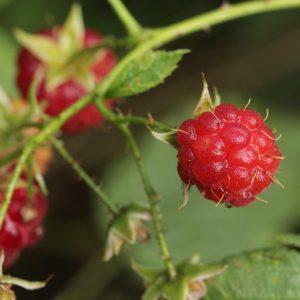
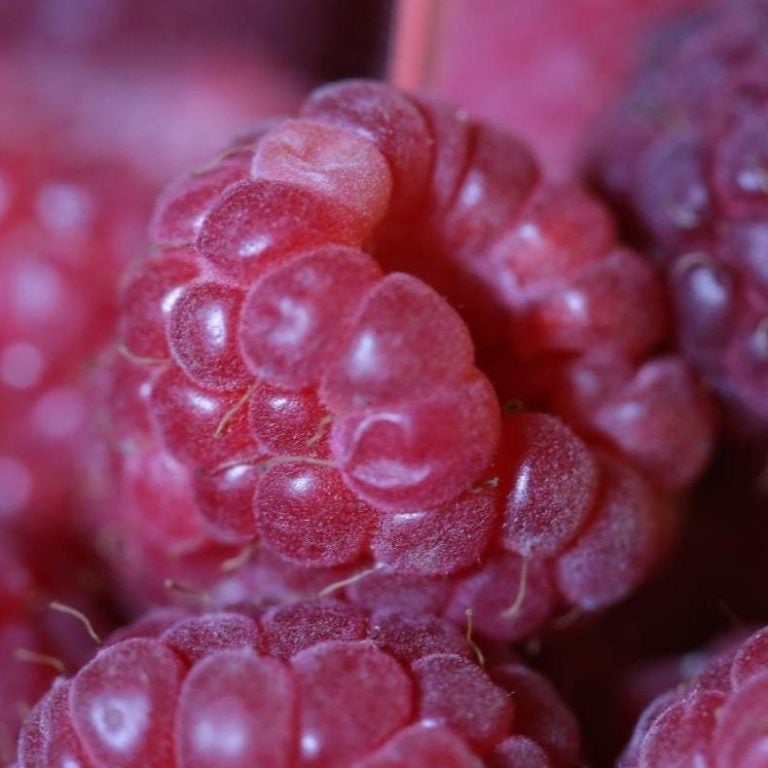
Berries are large for a raspberry, averaging 0.75 to 1.0 inch in diameter, which makes hand-picking efficient and gives the fruit strong visual appeal at market. Flavor shifts with ripeness stage: harvested at the reddish-purple stage, the taste is tart and bright; allowed to ripen to full dark purple, the flavor deepens into rich sweetness with clear black raspberry undertones and aromatic complexity absent in most red cultivars. Texture is soft and cohesive—drupelets hold together well on the receptacle but the fruit is too fragile for commercial long-distance shipping, making it best suited to home gardens, farmstands, and u-pick operations. Fresh shelf life runs 2 to 3 days refrigerated. For preservation, Royalty excels: its deep pigmentation holds color notably well through freezing, jam, jelly, and canning processes, unlike some red varieties that fade or turn brown. The edible young spring shoots can be eaten raw or cooked, and leaves are used in herbal tea. Yield potential is very high—among the heaviest-producing purple raspberry cultivars documented.
Ripening Season: Mid
Harvest Window: Late Jul - Late Aug
Fruit Size: 0.75-1 inch (large for a raspberry)
Flavor: Sweet, rich; flavor deepens from tart-red when picked early to sweet and complex with black raspberry notes when fully purple-ripe
Fruit Color: Reddish-purple to dark purple at full ripeness; can be harvested red-ripe for milder flavor
Fruit Texture: Soft; drupelets are cohesive; too soft for commercial shipping
Bearing Habit: Floricane (summer-bearing); fruits once per season on second-year canes
Years to Bear: 2 years
Storage Life: 2-3 days refrigerated fresh; excellent for freezing, jam, and jelly
Culinary Uses: Fresh eating, jam, jelly, preserves, freezing, baking, smoothies; color holds exceptionally well when canned or frozen
Royalty is susceptible to several fungal diseases; all respond to the same core practice of aggressive post-harvest canopy renovation. Spur blight (Didymella applanata) infects primocane nodes in humid weather, causing dark lesions that girdle lateral buds; removing spent floricanes immediately after harvest eliminates the primary inoculum reservoir. Anthracnose (Elsinoe veneta) appears as gray, sunken lesions on canes in wet springs; thinning primocanes to 4 to 6 per foot significantly reduces leaf wetness duration. Botrytis fruit rot (Botrytis cinerea) is the primary harvest-season threat; trellising canes upright and harvesting on a short interval in humid conditions reduce infection. Phytophthora root rot (Phytophthora fragariae var. rubi) is an exception—Royalty shows good resistance here. Spotted wing drosophila (Drosophila suzukii) is best managed with fine-mesh netting over the fruiting row at color break. Royalty shows very strong resistance to raspberry aphid (Amphorophora agathonica), limiting mosaic virus transmission without any spray program. Raspberry crown borer (Pennisetia marginata) and Japanese beetle (Popillia japonica) are moderate concerns; hand-picking beetles in the morning and monitoring crown-level wilting provide early intervention.
Spur Blight: Susceptible
Anthracnose: Susceptible
Cane Blight: Moderately Susceptible
Botrytis Fruit Rot / Gray Mold: Susceptible
Phytophthora Root Rot: Resistant
Spotted Wing Drosophila: Susceptible
Raspberry Aphid: Very Resistant
Raspberry Crown Borer: Moderately Susceptible
Japanese Beetle: Moderately Susceptible
- Harvest at full ripeness: Wait until berries turn deep purple rather than picking at the red stage — flavor complexity and sweetness increase substantially in the final days before peak color, and the black raspberry undertones that define Royalty only develop at full maturity.
- Cut floricanes immediately after harvest: Removing all second-year canes to ground level within a week of the last fruit pick is the highest-impact step for reducing spur blight and anthracnose inoculum going into the following season.
- Trellis before primocanes arch: Install a T-trellis or single high-wire at planting — waiting until canes reach full height leaves them on the ground where disease pressure spikes.
- Apply fine-mesh netting for spotted wing drosophila: Deploy exclusion netting (1.0 mm or finer) over the fruiting row at first color break; remove after final harvest. Royalty's soft fruit at peak ripeness is highly attractive to SWD and berries go from acceptable to infested quickly in warm, humid weather.
- Leverage the aphid resistance: Royalty's resistance to raspberry aphid limits mosaic virus transmission — use this to your advantage in mixed plantings by siting Royalty as a buffer row near aphid-susceptible red varieties.
We ship in late winter or early spring based on your USDA hardiness zone.
We strive to ship orders on the scheduled dates listed in the table below. However, please note that the actual shipping date may be subject to change due to factors like weather conditions and order volume.
The specific date for shipping your order will be determined according to your zipcode at the time of checkout.
Our plants are shipped bare root, packed in moist sawdust, and securely wrapped in plastic to prevent the roots from drying out. We use USPS Ground Advantage for shipping, ensuring that your plants typically arrive within 2-5 days after packaging.
In case you're unable to plant the trees immediately upon arrival, we recommend soaking them in water for a few hours and temporarily heeling them in. Ideally, they should be planted within three days of receipt for optimal health.
See our full shipping policy and map here
| Zone | Ship Date |
|---|---|
| 11 - 8b | March 1st, 2027 |
| 8a - 7b | March 8th, 2027 |
| 7a | March 15th, 2027 |
| 6b | March 22nd, 2027 |
| 6a | March 29th, 2027 |
| 5b - 5a | April 12th, 2027 |
| 4b - 4a | April 26th, 2027 |
| 3b - 1a | May 3rd, 2027 |
Our 365-Day Plant Guarantee: We ensure that our plants are delivered to you alive and healthy. If your plant does not survive its first year, you're eligible for store credit under these conditions:
- Your location falls within the appropriate USDA hardiness zone for the plant variety (refer to our hardiness zone map).
- You maintain the roots' moisture and plant within three days of delivery, following the instructions in our Planting Guide.
If you're concerned about your plant's health, please consult our guide, How to Tell if Your Tree is Dead or Dormant. Remember, our plants are shipped in a dormant state and may leaf out at different times based on their species. To check for plant vital
7 reviews for Royalty Purple Raspberry
Related products

Brandywine Raspberry
Checking fitRated 5.00 out of 5
Jewel Black Raspberry
Checking fitRated 4.60 out of 5
Prelude Raspberry
Checking fit
Arapaho Blackberry
Checking fitRated 4.67 out of 5


Ekaterina Sorokina (verified owner) –
Hallie (verified owner) –
Bare root but packaged well and looking healthy! Already in bud!
Ronald (verified owner) –
Perfect transaction
Tina EPPLIN (verified owner) –
Richard (verified owner) –
Same
Maura Pichette (verified owner) –
First time customer. Very impressed. Large healthy plants. Just starting to leaf out. Huge root systems. Cnr wait to taste the berries