Perfection Red Currant
$19.95
Perfection Red Currant (also known as Hooker’s Perfection Currant; Ribes sativum ‘Perfection’) is an American-bred red currant introduced in 1887, known for long fruit clusters and high yield, bearing juicy, sprightly-subacid berries that sweeten fully at peak ripeness, ideal for jams, jellies, and juices. It grows in USDA hardiness zones 3-7 and AHS heat zones 1-7, needs 800-1500 chill hours, and is self-fertile, fruiting reliably without a pollinator partner.
1-2′ Bare Root Plant
Propagation: Own-root
Can’t be shipped to: AK, DE, HI, ME, MA, MI, NJ, NC, RI, VT, WV
In stock
Perfection was introduced in 1887 by C. G. Hooker of Rochester, New York, making it one of the earlier American-bred red currant cultivars. Its parentage is documented as a cross between Fay, an established American red currant selection (originated 1868, introduced 1880), and White Grape, another currant variety in commercial use at the time. Hooker introduced Perfection commercially in 1909 after a period of evaluation, and it spread quickly through New York State and neighboring regions. By the 1930s, when the U.S. Department of Agriculture surveyed the American currant industry, Perfection was counted among the five varieties that together accounted for roughly 85 percent of national acreage. Its distinctive long fruit clusters — a trait traceable to the selection criteria Hooker applied — set it apart from shorter-clustered European standards. Also known as Hooker’s Perfection Currant, it is classified in the Slow Food Ark of Taste, recognizing its significance as a historically important American-bred variety that has largely disappeared from commercial production while remaining in specialty and heritage cultivation.
Perfection red currant performs best in cool-summer climates and tolerates partial shade more gracefully than many fruiting shrubs — a useful trait for sites with afternoon shade or north-facing slopes. In humid regions, air circulation around the canopy directly reduces fungal pressure from anthracnose and Botrytis, so spacing plants 5 to 6 feet apart (rather than the minimum 4 feet) pays dividends in disease management. Consistent soil moisture during fruit set in late spring is critical to cluster fill and berry size; uneven watering at that stage leads to uneven ripening across the strig. Soil pH in the 5.5 to 7.0 range suits the species, though organic matter content matters as much as pH — a well-amended loam or clay loam holds the steady moisture these plants need without becoming waterlogged. The shrub reaches 3 to 5 feet in 3 to 4 seasons given its fast growth rate, so site selection should account for full mature spread rather than just the young plant footprint.
USDA Hardiness Zone: 3-7
AHS Heat Zone: 1-7
Chill Hours: 800-1500
Sun Requirements: Full Sun to Partial Shade
Soil pH: 5.5-7.0
Soil Type: Loam, clay loam, or sandy loam; rich in organic matter
Soil Drainage: Well-drained
Water Requirements: Medium; consistent moisture needed
Drought Tolerance: Low
Heat Tolerance: Low; performs best in cool summers
Plant Spacing: 4-6 ft apart
Container Suitability: Yes; suitable for large containers
How to Prune: Prune annually in late winter or early spring before growth begins. Maintain 9-12 canes total (3-4 each of 1-, 2-, and 3-year-old wood). Remove all canes older than 4 years. Fruit is borne on spurs of 2- and 3-year-old wood.
The upright-spreading framework of Perfection builds multiple basal canes from a crown-rooted base, reaching 3 to 5 feet in height and spread at maturity. Growth rate is fast by small-fruit standards, which means the cane renewal cycle becomes relevant sooner than on slower species — fruit is borne on spurs of 2- and 3-year-old wood, and canes older than 4 years decline rapidly in productivity. Annual late-winter pruning to maintain 9 to 12 canes in three age classes (roughly 3 to 4 canes each of 1-, 2-, and 3-year wood) keeps the bearing surface young and well lit. The fibrous, shallow root pattern makes surface mulching effective for moisture retention and weed suppression, while also pointing to the need for care when cultivating near the drip line. Foliage is medium green and deciduous; the shrub offers modest fall color before leaf drop but is primarily valued for its spring-to-summer productive period.
Mature Height: 3-5 ft tall
Mature Spread: 3-5 ft wide
Growth Habit: Upright-spreading
Growth Rate: Fast
Foliage Type: Deciduous
Food Forest Layer: Shrub
Leaf Color: Medium green
Thorns?: No
Attracts Wildlife: Birds
Life Span: productive for 15-25 years
Perfection is self-fertile, so a single plant will set fruit without a cross-pollinator. Bloom opens in the early-April-to-late-May window, with greenish-yellow flowers arranged along pendant racemes. Bees are the primary transfer agents, though the flowers also accept wind-assisted pollen movement. Planting a second red or white currant cultivar within insect flight range reliably increases cluster fill and berry count — Jonkheer Van Tets is an early-blooming complement that extends the overlap window, while Red Lake overlaps the mid-season bloom period well. Neither is required for fruit set, but growers targeting maximum yield on limited space typically see 20 to 30 percent improvement with a companion plant within 10 to 15 feet.
Bloom Season: Very Late
Bloom Window: Early Apr - Late May
Pollination Requirements: Self-fertile; cross-pollination improves yield
Pollination Mechanism: Insect-pollinated (bees); also wind-assisted
Flower Color: Greenish-yellow
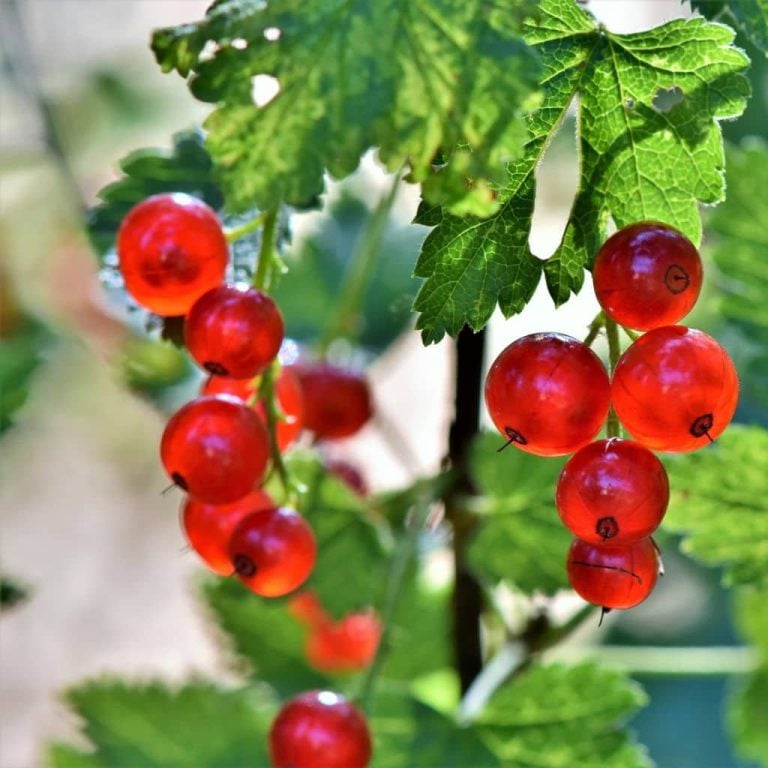
Each berry measures roughly 0.25 to 0.35 inch in diameter and ripens bright to dark red in pendant clusters of 15 to 25 fruits. Flavor at harvest is sprightly and subacid — clean tartness with enough acidity to balance sugar — then transitions to a milder, sweeter profile if left on the bush to full ripeness through mid-July. That flavor arc gives Perfection dual utility: early-harvested fruit works well in high-acid culinary applications such as jellies, tarts, and preserves where pectin-rich, acidic currants perform best, while fully ripe berries eaten fresh reward patience with noticeably softer acidity. Yield runs 3 to 10 pounds per plant, with the high end achievable under consistent management and cross-pollinator proximity. Refrigerated shelf life of 1 to 2 weeks is typical for fresh currants; for longer storage, the fruit freezes well with minimal textural loss and holds quality for up to a year frozen. The berry's thin but tough skin handles mechanical harvest better than many soft-fruited species.
Ripening Season: Very Early
Harvest Window: Mid Jun - Mid Jul
Fruit Size: 0.25-0.35 inch
Flavor: Sprightly subacid; becomes mild and sweet when fully ripe
Fruit Color: Bright to dark red
Fruit Texture: Juicy and tender
Fruit Skin: Smooth, thin yet tough, translucent
Bearing Habit: Bears on 2- and 3-year-old wood spurs; clusters of 15-25 berries
Years to Bear: 2-3 years
Storage Life: 1-2 weeks refrigerated; excellent for preserves and freezing
Culinary Uses: Fresh eating, jams, jellies, preserves, juices, tarts, muffins, wine, pies
Powdery mildew (Podosphaera mors-uvae) is Perfection's clearest disease strength — solid resistance means the variety stays productive through humid summers that defoliate more susceptible cultivars. Anthracnose leaf spot (Drepanopeziza ribis) and Botrytis fruit rot (Botrytis cinerea) both rate as moderately susceptible, so cultural management carries the load. For anthracnose, improving airflow through annual cane renewal and avoiding overhead irrigation reduces leaf wetness duration; raking fallen leaf litter each autumn removes overwintering inoculum. Against Botrytis, harvesting promptly as clusters ripen prevents ripe fruit from creating the trapped-moisture microclimate gray mold requires. Currant cane blight (Botryosphaeria ribis) is also moderately susceptible — prune out canes showing dark, sunken lesions back to healthy wood and sanitize tools between cuts. On the pest side, imported currantworm (Nematus ribesii), currant aphid (Cryptomyzus ribis), currant borer (Synanthedon tipuliformis), and spotted wing Drosophila (Drosophila suzukii) all rate as moderately susceptible. Check leaf undersides for currantworm larvae in May and remove by hand or apply kaolin clay early. OMRI-listed insecticidal soap targets aphid colonies. Currant borer causes wilting canes — cut below the entry hole and destroy removed wood. For spotted wing Drosophila, prompt harvest and fine-mesh exclusion netting during ripening are the most effective defenses.
Powdery Mildew: Resistant
Anthracnose Leaf Spot: Moderately Susceptible
White Pine Blister Rust: Moderately Resistant
Botrytis Fruit Rot: Moderately Susceptible
Currant Cane Blight: Moderately Susceptible
Imported Currantworm: Moderately Susceptible
Currant Aphid: Moderately Susceptible
Currant Borer: Moderately Susceptible
Spotted Wing Drosophila: Moderately Susceptible
- Cane Renewal: Keep no more than 12 canes per plant and cap individual cane age at 4 years — fruiting spur density drops sharply on older wood, and removing spent canes forces energy into young, productive replacements.
- Anthracnose Management: Thin canopy density during annual pruning to create airflow, and clean up fallen leaves each autumn to remove overwintering spore sources.
- Botrytis at Harvest: Inspect clusters daily during ripening and harvest promptly — leaving ripe or overripe berries on the bush in humid weather creates the stagnant, moist microclimate Botrytis fruit rot needs to establish.
- SWD Monitoring: Set a simple apple cider vinegar trap at bloom time to gauge Spotted Wing Drosophila pressure; if adults are active, cover plants with fine-mesh insect netting (1 mm or finer) before berries show color.
- Companion Planting for Yield: Even though Perfection sets fruit without a cross-pollinator, planting Jonkheer Van Tets or Red Lake within 15 feet typically lifts cluster fill noticeably in years with cool, overcast bloom weather that limits bee activity.
We ship in late winter or early spring based on your USDA hardiness zone.
We strive to ship orders on the scheduled dates listed in the table below. However, please note that the actual shipping date may be subject to change due to factors like weather conditions and order volume.
The specific date for shipping your order will be determined according to your zipcode at the time of checkout.
Our plants are shipped bare root, packed in moist sawdust, and securely wrapped in plastic to prevent the roots from drying out. We use USPS Ground Advantage for shipping, ensuring that your plants typically arrive within 2-5 days after packaging.
In case you're unable to plant the trees immediately upon arrival, we recommend soaking them in water for a few hours and temporarily heeling them in. Ideally, they should be planted within three days of receipt for optimal health.
See our full shipping policy and map here
| Zone | Ship Date |
|---|---|
| 11 - 8b | March 1st, 2027 |
| 8a - 7b | March 8th, 2027 |
| 7a | March 15th, 2027 |
| 6b | March 22nd, 2027 |
| 6a | March 29th, 2027 |
| 5b - 5a | April 12th, 2027 |
| 4b - 4a | April 26th, 2027 |
| 3b - 1a | May 3rd, 2027 |
Our 365-Day Plant Guarantee: We ensure that our plants are delivered to you alive and healthy. If your plant does not survive its first year, you're eligible for store credit under these conditions:
- Your location falls within the appropriate USDA hardiness zone for the plant variety (refer to our hardiness zone map).
- You maintain the roots' moisture and plant within three days of delivery, following the instructions in our Planting Guide.
If you're concerned about your plant's health, please consult our guide, How to Tell if Your Tree is Dead or Dormant. Remember, our plants are shipped in a dormant state and may leaf out at different times based on their species. To check for plant vital
10 reviews for Perfection Red Currant
Related products

Consort Black Currant
Checking fitRated 4.88 out of 5
Johns Elderberry
Checking fitRated 5.00 out of 5
Blueray Blueberry
Checking fit
Ouachita Blackberry
Checking fitRated 5.00 out of 5


Vanessa (verified owner) –
Anonymous (verified owner) –
Arrived healthy, they look to be of good stock. Cannot speak about the quality of the berry yet since we just received it.
Darrell Fulcher (verified owner) –
Ekaterina Sorokina (verified owner) –
Indre P. (verified owner) –
Colby N. (verified owner) –
Healthy looking plant with excellent root system. Shipping method was fast and kept all plants intact!
ryan s. (verified owner) –
Looked great
Ramon P. (verified owner) –
👍🏼👍🏼👍🏼👍🏼😁😁😁😁😁
Carrie (verified owner) –
My order arrived at the very week I requested for a Spring planting. All bare roots were in great shape. No obstacles here. Derek is working hard to please.
Rachelle Matz (verified owner) –
I can’t wait to see it grow!