
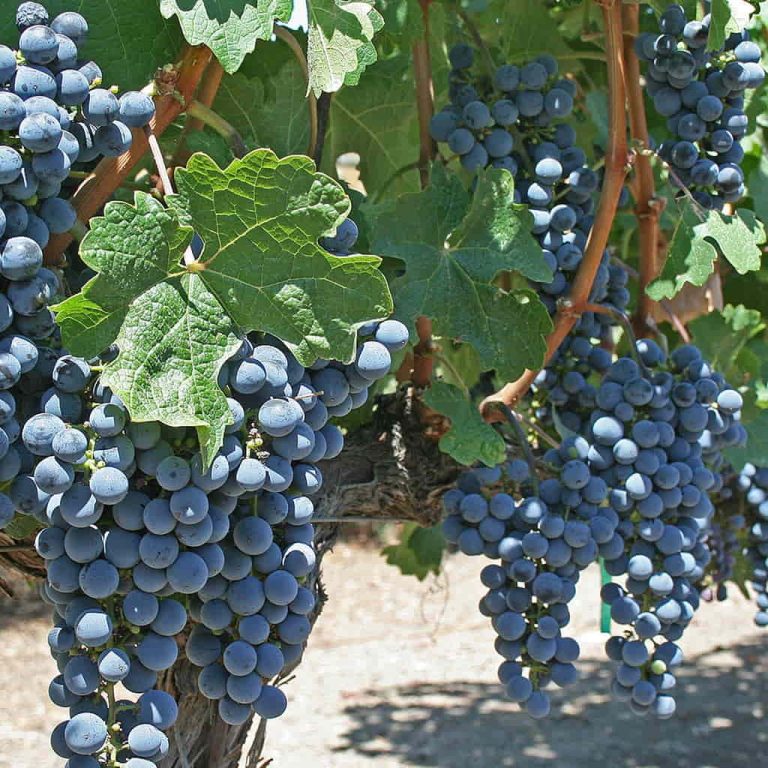
Marquette Grape
$24.95
Marquette Grape (Vitis ‘Marquette’) is a University of Minnesota interspecific hybrid wine grape bearing dark blue-black fruit with cherry, black currant, and spice flavors at 22–26° Brix, with strong mildew resistance that supports organic production. It grows in USDA hardiness zones 4-8 and AHS heat zones 1-7, needs 200-400 chill hours, and is self-fertile, fruiting reliably without a pollinator partner.
1-2′ Bare Root Vine
Propagation: Own-root
Can’t be shipped to: AK, HI, ID, OR, WA
In stock
Marquette was developed at the University of Minnesota Horticultural Research Center by breeders Peter Hemstad and James Luby through a 1989 cross of MN 1094 as female parent with Ravat 262 as male parent. MN 1094 is a Frontenac seedling from the Minnesota program; Ravat 262 is a French-American hybrid derived partly from Vitis riparia genetics. This lineage makes Marquette a third-generation Minnesota cold-climate selection with Pinot Noir in its distant ancestry through the vinifera components of Ravat 262, a relationship that contributes the aromatic complexity and tannin structure uncommon in cold-hardy hybrids. The seedling was selected in 1997 and released commercially in 2006 as MN 1211, protected under U.S. Plant Patent PP19579 assigned to the Regents of the University of Minnesota. Marquette’s combination of consistently high sugar accumulation at harvest, relatively low acidity, and cold-dormant bud tolerance to approximately -37°C positioned it as the most winemaker-friendly cultivar from the Minnesota program to that point. It became the signature variety for the upper Midwest and Great Lakes commercial wine industries within a decade of release, with plantings expanding rapidly across the cold-climate wine regions of Minnesota, Wisconsin, Michigan, and New York.
Marquette's 100 to 200 chill-hour requirement is unusually low for a cold-hardy wine grape, placing it comfortably in zones 4 through 8 — a wider thermal window than Frontenac, which struggles in warmer zones. Site selection concentrates on air drainage: low-lying frost pockets trap cold air during late spring bloom, which runs Late May through Early June, and even brief frost events can devastate an entire cluster set. Slopes or elevated ridgelines that channel cold air away from the vine row reduce this risk substantially. Soil drainage matters more than fertility — Marquette tolerates a broad pH of 5.5 to 7.0 but roots in saturated clay encourage Phytophthora infection and reduce vine vigor. Sandy loam and well-drained loam provide the best balance of moisture retention and oxygen availability at the root zone. Moderate water needs mean irrigation is rarely required in humid-summer climates, though consistent soil moisture during berry sizing (June through August) improves cluster weight. Full-sun exposure, at least 8 hours daily, is essential for driving the Brix accumulation that defines this variety's wine quality.
USDA Hardiness Zone: 4-8
AHS Heat Zone: 1-7
Chill Hours: 200-400
Sun Requirements: Full Sun
Soil pH: 5.5-7.0
Soil Type: Loam, sandy loam, clay loam
Soil Drainage: Well-drained
Water Requirements: Medium
Drought Tolerance: Moderate
Heat Tolerance: Moderate
Plant Spacing: 6-8 ft in-row; 10-12 ft between rows
How to Prune: Spur or cane pruning on Single High Wire or VSP trellis; maintain 60 buds per vine maximum; prune to 2-4 buds per spur during dormancy; shoot-thin to 2 shoots per spur
On a trellis, Marquette reaches 5 to 8 feet in height and 6 to 8 feet in width, behaving as a climbing vine with semi-upright shoot growth that responds well to training on a Single High Wire or Vertical Shoot Positioning (VSP) system. The fast growth rate means first-year shoots can reach 10 to 15 feet if not managed, making early trellis establishment critical — allow the vine to grow freely the first season to develop root mass, then begin trellis training in year two. Root architecture is deep, with a central taproot and lateral fibrous roots that anchor the vine and access subsoil moisture during dry spells. Foliage is deciduous with medium-sized leaves that display yellow to red fall color as temperatures cool in September and October. Shoot density can become heavy by midsummer, and canopy management through shoot thinning to 2 shoots per spur improves airflow, which directly reduces fungal pressure in humid summers. Vines spaced 6 to 8 feet in-row with 10 to 12 feet between rows reach full production within 4 to 5 years.
Mature Height: 5-8 ft tall (on trellis)
Mature Spread: 6-8 ft wide
Growth Habit: Climbing vine, semi-upright
Growth Rate: Fast
Foliage Type: Deciduous
Food Forest Layer: Vine
Permaculture Role: Fruiting vine; edge plant; canopy climber
Fall Foliage Color: Yellow to red
Attracts Wildlife: Birds, pollinators (bees), small mammals
Life Span: 20-50+ years
Marquette produces perfect (hermaphroditic) flowers that contain both male and female reproductive structures, making the vine reliably self-fertile — clusters set without any external pollinator. Bloom occurs Late May through Early June, with wind and insect activity (primarily bees) both contributing to pollen transfer. Because Marquette self-pollinates effectively, yields are consistent even in isolated plantings. That said, planting compatible varieties with overlapping bloom windows can increase pollinator traffic in the vineyard row and slightly improve cluster fill. Frontenac Grape blooms within the same Late May to Early June window and makes a practical companion for mixed-variety plantings. King of the North Grape is another cold-adapted variety with similar bloom timing that pairs well in northern-climate vineyard blocks.
Bloom Season: Very Late
Bloom Window: Late May - Early Jun
Pollination Requirements: Self-fertile
Pollination Mechanism: Wind and insects (self-fertile, perfect flowers)
Flower Color: Yellow-green
Ploidy: Diploid (2n)
Berries ripen Mid September through Early October, coloring to dark blue-black (purple-black) at maturity with a thin to medium-thick smooth skin. Individual berries average 0.5 inch in diameter, clustering into bunches that average 0.25 lb each, with vineyard yields typically reaching 3 to 4 tons per acre or 11 to 14 lbs per established vine. Sugar accumulation is a defining characteristic: Brix at harvest runs 22 to 26, high enough to produce full-bodied red wines without chaptalization. Flavor compounds span cherry, black currant, blackberry, black pepper, and spice with earthy undertones — a profile that points clearly toward Pinot Noir-style winemaking, though Marquette also succeeds as a Cab-blend component. Bright natural acidity provides structure and aging potential; wines can develop favorably over 3 to 5 years. Beyond wine, berries suit fresh eating, juice, jams, and jellies, though their small size makes fresh-market handling more labor-intensive than table grape varieties. Fresh berries refrigerate for 1 to 2 weeks post-harvest.
Ripening Season: Late
Harvest Window: Mid Sep - Early Oct
Fruit Size: 0.5 inch
Fruit Weight: Cluster average 0.25 lb
Flavor: Cherry, black currant, blackberry, black pepper, spice, earthy undertones; high sugar (22-26 Brix); bright natural acidity
Fruit Color: Dark blue-black (purple-black)
Fruit Skin: Thin to medium, smooth
Bearing Habit: Annual bearer on current season's shoots from one-year-old wood
Years to Bear: 2-3 years
Yield: 11-14 per vine
Storage Life: 1-2 weeks refrigerated (fresh); wine aging potential 3-5+ years
Culinary Uses: Red wine production; fresh eating; jams and jellies; juice
Marquette carries strong resistance to Powdery Mildew (Erysiphe necator) and Downy Mildew (Plasmopara viticola), the two diseases that most commonly force heavy fungicide programs in conventional vineyards — making certified-organic production practical without sacrificing fruit quality. Resistance to Black Rot (Guignardia bidwellii), Botrytis Bunch Rot (Botrytis cinerea), and Anthracnose (Elsinoe ampelina) is moderate, manageable under good cultural practices. For Black Rot and Anthracnose, the most effective organic strategy is canopy management: maintain 2 shoots per spur and orient the trellis to maximize airflow through the fruit zone; remove and destroy infected berries or mummified clusters before overwintering. Botrytis pressure peaks during prolonged wet weather near harvest — removing lateral shoots from the cluster zone reduces berry-to-berry infection pathways. Grape Berry Moth (Paralobesia viteana) and Japanese Beetle (Popillia japonica) are moderately susceptible pest targets; degree-day monitoring guides pheromone trap timing and Bt or kaolin clay applications for Berry Moth, while early-morning hand-picking targets Japanese Beetles during June and July. Grape Phylloxera (Daktulosphaira vitifoliae) resistance is moderate; phylloxera-tolerant rootstock is advisable in soils with documented phylloxera history. Spotted Wing Drosophila (Drosophila suzukii) resistance is strong, reducing monitoring burden at harvest.
Powdery Mildew: Resistant
Downy Mildew: Resistant
Black Rot: Moderately Resistant
Botrytis Bunch Rot: Moderately Resistant
Anthracnose: Moderately Resistant
Grape Phylloxera: Moderately Resistant
Grape Berry Moth: Moderately Susceptible
Japanese Beetle: Moderately Susceptible
Spotted Wing Drosophila: Resistant
- Limit to 60 Buds Per Vine: Marquette's fast growth encourages over-cropping; maintain a strict maximum of 60 buds per vine during dormant pruning to concentrate sugar in remaining clusters and protect wood maturation going into winter.
- Shoot-Thin Early for Airflow: By the time shoots reach 6–8 inches, thin to 2 shoots per spur — early removal is far less stressful to the vine than late removal and directly reduces Botrytis and Black Rot pressure through the season.
- Elevate the Fruiting Zone for Frost Protection: Training the fruiting wire at 36–42 inches keeps developing buds above the coldest air layer during late spring frost events, reducing the risk of crop loss between bud break and bloom.
- Monitor Berry Moth with Degree-Day Tracking: Grape Berry Moth completes multiple generations per season; use a degree-day calculator (base 50°F) to time pheromone traps and kaolin clay or Bt applications at each egg hatch rather than spraying on a calendar schedule.
- Hand-Pick Japanese Beetles Early in the Morning: Japanese Beetles are sluggish in early morning cool; knock them into soapy water before temperatures rise, focusing on June and July when adult pressure peaks.
We ship in late winter or early spring based on your USDA hardiness zone.
We strive to ship orders on the scheduled dates listed in the table below. However, please note that the actual shipping date may be subject to change due to factors like weather conditions and order volume.
The specific date for shipping your order will be determined according to your zipcode at the time of checkout.
Our plants are shipped bare root, packed in moist sawdust, and securely wrapped in plastic to prevent the roots from drying out. We use USPS Ground Advantage for shipping, ensuring that your plants typically arrive within 2-5 days after packaging.
In case you're unable to plant the trees immediately upon arrival, we recommend soaking them in water for a few hours and temporarily heeling them in. Ideally, they should be planted within three days of receipt for optimal health.
See our full shipping policy and map here
| Zone | Ship Date |
|---|---|
| 11 - 8b | March 1st, 2027 |
| 8a - 7b | March 8th, 2027 |
| 7a | March 15th, 2027 |
| 6b | March 22nd, 2027 |
| 6a | March 29th, 2027 |
| 5b - 5a | April 12th, 2027 |
| 4b - 4a | April 26th, 2027 |
| 3b - 1a | May 3rd, 2027 |
Our 365-Day Plant Guarantee: We ensure that our plants are delivered to you alive and healthy. If your plant does not survive its first year, you're eligible for store credit under these conditions:
- Your location falls within the appropriate USDA hardiness zone for the plant variety (refer to our hardiness zone map).
- You maintain the roots' moisture and plant within three days of delivery, following the instructions in our Planting Guide.
If you're concerned about your plant's health, please consult our guide, How to Tell if Your Tree is Dead or Dormant. Remember, our plants are shipped in a dormant state and may leaf out at different times based on their species. To check for plant vital
Related products

Summit Muscadine Grape
Checking fitRated 5.00 out of 5
Reliance Grape
Checking fitRated 4.50 out of 5- SOLD OUT

Canadice Grape
Checking fit 
Fredonia Grape
Checking fit


Reviews
There are no reviews yet.