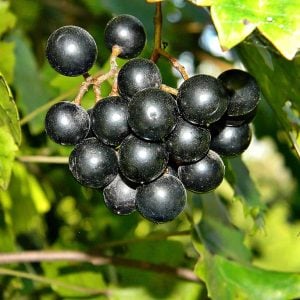
Black Spanish Grape
$24.95
Black Spanish Grape (also known as Lenoir; Vitis hybrid) is a vigorous American hybrid grape with strong Pierce’s Disease resistance, bearing small blue-black berries with red-pigmented flesh and rich earthy, dark-fruit flavor at 22–25° Brix — outstanding for Port-style and dry red wines. It grows in USDA hardiness zones 7-9 and AHS heat zones 5-10, needs 200-400 chill hours, and is self-fertile, fruiting reliably without a pollinator partner.
1-2′ Bare Root Vine
Propagation: Own-root
Can’t be shipped to: AK, HI, ID, OR, WA
Out of stock
Out of stock — back next season
Spring 2027 inventory drops in June. Drop your email and we'll notify you the day this variety is back in stock.
You're on the list. Check your inbox for a confirmation link — click it to lock in your spot. We'll email you the day this variety is back in stock.
Black Spanish is a naturally occurring American hybrid whose precise origin traces to South Carolina sometime in the early nineteenth century, though reports suggest the variety may have been cultivated as far back as the eighteenth century along the Santee River region. It spread across the antebellum South under a tangle of regional synonyms — Lenoir, Jacquez, Jack, Blue French, El Paso, Ohio — each reflecting independent discovery rather than deliberate breeding. Genetic analysis has clarified its complex ancestry: predominantly Vitis vinifera (approximately 69%) with contributions from Vitis aestivalis and minor components of V. berlandieri, V. rupestris, and V. riparia. No single breeder or institution produced this variety; it is a spontaneous hybrid that predates systematic American viticulture. The V. berlandieri ancestry underpins its tolerance of Pierce’s Disease (Xylella fastidiosa), the bacterial pathogen that devastates vinifera plantings across the Gulf Coast and Carolinas. Its teinturier character — red-fleshed berries that produce deeply pigmented juice without skin maceration — is unusual among American hybrids and reflects the high vinifera percentage in its makeup.
Black Spanish settles into zones 6 through 10 and needs only 100 to 200 chilling hours, making it viable across the Deep South, Texas, and warm coastal valleys where cold-dependent grape varieties fail to break dormancy properly. The vine performs best in full sun on well-drained loam or sandy soils; heavy clay that holds water through the growing season increases root-zone humidity and raises black rot pressure substantially. Target a soil pH of 5.5 to 6.5—slightly acidic encourages nutrient availability without tipping toward mineral lock-out. Once established, the vine handles dry spells without supplemental water, though consistent moisture at fruit set (berry shatter stage) improves cluster fill and berry sizing. Avoid low-lying frost pockets; late spring frosts in zones 6 and 7 can clip emerging shoots and reduce yield significantly. A sturdy trellis rated for vigorous canes—at minimum a five-wire system or strong arbor posts—is essential, as untrained vines can exceed 15 feet. Annual dormant pruning in late winter removes roughly 90 percent of the prior year's growth, channeling vigor into productive new wood.
USDA Hardiness Zone: 7-9
AHS Heat Zone: 5-10
Chill Hours: 200-400
Sun Requirements: Full Sun
Soil pH: 5.5-6.5
Soil Type: Adaptable; tolerates sandy to clay soils; prefers well-drained loam
Soil Drainage: Well-drained; does not tolerate wet feet
Water Requirements: Low to Medium; drought tolerant once established
Drought Tolerance: High
Heat Tolerance: High
Plant Spacing: 6-8 ft apart; rows 8 ft apart
Container Suitability: Not suitable; vigorous vine requires permanent trellis or arbor
How to Prune: Cane pruning in late winter (February); remove ~90% of previous year's growth; fruit produced on new wood; can also be spur pruned on bilateral cordons (fruitful on basal nodes)
Black Spanish grows as a highly vigorous climbing vine, pushing canes aggressively each season and anchoring with twining tendrils that grip wire, wood, or lattice. Managed on a trellis, the canopy typically fills 6 to 8 feet of vertical space and spreads 6 to 10 feet laterally; left to its own devices without training, a mature vine can ramble to 15 to 20 feet. The deep taproot with extensive lateral branching improves drought tolerance and, notably, is often grown on its own roots rather than grafted stock—a practical advantage given its inherent resistance to grape phylloxera (Daktulosphaira vitifoliae), which typically necessitates grafted rootstocks for vinifera varieties. Foliage is deciduous with dark green summer leaves that transition to yellow and red in autumn. The fast growth rate rewards heavy dormant pruning; without it, the vine channels resources into vegetative growth at the expense of fruit development. For vineyard rows, plant 6 to 8 feet apart with 8-foot row spacing to ensure adequate air circulation around the canopy.
Mature Height: 6-8 ft tall (on trellis); can reach 15-20 ft without training
Mature Spread: 6-10 ft wide
Growth Habit: Climbing vine; upright to trailing with twining tendrils; requires trellis, arbor, or sturdy support
Growth Rate: Fast; highly vigorous
Foliage Type: Deciduous
Food Forest Layer: Vine
Leaf Color: Dark green
Fall Foliage Color: Yellow to red; typical Vitis autumn color
Thorns?: No
Attracts Wildlife: Yes; birds (songbirds, wild turkey, ruffed grouse), white-tailed deer, raccoon, black bear
Life Span: vines can live 50-100+ years with proper management
Black Spanish carries perfect (hermaphroditic) flowers and is fully self-fertile, so a single vine sets fruit without a cross-pollinator. Bloom runs from late April through early June, with small greenish-white flower clusters that are both wind- and insect-pollinated. Keeping nearby pollinator habitat—cover crops, native flowering plants along row ends—improves insect traffic during bloom and modestly increases berry set consistency, though it is not required. Because the vine blooms over a 4 to 6 week window, late frost events in zone 6 or 7 may clip early flower clusters while leaving later ones intact, partially reducing but rarely eliminating yield in a given season.
Bloom Season: Late
Bloom Window: Late Apr - Early Jun
Pollination Requirements: Self-fertile; no cross-pollinator required
Pollination Mechanism: Wind and insect pollinated; small perfect flowers (hermaphroditic)
Flower Color: Greenish-white; small and inconspicuous
Clusters are medium to large and loosely shouldered, with small blue-black to black berries averaging 0.4 to 0.6 inch in diameter and roughly 1.2 grams per berry. The defining characteristic is the teinturier flesh—red-pigmented pulp that contributes deeply colored juice without requiring extended skin contact maceration. Brix at harvest reaches 22 to 25 degrees, translating to sufficient sugar for dry red table wines without chapitalization. Flavor is earthy and dark-fruited, with notes of black currant and wild cherry and noticeable acidity that provides structure in wine and balances sweetness in jelly. Primary uses include Port-style and dry red wines, juice, jams, and jelly; fresh eating is possible but the moderately thick skin and wild flavor character suit processing better than out-of-hand consumption. Storage life is short—1 to 2 weeks refrigerated—so harvest-to-processing turnaround should be planned in advance. The vine produces roughly 30 clusters per plant under good management, with trial data recording approximately 3.68 tons per acre under vineyard conditions.
Ripening Season: Early
Harvest Window: Late Jul - Late Sep
Fruit Size: 0.4-0.6 inch
Fruit Weight: 1.2 g per berry
Flavor: Sweet and juicy; earthy, dark fruit character with black currant and cherry notes; wild, distinctive flavor; high acidity; 22-25° Brix at maturity
Fruit Color: Blue-black to black
Fruit Texture: Juicy; moderately thick skin; red-fleshed (teinturier)
Fruit Skin: Thick; blue-black; contributes to deeply colored wine
Bearing Habit: Regular bearer; heavy consistent producer on new season's wood
Years to Bear: 2-4 years
Storage Life: 1-2 weeks refrigerated; best processed fresh into wine, juice, or jelly
Culinary Uses: Red wine (Port-style, dry reds, rosé); juice; jelly and jam; fresh eating; blending grape
Black Spanish's most significant asset is strong resistance to Pierce's Disease (Xylella fastidiosa), the bacterial pathogen vectored by glassy-winged sharpshooters that eliminates vinifera from much of the South and lower Midwest, allowing long-lived planting where most premium wine grapes fail. Powdery mildew (Erysiphe necator) and Botrytis bunch rot (Botrytis cinerea) elicit a moderately resistant response; OMRI-listed sulfur or copper applications during bloom and pre-harvest are usually sufficient. Black rot (Guignardia bidwellii) and downy mildew (Plasmopara viticola) present moderate susceptibility. For black rot, remove mummified berries and infected canes before budbreak, prune for canopy airflow, and apply copper fungicides at 10 to 14 day intervals from budbreak through fruit set. For downy mildew, avoid overhead irrigation and mulch to limit soil-splash dispersal. Grape berry moth (Paralobesia viteana), Japanese beetle (Popillia japonica), and grape leafhopper (Erythroneura comes) show moderate susceptibility. Pheromone traps guide berry moth timing; kaolin clay reduces beetle feeding; understorey cover crops support parasitic wasps that suppress leafhoppers. Grape phylloxera (Daktulosphaira vitifoliae) resistance allows own-root production, eliminating grafted rootstocks.
Pierce's Disease: Resistant
Black Rot: Moderately Susceptible
Downy Mildew: Moderately Susceptible
Powdery Mildew: Moderately Resistant
Botrytis Bunch Rot: Moderately Resistant
Grape Berry Moth: Moderately Susceptible
Grape Phylloxera: Resistant
Japanese Beetle: Moderately Susceptible
Grape Leafhopper: Moderately Susceptible
- Dormant sanitation for black rot: Remove all mummified berry clusters and infected cane stubs during dormant pruning — black rot overwinters in these tissues and reinfects new growth at budbreak.
- Prune hard each dormant season: Removing roughly 90% of the previous season's cane wood redirects the vine's vigor into fruit production rather than vegetative mass.
- Harvest by Brix, not color: Berries turn blue-black weeks before peak sugar; use a refractometer to confirm 22+ Brix before picking for wine or jelly — under-ripe fruit carries harsh acidity processing won't correct.
- Monitor grape berry moth: Set pheromone traps at budbreak to track first-flight timing and calibrate organic spray windows with degree-day models.
- Own-root planting is viable: Black Spanish resists grape phylloxera natively, so grafted stock is unnecessary in most soils.
We ship in late winter or early spring based on your USDA hardiness zone.
We strive to ship orders on the scheduled dates listed in the table below. However, please note that the actual shipping date may be subject to change due to factors like weather conditions and order volume.
The specific date for shipping your order will be determined according to your zipcode at the time of checkout.
Our plants are shipped bare root, packed in moist sawdust, and securely wrapped in plastic to prevent the roots from drying out. We use USPS Ground Advantage for shipping, ensuring that your plants typically arrive within 2-5 days after packaging.
In case you're unable to plant the trees immediately upon arrival, we recommend soaking them in water for a few hours and temporarily heeling them in. Ideally, they should be planted within three days of receipt for optimal health.
See our full shipping policy and map here
| Zone | Ship Date |
|---|---|
| 11 - 8b | March 1st, 2027 |
| 8a - 7b | March 8th, 2027 |
| 7a | March 15th, 2027 |
| 6b | March 22nd, 2027 |
| 6a | March 29th, 2027 |
| 5b - 5a | April 12th, 2027 |
| 4b - 4a | April 26th, 2027 |
| 3b - 1a | May 3rd, 2027 |
Our 365-Day Plant Guarantee: We ensure that our plants are delivered to you alive and healthy. If your plant does not survive its first year, you're eligible for store credit under these conditions:
- Your location falls within the appropriate USDA hardiness zone for the plant variety (refer to our hardiness zone map).
- You maintain the roots' moisture and plant within three days of delivery, following the instructions in our Planting Guide.
If you're concerned about your plant's health, please consult our guide, How to Tell if Your Tree is Dead or Dormant. Remember, our plants are shipped in a dormant state and may leaf out at different times based on their species. To check for plant vital
Related products

Noble Muscadine Grape
Checking fitRated 5.00 out of 5- SOLD OUT

Glenora Grape
Checking fit - SOLD OUT

Canadice Grape
Checking fit 
Reliance Grape
Checking fitRated 4.50 out of 5

Reviews
There are no reviews yet.