
Loblolly Pine
$11.95
Loblolly Pine (also known as Oldfield Pine; Pinus taeda) is the dominant commercial forest tree of the southeastern United States, growing exceptionally fast to 60–100 feet while providing seeds for squirrels and woodpeckers and shelter for cavity-nesting birds. It grows in USDA hardiness zones 6-9 and AHS heat zones 6-10.
6-12″ Bare Root Seedling Tree
Propagation: Seedling (own-root)
In stock
Loblolly pine (Pinus taeda) is the most commercially important forest tree in the Southern United States, dominant on approximately 11.7 million hectares across the Southeast and accounting for more than half of the standing pine volume in the region. The species name taeda is a Latin term for resinous or pitchy wood, reflecting the tree’s high pitch content documented since antiquity. It is a wild-type native species — not a cultivar or hybrid — distributed from southern New Jersey south through Florida and west to eastern Texas, and described botanically by Linnaeus in 1753. Ecologically, loblolly functions as an old-field pioneer, rapidly colonizing abandoned agricultural land and disturbed sites — a behavior reflected in its regional common names oldfield pine and rosemary pine. Its timber has been central to Southern forestry, pulpwood, and construction industries from European settlement through the present; its range overlap with the federally listed red-cockaded woodpecker (Dryobates borealis), which excavates cavities in living pines, makes it relevant to regional conservation planning, though the woodpecker’s stronghold historically lies in longleaf pine ecosystems.
Loblolly establishes most successfully in full sun with at least six hours of direct light daily — shade slows the vertical growth that makes the species so competitive in reforestation settings. It tolerates a wide pH range of 4.5 to 6.5 and adapts to sandy, loam, or clay soils, including seasonally saturated sites where most conifers struggle. Average to moist moisture levels suit it best; the tree handles brief flooding but performs poorly in prolonged inundation. Despite moderate drought tolerance in established specimens, young trees need supplemental water during the first two seasons if summers are dry. Heat tolerance is high, making it one of the few large conifers suited to the humid, hot conditions of zones 8 and 9. Because it grows 2 to 3 feet per year under good conditions, proper spacing at planting is critical — place trees at least 20 feet apart in windbreak plantings and 30 or more feet apart in specimen settings to allow full crown development without overcrowding.
USDA Hardiness Zone: 6-9
AHS Heat Zone: 6-10
Sun Requirements: Full Sun
Soil pH: 4.5-6.5
Soil Type: Sand, loam, clay
Soil Drainage: Well-drained to poorly-drained
Water Requirements: Average to Moist
Drought Tolerance: Moderate
Heat Tolerance: High
Container Suitability: Not suitable (large canopy tree; develops deep taproot)
Young loblolly pines carry a classic pyramidal silhouette that gradually transitions to a columnar or broadly oval crown as the tree matures and self-prunes its lower limbs. Mature trees reach 60 to 100 feet tall with a spread of 25 to 40 feet, producing a deep taproot flanked by wide-spreading lateral roots that anchor the trunk effectively even in sandy soils. The root architecture makes established trees highly resistant to uprooting in all but the most severe windstorms, despite the species rating as moderately wind-sensitive during establishment. Needle clusters of three, typically 6 to 9 inches long, produce a resinous fragrance and generate a heavy mulch layer as they drop — beneficial for acidifying soil beneath the drip line. The evergreen canopy provides year-round cover for wildlife, and the bark's plated structure becomes increasingly pronounced with age, improving its insulation against low-intensity ground fires. Pruning needs are minimal; remove dead lower branches as they develop to encourage clean trunk development for timber or aesthetics.
Mature Height: 60-100 ft tall
Mature Spread: 25-40 ft wide
Growth Habit: Pyramidal when young, becoming columnar/oval with age
Growth Rate: Fast
Foliage Type: Evergreen
Food Forest Layer: Canopy
Permaculture Role: Canopy tree
Leaf Color: Green
Thorns?: No
Attracts Wildlife: Squirrels, Birds (seeds), Red-Cockaded Woodpecker, Imperial Moth larvae
Life Span: 200-300+ years
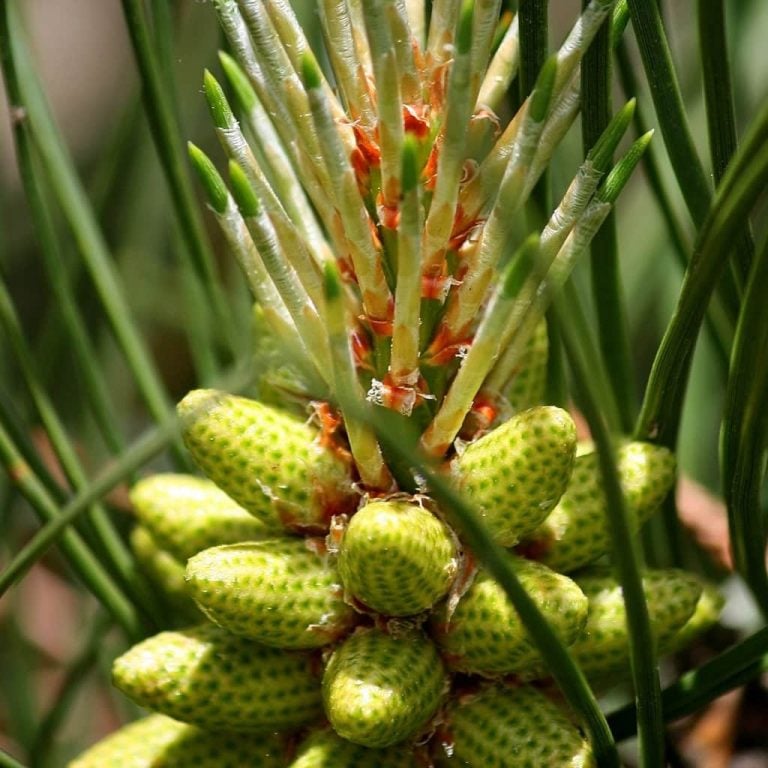
Loblolly pine is monoecious — each tree bears both male and female cone structures, making it self-contained for reproduction. Male cones (strobili) are produced in clusters near branch tips in March through April; they shed abundant yellow pollen by wind, which travels widely on spring air currents. Female cones form near the upper crown and require roughly 18 months from pollination to seed maturity, meaning the spiny, oval cones that shed seeds in fall of year two were pollinated the previous spring. No companion planting is required for cone production, though trees growing near other loblollies benefit from increased pollen density, which can improve seed set. The wind-dispersed pollen is a notable allergen during bloom season in zones 6 to 9, a practical consideration for plantings near occupied structures.
Bloom Season: Very Early
Bloom Window: Mid Mar - Mid Apr
Pollination Requirements: Wind-pollinated; monoecious (separate male and female cones on same tree)
Pollination Mechanism: Wind (anemophilous)
Flower Color: Red to yellow (male cones); yellow to purple (female cones)
Loblolly pine produces spiny ovoid cones, typically 2.5 to 5 inches long, that ripen and open in fall of the second year after pollination. The small winged seeds — roughly 0.4 to 0.6 inches — are consumed by a wide range of birds and small mammals, including wild turkeys, brown-headed nuthatches, and eastern chipmunks. Squirrels cache seeds extensively, making loblolly an indirect driver of forest regeneration. Beyond wildlife value, the species has ethnobotanical uses: the starchy inner bark (cambium) was used as a survival food by Native American peoples; young spring-growth needles yield a vitamin C-rich tea; and pollen has been collected for culinary use. The resin has commercial significance in naval stores production. Seed crops occur reliably after trees reach 10 to 15 years of age, with heavy mast years following favorable spring weather conditions.
Culinary Uses: Pine seeds edible; vanillin flavoring from resin by-products; young needles used for pine needle tea; inner bark historically used as survival food
Loblolly pine faces a well-documented suite of diseases and pests. Fusiform rust (Cronartium quercuum f. sp. fusiforme) causes spindle-shaped stem galls and is moderately susceptible in this species; selecting rust-resistant seedlot genetics from university-tested seed orchards significantly reduces incidence. Pitch canker (Fusarium circinatum), also moderately susceptible, spreads through wounds — avoid mechanical injury during mowing and pruning. Brown spot needle blight (Lecanosticta acicola) is a more serious concern; the fungus overwinters in infected needles, so sanitation through prompt removal of fallen needles and pruning of heavily infected branches is the primary cultural control. Annosum root rot (Heterobasidion annosum) spreads via spores landing on freshly cut stumps — treat stump surfaces promptly with borax paste when thinning stands. Lophodermium needlecast (Lophodermium seditiosum) responds to improved airflow; avoid overcrowding and remove fallen infected needles. On the pest side, Southern pine beetle (Dendroctonus frontalis) and Ips engraver beetles (Ips spp.) are the most serious threats, exploiting stressed trees almost exclusively — maintaining vigorous growth through appropriate spacing and moisture management is the most effective defense. Nantucket pine tip moth (Rhyacionia frustrana) and redheaded pine sawfly (Neodiprion lecontei) cause moderate damage; remove infested shoot tips when tip moth is detected, and hand-pick or apply Bt (Bacillus thuringiensis) for sawfly caterpillars in early instars.
Fusiform Rust: Moderately Susceptible
Pitch Canker: Moderately Susceptible
Brown Spot Needle Blight: Susceptible
Annosum Root Rot: Susceptible
Lophodermium Needlecast: Moderately Susceptible
Southern Pine Beetle: Susceptible
Ips Engraver Beetles: Susceptible
Nantucket Pine Tip Moth: Moderately Susceptible
Redheaded Pine Sawfly: Moderately Susceptible
- Spacing for health: Plant at 20-foot minimum intervals in windbreaks and 30+ feet for specimens — dense stands invite Southern pine beetle and Ips beetle attacks.
- Rust-resistant stock: Source seedlings from certified rust-resistant seed orchards; fusiform rust is endemic across humid regions, and resistant genetics dramatically reduce gall formation without any spray program.
- Stump treatment after thinning: Apply borax paste to freshly cut stumps within hours of cutting to block Heterobasidion annosum spore entry — the single most effective prevention for annosum root rot in pine stands.
- Tip moth monitoring: Scout for Nantucket pine tip moth damage in late spring; prune and dispose of infested tips promptly to break the life cycle without chemical intervention.
- Needle sanitation: Rake and remove fallen needles beneath trees showing brown spot needle blight symptoms — the pathogen overwinters in debris and reinfects new foliage the following season.
We ship in late winter or early spring based on your USDA hardiness zone.
We strive to ship orders on the scheduled dates listed in the table below. However, please note that the actual shipping date may be subject to change due to factors like weather conditions and order volume.
The specific date for shipping your order will be determined according to your zipcode at the time of checkout.
Our plants are shipped bare root, packed in moist sawdust, and securely wrapped in plastic to prevent the roots from drying out. We use USPS Ground Advantage for shipping, ensuring that your plants typically arrive within 2-5 days after packaging.
In case you're unable to plant the trees immediately upon arrival, we recommend soaking them in water for a few hours and temporarily heeling them in. Ideally, they should be planted within three days of receipt for optimal health.
See our full shipping policy and map here
| Zone | Ship Date |
|---|---|
| 11 - 8b | March 1st, 2027 |
| 8a - 7b | March 8th, 2027 |
| 7a | March 15th, 2027 |
| 6b | March 22nd, 2027 |
| 6a | March 29th, 2027 |
| 5b - 5a | April 12th, 2027 |
| 4b - 4a | April 26th, 2027 |
| 3b - 1a | May 3rd, 2027 |
Our 365-Day Plant Guarantee: We ensure that our plants are delivered to you alive and healthy. If your plant does not survive its first year, you're eligible for store credit under these conditions:
- Your location falls within the appropriate USDA hardiness zone for the plant variety (refer to our hardiness zone map).
- You maintain the roots' moisture and plant within three days of delivery, following the instructions in our Planting Guide.
If you're concerned about your plant's health, please consult our guide, How to Tell if Your Tree is Dead or Dormant. Remember, our plants are shipped in a dormant state and may leaf out at different times based on their species. To check for plant vital
2 reviews for Loblolly Pine
Related products

Black Walnut
Checking fit
River Birch
Checking fit
Redbud
Checking fitRated 4.33 out of 5
Swamp Chestnut Oak
Checking fitRated 5.00 out of 5


Daniel A. (verified owner) –
Thank you for all of the pine trees!
Daniel A. (verified owner) –
One tree was very limp out of the bag. I do not believe it’s the fault of anyone. The temperature in transit may be the culprit.