Kristin Cherry
$59.95
Kristin Cherry (Prunus avium) is a vigorous dark sweet cherry developed at Cornell University, producing large, nearly black fruit with firm flesh and a rich, sweet flavor. Trees are notably productive and cold-hardy for a sweet cherry, with vigor that supports a long productive lifespan when trained properly. Pollination is reported to benefit from a nearby compatible variety, and planting a companion such as Stella Cherry or Rainier Cherry is recommended for the most consistent crops.
4-5′ Bare Root Grafted Tree
Rootstock: K5 – Semi Dwarf
Reduces tree size 20-30% against Mazzard. Precocious, compatible with all cherries, and adapted to both cold and hot climates on heavier soils. Plant certified virus-free stock — it is hypersensitive to ringspot and prune dwarf viruses.
• Support: Freestanding; well anchored with wide crotch angles.
In stock
Kristin was developed at Cornell University’s New York State Agricultural Experiment Station in Geneva, New York — one of the most important stone fruit breeding programs in the northeastern United States. The variety was selected for its combination of vigor, fruit size, and adaptability to the cooler, wetter growing conditions common across the Northeast and upper Midwest. Trees are notably cold-tolerant for a sweet cherry, a characteristic that has made Kristin a common selection for growers in zones where less hardy sweet cherries frequently suffer winter damage. The fruit is large, deep-colored, and firm-fleshed, qualities that align with fresh-market preferences. Cornell’s breeding work on this selection prioritized tree health and productivity alongside fruit quality, and Kristin’s vigor reflects that design intent. The variety continues to appear in regional trial lists as a reliable mid-to-late-season performer.
Kristin grows vigorously and will reach a substantial size on standard rootstocks, so site selection and training are important early decisions. Well-drained loamy soil with a pH of 6.0–7.0 suits the variety well. Training to an open-vase or central-leader form while the tree is young channels the natural vigor into a productive, manageable structure. Prune in late summer rather than spring to reduce bacterial canker risk — the same guidance that applies to all sweet cherries in humid climates. The Cornell breeding background gives Kristin a meaningful edge in cold-hardiness relative to many European sweet cherry selections, making it a useful option for growers in the northern edges of the sweet cherry adaptation range. Consistent soil moisture during the period from pit hardening through final swell reduces fruit cracking. Mulching the root zone helps maintain even moisture and keeps the soil pH stable over time.
USDA Hardiness Zone: 4-8
Chill Hours: 450-500
Sun Requirements: Full Sun
Soil pH: 6.0-7.0
Soil Type: Loam
Soil Drainage: Well-drained
Water Requirements: Medium
Kristin is a vigorous, upright-spreading sweet cherry with a strong central leader when trained young. The natural growth habit is energetic, and trees on standard rootstocks will develop a large canopy over time — plan for eventual mature size when selecting a planting site. The notable cold-hardiness for a sweet cherry is one of Kristin's distinguishing traits, a direct outcome of the Cornell breeding program's focus on northeastern adaptability. Leaves are broad and ovate with serrated margins; fall color develops shades of orange-red before drop. Spurs along the main scaffolds become the primary fruiting wood as trees mature. The dark, glossy fruit stands out visually at harvest against the green foliage — a practical cue for picking. Bark and wood are strong, supporting the productive lifespan of a well-managed tree.
Foliage Type: Deciduous
Permaculture Role: Pollinator support, wildlife food
Leaf Color: Green
Attracts Wildlife: Bees and butterflies (pollinators); birds and small mammals (fruit)
Kristin is self-incompatible and requires cross-pollination from a compatible sweet cherry that overlaps its early-to-early-mid bloom. Plant the pollinizer within about 50 feet so bees can move pollen between trees. Lapins Cherry is self-fertile and blooms early enough to be considered where local bloom overlap is confirmed. A second compatible sweet cherry improves reliability and supports full fruit sizing.
Pollination Requirements: Cross-pollination required
Pollination Mechanism: Insect-pollinated (primarily bees)
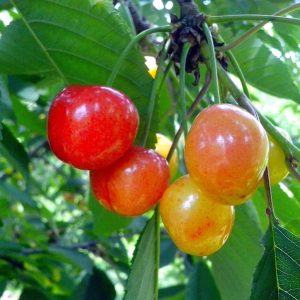
Kristin produces large, dark — nearly black — sweet cherries with firm, dark-red flesh and a rich, full flavor. The fruit size is a consistent characteristic across growing regions and is one of the primary reasons the variety appears in regional trial reports. Firm flesh holds up well for short transport and fresh sales, resisting bruising better than softer-fleshed sweet cherries. The deep pigmentation is attractive at the farmers market and point-of-sale. Kristin ripens in the mid-to-late season, providing a useful harvest window for multi-variety operations that need to spread labor and sales over several weeks. The cherries are primarily a fresh-eating variety, though the firm, flavorful flesh works well in baked preparations and preserves where a sweet, full-flavored cherry is desirable.
Fruit Size: 1 inch
Flavor: Sweet
Fruit Color: Dark
Fruit Texture: Firm
Kristin faces the same disease and pest pressures as other sweet cherries grown in humid, temperate climates. Brown rot (Monilinia fructicola) is the most urgent concern at and just before harvest; keeping the canopy open with annual pruning, removing mummified fruit before the season, and avoiding overhead irrigation during ripening are the most effective cultural controls. Cherry leaf spot (Blumeriella jaapii) builds up during wet growing seasons; fall cleanup of dropped leaves removes the primary overwintering inoculum. Bacterial canker (Pseudomonas syringae) is managed by scheduling pruning in late summer when callusing is rapid. Black knot (Apiosporina morbosa) should be pruned out well below visible gall tissue and the cuttings removed from the site. X-Disease (Candidatus Phytoplasma pruni) has no cure; removing infected trees and controlling wild host plants nearby (chokecherry, bitter cherry) limits spread. Plum curculio adults are monitored with sticky traps; kaolin clay provides a physical barrier during early fruit development. Cherry fruit fly and spotted wing drosophila are both managed with trapping, timely harvest, and prompt removal of dropped fruit. Black cherry aphid colonies are dislodged with strong water sprays or checked by encouraging natural predators.
Brown Rot: Susceptible
Cherry Leaf Spot: Moderately Resistant
Bacterial Canker: Susceptible
Black Knot: Moderately Susceptible
X-Disease / Cherry Buckskin: Susceptible
Plum Curculio: Susceptible
Cherry Fruit Fly: Susceptible
Spotted Wing Drosophila: Susceptible
- Train early for vigor management: Kristin's strong growth habit responds well to early scaffold selection — establishing a good framework in the first three years makes long-term management much easier.
- Prioritize cold-hardy sites: The Cornell background gives Kristin an edge in winter hardiness, making it one of the better sweet cherry choices for growers at the northern end of the sweet cherry adaptation range.
- Add a pollinator companion: Even if Kristin sets some fruit alone, a compatible nearby variety like Lapins or Regina reliably increases crop size and fruit uniformity.
We ship in late winter or early spring based on your USDA hardiness zone.
We strive to ship orders on the scheduled dates listed in the table below. However, please note that the actual shipping date may be subject to change due to factors like weather conditions and order volume.
The specific date for shipping your order will be determined according to your zipcode at the time of checkout.
Our plants are shipped bare root, packed in moist sawdust, and securely wrapped in plastic to prevent the roots from drying out. We use USPS Ground Advantage for shipping, ensuring that your plants typically arrive within 2-5 days after packaging.
In case you're unable to plant the trees immediately upon arrival, we recommend soaking them in water for a few hours and temporarily heeling them in. Ideally, they should be planted within three days of receipt for optimal health.
See our full shipping policy and map here
| Zone | Ship Date |
|---|---|
| 11 - 8b | March 1st, 2027 |
| 8a - 7b | March 8th, 2027 |
| 7a | March 15th, 2027 |
| 6b | March 22nd, 2027 |
| 6a | March 29th, 2027 |
| 5b - 5a | April 12th, 2027 |
| 4b - 4a | April 26th, 2027 |
| 3b - 1a | May 3rd, 2027 |
Our 365-Day Plant Guarantee: We ensure that our plants are delivered to you alive and healthy. If your plant does not survive its first year, you're eligible for store credit under these conditions:
- Your location falls within the appropriate USDA hardiness zone for the plant variety (refer to our hardiness zone map).
- You maintain the roots' moisture and plant within three days of delivery, following the instructions in our Planting Guide.
If you're concerned about your plant's health, please consult our guide, How to Tell if Your Tree is Dead or Dormant. Remember, our plants are shipped in a dormant state and may leaf out at different times based on their species. To check for plant vital
Related products

Black Cherry
Checking fitRated 4.71 out of 5
Lapins Cherry
Checking fitRated 5.00 out of 5
Royal Ann Cherry
Checking fit
Rainier Cherry
Checking fitRated 5.00 out of 5

Reviews
There are no reviews yet.