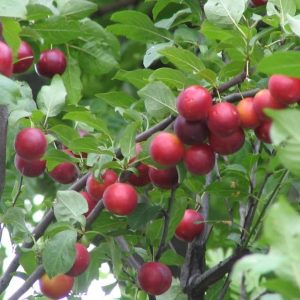
Hollywood Plum
$49.95
Hollywood Plum (Prunus salicina x Prunus cerasifera ‘Hollywood’) is a dual-purpose ornamental and fruiting plum with deep burgundy-purple foliage that persists through the season, plus dark red, richly flavored fruit suited to fresh eating and preserves. It grows in USDA hardiness zones 5-9 and AHS heat zones 3-8, needs 400-600 chill hours, and is self-fertile, fruiting reliably without a pollinator partner.
4-5′ Bare Root Grafted Tree
Rootstock: K86 – Standard
Vigorous with excellent anchorage and strong tolerance of heavy, wet ground. Not a match for sandy soils, and susceptible to root-knot and ring nematodes.
• Support: Freestanding; exceptional anchorage.
Can’t be shipped to: AK, CO, HI, MT, OR, WA
In stock
Hollywood plum originated in 1932 as a chance discovery in Modesto, California, and was released commercially in 1936 by L. L. Brooks of Modesto. Its parentage is attributed to Prunus cerasifera ‘Pissardii’ crossed with the red-fleshed Japanese plum ‘Duarte’ (Prunus salicina), though this cross has not been definitively confirmed in the scientific literature and some historians suggest it may be one of Luther Burbank’s unnamed purple-leaf selections that resurfaced under a new name. The Pissardii parent traces to the 1880 introduction of the original purple-leaf cherry plum from Persia into European horticulture, providing Hollywood with its deep burgundy foliage — a trait rare among fruiting plums. Hollywood gained rapid adoption in Pacific Northwest nursery trade through the mid-twentieth century as both a landscape specimen and a productive edible, distinguishing itself from purely ornamental purple-leaf plums by bearing substantial crops of dark-fleshed, usable fruit.
Hollywood's low chill requirement of roughly 300 to 400 hours makes it one of the more adaptable stone fruits across the Zone 5–9 band, performing reliably in both cooler temperate climates and warmer regions where many standard Japanese plums struggle to break dormancy correctly. Full sun is essential — shading suppresses both fruiting and the intensity of the characteristic purple foliage coloration. Soil pH between 5.5 and 7.5 gives it broad flexibility, though moderately acidic, well-drained loam produces the strongest growth. Consistent soil moisture during fruit set and the weeks immediately following bloom reduces stress-related fruit drop; waterlogged roots, however, promote Phytophthora and exacerbate bacterial canker entry points at the crown. Trees typically begin bearing in two to three years from planting. Annual pruning in late winter to open the canopy is critical not just for structure but for reducing the humid microclimate that drives brown rot and bacterial canker infections — the two most significant management challenges for this variety.
USDA Hardiness Zone: 5-9
AHS Heat Zone: 3-8
Chill Hours: 400-600
Sun Requirements: Full Sun
Soil pH: 5.5-7.5
Soil Type: Loam, sandy loam, clay loam
Soil Drainage: Well-drained
Water Requirements: Medium
Heat Tolerance: Moderate to High; suitable through Zone 9 with adequate summer water
Hollywood grows to 10 to 15 feet tall and spreads equally wide, developing an upright, rounded canopy that broadens with age. Growth rate runs moderate, averaging 13 to 24 inches per year in well-maintained sites, producing a full-sized small tree within five to seven years. The deep burgundy-purple foliage — copper-tinted when emerging in early spring — holds its color through summer and into fall before leaf drop, making it one of the few dual-purpose trees that earns its place in a designed landscape without sacrificing yield. Light pink to white flowers appear in early to late March, often before the leaves fully unfurl, creating a brief but striking floral display. The upright-rounded form responds well to open-center or modified central leader training; either approach improves light penetration and airflow through what can become a fairly dense canopy at maturity. Root architecture is moderately spreading — avoid planting within 8 to 10 feet of water lines or shallow foundations.
Mature Height: 10-15 ft tall
Mature Spread: 10-15 ft wide
Growth Habit: Upright, rounded
Growth Rate: Moderate; 13-24 inches per year
Foliage Type: Deciduous
Food Forest Layer: Canopy, Sub-canopy
Leaf Color: Deep burgundy-purple (spring to fall); copper-toned when emerging
Fall Foliage Color: Burgundy to dark purple
Attracts Wildlife: Bees, butterflies, birds
Life Span: 20-30+ years
Hollywood Plum flowers in the early relative window in the Zone 7 Ozarks planning model. Self-fruitful; viable pollen has been used experimentally.
Bloom Season: Early
Bloom Window: Mid Mar - Late Mar
Pollination Requirements: Self-fruitful; viable pollen has been used experimentally.
Pollination Mechanism: Insect (bee)
Flower Color: Light pink to white
Dark red to deep crimson skin and matching deep red flesh — an unusual all-red presentation that reflects the cherry plum heritage — distinguish Hollywood fruit at harvest, which runs 1.5 to 2.5 inches in diameter. Flavor is sweet with mild tartness and rich depth; the fruit lacks the high acidity of European plums, making it approachable fresh off the tree. Clusters of 30 or more pounds per tree at full production are typical for well-pollinated trees in favorable sites. Refrigerated storage extends to one to two weeks, adequate for home use but tight for market purposes — harvest timing matters, as the fruit softens quickly past peak ripeness. The deep-colored flesh holds color well in processing, making Hollywood a preferred choice for jams, jellies, and preserves where visual appeal matters. It is also suitable for pies, wine, and juice. Pits, leaves, and bark contain cyanogenic glycosides and should not be consumed; the flesh is fully edible. Birds are attracted to ripe fruit, so netting is advisable when fruit begins coloring.
Ripening Season: Mid
Harvest Window: Late Jun - Early Aug
Fruit Size: 1.5-2.5 inch
Flavor: Sweet, richly flavored with mild tartness; deep red flesh
Fruit Color: Dark red to deep crimson skin; deep red flesh
Fruit Texture: Firm and juicy
Bearing Habit: Regular bearer; heavy production in clusters
Years to Bear: 2-3 years
Storage Life: 1-2 weeks refrigerated
Culinary Uses: Fresh eating, jams, jellies, preserves, pies, wine, juice
Hollywood carries susceptibility to brown rot (Monilinia fructicola) — the primary concern in humid climates. Start with canopy sanitation: remove mummified fruit each winter, prune to open airflow, and avoid overhead irrigation. OMRI-listed copper sprays applied at petal fall on a 7–10 day schedule during wet stretches suppress infection without synthetic fungicides. Bacterial canker (Pseudomonas syringae) enters at pruning wounds and frost cracks; prune during dry weather only, apply copper at leaf drop and bud break, and keep nitrogen inputs moderate to avoid producing soft, canker-prone wood. Black knot (Apiosporina morbosa) rates moderate susceptibility; remove galls 4 inches below visible infection, disinfect tools between cuts, and destroy prunings. Bacterial spot (Xanthomonas arboricola pv. pruni) and plum pox virus also rate moderate; the latter has no curative treatment — plant only certified virus-free stock. Three insects are fully susceptible: plum curculio (Conotrachelus nenuphar), oriental fruit moth (Grapholita molesta), and spotted wing drosophila (Drosophila suzukii). Kaolin clay at petal fall deters curculio; mating disruption lures reduce moth pressure; fine-mesh exclusion netting is the most reliable SWD defense at harvest. American plum borer (Euzophera semifuneralis) is moderately susceptible — prevent entry by maintaining tree vigor and avoiding bark injuries.
Brown Rot: Susceptible
Black Knot: Moderately Susceptible
Bacterial Canker: Susceptible
Bacterial Spot: Moderately Susceptible
Plum Pox Virus: Moderately Susceptible
Plum Curculio: Susceptible
Oriental Fruit Moth: Susceptible
Spotted Wing Drosophila: Susceptible
American Plum Borer: Moderately Susceptible
- Time your canopy pruning precisely: Prune Hollywood in late winter during a dry-weather window, just before bud swell. Late pruning closes wounds faster and minimizes both bacterial canker and brown rot entry during the damp early spring period when both pathogens are most active.
- Deploy kaolin clay at petal fall: A thorough kaolin clay coating applied at petal fall and maintained through the first six weeks of fruit development sharply reduces plum curculio egg-laying damage — the pest responsible for most early-season fruit drop in humid regions.
- Net ripe fruit against spotted wing drosophila: Spotted wing drosophila lays eggs in softening ripe fruit; once infested, fruit is unmarketable within days. Install fine-mesh exclusion netting (1 mm or finer) over the canopy as fruit begins to color, before the exterior softens.
- Plant a bloom-matched companion within 50 feet: Although Hollywood sets some fruit solo, adding Methley or Bruce plum within pollinator flight range — ideally within 50 feet — typically doubles or triples total yield. Both share the early-March bloom window.
- Sanitize aggressively against brown rot: Remove every mummified fruit, fallen plum, and pruning stub from under the tree each fall and early spring. Brown rot (Monilinia fructicola) overwinters in mummified fruit; sanitation is the single highest-return management step for susceptible varieties.
We ship in late winter or early spring based on your USDA hardiness zone.
We strive to ship orders on the scheduled dates listed in the table below. However, please note that the actual shipping date may be subject to change due to factors like weather conditions and order volume.
The specific date for shipping your order will be determined according to your zipcode at the time of checkout.
Our plants are shipped bare root, packed in moist sawdust, and securely wrapped in plastic to prevent the roots from drying out. We use USPS Ground Advantage for shipping, ensuring that your plants typically arrive within 2-5 days after packaging.
In case you're unable to plant the trees immediately upon arrival, we recommend soaking them in water for a few hours and temporarily heeling them in. Ideally, they should be planted within three days of receipt for optimal health.
See our full shipping policy and map here
| Zone | Ship Date |
|---|---|
| 11 - 8b | March 1st, 2027 |
| 8a - 7b | March 8th, 2027 |
| 7a | March 15th, 2027 |
| 6b | March 22nd, 2027 |
| 6a | March 29th, 2027 |
| 5b - 5a | April 12th, 2027 |
| 4b - 4a | April 26th, 2027 |
| 3b - 1a | May 3rd, 2027 |
Our 365-Day Plant Guarantee: We ensure that our plants are delivered to you alive and healthy. If your plant does not survive its first year, you're eligible for store credit under these conditions:
- Your location falls within the appropriate USDA hardiness zone for the plant variety (refer to our hardiness zone map).
- You maintain the roots' moisture and plant within three days of delivery, following the instructions in our Planting Guide.
If you're concerned about your plant's health, please consult our guide, How to Tell if Your Tree is Dead or Dormant. Remember, our plants are shipped in a dormant state and may leaf out at different times based on their species. To check for plant vital
Related products

American Plum
Checking fitRated 4.63 out of 5
Moonglow Pear
Checking fitRated 4.75 out of 5
Orient Pear
Checking fitRated 5.00 out of 5
Toka Plum
Checking fit


Reviews
There are no reviews yet.