$59.95Original price was: $59.95.$47.96Current price is: $47.96.
Fuyu Persimmon (also known as Japanese Persimmon; Diospyros kaki ‘Fuyu’) is a large, rounded tree bearing 3–4 inch deep-orange fruit with honey-sweet, non-astringent flesh that can be eaten crisp like an apple or allowed to soften, with excellent versatility from fresh salads to baked goods and drying. It grows in USDA hardiness zones 7-10 and AHS heat zones 4-10, needs 200-400 chill hours, and is self-fertile, fruiting reliably without a pollinator partner.
4-5′ Bare Root Grafted Tree Rootstock: Diospyros virginiana
American Persimmon Seedling (Standard): Grafted onto American persimmon seedling roots — full natural size, very cold hardy, drought tolerant once established. Expect occasional root suckers.
• Support: Freestanding; the deep taproot gives excellent anchorage.
Fuyu — known in Japanese as Fuyugaki, meaning “winter persimmon” — is one of the most widely grown cultivars of Diospyros kaki and the defining non-astringent variety in world commerce. Diospyros kaki originated in China, where cultivation spans at least 2,000 years and where the center of genetic diversity for the species lies; the cultivated species spread to Japan roughly 1,300 years ago and to Korea thereafter. Fuyu is a traditional Japanese selection, not a controlled cross, with an origin date undocumented in historical records; it was selected and propagated clonally through grafting across Japan for centuries before Western introduction. Asian persimmons were first brought to the United States in the mid-1850s, and USDA-distributed grafted trees followed from 1870 onward; Japanese immigrant farming communities in California also introduced cultivars directly during this period. Fuyu’s combination of ease — edible at the crisp stage without waiting for softening — with low chill requirement and adaptability across a wide zone range made it the dominant commercial kaki cultivar worldwide by the late twentieth century.
Fuyu's chill requirement of roughly 100 to 200 hours places it firmly in the low-chill category, making it viable across the Gulf Coast, the Southeast Coastal Plain, and California's Central Valley with equal confidence. Deep, well-drained loam to clay loam at pH 6.0 to 7.5 is ideal; the species tolerates moderate clay far better than most fruit trees, but standing water near the root crown invites crown rot and Botryosphaeria canker. Consistent moisture during fruit development from late spring through midsummer reduces the premature fruit drop that occasionally plagues persimmons in hot, dry climates — pull back on irrigation in late summer to encourage sugars to concentrate and skin color to intensify. Trees prefer full sun and show heat tolerance well above most temperate fruit crops, performing strongly in AHS Heat Zones 4 through 10. Spacing at 12 to 18 feet accommodates mature spread; persimmons develop deep taproots early and resist transplanting poorly as they age, so site selection is worth deliberate planning. Established trees handle occasional drought but respond with fruit drop under sustained water stress during cell expansion.
USDA Hardiness Zone: 7-10 AHS Heat Zone: 4-10 Chill Hours: 200-400 Sun Requirements: Full Sun Soil pH: 6.0-7.5 Soil Type: Loam, clay loam, sandy loam; well-drained Soil Drainage: Well-drained; does not tolerate waterlogged soil Water Requirements: Medium; 36-48 inches annually; regular watering during fruit development; reduce in fall Drought Tolerance: Moderate; established trees tolerate occasional drought but fruit drop may occur under stress Heat Tolerance: High; performs well in hot summer climates Plant Spacing: 12-18 ft apart How to Prune: Minimal pruning required; train to modified central leader or open vase in early years; remove crossing/dead branches; does not require annual heavy pruning
Fuyu matures into a broadly rounded, spreading tree reaching 20 to 30 feet tall and 20 to 25 feet wide over several decades, though grafted specimens in managed home orchards frequently stabilize at the shorter end of that range with light annual shaping. The deep taproot system provides structural stability in most soil profiles but makes it critical to transplant before the tree establishes — once the taproot anchors, moving the tree rarely succeeds. Bark is gray-brown and develops attractive interlocking ridges on mature trunks. Leaves are large, dark glossy green through summer, then shift to yellow-orange in fall — persisting on the tree until late, which combined with the luminous orange fruit hanging on bare branches makes Fuyu a late-season landscape specimen. The tree has no thorns. Early training to a modified central leader or open vase shape distributes scaffold branches for good light penetration; thereafter Fuyu asks for very little pruning compared to stone fruits or apples, making it well-suited to low-maintenance food forest canopy.
Mature Height: 20-30 ft tall Mature Spread: 20-25 ft wide Growth Habit: Rounded, spreading deciduous tree Growth Rate: Slow to Moderate Foliage Type: Deciduous Food Forest Layer: Canopy Permaculture Role: Canopy fruit tree; wildlife food source; late-season nectar source Leaf Color: Dark glossy green (spring/summer) Fall Foliage Color: Yellow to orange Thorns?: No Attracts Wildlife: Birds, deer, foxes, raccoons, opossums, squirrels Life Span: 50-100+ years
Fuyu is self-fruitful and sets fruit through parthenocarpy — the ability to form seedless fruit without fertilization — so a solitary tree fruits reliably every season without a pollinator partner. Flowers open mid-April through early May in a temperate climate, with female flowers borne on current-season growth. Because Fuyu occasionally produces only pistillate (female) flowers and seldom if ever male flowers, planting a second Fuyu or a male-flowering persimmon nearby can increase fruit size and seed count, but fruit set itself is rarely the limiting factor. Bees and other insects visit the cream-white flowers and can carry pollen if male-flowered individuals are nearby, but yield on single-tree plantings is commercially viable without cross-pollination. Growers in humid climates benefit from selecting a site with good airflow around bloom time, since cool, wet springs can slow pollinator activity — though for a parthenocarpic variety, this matters less than for obligate cross-pollinators.
Bloom Season: Very Early Bloom Window: Mid Apr - Early May Pollination Requirements: Self-fruitful; no cross-pollinator required; parthenocarpic (sets fruit without fertilization) Pollination Mechanism: Parthenocarpy (seedless fruit set without pollination); insect-pollinated if cross-pollinator present Flower Color: White to cream (female flowers); pinkish (male flowers on other varieties)
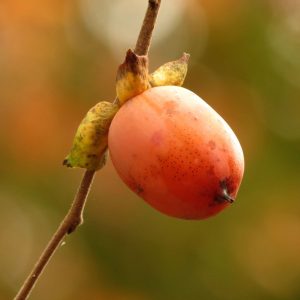
The defining characteristic of Fuyu fruit is its non-astringency at the firm, crisp stage — tannins are absent from the flesh even before full softening, unlike Hachiya and other astringent kaki types that require complete ripening before eating. Fruit measures 3 to 4 inches in diameter with deep orange skin and light orange flesh; the oblate, tomato-like shape distinguishes it visually from the acorn-shaped Hachiya. Flavor runs sweet with mild honey-like notes and very low acidity; sugar content is high enough that fresh Fuyu needs no additional sweetener in most culinary applications. Shelf life of 1 to 4 weeks refrigerated is longer than early-ripening stone fruits, and fruit freezes well for up to 6 months. Harvest runs mid-October through early December, providing fruit at a time when most deciduous tree crops have finished. Culinary applications span fresh eating, sliced into salads, baked into cookies and puddings, dried whole or in slices, made into jams, syrups, and ice cream. The skin is edible. Leaves have a traditional use as tea in East Asian cultures.
Ripening Season: Late Harvest Window: Mid Oct - Early Dec Fruit Size: 3-4 inch Flavor: Sweet, mild, honey-like; non-astringent; can be eaten firm like an apple Fruit Color: Deep orange skin; light orange flesh Fruit Texture: Crisp to firm when ripe (non-astringent); softens slightly as it matures; not grainy Bearing Habit: Annual bearing; may alternate slightly in heavy crop years Years to Bear: 3-5 years (grafted trees) Storage Life: 1-4 weeks refrigerated; up to 6 months frozen; longer shelf life than early-season varieties Culinary Uses: Fresh eating, salads, baked goods (cookies, pies, puddings), jams and jellies, syrups, ice cream; excellent for drying
Fuyu carries moderate susceptibility to three leaf and canker diseases that growers in humid climates should monitor. Circular Leaf Spot (Plurivorosphaerella nawae) and Cercospora Leaf Spot (Cercospora kaki) both cause premature defoliation in wet summers; the primary organic strategy is sanitation — rake and remove fallen leaves promptly in autumn to break the overwintering spore cycle, and avoid overhead irrigation. Botryosphaeria Canker (Botryosphaeria dothidea) enters through wounds or drought-stressed tissue; keeping trees well-watered during fruit development and disinfecting pruning tools between cuts significantly reduces entry points. Fuyu shows moderate resistance to Anthracnose (Colletotrichum gloeosporioides) and Crown Gall (Agrobacterium tumefaciens), meaning these are lower-priority concerns under normal management but still worth watching at planting sites with known gall history. On the pest side, Persimmon Borer (Sannina uroceriformis) is moderately susceptible; larvae tunnel beneath bark at the root crown and lower trunk, so wrapping the lower trunk with physical mesh barriers during moth flight periods in summer reduces infestation. Scale Insects (Asiacornococcus kaki and related species), Persimmon Psyllid (Trioza diospyri), and Mealybugs (Planococcus citri and related species) are managed with dormant-season horticultural oil applications and by encouraging populations of parasitic wasps through nearby insectary plantings. Good airflow from open pruning reduces the sheltered microhabitats that scale and mealybugs prefer.
Plant young and in the permanent spot: Fuyu develops a deep taproot quickly. Transplanting trees older than two to three years rarely succeeds — select the final site carefully before planting a small container tree.
Reduce irrigation in late summer: Pulling back on water from late August onward concentrates fruit sugars and deepens skin color. Consistent summer moisture during cell expansion followed by a dry-down phase in September improves flavor.
Leaf spot sanitation in fall: Both Circular Leaf Spot and Cercospora Leaf Spot overwinter on fallen leaves. Rake and remove or hot-compost all leaf litter in autumn to reduce spore loads for the following spring.
Check the lower trunk for borer entry: Persimmon Borer moths lay eggs at the root crown and trunk base in summer. Inspect for sawdust-like frass monthly from June through August; physical mesh guards or kaolin clay during moth flight reduce egg-laying.
Dormant oil for scale management: A single well-timed dormant horticultural oil application in late winter, before bud swell, controls overwintering scale crawlers and psyllid adults with minimal inputs.
We ship in late winter or early spring based on your USDA hardiness zone.
We strive to ship orders on the scheduled dates listed in the table below. However, please note that the actual shipping date may be subject to change due to factors like weather conditions and order volume.
The specific date for shipping your order will be determined according to your zipcode at the time of checkout.
Our plants are shipped bare root, packed in moist sawdust, and securely wrapped in plastic to prevent the roots from drying out. We use USPS Ground Advantage for shipping, ensuring that your plants typically arrive within 2-5 days after packaging.
In case you're unable to plant the trees immediately upon arrival, we recommend soaking them in water for a few hours and temporarily heeling them in. Ideally, they should be planted within three days of receipt for optimal health.
Our 365-Day Plant Guarantee: We ensure that our plants are delivered to you alive and healthy. If your plant does not survive its first year, you're eligible for store credit under these conditions:
You maintain the roots' moisture and plant within three days of delivery, following the instructions in our Planting Guide.
If you're concerned about your plant's health, please consult our guide, How to Tell if Your Tree is Dead or Dormant. Remember, our plants are shipped in a dormant state and may leaf out at different times based on their species. To check for plant vital
11 reviews for Fuyu Persimmon
Rated 5 out of 5
Judith Holshouser (verified owner)–
The tree arrived well packed and appears to be in good condition. I will plant as instructed and watch for new growth and leaves.
Rated 5 out of 5
Gregory Snelgrove (verified owner)–
received trees on 3/11/2022. trees were big and have plenty of good roots.
Rated 5 out of 5
Reza Shabestari (verified owner)–
This tree was healthy and good size. It is planted and doing well
Rated 5 out of 5
Bruce D. (verified owner)–
Trees arrived fast and in perfect condition. Nice looking trees and should do well. Thanks
Rated 5 out of 5
Karen C. (verified owner)–
Great service; Beautiful Trees!!
Rated 5 out of 5
Anonymous (verified owner)–
Arrived safely all the way in Hawaii!
Rated 3 out of 5
Kathryn S. (verified owner)–
My persimmon was shipped on Monday and arrived on Friday. The roots were barely damp so I soaked them right away. There were very few fibrous roots so I am worried about the tree’s survival. The rest of the plant looked to be in good shape.



Judith Holshouser (verified owner) –
The tree arrived well packed and appears to be in good condition. I will plant as instructed and watch for new growth and leaves.
Gregory Snelgrove (verified owner) –
received trees on 3/11/2022. trees were big and have plenty of good roots.
Reza Shabestari (verified owner) –
This tree was healthy and good size. It is planted and doing well
Bruce D. (verified owner) –
Trees arrived fast and in perfect condition. Nice looking trees and should do well. Thanks
Karen C. (verified owner) –
Great service; Beautiful Trees!!
Anonymous (verified owner) –
Arrived safely all the way in Hawaii!
Kathryn S. (verified owner) –
My persimmon was shipped on Monday and arrived on Friday. The roots were barely damp so I soaked them right away. There were very few fibrous roots so I am worried about the tree’s survival. The rest of the plant looked to be in good shape.
Kevin W. (verified owner) –
Japanese Persimmon was still dormant but healthy.
Bruce Donaldson (verified owner) –
Trees are already starting to grow after a week!
Laura G. (verified owner) –
Healthy tree I’m eager to plant.
Anonymous (verified owner) –
Great tree